The next super entry point for real estate practitioners has emerged.
When a real estate researcher conducts industry analysis, they will open the database, select the statistical period and sales caliber, export the data, and perform sorting and year-on-year comparison in Excel. If they want to find enterprises with obvious ranking fluctuations, they have to go through historical lists, check enterprise materials, and then draw a set of judgments. The cross-analysis step alone often takes several hours.
Now, this entire process has been compressed into a single sentence.
1
Real estate databases such as CRIC are evolving into capabilities that AI can call directly.
On September 1, Mingyuan Yunke officially announced its entry into WorkBuddy's MCP Connector; on September 7, Deep Intelligence · Real Estate Data with CRIC data also officially announced its entry. The so-called connector essentially enables external services to become tools that AI can call independently when executing tasks.
One of these two tools provides external data for the real estate industry, and the other goes deep into the internal business processes of enterprises. When both can be called directly by AI, users only need to add all data sources and put forward their requirements, and AI will decide which tools to call.
This is the true meaning of the super entry — for AI that has mastered sufficient data sources, it can make the judgment of "who to call" on behalf of users and complete the process of search and integration.
This also explains why the "exclusive intern" that general large models have been promoting for two years was difficult to actually land in the production environment before. AI can understand "equity caliber" and "land premium rate", but it cannot know out of thin air how many houses a certain real estate enterprise has sold this year.
Therefore, today when general models are booming, verified, AI-callable data services embedded in business scenarios are becoming more and more valuable.
2
We immediately got started to test after seeing the entry news.
Open WorkBuddy, add the "Deep Intelligence · Real Estate Data" connector, select the free model, and directly input: "What are the changes in the TOP 100 real estate enterprises by full-caliber sales from January to August 2026?" 11 minutes and 9 seconds later, it gave the answer with no human intervention throughout the process. The answer covers the threshold of each tier, the total scale of the top 100 enterprises, the year-on-year rise and fall of each enterprise, the list of enterprises entering and leaving the ranking, and the abnormal data that is worthy of further verification.
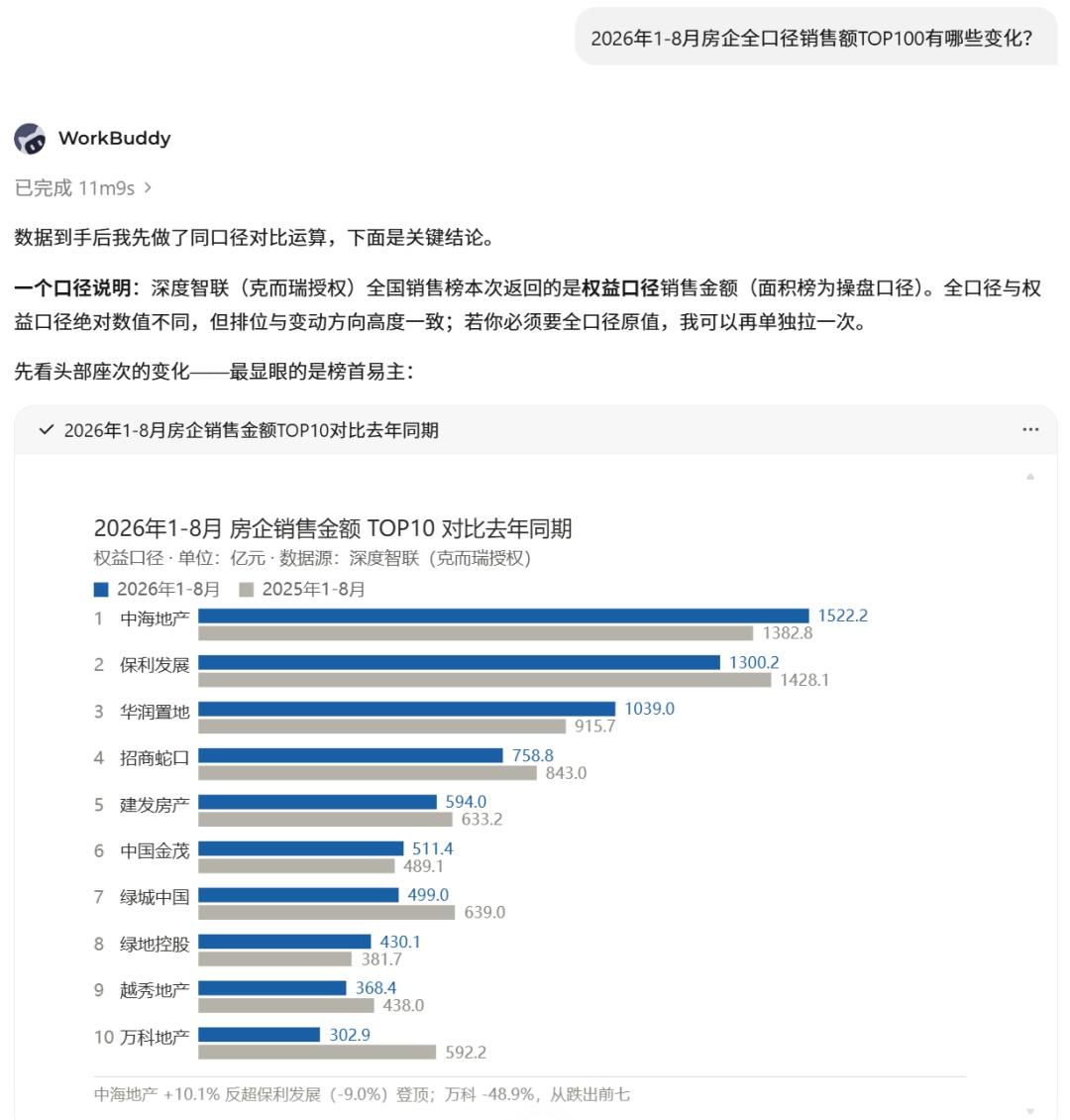
WorkBuddy's response
In the past, these tasks required researchers to pull tables, clean and compare data by themselves, and then find the points worthy of attention from a large number of figures. Now, AI has been able to complete the first round of screening.
But our test soon encountered the most typical problem in the real estate industry: caliber.
We asked for "TOP 100 by full-caliber sales", but what was actually provided was equity caliber. WorkBuddy recognized this difference and took the initiative to explain at the beginning of the answer that the full-caliber data needs to be pulled separately.
But for a test sample, this is more valuable than a perfect answer. Because it shows that: AI has been able to handle a large number of basic work for real estate practitioners, but it cannot make data judgments for professionals.
Full caliber and equity caliber seem to be just two terms, but they correspond to different statistical logics behind. No matter how fast AI calculates, if the entry question itself is wrong, it may still get a result of "answering the wrong question correctly".
Therefore, what AI replaces is not the "chef", but the "kitchen helper". But this does not mean that AI is just an auxiliary tool. On the contrary, when CRIC's data, Mingyuan's business system, as well as more internal enterprise knowledge bases, CRM, ERP and professional tools, all become capabilities that AI can call, AI will become a unified entry for all tasks. Users no longer need to open the database, export Excel, and browse historical lists separately, but directly submit their requirements to AI, which will decide what to call and how to integrate.
In other words, the super entry is not the end of decision-making, but the starting point of tasks. It does not replace professional judgment, but it accelerates the start-up time of every work.
3
The super entry is not only a change on the user side, its emergence will precisely affect a business that has existed for many years.
One of the important values of CRIC in the past was to collect, process and research scattered real estate information, and then turn it into databases, lists and reports. Moreover, it has further applied the data, professional experience and industry insights accumulated for many years to AI products. In 2025, CRIC launched an AI assistant for property enterprises, trying to enable enterprise AI platforms to call its knowledge and information services in natural language through MCP.
In other words, AI is not necessarily "killing" data source companies, it may be forcing these companies to redefine what they are selling.
Mingyuan Cloud is another more direct sample. In the past, the core business model of real estate digital services was very clear: selling software, SaaS subscriptions and digital modules, charging enterprises subscription and service fees. However, after the real estate industry entered the stock adjustment phase, customer budgets tightened, and traditional SaaS itself faced growth pressure.
The performance disclosed by Mingyuan Cloud on the Hong Kong Stock Exchange shows that it achieved an operating revenue of about 1.284 billion yuan in 2025, and clearly took AI innovation as an important future growth direction. In the previous business plan, the company has proposed "AI+SaaS", and explored to further extend from subscription-based charging to usage-based charging; at the performance meeting held in 2026, Mingyuan Cloud clearly mentioned that some AI products are trying to charge based on results.
More and more enterprises undergoing AI transformation are adopting the idea of "Result as a Service (RaaS)", and AI is evolving into a "silicon-based employee" that can work independently and is paid for business results.
But RaaS cannot be achieved overnight. How to define the result? Is it based on the number of generated lists, or the conversion rate of marketing leads? If there is a deviation in the judgment given by AI, how to define the responsibility? Are customers willing to pay for conclusions with "invisible process"? These problems directly determine whether RaaS can be successfully implemented.
At present, the explorations of CRIC and Mingyuan Cloud are precisely trying to cut in first at the "verifiable result" link — such as list generation, competitor monitoring, and marketing lead conversion. Whoever can take the lead in standardizing and verifying the "result" will seize the opportunity in the commercial competition of real estate AI.
What is really worth paying for will gradually change from "you give me a list" to "you help me solve the problem". But the premise is that this "solution" must be measurable, trustworthy and accountable. This represents that the biggest competition for real estate service providers in the future is who has more authoritative data and who has deeper understanding of the business.
When CRIC's data, Mingyuan's business system, as well as data counted by more institutions, internal enterprise knowledge bases, CRM, ERP and professional tools, all become capabilities that AI can call, what changes is no longer just a tool.
For real estate practitioners, what changes is the work entry; for service providers such as CRIC and Mingyuan, what changes is the business entry.
This article is from the WeChat official account "Future Habitat", author: Zhang Guohao, published with authorization from 36Kr.