Solving a 20-year-old mathematical problem, Microsoft has open-sourced Argus, which adopts an evidence-driven approach to conduct 1548 hours of automated research.
What is still missing for long-horizon Agents from "being able to execute" to "being able to steer the course"?
In the current era of rapid Agent development, Harness has already allowed large language models to connect to the real world, call tools, modify code and run experiments. But when tasks extend from tens of minutes to several days, the system still requires a human to stay in front of the screen for a long time to judge the next direction of progress.
The key to this bottleneck lies not only in the insufficient capability of the model, but also in the fact that most existing Agents only automate the "execution" part, without truly automating the "steering" logic above execution. Harness endows the model with the ability to act, while humans endow the model with the ability to make decisions. Once the human leaves, the project will stop accordingly. Moreover, without dense reward feedback, the execution and response of Agents will appear slow and clumsy.
To solve this problem, institutions including Microsoft and Shanghai Jiao Tong University have open-sourced Argus, a general Agent inference runtime for long-cycle research tasks, and released the technical report. Through designs such as evidence-driven, self-evolution, multi-Agent collaboration, and core-vertical decoupling, the system enables Agents to expand to multi-domain continuous research for several days without dense standard feedback.
The report covers 27 Campaigns with a total wall-clock time of 1,548 hours. On average, it actively requests human intervention once every 40.7 hours; the duty cycle of the work in the report is 95.1%~98.7%. What Argus delivers this time is not just high-score benchmarks, but a complete production-level result portfolio. The team has presented results in a wide range of tasks including AI4AI, GPU Kernel, model training, AI4Science, chip design, AI4math, and AI4System, which demonstrates the generality and real research-level intelligence of Argus.
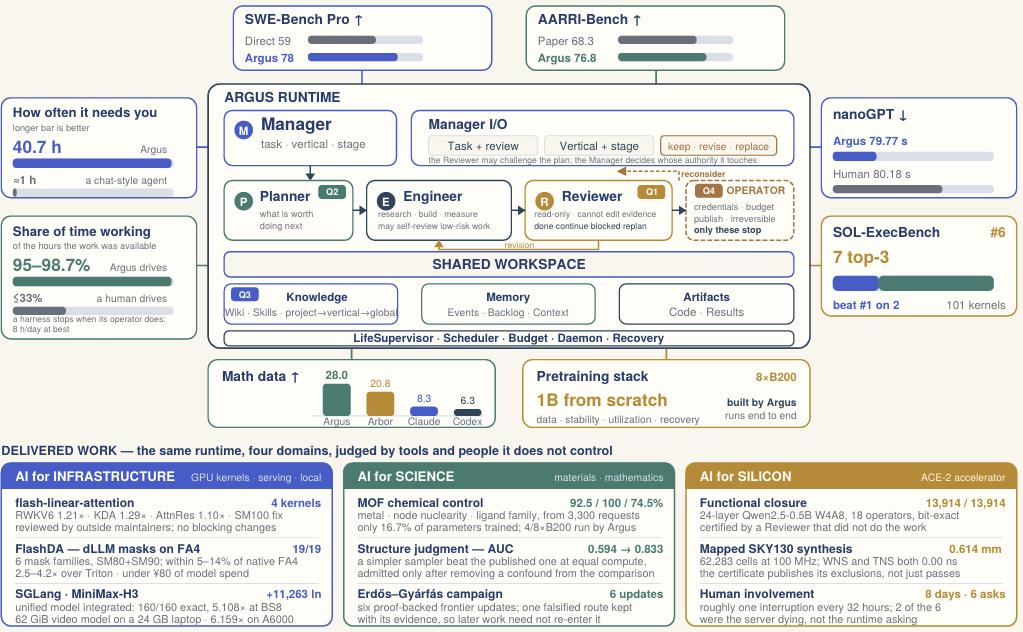
Figure 1: Overview of Argus runtime, capability benchmarks and delivery outcomes.
- Paper Title: Argus: Who Drives the Harness for Days?
- Paper: https://arxiv.org/abs/2608.05144
- Code: https://github.com/lbx154/Argus
- Project Homepage: https://argusbot.cn/
- Open Source Repository of Project Outcomes: https://github.com/Argus-AiTeam
- Live Stream of Project Mathematical Problem Solving: https://open.argusbot.cn/#counterexample-live
01
Shift from Goal-Driven to Evidence-Driven:
Who decides the next step of the Agent?
Over the past two years, the main progress in Agent engineering has focused on Harness: taking the FSD of autonomous driving as a metaphor, the model is like the engine, and Harness is like the transmission system, but it is still the person sitting in front of the screen that truly decides where the vehicle will go. In short tasks, just like ordinary automatic parking, the task itself can provide clear feedback; once the task extends to several days, research problems often have neither stable rewards nor clearly defined goals from the very beginning. Existing Agents thus expose the real bottleneck: they already know how to execute, but still cannot make continuous judgments in the face of uncertainty.
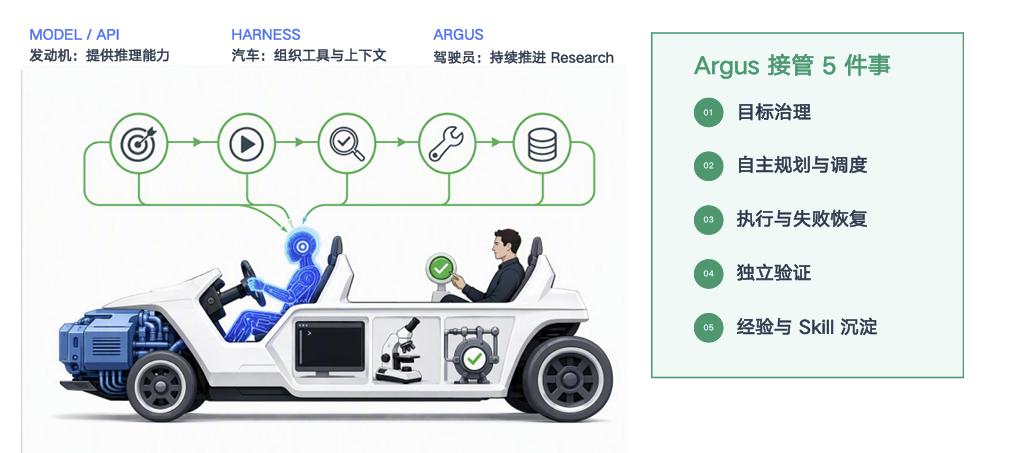
Figure 2: By realizing auto-research autonomous scientific research, Argus changes the role of humans from the continuously driving driver's seat to the co-pilot.
Argus calls the previously unautomated position above Harness the Driver. What it needs to do is to continue to steer according to the evidence when there is a conflict between the plan and reality. The goals written down at the beginning of the research are only initial hypotheses at the stage with the least information; if the Agent can only chase the preset end point in a Goal-Driven way, and even repeatedly wastes Tokens on impossible goals, it will lead to goal rigidity. Evidence-Driven reverses the control logic: the next step is determined by the existing evidence, not by the initial hypothesis of the plan. All results during operation are valid evidence that will change the route; the system is exactly driven by evidence. Specifically, the Driver needs to repeatedly answer the following four questions based on the current evidence:
1. Is this task already completed with sufficiently good quality?
2. Combined with the current evidence, what is the most worthwhile thing to do next?
3. How should the experience obtained in this round change the subsequent behavior of the system?
4. Do the remaining problems involve decisions that only humans can make?
02
Build a general customizable long-horizon runtime
Argus organizes long-term projects into persistent Campaigns, which are then split into a series of clearly bounded Missions. Its basic closed loop is Manager → Planner → Engineer ⇄ Reviewer → Manager:
Taking the /goal mode of OpenAI Codex as a reference, we can more clearly clarify the design orientation of Argus. /goal stretches the single-round loop of one agent into a persistent loop with a goal state; Argus organizes research projects into a long-horizon runtime with multiple roles, multiple harnesses, and knowledge precipitation. The former answers "how to keep the agent from stopping", while the latter answers "how to work effectively after the agent keeps running". This is exactly the structural difference corresponding to the shift from Goal-Driven to Evidence-Driven at the runtime level.
1. The Manager is responsible for phase transition, process approval, and global strategy;
2. The Planner plans specific tasks based on current evidence;
3. The Engineer enters the real codebase, conducts experiments and executes tasks;
4. The Reviewer independently reviews the artifacts, verifies their innovation and effectiveness, and reports to the Manager or sends them back to the Engineer.
The key point here is not the multi-role setting itself, but the separation of contexts — multiple roles cooperate with each other to prevent the agent from becoming a simple local hill-climber. Each role has its own unique context but shares the workspace, so that planning, execution and verification will not all be handed over to one agent, which can improve token efficiency. For this reason, different harnesses such as Pi, Codex, Claude Code, and DeepSeek Harness can be enabled simultaneously in one Argus task, ensuring a high degree of customization.
The system stores a complete set of artifacts; only the experience that meets the evidence threshold will be stored in Wiki and Skill, and can be reused for subsequent tasks according to the scope of Project, Vertical or Global.
At the same time, Core and Vertical remain decoupled: Core is responsible for role permissions, evidence submission and human boundary, while Vertical is defined by domain experts to clarify what counts as valid evidence in tasks such as mathematics, GPU and materials, as well as related human skills and knowledge; Vertical can significantly improve the delivery quality of research tasks, and also provides an interface for human experts and agents to co-evolve and customize workflows.
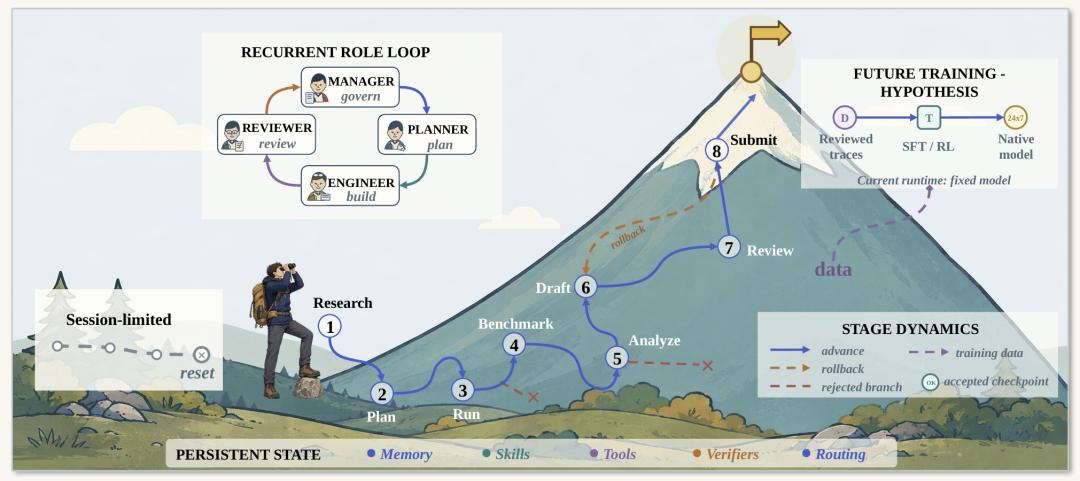
Figure 3: The long-horizon operation mechanism of Argus. Four types of roles circulate around the persistent state, and the Campaign can advance or roll back between eight research phases.
03
What does Argus leave behind after 1548 hours?
What truly determines whether a long-horizon Agent is feasible is whether time can be transformed into real research results. Less than a month after Argus was open-sourced, it has made outstanding contributions in infrastructure, materials, chips, mathematics and AI system research. At the same time, we are the first team to publish the complete end-to-end screening log for mathematical conjecture solving, and all operation track sessions are open to the public. The following is a summary of various outcomes after Argus is open-sourced:
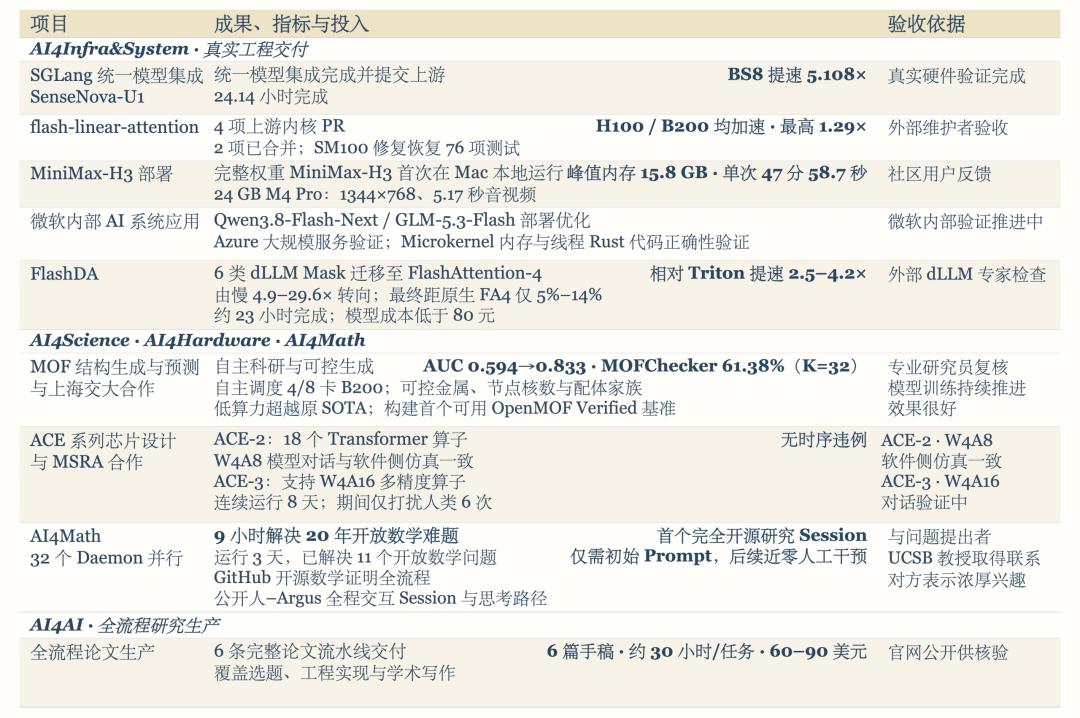
Figure 4: Representative research outcomes, key indicators and acceptance basis of Argus
As shown in the table above, Argus first converts continuous operation into verifiable real delivery in AI4System & Infra, completing the first step from automatic execution to autonomous research with clear engineering results; subsequently, tasks extend from AI infrastructure to AI4Science, AI4Hardware, and AI4Math, and the evaluation criteria also shift from "whether the established task is completed" to "whether it can explore unsolved real research problems", so automatic research is further advanced from automated delivery to automated exploration; on this basis, Argus expands from single-point outcomes to the complete research process in the AI4AI direction, and continuously drives task progress with evidence without requiring humans to stay in front of the screen all the time, thus forming a progressive path from real delivery, cross-domain exploration to full-process autonomous research.
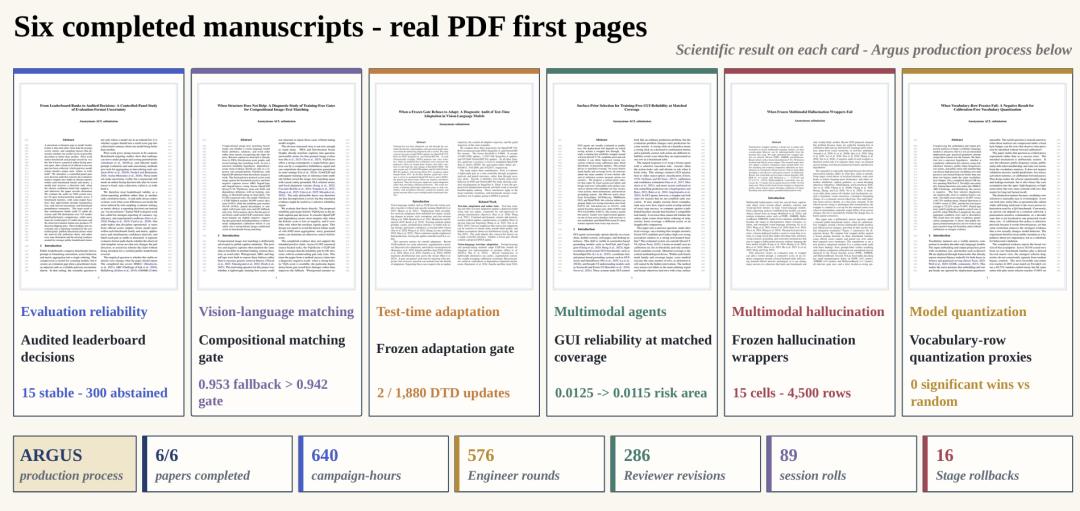
Figure 5: The delivery results of Argus in the full-process paper production.
All the above results were achieved within 1 month. Connecting these outcomes, Argus is a value chain that deepens step by step: the automation object expands from a single execution to evidence-driven research advancement, which greatly accelerates the research progress, and this is also the most direct answer to "who will drive the Agent after the human leaves the screen".
Conclusion
After the screen goes out, the project does not return to zero
Long-horizon intelligence is to convert Tokens into intelligence, and then use intelligence to continuously promote a research project to generate practical value. Argus organizes the originally disconnected model calls into a continuously operating research system, lets Evidence-Driven control the direction, and precipitates experience into capabilities through self-evolution.
What Argus demonstrates is not just an Agent that runs for a longer time, but a new research organization method: Harness solves how the model acts, and Driver determines how the system moves forward continuously, so the research speed is no longer limited by human working and entertainment time. This may mean that the accelerated era of research is coming. The screen can go out, but the research continues.
About the Author
Argus is led by researchers from Microsoft and Shanghai Jiao Tong University, and is jointly promoted by researchers from multiple universities.
This article is from the WeChat official account Synced and is published by 36Kr with authorization.