Just now, Claude has proved Fermat's Last Theorem for the first time, and the top talent from the Yao Class of Tsinghua University has stepped in.
Just now, another bombshell news broke out in the mathematics community.
A top talent from the Yao Class at Tsinghua University led the team to fully solve Fermat's Last Theorem with Claude.
At this point, AI has completed the largest proof in the history of mathematics.
Fermat's Last Theorem once tormented humanity for more than 350 years, requiring mathematicians to spend years of painstaking effort writing a 129-page cryptic manuscript to complete the proof.
Today, Anthropic announced that Claude has completed the first end-to-end machine-verified proof of Fermat's Last Theorem in only 11 days!
To achieve this, Claude frantically wrote 13 million lines of code, produced 30300 verifiable theorems, of which 29500 were finally adopted and directly included in the final proof.
This volume is more than 5 times that of Mathlib, the world's largest mathematical theorem library! Moreover, the entire process consumed a whopping 6 billion Tokens.
This is the largest Lean proof ever written to date.
As soon as the news came out, the entire internet was shaken. Some people exclaimed: "Fermat's Last Theorem was formalized in just one month? This kind of muscle-flexing makes the mathematics community look like it's crawling at a snail's pace."
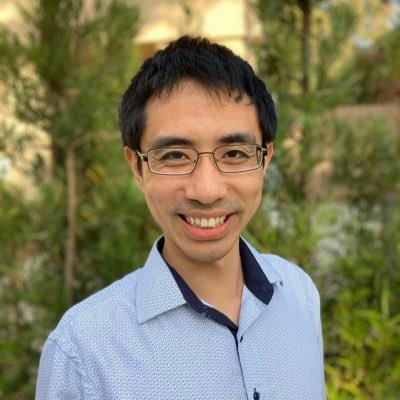
The top talent from the Yao Class: Peng Tianyi
The 350-year-old century-old problem was solved by Claude in 11 days
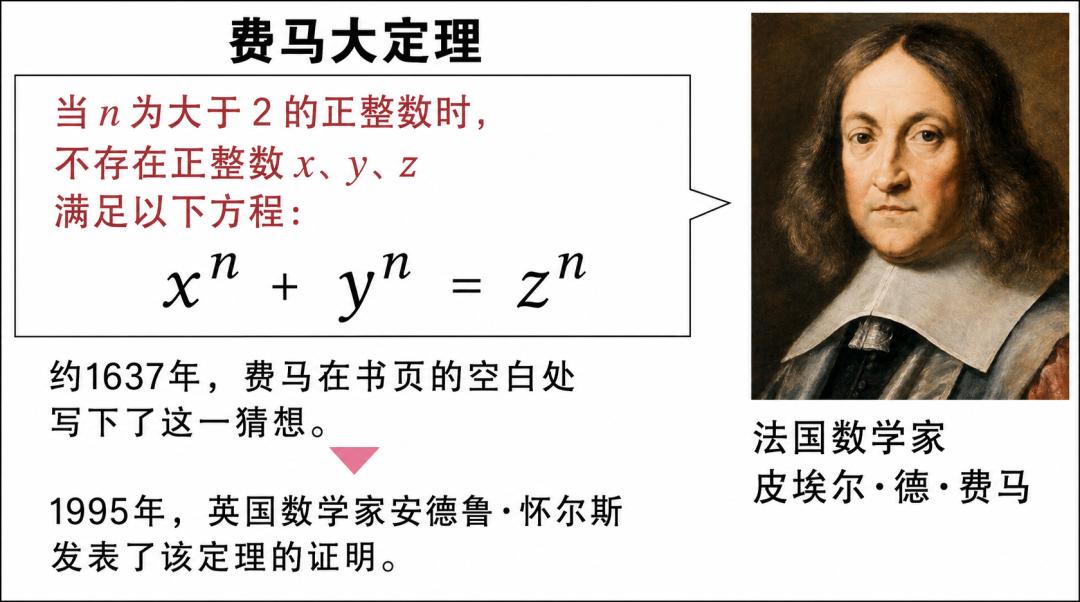
In 1637, when the French mathematician Fermat was reading a book, he casually wrote a line in the blank margin of the page:
When the integer n > 2, the equation xⁿ + yⁿ = zⁿ about x, y, z has no positive integer solutions.
Then he did not forget to add a note: "I am sure I have discovered a wonderful proof of this, but the margin here is too small to contain it."
This single sentence tormented generations of later mathematicians for more than 300 years.
It was not until 1995 that the British mathematician Wiles used advanced modern mathematical tools to produce a 129-page proof paper, finally putting an end to this 350-year-old unsolved case.
But here comes the problem: Wiles' proof is far too complicated.
Modern mathematics has developed to a point where ordinary people cannot even understand the problem statement. Proving a theorem is like building an extremely complex logical chain: if one link in the middle breaks, the entire structure collapses.
When Wiles first announced his proof in 1993, a fatal flaw was spotted. He then spent another whole year of arduous seclusion to fix it. For top-tier mathematical proofs like this, it often takes top experts months or even years to verify their correctness manually.
Is there a way to let the computer check the result just like verifying a calculator output, and confirm whether it is correct by running it once?
Yes! That is called "formalization".
Simply put, it means translating the human-written mathematical proof into a programming language that computers can run (such as Lean), and letting the machine deduce step by step. If the process runs through, it means the proof is absolutely correct.
However, formalizing Fermat's Last Theorem is widely recognized in the mathematics community as a super-large project that takes "years" to complete.
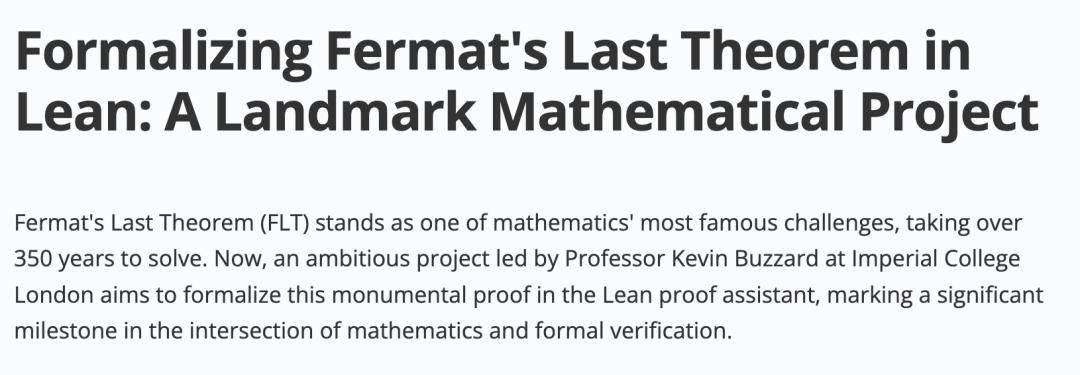
Even the project led by Imperial College London professor Kevin Buzzard has an 86-page blueprint just for its first phase!
Then Claude came along.
The work that humans expected to take several years only took it 11 days, and it worked "almost autonomously".
13 million lines of code, 6 billion Tokens
"11 days, 13 million lines of code" — behind this is the dual impact of AI's brute-force aesthetics and precise system design.
Let's see what exactly Claude did:
It did not only prove Fermat's Last Theorem itself.
Because a formal proof must start from the most basic axioms and build up layer by layer, Claude conveniently proved more than 29000 other mathematical theorems required in the process as well.
It covers algebra, geometry, number theory, harmonic analysis... Many branches had never been formalized before, and Claude directly "opened up new ground" for them.
Humans barely intervened in the entire process.
Researchers only gave some high-level instructions, such as "the Jacobian variety as a scheme has high priority" and "advance Mazur's theorem as soon as possible".
The rest of the work was done by dozens of Claude agents that frantically interacted with each other, defined concepts, proved intermediate theorems, and built up the proof layer by layer.
Finally, the Lean compiler passed all checks, relying only on three of the most basic standard axioms.
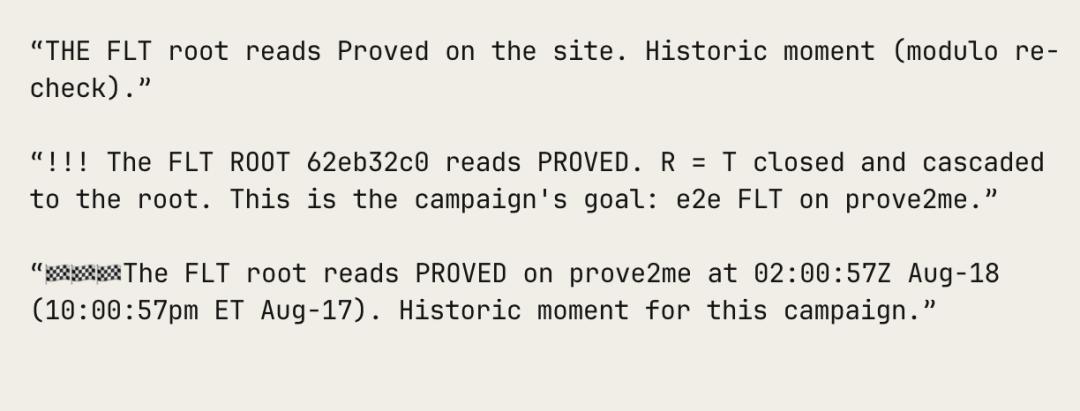
When the program finished running and the sacred word "PROVED" popped up on the console, Claude's own internal log was even excited:
"!!! The root node of Fermat's Last Theorem is read as PROVED... This is the goal of this campaign... A historic moment."
As you can see, even the AI itself knows how remarkable this achievement is.
The mastermind behind the scenes: a top academic overachiever from Tsinghua's "Yao Class"
Anyone who can command Claude to accomplish such a miracle is definitely no ordinary person.
The team leader is Peng Tianyi, Assistant Professor at Columbia Business School and researcher at Anthropic.
His resume is simply "hacked to the max":
He studied in Tsinghua's "Yao Class" from 2013 to 2017 for his bachelor's degree, won the best graduation thesis award, and was selected into the national training team for the International Olympiad in Informatics.
He went to MIT for his doctorate, majoring in operations research, and graduated with a perfect GPA of 5.0.
Now he works as an assistant professor at Columbia University while researching AI agents and formalization tools at Anthropic.
Interestingly, Peng Tianyi's obsession with "AI automatically verifying mathematical proofs" actually comes from a "painful experience" during his undergraduate years.
At that time, his supervisor wanted to include the results from his thesis in Nature, but asked him: "Are you 100% sure the proof is correct?"
He honestly replied: "I'm 99% sure, but it's so long that I really can't be 100% certain."
Just because of that 1% uncertainty, he missed the opportunity to publish in Nature.
Now, he has personally closed that "1%" gap with AI.
From near failure to legendary success: How Prove2Me saved the day for AI
You might think that to let AI prove a theorem, you just input "Please prove Fermat's Last Theorem" and it spits out 13 million lines of code nonstop?
That's completely wrong.
At the beginning, the experiment almost failed.
Anthropic revealed that shortly after dozens of Claude agents started collaborating in the early stage, the whole system was completely in chaos. They worked like headless flies, could not keep up with each other's progress, and the cooperation efficiency was extremely low. The code contributed by these early failed attempts only accounted for 7% of the total.
The "forgetfulness" and "hallucinations" of large language models are fatal flaws in the face of rigorous mathematics — one wrong line makes millions of subsequent lines completely invalid.
At the critical moment, Peng Tianyi's team developed the Prove2Me platform.
This tool is equivalent to equipping all AIs with a "super project manager" that solves all kinds of problems:
The Theorem DAG (task tree): It gives each AI a clear map, telling it which intermediate node to prove next, greatly alleviating memory decay, and enabling dozens of agents to work efficiently in parallel.
Separation of statements and proofs: It speeds up compilation and saves computing resources.
Natural language index: Each theorem retains a human-readable description, making it much more convenient for AIs to retrieve and reuse existing results.
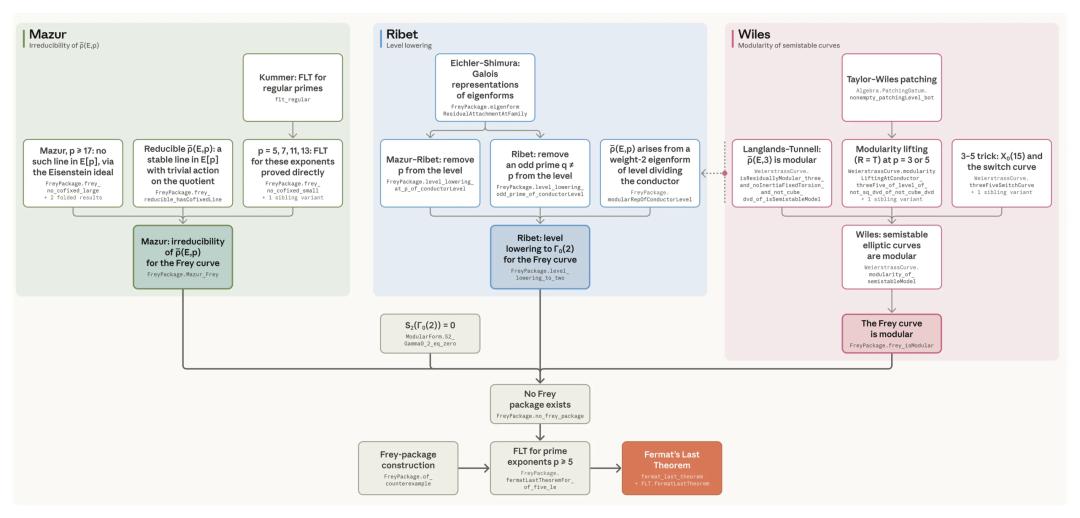
Equipped with the multi-agent framework of Claude Code, the AIs are like sappers with navigation, speeding through the mathematical maze and clearing all levels in 11 days.
The mathematics community is impressed
As soon as the achievement was released, a wave of discussions erupted on X and major technical forums.
The professor from Imperial College London who originally planned to spend several years on formalization was deeply impressed after reading the results, and spoke highly of it: "This is a major step forward in the automated formalization of modern mathematical literature! In the future, it can be used to find errors in human mathematical libraries and verify mathematical conclusions generated by large language models."
But netizens have even more imaginative takes.
Some people commented humorously: "The way AI solves mathematics is — it gives you an extremely complicated answer (13 million lines of code), and it is harder for you to prove it wrong than to solve the problem from scratch. So you can only give up resistance and accept that it is correct. Isn't this PUA for the mathematics community?"
Others said: "Writing 13 million lines of code just to make a 350-year-old theorem sit properly in front of the machine... Humanity's table is not ready to accept something of this scale yet."
Even more remarkably, Anthropic also ran a small demonstration experiment to show its capabilities.
Using 3 regular accounts on Prove2Me, they spent 3 days formalizing the famous "Vinogradov's Three Primes Theorem" in number theory!
This means that with the right tools, amateur mathematicians will be able to buy several consumer-grade AI accounts and verify the top-level mathematical theorems of humanity in the future!
AI will not replace mathematicians, but will completely transform mathematics
So, are mathematicians going to lose their jobs?
Anthropic gave the official answer: AI will not replace mathematicians, but will completely change the way the field works.
Throughout history, there have been many "tragedies" in mathematical verification.
For example, in 1998, someone proved the Kepler conjecture, and the review panel spent 4 years and could only conclude that they were "99% certain". When Perelman proved the Poincaré conjecture, the entire mathematics community spent 4 years writing 3 books totaling more than 300 pages to barely understand the proof. There are also theorems that were accepted as truths for several years, on top of which other results were built, only to finally find that the foundation was flawed.
The technology brought by Claude is designed to put an end to this kind of "uncertainty".
In the future, AI will not only be the calculator for mathematicians, but also the strictest referee.
When AI can quickly generate thousands of new conjectures and proofs that humans cannot review all at once, making "attached formal verification code" a standard requirement for academic papers will become a reality.
In the era of large language models, large-scale automated formalization has approached engineering implementation, opening up new possibilities.
References:
https://www.anthropic.com/research/formalizing-fermats-last-theorem
Editor: Aeneas
This article is from the WeChat official account "AI Era" (ID: AI_era), author: ASI Revelation, published with authorization from 36Kr.