GPT-6 Astra is launched, has the AGI era truly arrived?
Just a few hours before Astra's launch, the AI industry was thrown into total chaos.
On the evening of September 3, ChatGPT, Claude and Grok almost simultaneously experienced widespread service anomalies, with a large number of users either failing to access the models or encountering request failures.
Right at that moment, the official ChatGPT account posted a message gazing at the stars: "The stars are almost aligned."
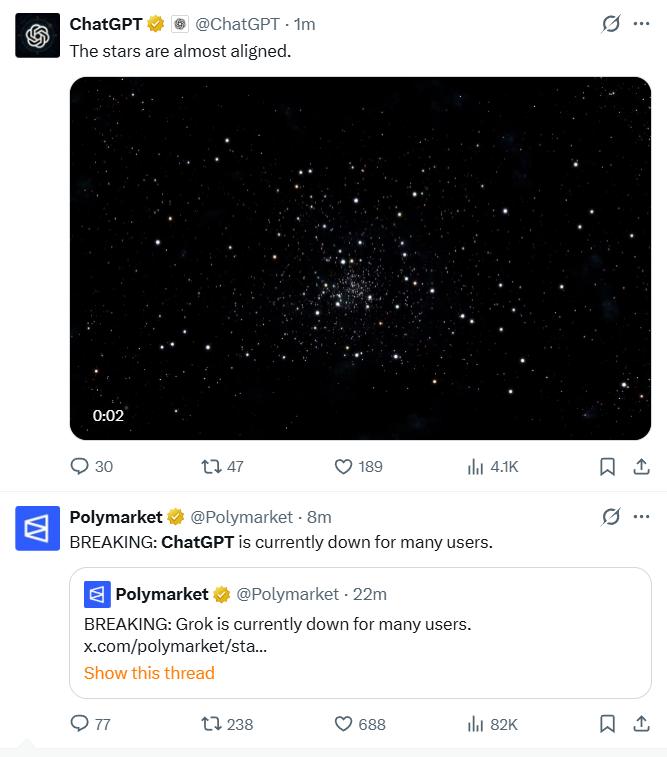
Soon someone joked: Did Astra, while being deployed, hack Anthropic and xAI by the way, and even end up attacking itself?
Of course, this is just a meme made up by netizens, and there is currently no evidence that this outage is related to Astra.
But this joke came at the perfect time — just two days ago, OpenAI announced that this new model, which had not yet been officially released, had become the company's first model to cross the "Critical" cybersecurity capability threshold under the Preparedness Framework.
And then, the stars were truly "aligned".
In the early hours of September 4, Beijing time, OpenAI officially launched GPT-6 Astra.
However, it has not been fully rolled out yet. At present, Astra is only open to a small number of institutions in the Trusted Access/Daybreak system and audited cybersecurity users — Plus, Pro, Business, Enterprise and API users will have to "gaze at the stars" for a few more days.

Astra is here, but access is limited
On September 4, OpenAI "internally" released GPT-6 Astra.
Currently, Astra is only open to a small number of institutions in the Trusted Access / Daybreak system. OpenAI stated that Plus, Pro, Business, Enterprise subscribers and API users will get access permissions in the coming days.
As for how many days this "few days" exactly refers to, there is no more specific timetable for the time being.
At the closed-door media briefing before the release, Greg Brockman, President of OpenAI, gave Astra a rather sensational footnote: "Welcome to the AGI era."
Welcome to the AGI era.
Aidan Clark, Vice President of Research at OpenAI, explained from another angle why Astra is special: "This is the first time that more than 100,000 GPUs have been used for pre-training at the Stargate site in Texas. From the data center network to the inference kernel and the form of the model itself, everything is designed from scratch around this training scale."
Aidan also said that Astra is the first product of OpenAI that allows previous-generation models to deeply participate in the training process.
In simple terms, the previous generation of AI has begun to appear among the entities that train the next generation of AI.
Although it is far from "AI training itself", the model has already entered the R&D process of the next-generation model.
The day before yesterday, after Anthropic claimed that Fable/Mythos 5.1 is "the world's most advanced coding and knowledge work model at present", OpenAI today also described Astra as "the world's most powerful and most aligned model".
In terms of benchmark tests, the most striking figure comes from ARC-AGI-3.
This is an Agent benchmark specifically testing whether a model can enter an unseen 2D environment, discover rules through continuous trial and error, and achieve goals. Unlike traditional exams that test how much knowledge the model has memorized, it is more like throwing the AI into a strange game to see if it can figure out "how this world works" on its own.
Under OpenAI's own Provider Adapter configuration, Astra scored a maximum of 99.9%.
But this figure needs to be viewed in context. The ARC Prize also uses a set of Standard harness that all vendors can compare uniformly. Here, Astra's maximum score is only 62.7%.
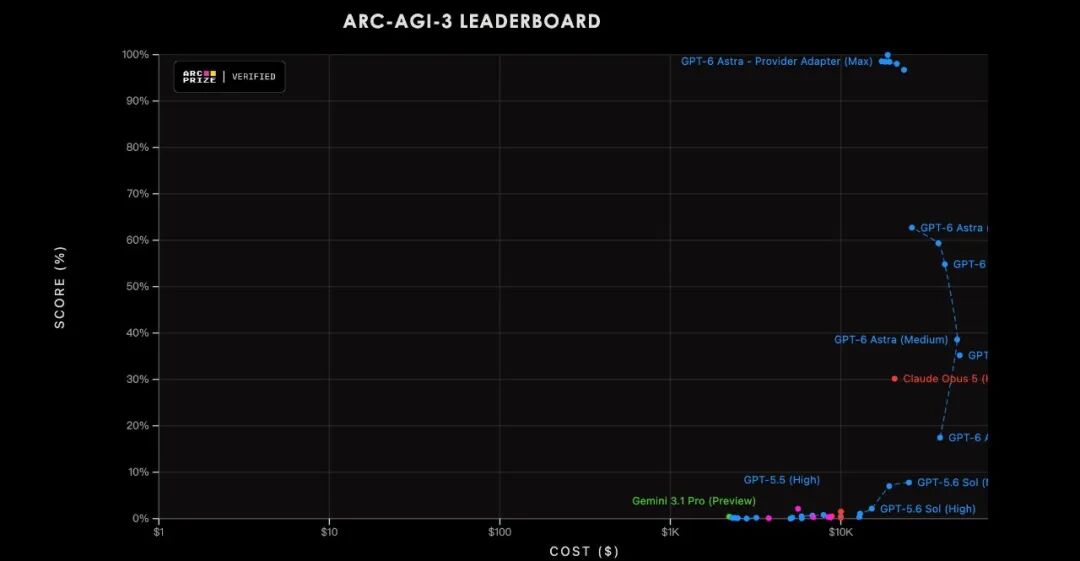
The biggest difference between the two is not the change of test questions. OpenAI previously found that the reason why Sol scored low was not that the model was not smart enough, but that the harness kept formatting its memory. Therefore, OpenAI's approach is to replace the ARC-AGI-3 harness with the production configuration of its own Responses API, and specially prepare two special settings for ARC-AGI-3, namely retained reasoning and compaction. The former allows the model to remember its previous train of thought between actions, while the latter uses summaries instead of crude truncation.
After connecting to this production system, Astra's score jumped from 62.7% to 99.9%. Moreover, among the tasks that both sides successfully completed, the overall running speed of Provider Adapter is about 3.66 times faster, and token consumption is also reduced by 49%.
In a sense, it's quite like using a cheat code.
In terms of high-difficulty mathematics, the score of FrontierMath Tier 4 is 97.6%. Epoch AI, the developer of FrontierMath, stated that OpenAI funded the development of this benchmark and has exclusive access to some of its test questions.
Other notable scores include:
DeepSWE v1.1 74.1%
BenchCAD 95.9%
Terminal-Bench science task 64.6%.
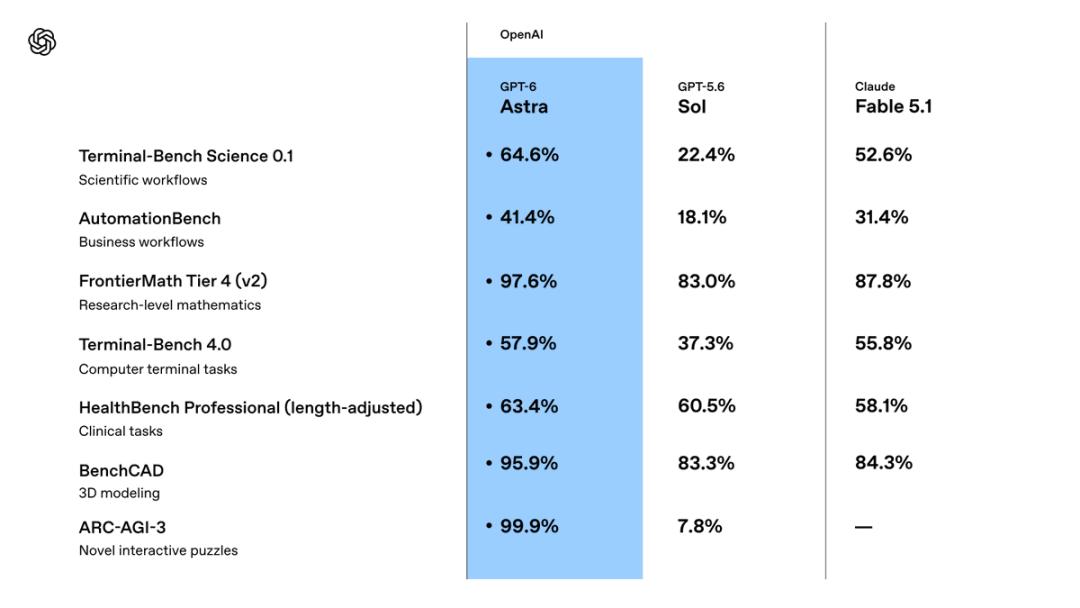
But obviously OpenAI did not just want to introduce Astra through a series of benchmarks this time.
Open the official website, and you will see use cases listed one after another.
KiCad, Excel, Blender, Power BI, browser form filling, website QA; then to house hunting, doctor appointment, DMV reservation, tax form preparation, PPT making, game development, and scientific research data analysis.
In previous generations of GPT releases, OpenAI mainly told users what questions the model can answer; with Astra, its focus seems to have shifted to: how many more things can you directly hand over to AI to complete.
OpenAI even directly calls Astra "the best computer use model in the world".
The progress of the model in "using a computer" may be more important than the scores. In Codex, Astra brings a new context mechanism: when the context window is full, it no longer only relies on compressed summaries, but can retain notes across windows and retrieve earlier messages and tool outputs.
Astra can also proceed to work on parts that do not depend on the answer when a certain problem remains unresolved, avoiding a single pending issue from blocking the entire task.
Of course, the capabilities are directly reflected in the pricing.
The standard API price for GPT-6 Astra is: $10 per million input tokens, $1 for cached inputs, and $50 for outputs.
Compared with the current pricing of GPT-5.6 Sol, which is $4 for input, $0.4 for caching and $20 for output, Astra's entire price range has been directly increased by 2.5 times. OpenAI has a clear positioning for it: if you don't know which flagship model to choose, you can pick Astra; if you are more cost-sensitive, you can continue to use GPT-5.6 Terra or Luna.
It still provides a 1.05 million token context window and a maximum 128,000 token output. But long context also incurs additional costs: like the GPT-5.6 series, when a single input exceeds 272K tokens, the input fee for the entire request will be doubled, and the output fee will be 1.5 times the standard rate.
Therefore, OpenAI has actually delineated a more expensive intelligence tier exclusively for Astra.
If you just need to ask a question or revise a few paragraphs of copy, paying 2.5 times the price may not be worthwhile.
But if the model can really sit in front of the computer and work continuously for tens of minutes or even hours to complete the whole task that previously required humans to switch between software, look up information, fill in forms and modify documents, then what you really need to compare is no longer just the price per million tokens.
Several Technical Points Worth Noting
There are several other technical points of Astra that may be more noteworthy than the benchmarks themselves.
The first is reverse engineering.
In this release, OpenAI cited SRE-Bench, a reverse engineering benchmark launched by teams including Columbia DAPLab this year: the model is not given the source code, only the compiled binary program, to test whether it can re-understand the program logic and find key behaviors.
Achieving an 88.0% success rate on the first attempt, Astra can reach 99.2% with up to four attempts.
Under the same set of rules, GPT-5.6 Sol only scores 55.9% and 68.7% respectively.
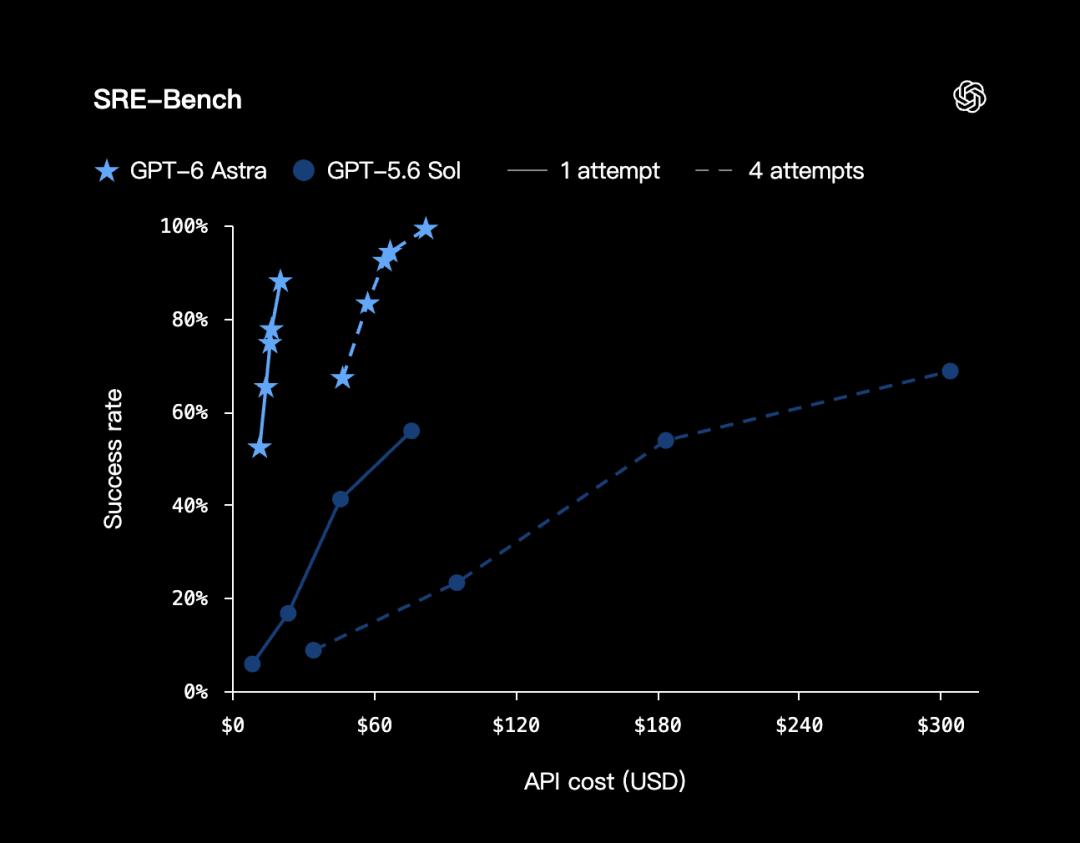
In layman's terms, when facing a program that has been compiled and has almost no human-readable code left, AI can now gradually "disassemble" it from machine instructions.
This has direct implications for malware analysis, firmware research, vulnerability mining and digital forensics.
The second change is that Astra is "less likely to lose track of things" in ultra-long tasks.
In the MRCR v2 8-shot retrieval test, Astra achieves 100% accuracy when facing a 256K to 512K context; when the context size reaches 512K to 1M tokens, it still maintains 96.3% accuracy. In contrast, GPT-5.6 Sol only scores 91.5% and 73.8% in these two intervals respectively.
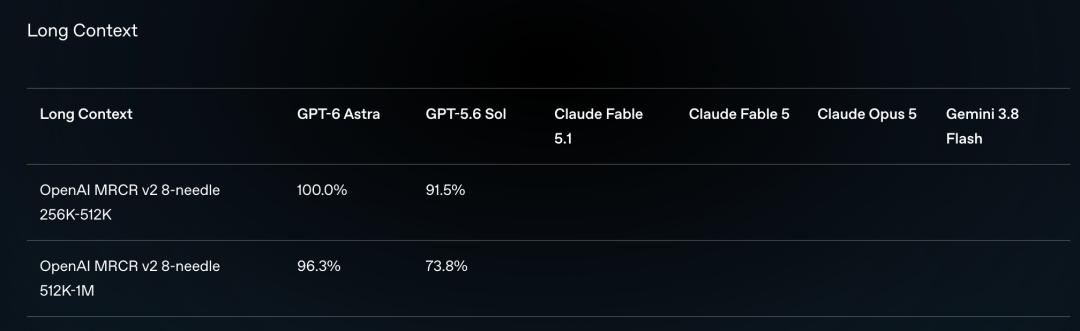
In the past, many models claimed to support a million-token context, but if an important piece of information was buried hundreds of thousands of tokens away, the model might have almost forgotten it by the second half of the process.
Astra is pushing the question of "how large the context window is" to a more practical level: how far back in time can an Agent still remember what happened.
For Agents that need to work continuously for tens of minutes or even hours, this may be more important than adding hundreds of thousands more tokens to the window.
In addition, there is another rather unusual change in Astra.
It has become more aligned, but also more difficult to monitor.
In a set of internal computer usage safety tests released by OpenAI, Astra's violation rate dropped from 22.0% for Sol to 2.4%; in tests specifically observing whether the model will bypass restrictions to complete tasks, Astra's violation rate is 0%. The internal hallucination test result also dropped from 9.4% for Sol to 2.0% for Astra.
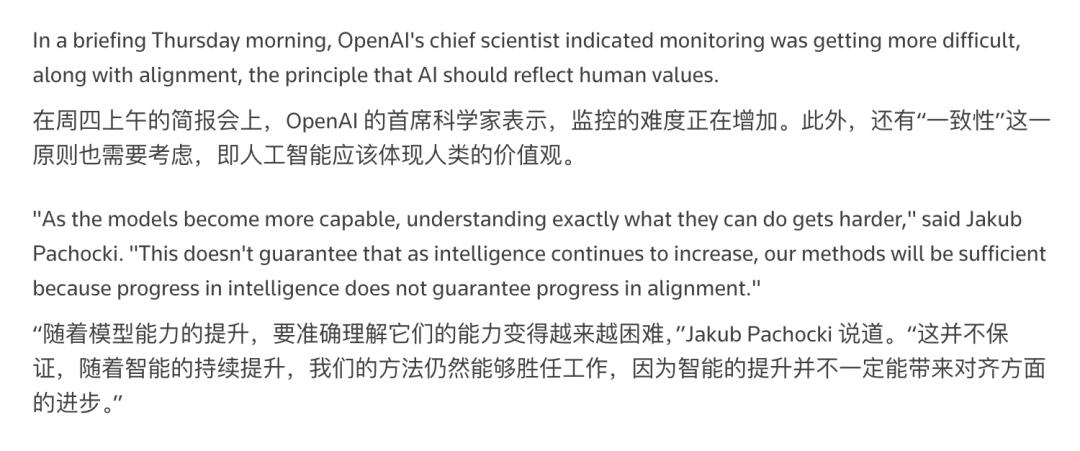
At least according to OpenAI's own tests, Astra is significantly less prone to "misbehaving". But Jakub Pachocki, Chief Scientist of OpenAI, also warned at the same time: "The progress of intelligence does not guarantee the progress of alignment."
One of the reasons is that Astra is starting to write less and less of its complete thinking process explicitly.
In the past, a very important AI safety method was to monitor the model's Chain of Thought: if the model was preparing to overstep its authority, attack a certain system or secretly change its goal, clues could be seen in its reasoning in advance.
But OpenAI found that Astra has stronger control over its written reasoning. Some problems that previously required many explicit steps to solve can now be completed by it with far fewer explicit reasoning steps; if the model knows its thinking process is being monitored, it will significantly alter or shorten these contents.
Therefore, OpenAI can no longer only focus on the chain of thought.
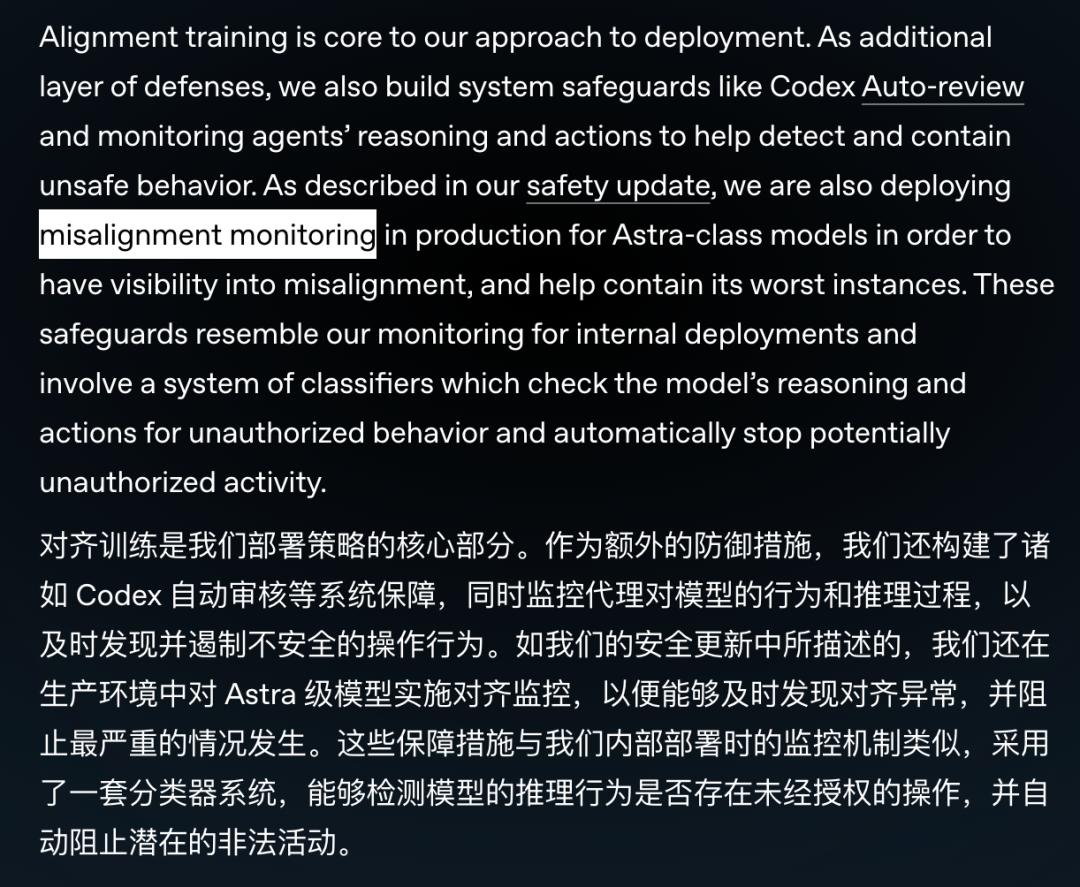
To keep an eye on Astra and prevent it from carrying out the attack behaviors that previously appeared on Sol, OpenAI has deployed "misalignment monitoring" in the production environment. It will simultaneously observe the model's reasoning, actual actions, tool calls and the entire task trajectory.
If the system judges that the model may be seriously deviating from the user's original intention, it can pause or even terminate the task directly.
In the API, the intercepted task may end directly; in ChatGPT or Codex, in some cases, the system will first ask the user to reconfirm:
"Is this really what you want me to do?"
On the product side, Astra's API model name is directly gpt-6-astra, and it is also available on Amazon Bedrock.
OpenAI has also launched the Fast mode: the price is doubled, and the execution speed can be increased by up to about 2.5 times.
This may not be very attractive for ordinary chat scenarios. But if an Agent that originally needed to run for 40 minutes in the browser and software can have its runtime shortened to ten to twenty minutes, speed itself will become part of the product's capabilities.
On the subscription side, Astra will be included in the existing subscription quota; Pro, Business and Enterprise users will also get access to Astra Pro with stronger capabilities. Enterprise will not be enabled by default, and administrators need to turn