Moments ago, GPT-6 made its stunning debut! Humanity has entered the era of large-scale AGI-driven division of labor.
GPT-6 Astra arrives completely unexpectedly.
Just now, OpenAI officially defined it as "the most intelligent model in the world that best fits human intentions".
OpenAI stated that Astra integrates years of research achievements in the fields of pre-training, reinforcement learning and model alignment, and has reached new capability levels in multiple directions including computer operation, web browsing, software engineering, cybersecurity, scientific research and professional work.
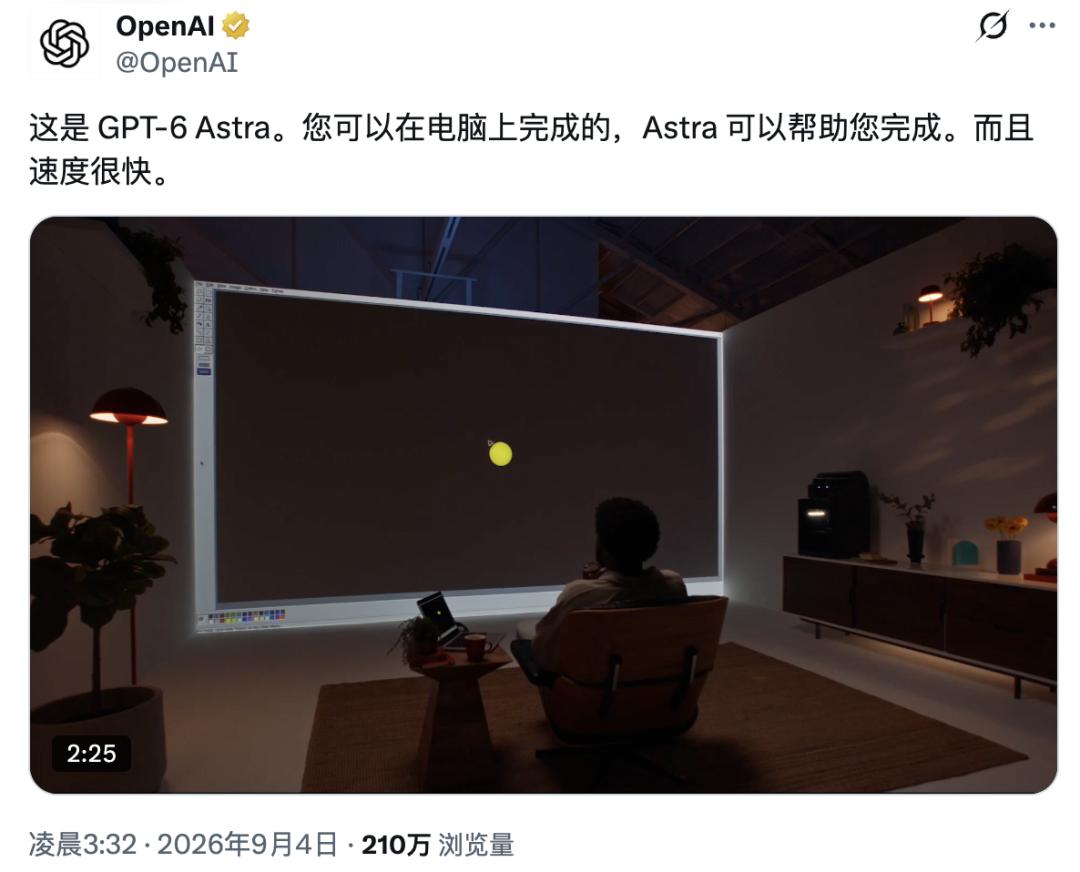
Compared with previous generations of models that focus on chatting, writing and question answering, Astra is more like an AI Agent that can get work done directly: it can call tools, operate software, browse web pages, and independently complete complex tasks.
This release is also the largest-scale model upgrade of OpenAI in recent years.
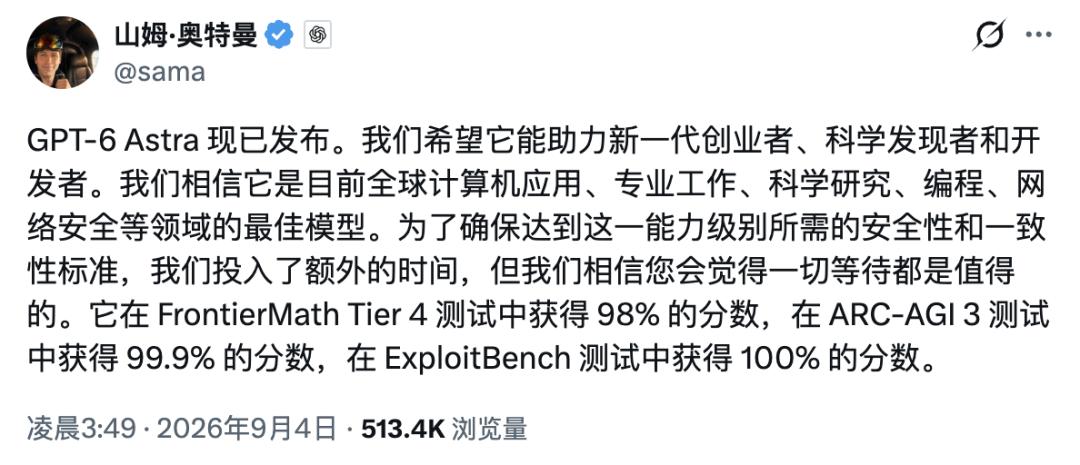
According to Aidan Clark, Head of Research at OpenAI, Astra is one of the largest training projects OpenAI has ever launched, and it is also the first new-generation model that extensively uses previous models to participate in supervision during the training process. This model was pre-trained for the first time at OpenAI's Stargate Texas base with more than 100,000 GPUs.
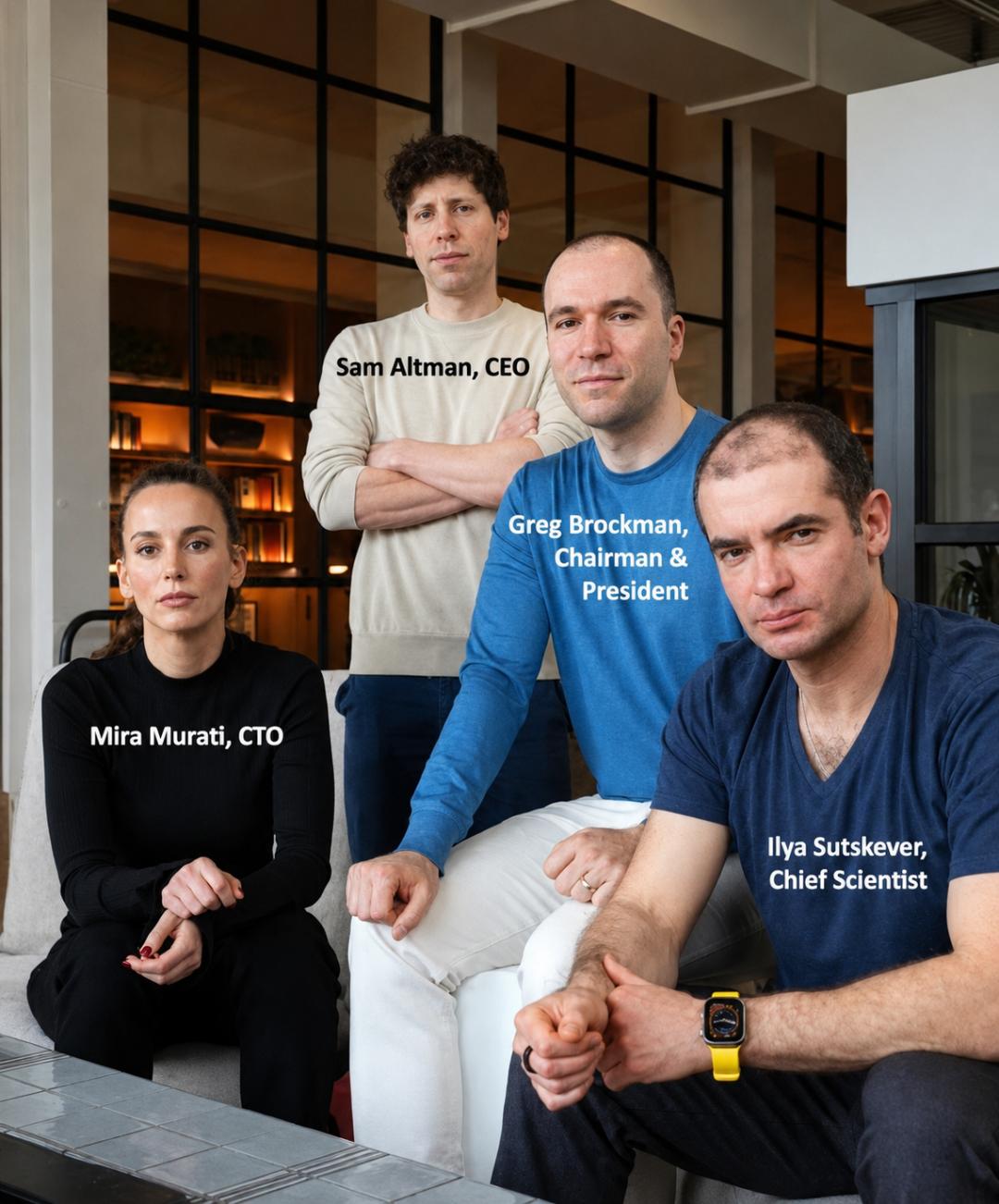
Greg Brockman, President of OpenAI, even stated directly: Looking back a few years later, today is the starting point of the AGI era.
GPT-6 Astra is launched, aiming to let AI take over software operations
The biggest change of GPT-6 Astra is its Computer Use capability.
Although large models in the past could generate code, summarize materials and answer questions, there were still obvious limitations when they actually entered the real software environment to perform tasks. Tasks such as browsing web pages, filling out forms, operating office software and handling complex processes required a lot of manual intervention.
Astra tries to change this situation.
OpenAI claims that Astra is currently the strongest computer operation model, which can complete filling in online forms, updating CRM data, organizing schedules, conducting online research, and generating content in emails and document editors. It can also analyze scientific data, generate charts, create websites, and automatically run front-end quality tests.

In the official demo, Astra demonstrated multiple creative scenarios close to real work.
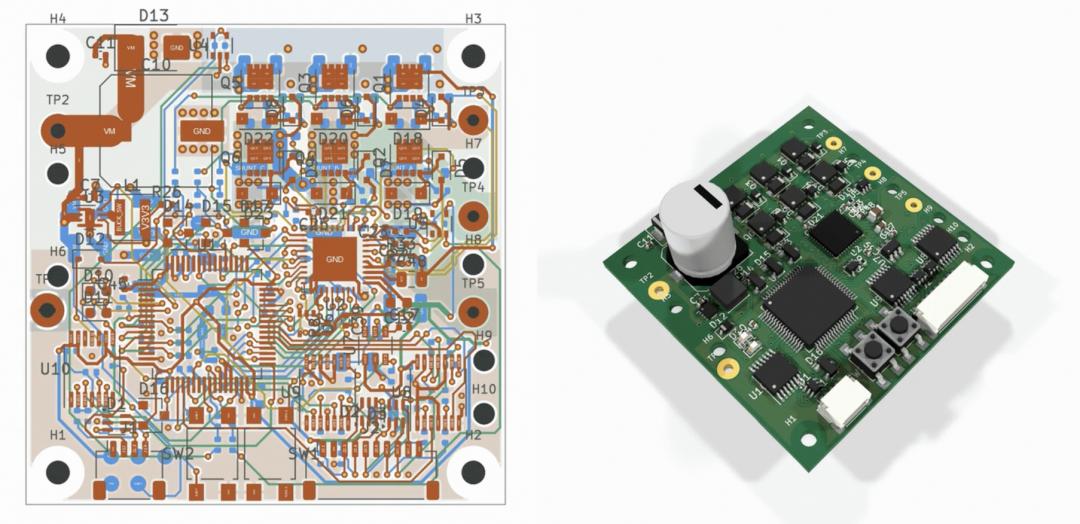
It can use KiCad to complete PCB design, convert electronic schematics into manufacturable circuit board layouts; operate office tools such as Excel and Power BI; use Blender to create 3D models, and further convert them into interactive and browsable spaces in Unreal Engine 5.
In addition, we can also let Astra build a complete house model starting from the design drawing: the model first completes 3D modeling in Blender, then automatically imports Unreal Engine 5 to generate an interactive scene that can be explored freely.

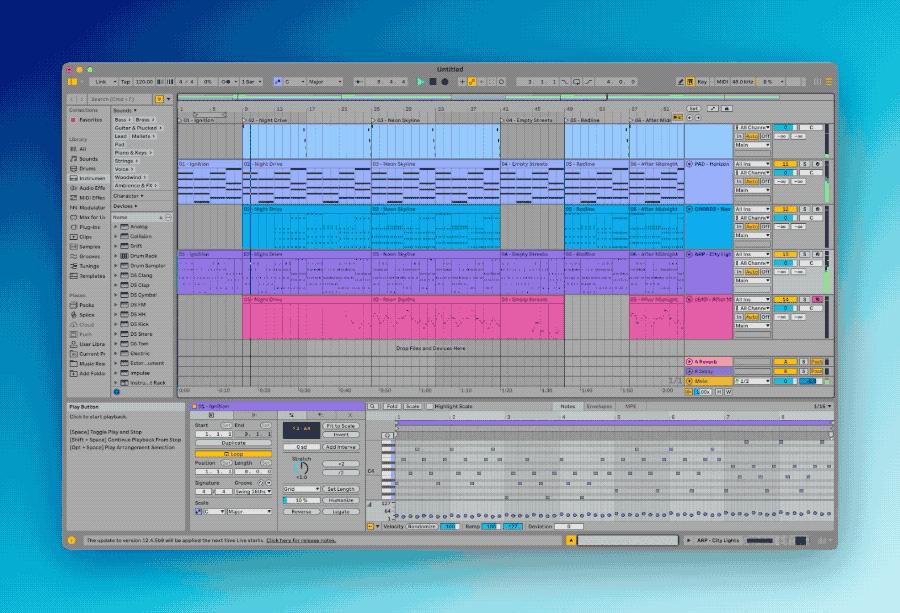
Even another user can connect Ableton through MCP to let Astra create complete music from scratch, including timbre design, instrument arrangement and mixing process.
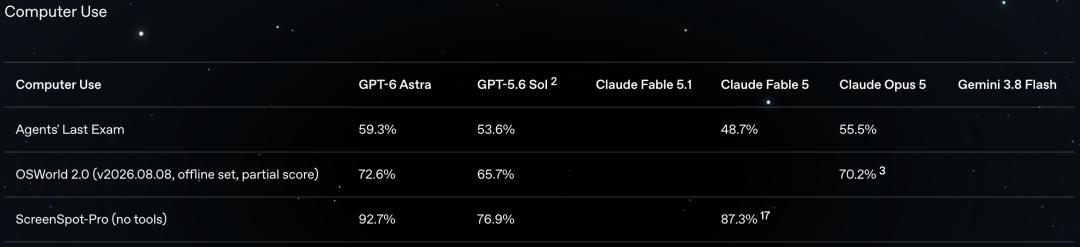
Benchmark test results also show that Astra's Computer Use capability has been significantly improved.
In the OSWorld 2.0 test, GPT-6 Astra scored 72.6%, higher than 65.7% of GPT-5.6 Sol. In the Agents' Last Exam test, Astra scored 59.3%, higher than 55.5% of Claude Opus 5 and 53.6% of GPT-5.6 Sol.
In addition, OpenAI also upgraded the Codex harness synchronously.
In the past, one of the biggest problems with AI programming Agents was that they easily lost context during long-running tasks. In a large-scale development task that lasts for several hours, the model may forget why a certain piece of code was modified before, or miss the restrictions put forward by users in the early stage.
Astra introduces a new context management method.
OpenAI stated that Codex no longer relies solely on compression and summarization to save history. Instead, it can save notes across context windows, and search for previous messages and tool outputs to find previous requirements, test results and modification records.
At the same time, Astra can continue to advance tasks that do not depend on this information while waiting for user replies. If the problem will affect the final result, the model will wait for user confirmation; if the impact is small, it will continue to execute based on reasonable assumptions.
In short, in the past, people paid more attention to whether the model could give accurate answers; next, what will truly widen the gap will be whether it can independently complete a complete work.
Code, mathematics and science become the new battlefield for GPT-6 Astra
OpenAI hopes that Astra is not just an efficiency tool, but can enter the core workflow of enterprises.
Among them, software engineering is one of the most fiercely competitive fields.
OpenAI calls Astra the strongest software engineering model at present.
In the Terminal-Bench 4.0 test that examines terminal environment performance, Astra scored 57.7%, significantly higher than 37.3% of GPT-5.6 Sol, and the estimated API cost per task is lower than that of Sol and Claude Fable 5.1. In the DeepSWE v1.1 test, Astra scored 74.1%.
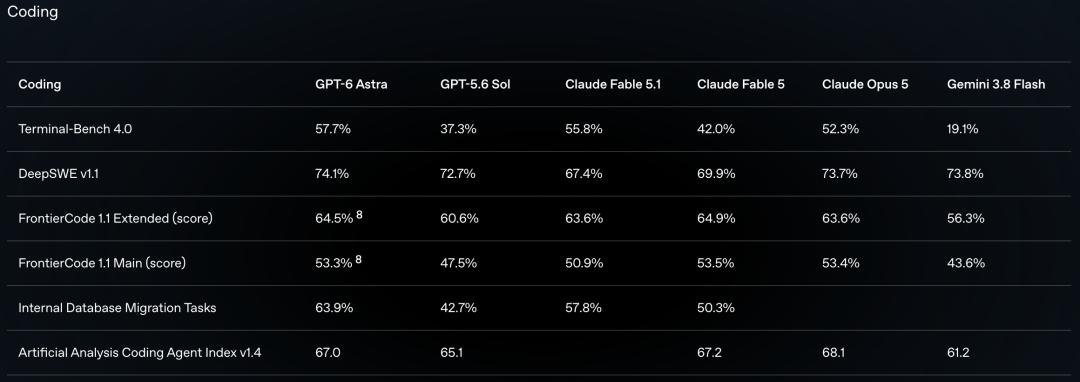
What OpenAI emphasizes more is Astra's performance in complex real development environments.
Partner Jane Street stated that in Agent programming scenarios, Astra is easier for developers to understand, and the generated code requires fewer iterations to reach production quality.
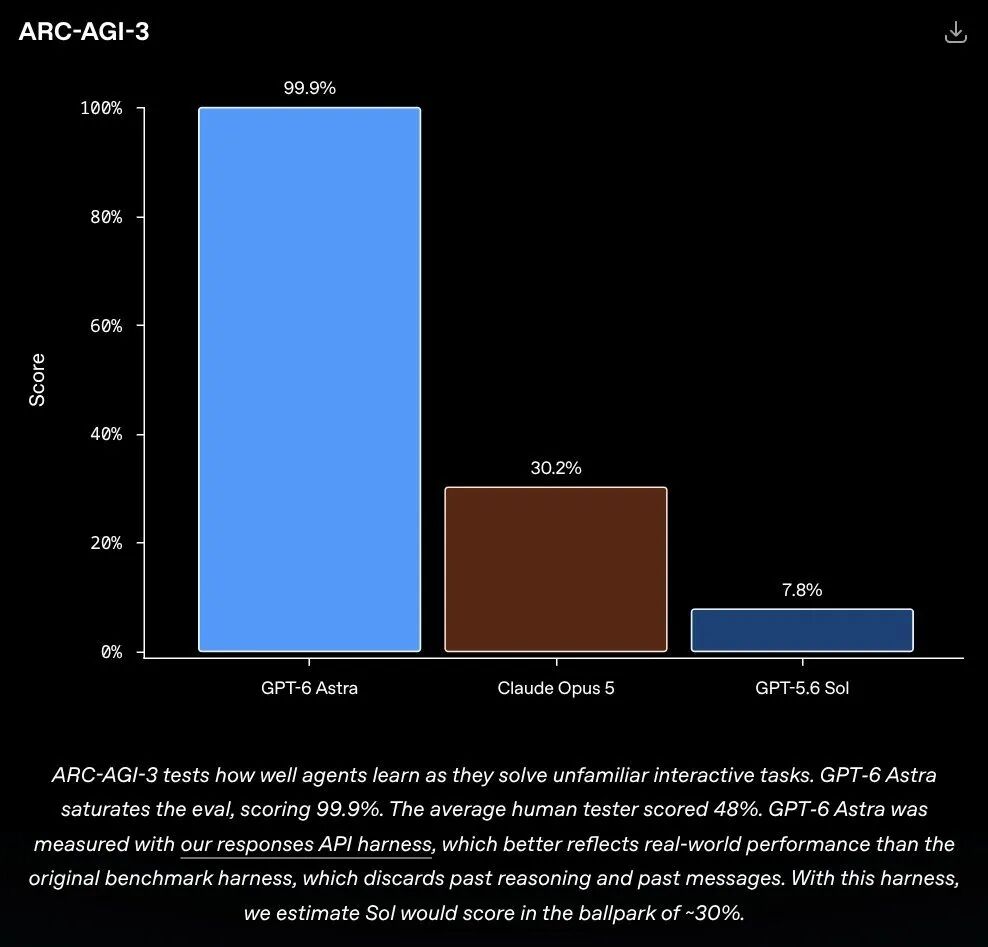
The score of ARC-AGI-3 reaches 99.9%
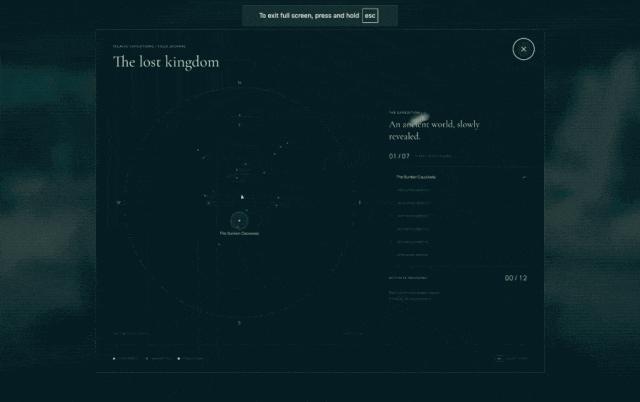
AI creator Pietro Schirano demonstrated the process of Astra generating 3D models and animations from pictures, and creating a complete underwater exploration game with a single target instruction, which includes 3D elements, sound and interactive gameplay.
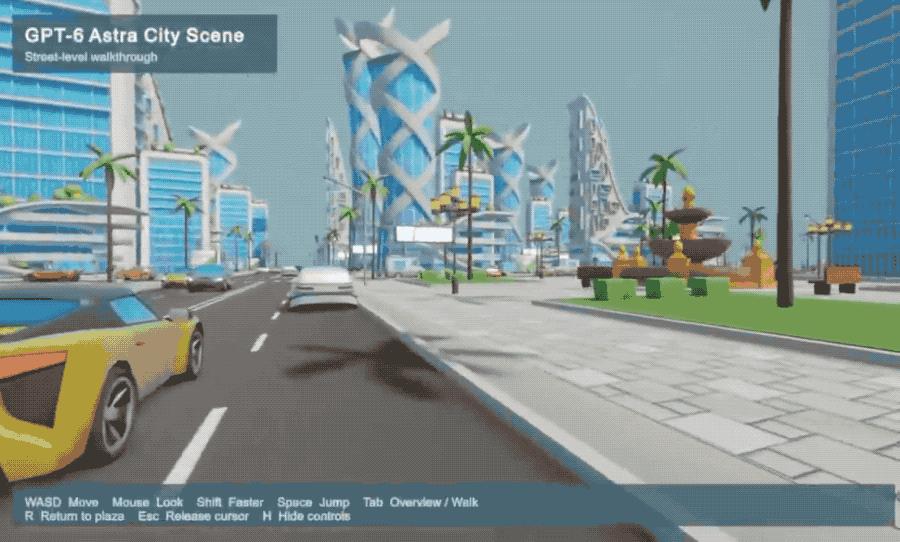
Another user Chris said that Astra's performance in the Unity environment has been significantly improved compared with previous versions, and it can directly use existing resources to assemble city scenes, generating content that is closer to the real game development process.
Scientific research is another key area where Astra demonstrates its capabilities.
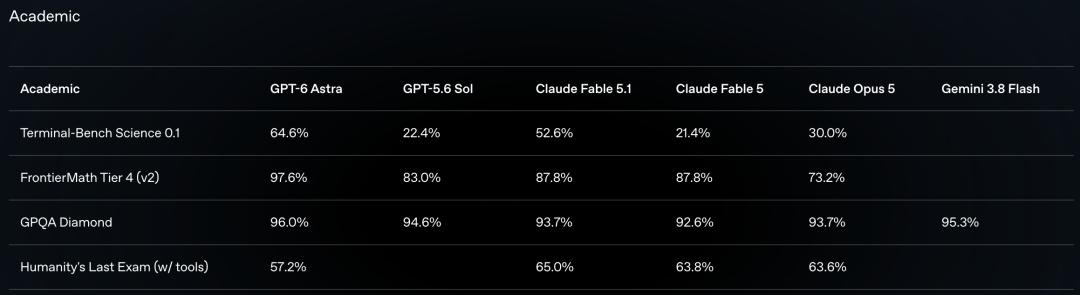
OpenAI stated that Astra achieved a score of 97.6% in the FrontierMath Tier 4 test and 96.0% in the GPQA Diamond scientific reasoning test.
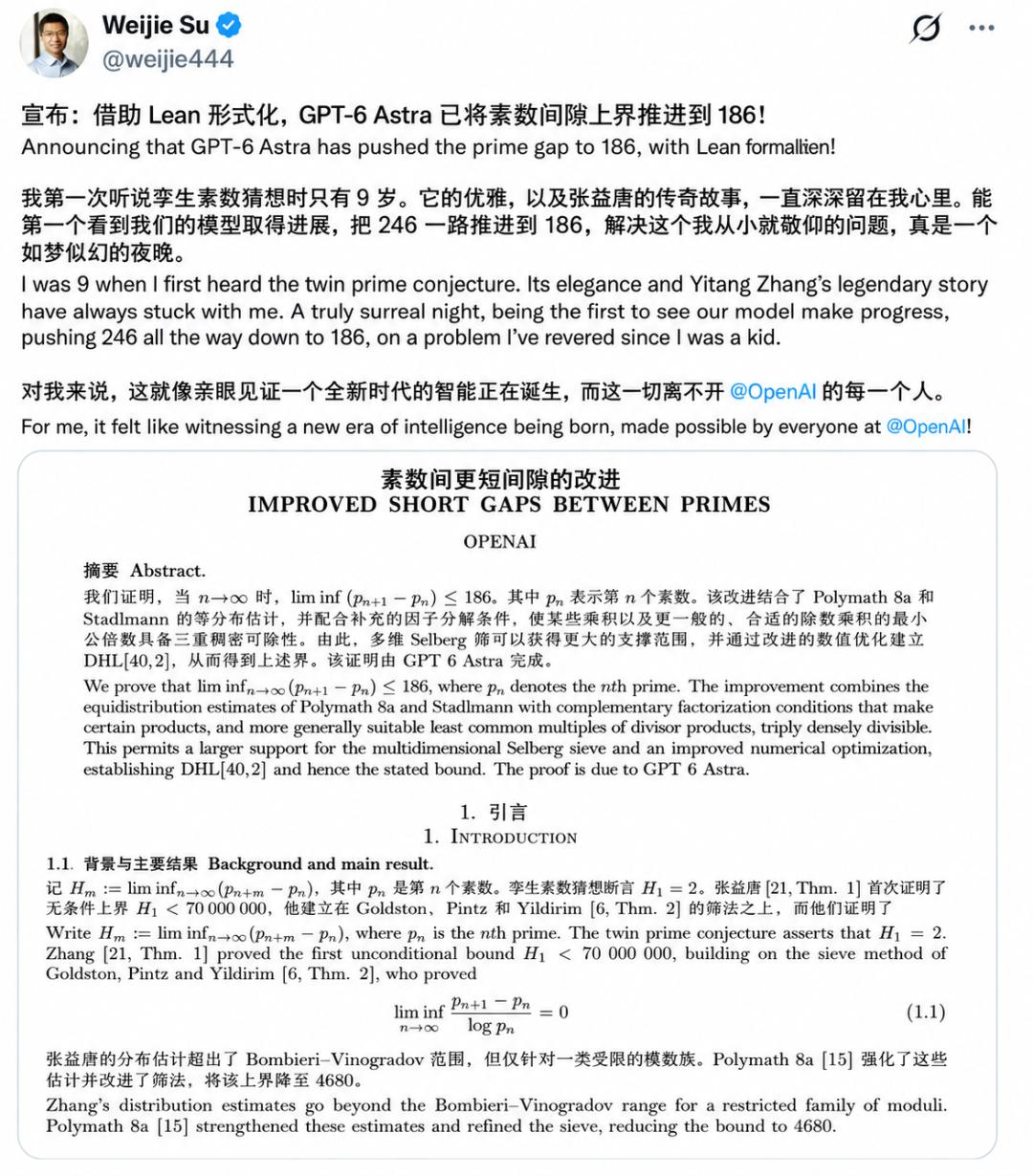
This new model also participates in mathematical research. OpenAI stated that Astra has helped advance the research on the prime gap problem, and one of its results has further narrowed the known upper bound of the distance between infinitely many pairs of prime numbers.
In the actual scientific research process, Astra not only answers scientific questions, but can directly enter the professional software environment to analyze data. For example, it can check gene sequencing quality, analyze genetic changes, and help researchers determine the next research direction.
However, Astra's most high-profile capability also brings the biggest security controversy.
OpenAI stated that Astra has reached the "key cybersecurity capability threshold" in its Preparedness Framework.
In the ExploitBench test, Astra achieved a 100% score, higher than 78.5% of GPT-5.6 Sol; in the ExploitGym test, Astra's success rate reached 42.4%, higher than 30.3% of Sol.
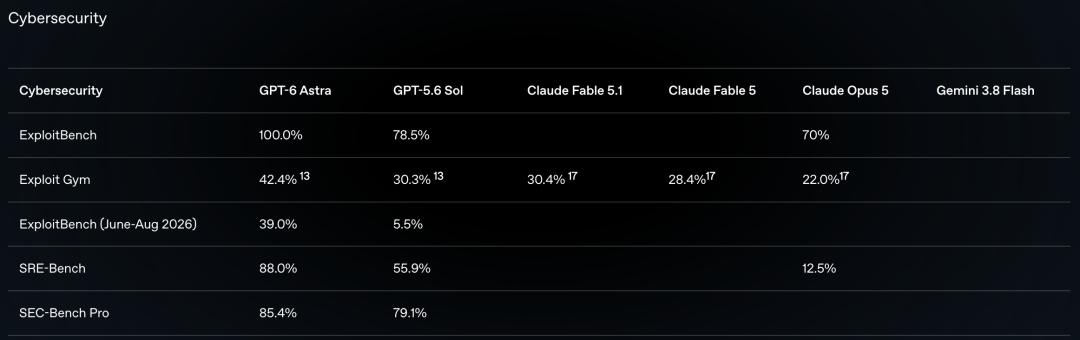
Further tests show that Astra discovered and exploited two previously unknown zero-day vulnerabilities in recent vulnerability tests, and OpenAI said it has disclosed them to relevant maintainers.
The same model can not only help enterprises discover vulnerabilities and fix code, but also may be used to attack systems. Therefore, OpenAI has adopted a stricter hierarchical strategy for Astra's access.
The regular user version will reject some advanced cybersecurity requests, while audited security teams can get more open access permissions through the Daybreak project.
The era of great division of labor between humans and AI
After the release of GPT-6 Astra, AGI has once again become the focus of industry discussions.
OpenAI has not officially announced that AGI has been achieved, but Greg Brockman's statement is significantly more positive.
He believes that people in the future may regard Astra as an important starting point of the AGI era, and at the same time point out that AGI is more like a "mission concept" rather than a technical indicator that can be simply defined.
"If we look back a few years later on when AGI was truly created, I think it might be right now, it might be this model," Brockman said.
During the release of Astra, OpenAI also