AI giants have once again launched a new round of fierce competition among themselves, with Google and Meta taking action at the same time, and the highly-anticipated Gemini 3.8 and Muse Spark 1.3 have been grandly released.
The past couple of days have seen a bustling AI industry, with a wave of intensive updates hitting the large language model market.
On September 1, Anthropic just released Claude Fable 5.1 and Claude Mythos 5.1, which are optimized for coding, knowledge work and long-duration Agent tasks. Shortly afterwards, Google and Meta also launched new models at almost the same time: Google rolled out Gemini 3.8 Flash and Gemini 3.8 Flash Cyber, while Meta released Muse Spark 1.3.
In just a few days, three leading AI companies have successively launched new products, all focusing on coding, Agent and complex task execution by coincidence. The competition of large language models is no longer simply about "whose answer is smarter", but further shifting to competing for the ability to actually get things done.
Only three weeks later, Gemini 3.8 Flash is here
Looking back, the release of the Gemini 3.7 Flash version was only three weeks ago.
Now Google has accelerated the pace of model version iteration, and newly launched Gemini 3.8 Flash and Gemini 3.8 Flash Cyber. According to the official statement, this is the smartest Flash model so far, with key improvements in software engineering, Agent tasks and multi-step reasoning capabilities.
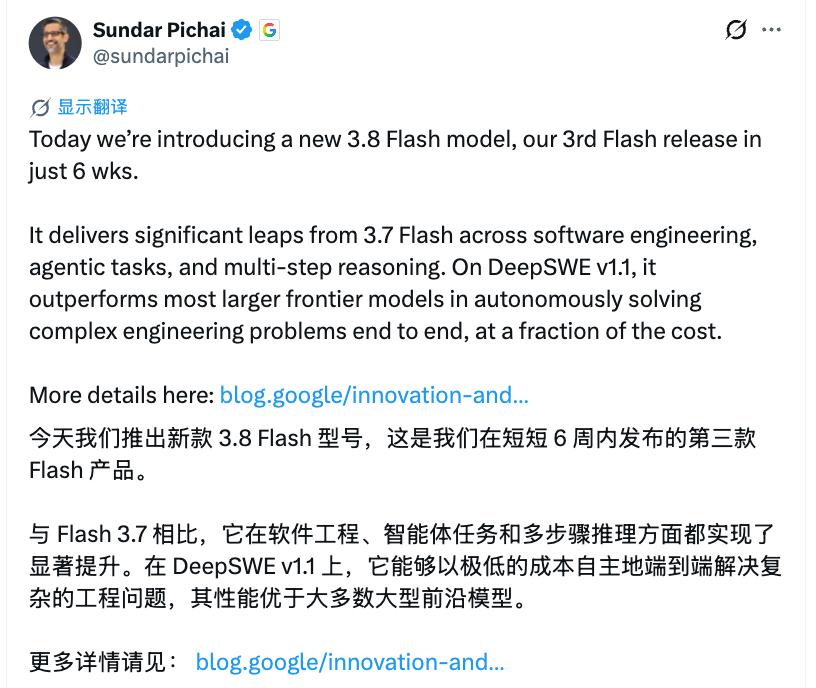
Among them, the biggest feature of Gemini 3.8 Flash is that while maintaining the speed and cost advantages of the Flash series, it starts to move closer to models with higher capabilities.
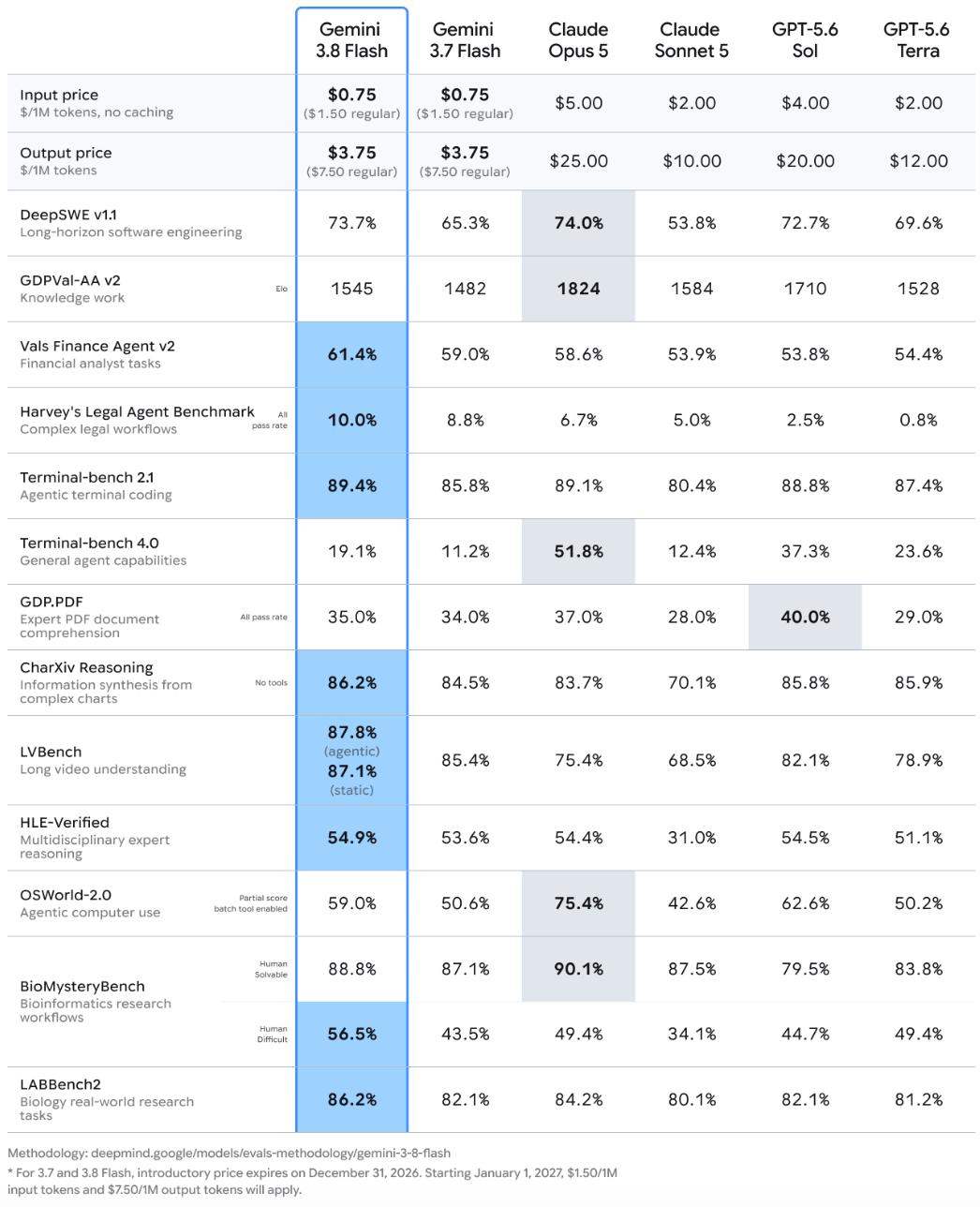
It supports 1 million tokens of context, with an input price of $0.75 per million tokens and an output price of $3.75 per million tokens. The model also supports three levels of thinking intensity: low, medium and high, which can be adjusted between performance, latency and cost.
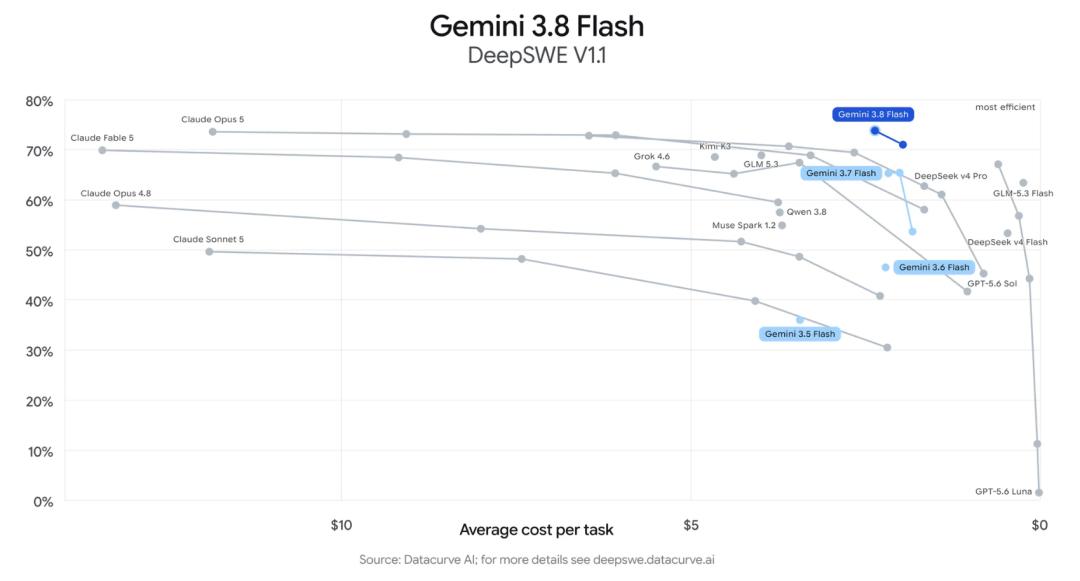
In the DeepSWE v1.1 long-horizon software engineering test, data released by Google itself shows that Gemini 3.8 Flash can handle complex engineering problems independently.
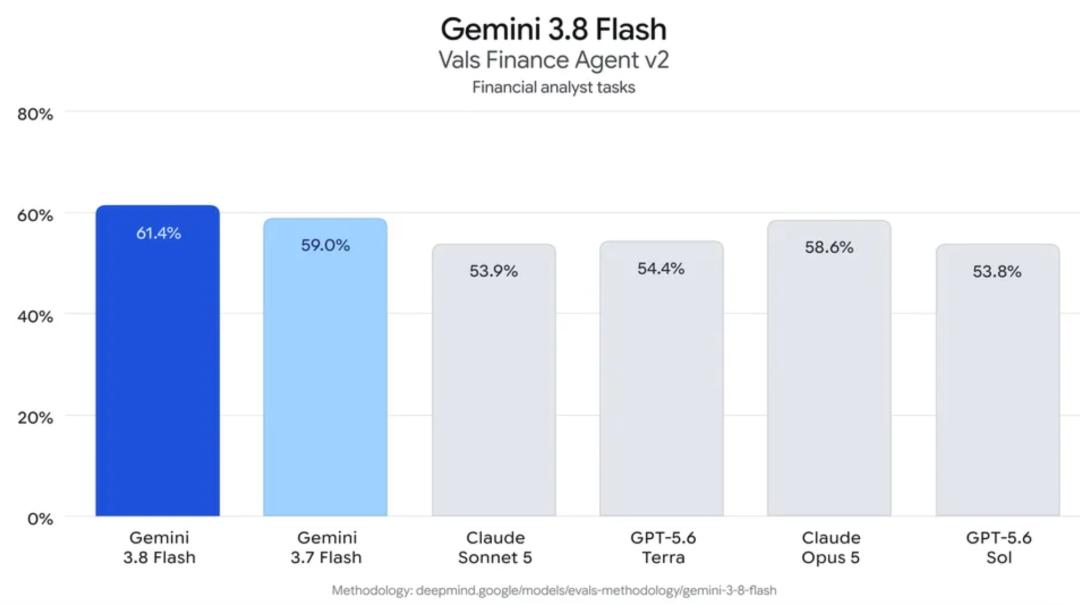
It also outperforms the previous generation in professional Agent tests such as Vals Finance Agent V2 and Harvey’s Legal Agent Benchmark. Its HLE-Verified score reaches 54.9%, which proves its ability to handle multi-step reasoning in STEM, humanities and professional fields.
Third-party tests have also yielded positive results.
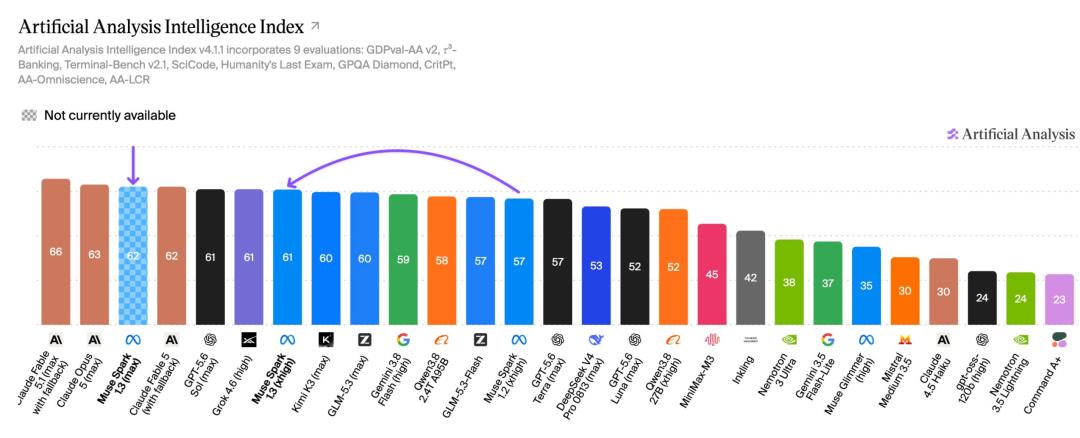
Tests from Artificial Analysis show that Gemini 3.8 Flash scores 59 at the highest reasoning intensity, 3 points higher than the 56 points of Gemini 3.7 Flash; it scores 57 at medium reasoning intensity and 52 at low reasoning intensity.
This is only slightly behind Anthropic's GPT-5.6 Sol and SpaceXAI's Grok 4.6.
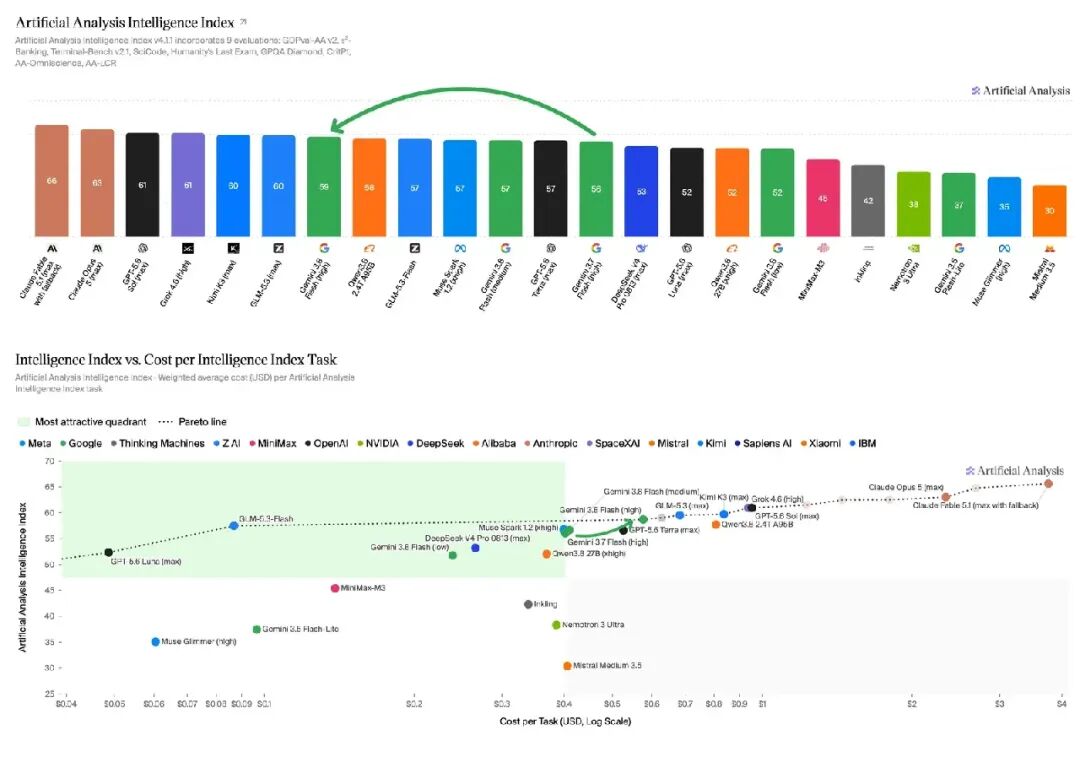
However, Google is also very frank: 3.8 Flash will "think more".
When dealing with complex tasks, this model will perform more meticulously, increase reasoning steps, and call tools repeatedly. Sometimes, in order to maximize task performance as much as possible, the model will consume more tokens, especially at higher reasoning intensity.
Google gives the following suggestion: For application scenarios where computing power efficiency is the top priority, developers can choose a lower reasoning intensity to reduce token overhead; or they can continue to use Gemini 3.7 Flash. The latter is still fully supported and is suitable for workloads that place more emphasis on efficiency and cost.
Gemini 3.8 Flash Cyber: Google Separates Cybersecurity as a Standalone Capability
Released alongside Gemini 3.8 Flash is Gemini 3.8 Flash Cyber, which is also worthy of attention.
This version is not an "enhanced Gemini" for ordinary users, but is specially designed for cybersecurity defense. It is currently provided to a group of trusted defenders through Google's newly launched Fairwind Program.
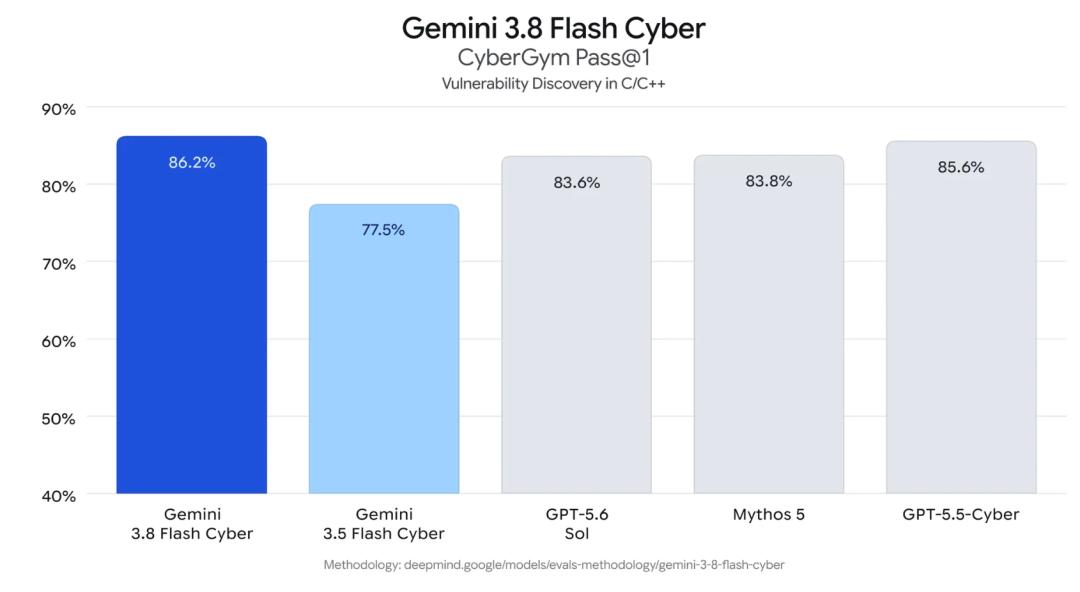
Google focused on testing two capabilities: vulnerability detection and automatic vulnerability remediation.
In CyberGym, the industry-standard benchmark for vulnerability detection, Gemini 3.8 Flash Cyber has reached the cutting-edge level, surpassing Gemini 3.5 Flash Cyber and even larger models.
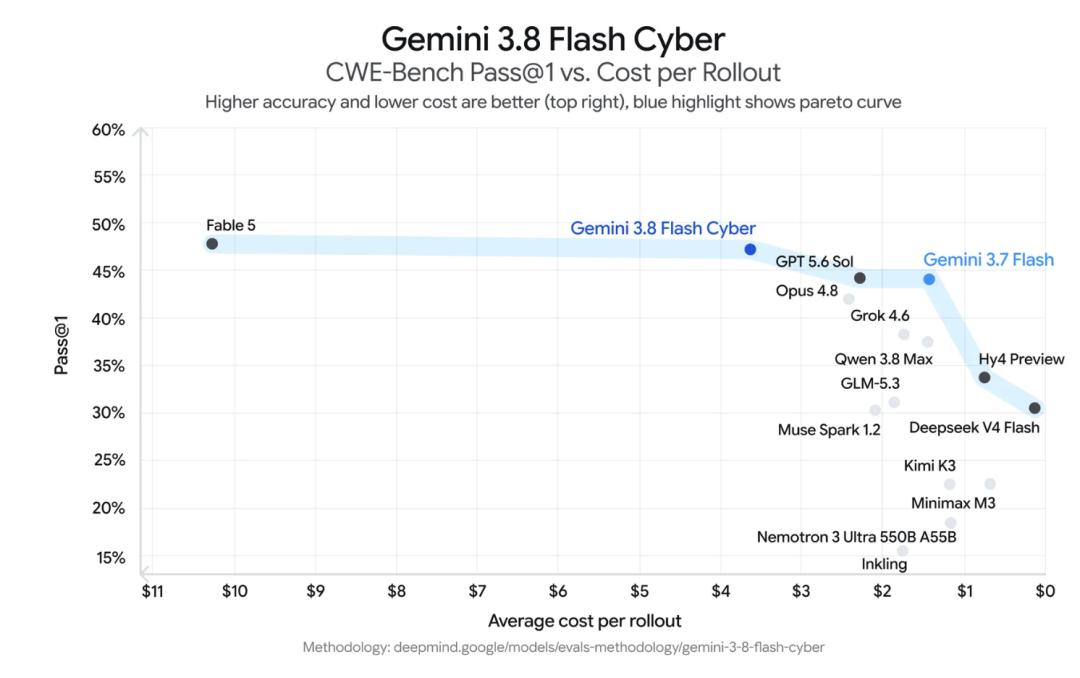
In the CWE-Bench vulnerability remediation test, the model achieves a pass@1 rate of 47.2%, which is very close to the 47.8% of the leading cutting-edge model, but Google emphasizes that its cost is significantly lower. A more straightforward example comes from actual usage: the Chrome security team found that the number of correct vulnerability patches generated by 3.8 Flash Cyber is 2.6 times the best result of larger commercial models.
Google also disclosed that the Cloud Vulnerability Research team used this model to discover a critical underlying vulnerability in less than 2 hours, while this type of vulnerability usually takes months of research to find.
Of course, this capability also means stricter access control. Google stated that Gemini 3.8 Flash has added security measures against cyberattacks and CBRN-related abuse, and the Cyber version is only open to trusted defenders because it needs to provide more complete cybersecurity capabilities.
Meta Muse Spark 1.3 Competes on the Same Stage, Alexandr Wang Jokes: "Who is Gemini?"
On the same day, Meta AI Research also launched Muse Spark 1.3, a new model upgraded in a short period of time after the release of Muse Spark 1.2 in August this year.
Alexandr Wang, the head of Meta AI who has always been keen to "endorse" his own models, did not forget to joke after the new model was released, and directly asked on the social platform: "I really don't want to say this, but... who is Gemini?"
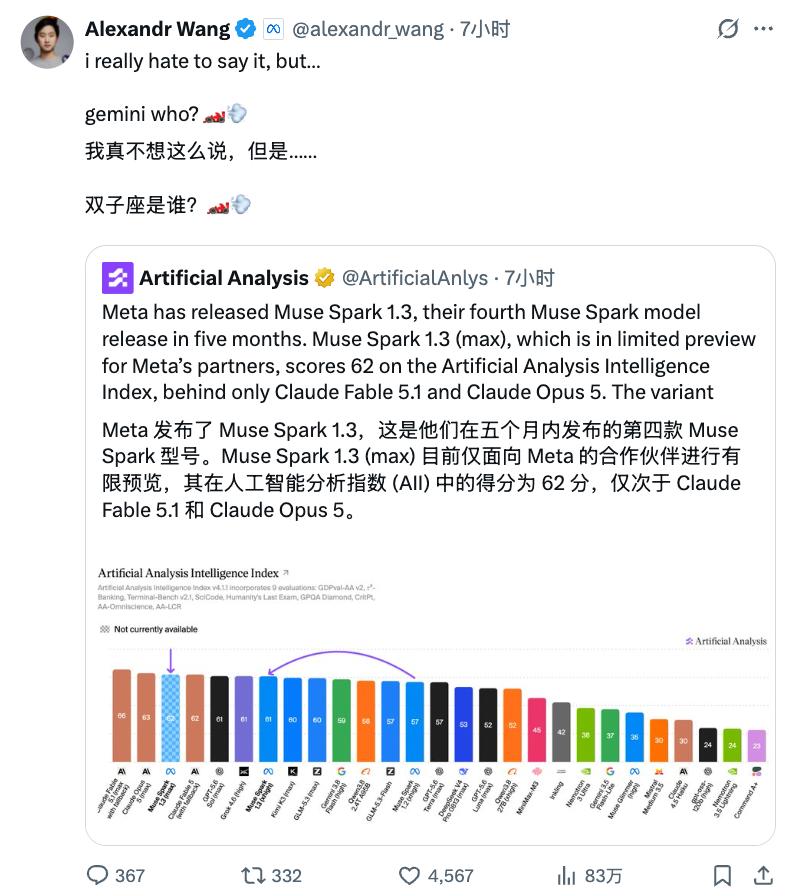
Compared with the more obvious model upgrades previously made by Google and Anthropic, Meta has not changed the positioning of Muse Spark this time, but continued to increase its focus on Agent and programming capabilities.
According to the official statement, Muse Spark 1.3 has significantly improved the performance of Agentic tasks and programming tasks, and has carried out a large number of optimizations for real usage scenarios, so that the model not only performs better in tests, but also handles complex tasks requiring multi-step execution more stably.
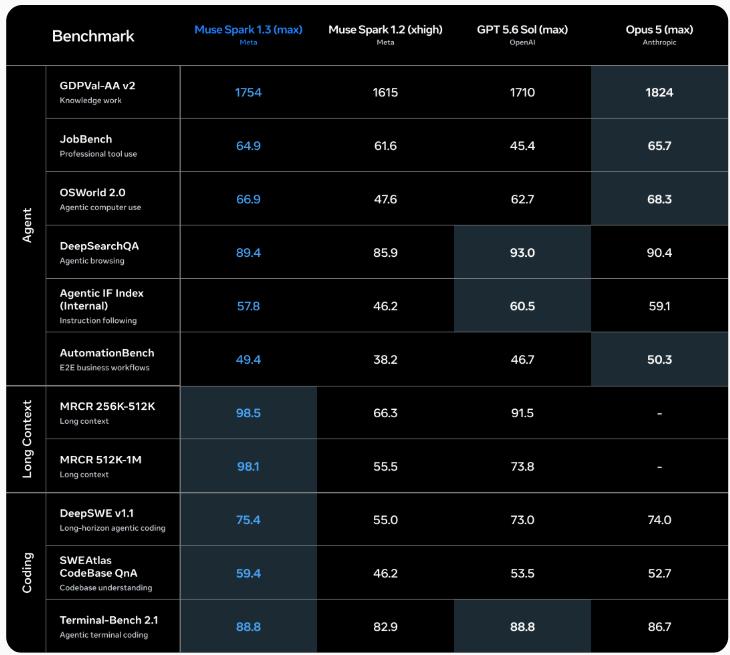
In detail, Muse Spark 1.3 is optimized for Agent and coding tasks, and can handle multiple workflows simultaneously in a long conversation thread. Faced with open-ended tasks, it can use tools to collect context, discover gaps in the plan and take the initiative to make corrections, while remembering the information it has obtained during the task.
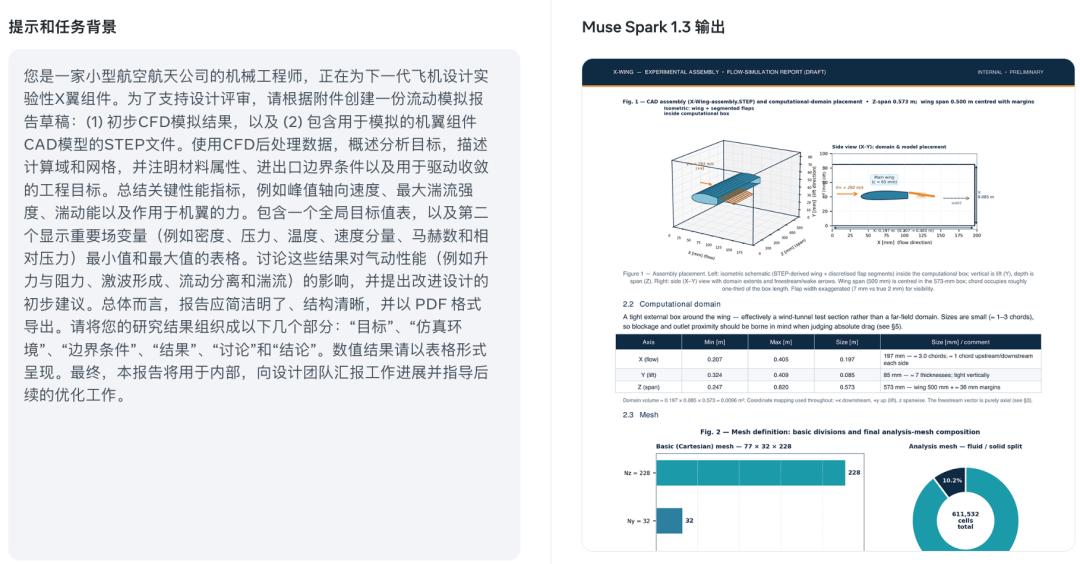
This capability is especially important in practical work. For example, if the user asks the model to produce an aeronautical engineering report based on CFD simulation data and CAD files, Muse Spark 1.3 not only needs to read different types of inputs, but also extract simulation data, sort out performance indicators, generate tables, analyze aerodynamic performance, and finally output a PDF in accordance with the specified structure.
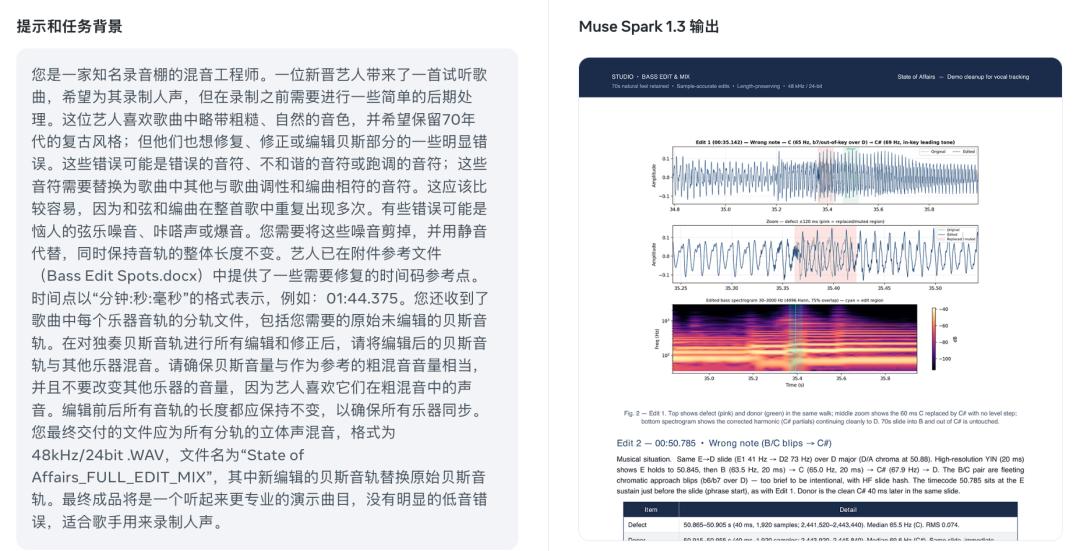
Another case demonstrated by Meta requires the model to handle audio engineering tasks, locate wrong notes, noises and pops in the bass track according to the time code, and then complete editing and mixing.
In terms of collaboration with users, Muse Spark 1.3 has also been optimized. Faced with ambiguous requirements, the model will take the initiative to ask for clarification; when encountering unsolvable problems during execution, it can also seek help from users, and confirm before performing important operations.
For long-duration tasks, it can also choose to continuously report progress according to the scenario, or minimize disturbances and complete the work in the background.
Programming is also the focus of this upgrade. Meta stated that Muse Spark 1.3 is optimized for long-cycle coding tasks and common software engineering workflows, reduces interaction rounds when unnecessary, and makes the code more concise at the same time.
According to tests by Meta engineers, in the same type of tasks, Muse Spark 1.3 reduces the number of tool calls by about 20% and token usage by about 25% compared with Muse Spark 1.2. This means that the new model does not simply rely on more reasoning and tool calls to complete tasks, but improves execution efficiency while reducing invalid operations.
In terms of security, Muse Spark 1.3 is also optimized for Agent and coding scenarios, including enhancing the ability to resist malicious input and Prompt Injection, improving the judgment of high-risk and irreversible operations, and pausing execution and requesting user confirmation when necessary.
At present, Muse Spark 1.3 has been launched on Muse Code and Meta Model API. The previously provided reasoning mode is now open, and the higher-intensity Max Reasoning mode will be launched after completing additional security tests.
For this new version, Alexandr Wang said that this upgrade is also part of Meta's continuous promotion of "Personal Agent", with the goal of enabling Agents to run for a long time in the future and complete tasks for users.
When Different Models Gather, What Really Matters is the "Ability to Get Work Done"
In fact, if you look at these models together, you will find a very obvious change.
This round of new products can hardly be simply summed up by "whose model is smarter".
Claude Fable 5.1 currently ranks first on the Artificial Analysis Comprehensive Intelligence Index with a score of 66. Its advantages focus on complex reasoning, coding and professional knowledge work, but it also consumes a large number of tokens at the highest intensity.
Gemini 3.8 Flash is more like a cost-effective "workhorse". It scores 59 at the highest reasoning intensity, and developers can also actively reduce the thinking intensity to further lower the cost of a single task.
Muse Spark 1.3 focuses on the execution efficiency of long tasks. It not only improves the capabilities of the model itself, but also tries to make the Agent call tools fewer times, consume fewer tokens, and better maintain context and execution constraints in complex tasks.
This is why model releases have become more and more frequent recently, but they are less and less like the simple "benchmark chasing" in the past.
Models have entered a new stage of competition: they not only need to give correct answers, but also be able to work continuously; they not only need to write code, but also run, test and modify it on their own; they not only need to complete tasks, but also control the token and time cost of task completion.
From this perspective, although these new products from Anthropic, Google and Meta are moving in different directions, they are all targeting the same problem — when large language models are no longer just chatbots, but start to actually perform tasks for users, who can make them work longer, more stably, faster, and at an