2026, the first year of mass production, sees humanoid robots starting to "go to work".
If you have been following the embodied intelligence industry, you must have sensed that 2026 is truly a year unlike any other.
On September 1, a batch of national standards for robot intelligent control including GB/T 47245—2026 General Architecture of Robot Intelligent Control System were officially implemented.
On the same day, the National Development and Reform Commission stated at a press conference that it would support small and medium-sized robotics enterprises to cross the verification threshold "from prototype to mass production".
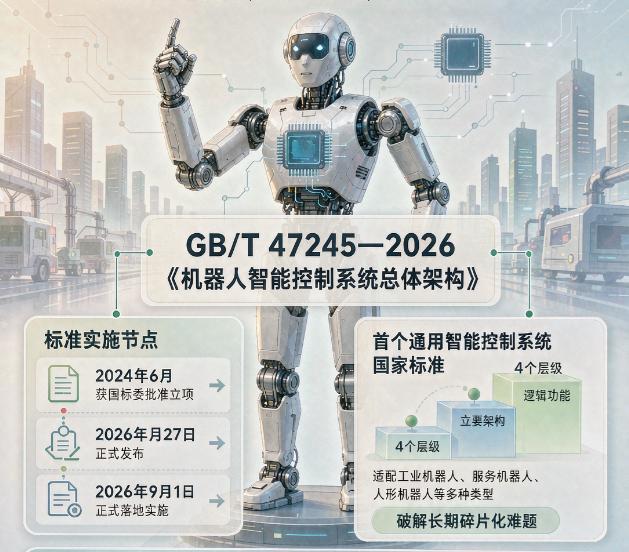
General Architecture of Robot Intelligent Control System is the first national standard for general-purpose intelligent control systems in China's robotics sector. The standard was approved for establishment by the Standardization Administration of China in June 2024, officially released on February 27, 2026, and came into effect on September 1, 2026. It specifically stipulates the logical architecture and core functions of the intelligent control system at four levels, which can be widely adapted to various types of robots such as industrial robots, service robots, and humanoid robots, solving the long-term fragmentation problem of control systems from the source.
The Industry Landscape Has Shifted
Two years ago, at the World Robot Conference (WRC), humanoid robots capable of backflips were surrounded by huge crowds. Robots playing the piano and dancing were the biggest attractions, with audiences holding up their phones to take videos, share them on social media, and exclaim "That's so cool".
At the WRC in August this year, the landscape changed. On the exhibition booths, robots no longer performed somersaults. They were screwing bolts, sorting parcels, and inspecting electrical control cabinets on simulated production lines. The questions from the audiences also became different — "How long can this machine operate stably?" "Does it have a high error rate?"
Wang Xingxing, founder of Unitree Robotics, previously made a judgment: Robots have been deployed in factories for several years but have not been widely promoted, the core reason being that their work efficiency is lower than that of human workers, and their generalization capability is insufficient. This statement has proven to be true now.
However, data also tells a clear story. In the first half of 2026, the shipment volume of humanoid robots in China exceeded 40,000 units, accounting for 97% of the global total. The full-year output of complete robots is expected to exceed 100,000 units.
The jump from thousands of units to the 100,000-unit level is not a gradual change, but a sudden leap.
In addition, this year's WRC launched the "Procurement Day" for the first time. 49 central state-owned enterprises came with demands from 12 real scenarios including power grid, aerospace, mining and metallurgy to place orders. The demand-side parties are now in the central position, which sends a very clear signal.
Policies Are Paving the Way, and Capital Is Making Bets
The industry cannot achieve rapid growth relying solely on the efforts of enterprises themselves.
In June this year, the Ministry of Industry and Information Technology and the State-owned Assets Supervision and Administration Commission jointly launched the "Special Action for Real-scenario Practical Training of Humanoid Robots and Embodied Intelligence", covering 10 provinces and municipalities. The goal is very specific: to identify more than 100 high-value application scenarios by the end of the year, and drive the implementation capacity at the scale of 10,000 units.
Shortly afterwards in August, the Ministry of Industry and Information Technology released the draft for comments on the construction guide for the humanoid robot industry standard system, clarifying that at least 100 key standards will be formulated by 2028.
Some experts call this approach "formulating standards while developing, and promoting standardization through development". Let robots run in real scenarios first to expose problems and accumulate data, then solidify the experience into standards. This logic is very pragmatic. To put it simply: do not wait until everything is planned before taking action, and make specifications while advancing the work.
The industrial side is also accelerating its pace. On August 25, BYD signed a strategic cooperation agreement with tactile perception enterprise Pansini to promote the implementation of robots in industrial manufacturing scenarios. BYD's first self-developed humanoid robot "Xiao Di" also made its debut at the World Robot Conference, and the first batch of units will be deployed in its own production lines to complete handling and quality inspection work.
The capital side is mainly reflected in the valuation reshaping of leading enterprises. For example, XPeng's humanoid robot business completed its first round of financing, raising more than 900 million US dollars, with a post-investment valuation of 6.3 billion US dollars, setting a new record for the single-round private equity financing of embodied intelligence projects in China. Unitree Robotics was listed on the Sci-Tech Innovation Board of the Shanghai Stock Exchange in August, with its opening market value once reaching 444.9 billion yuan. The total financing amount of the track in the first half of the year was 93.5 billion yuan, a year-on-year increase of nearly 5 times.
Capital is pouring in, talents are entering the sector, and standards are being refined. The superposition of these signals makes it hard to argue that this is just a concept hype.
Mass Production Is Not as Simple as It Seems
Of course, for all the excitement, there are still plenty of difficulties to tackle.
Joint modules account for nearly half of the total cost of a complete humanoid robot. Although the localization rate has exceeded 85% at present, to expand production from the 10,000-unit level to the million-unit level, the manufacturing process of components still needs major upgrades. Some enterprises stated that the assembly of a single joint currently requires tightening dozens of bolts, which is an overly complicated process. There are still many barriers between mass production figures and commercialization capabilities.
Zhou Jian, founder of UBTECH, once said a very practical remark: The order volume of over 13,000 units for the U1 series is certainly impressive, but "the difficulty of such mass production is rare in the history of human manufacturing". The U1 Pro is equipped with 88 high-precision degrees-of-freedom joints all over its body, and its head part alone has 2000 to 3000 components. No mistakes are allowed in any of the links including capacity ramp-up, yield rate control, and delivery consistency.
Some industry insiders put it more bluntly: A signed order does not equal delivery, delivery does not equal stable operation, and stable operation does not equal repurchase from customers.
With Capital and Standards in Place, Next We Will See Who Can Truly Deliver Practical Value
Looking back at the timeline of 2026 — the national standard took effect on September 1. The draft for comments on the standard system construction guide was released. The special action for real-scenario practical training was launched. The first Procurement Day was held at the World Robot Conference. Players from all sectors including BYD, XPeng and Unitree took intensive actions.
China Commerce Industry Research Institute predicts that the shipment volume of humanoid robots in China will reach about 38,000 units this year, with a market size of about 34 billion yuan. It is expected to reach 380,000 units and exceed 200 billion yuan by 2030. The market size of the broad-sense embodied intelligence sector is expected to exceed 1 trillion yuan this year.
Whether these figures can be realized is another matter, but the direction is very clear — the industry is shifting from showing demos to investors to delivering functional equipment to customers.
The National Development and Reform Commission also issued a reminder: it is necessary to prevent blind following and mindless swarm investment. This warning is very applicable to any fast-heating industrial track.
2026 is known in the industry as the first year of humanoid robot mass production. Whether the sector can maintain steady development and go far after this starting year does not depend on who makes the most eye-catching promotional videos, but on whose robots can complete work well and sustainably in factories.
Capital is in place, standards are ready, and scenarios are open. Next, we will see who can truly deliver practical results.