Two minor metals have become critical bottlenecks restricting the development of the AI industry, and China dominates the corresponding supply chain.
Apart from electricity, amid this wave of AI data center capacity expansion, two other natural advantages of China have also been noticed by overseas players.
Recently, IEEE has pointed out two names that have rarely been paid attention to by the market before —
Erbium (Er) and Yttrium (Y).
One of them is hidden in the long-distance optical communication networks between data centers, and the other is hidden in the gas turbines that supply power to data centers, corresponding to the two most urgent issues for AI Infra at the moment:
Network and Power.
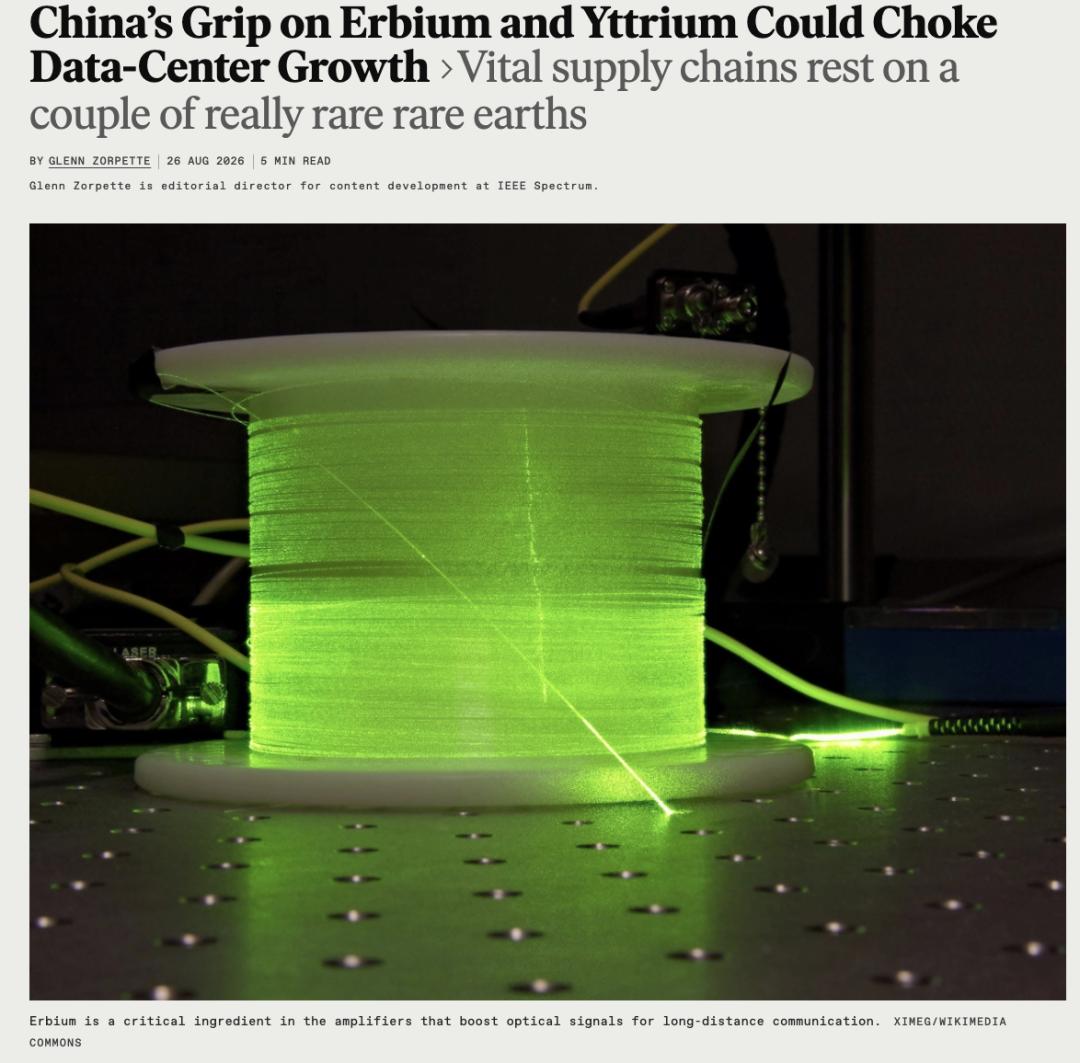
Simply put, erbium is responsible for making data travel farther; yttrium is used in high-temperature materials for gas turbines, helping them operate stably at higher temperatures and improve power generation efficiency.
With the frantic expansion of AI data centers, these two applications have also become increasingly important.
On the one hand, computing power clusters are getting larger and larger, more and more computing power is deployed across parks and cities, and more high-speed, long-distance optical networks need to be built between data centers;
On the other hand, AI servers have pushed power demand all the way to hundreds of MW and even GW level, and the United States has set off a new wave of gas turbine orders to fill the new capacity of the power grid.
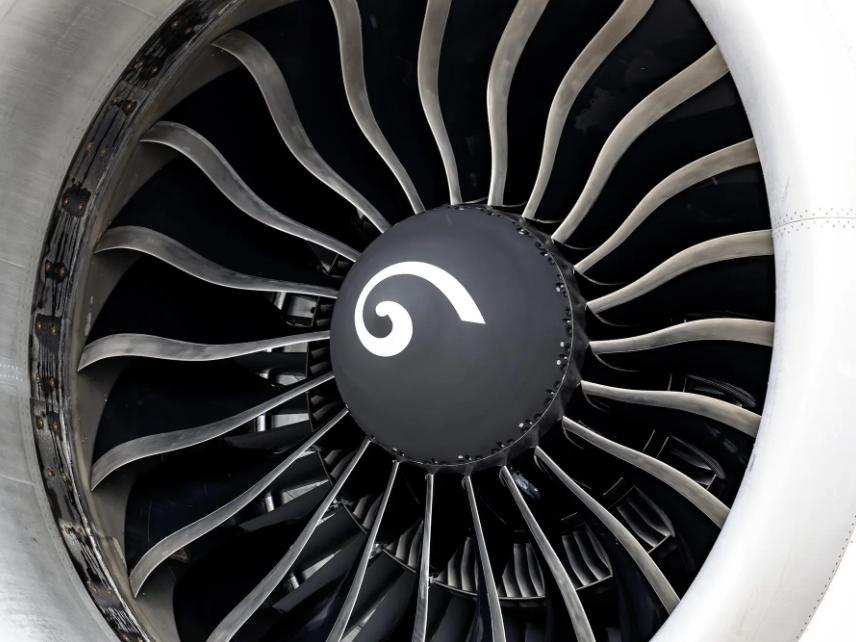
It can be said that as AI capital expenditure spreads from GPUs to optical networks and power systems, these two minor metals that were once hidden in the deepest part of the supply chain have also been brought back to the table.
More notably, according to IEEE reports, China accounts for almost 100% of the production of these two minor metals.
In other words, the dividends brought by the expansion of AI data centers at home and abroad may not only fall on the prominent links such as GPUs, optical modules and power equipment.
Dig further upstream in the supply chain, we still have cards in our hands.
So, how exactly do erbium and yttrium participate in the construction of AI data centers?
Next, we will look at them one by one.
Erbium, Let Light Travel One More Leg
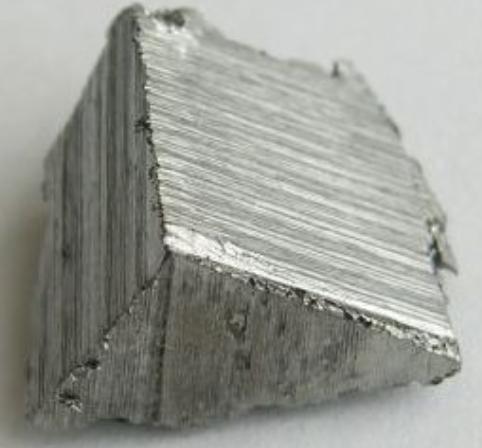
Erbium has the element symbol Er, atomic number 68, and belongs to the lanthanide heavy rare earths.
△
Its most direct connection with AI data centers lies in the long-distance optical fiber networks between data centers.
As we all know, today's data centers are far more complex than just filling a building with servers.
As the scale of a single AI cluster continues to expand, training, inference, and storage resources are scattered across different parks, even different cities and countries, and the volume of data exchange between data centers has skyrocketed accordingly.
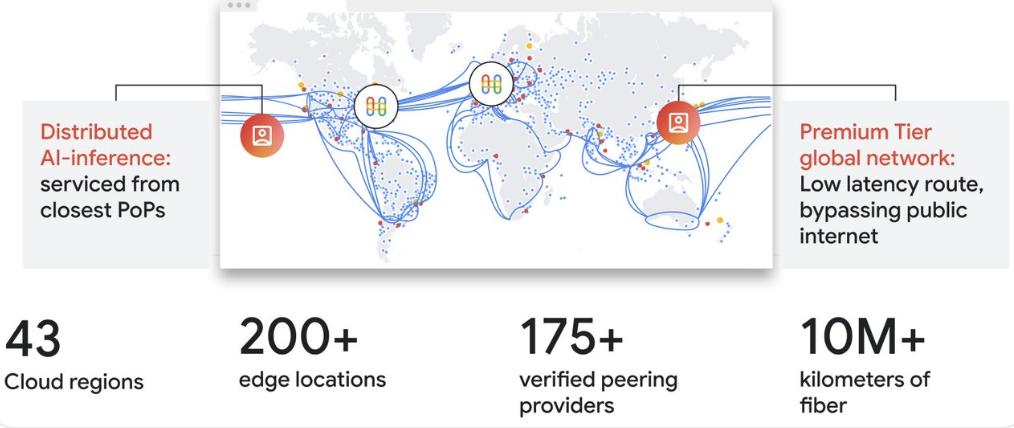
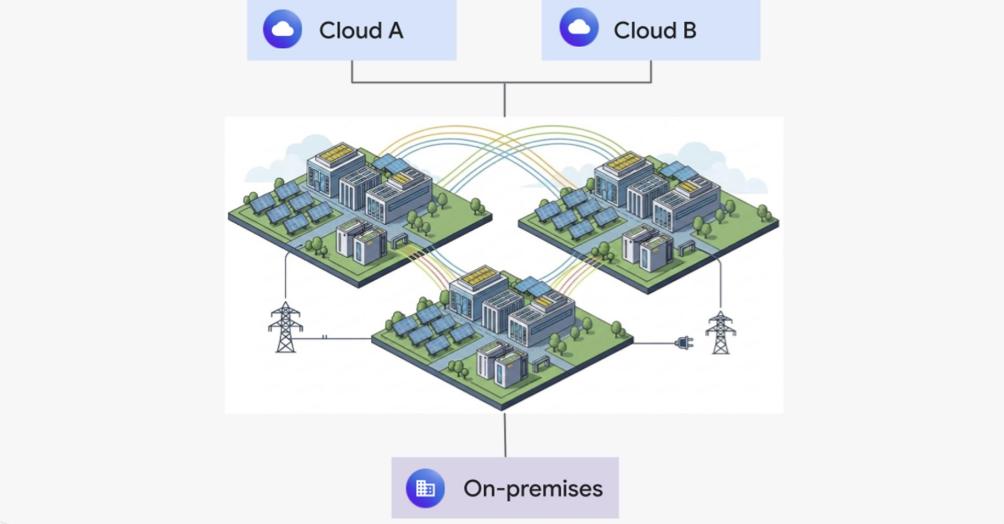
For example, Google has specially built a private wide area network connecting data centers around the world, using optical fibers spread across land and seabeds as the backbone.
This year, the total length of optical fibers on this network has exceeded 10 million kilometers, connecting 43 Google Cloud regions.
These optical fiber links that stretch for hundreds or thousands of miles have also brought up a very simple problem: The farther the light travels, the weaker the signal becomes.
To better understand the role of erbium here, let's insert an introduction to the principle of optical communication.
After leaving the computer room, data will be encoded into high-speed changing laser pulses, which travel along the optical fiber to the next node.
But the problem is that even though modern silica optical fibers have achieved very low loss, the signal will continue to attenuate as the transmission distance increases.
After the data signal is transmitted for tens or hundreds of kilometers, the signal needs to be amplified again.
Previously, the common practice was "optical-electrical-optical", that is, first convert the optical signal into an electrical signal, complete amplification and processing, and then convert it back to light for transmission.
But in modern DWDM (Dense Wavelength Division Multiplexing) optical networks, a single optical fiber can transmit dozens or even hundreds of signals of different wavelengths at the same time.
If each channel has to be converted to electricity, processed, and then converted back to light, not only the equipment is complex, but the cost and power consumption will also rise accordingly.
At this time, Erbium-Doped Fiber Amplifier, or EDFA for short, comes into play.
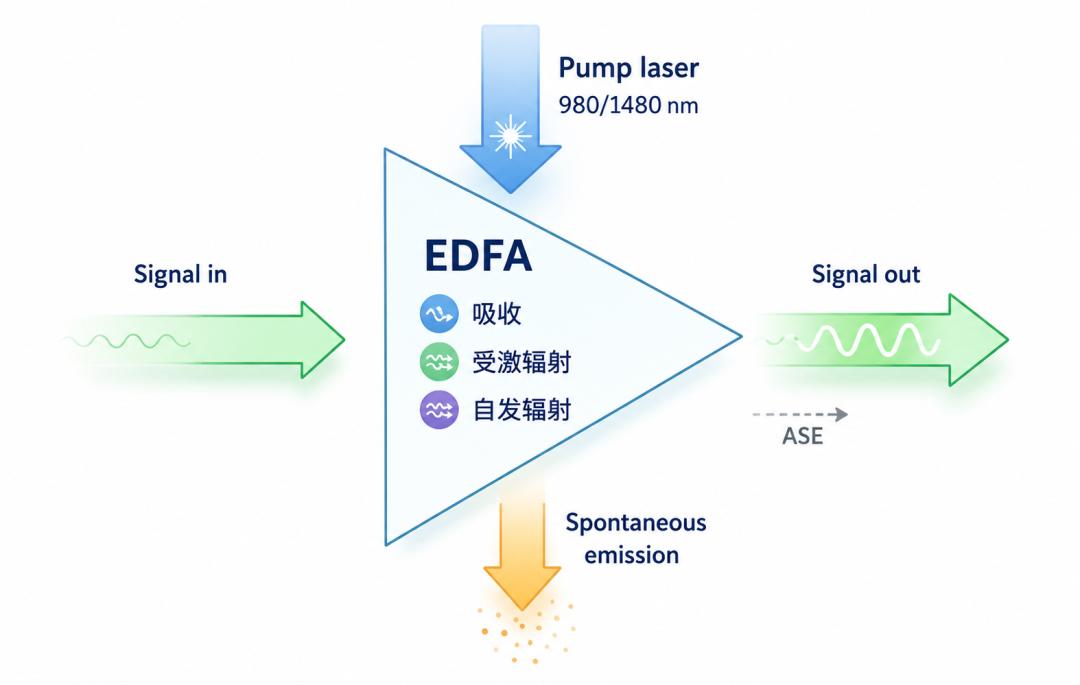
Specifically, in EDFA, engineers dope a small section of optical fiber with a small amount of Er³⁺ ions, and then use 980nm or 1480nm laser for "pumping".
After erbium ions absorb energy and enter the excited state, when the communication optical signal passes through, they will release new photons through stimulated radiation, directly amplifying the original optical signal.
Obviously, this approach directly eliminates the process of converting light into electricity.
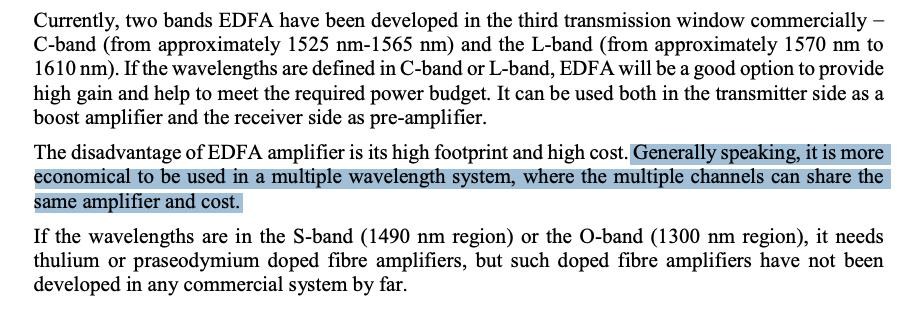
Coincidentally, the wavelength band where erbium is best at working is around 1550nm, which is precisely one of the windows with the lowest loss of modern silica optical fibers and the most commonly used for long-distance communication.
In addition, according to the data from the International Telecommunication Union ITU, EDFA can also amplify multiple optical signals of different wavelengths at one time, without completing photoelectric conversion channel by channel.
Therefore, in today's terrestrial backbone networks, submarine optical cables and cross-regional data center interconnections, EDFA has become a very mature type of core equipment.
In other words, the logic between erbium and this round of AI data center expansion is that the more data centers there are and the farther the computing power is distributed, the more long-distance optical networks need to be built and upgraded, and the demand for EDFA will also rise accordingly.
However, it should be noted that erbium mainly benefits from medium and long-distance optical communication, not short-distance interconnection of tens or hundreds of meters inside the cabinet.
In addition, EDFA is not absolutely irreplaceable.
According to ITU data, in addition to EDFA, Raman amplifiers, semiconductor optical amplifiers (SOA), and even O/E/O regenerative equipment that needs to complete photoelectric conversion, can undertake different forms of link amplification or extension functions.

In actual long-distance optical networks, there are also hybrid amplification schemes of Raman+EDFA.
But after decades of industrialization, EDFA has become the most mature technical route among them.
Yttrium, Put a Heat Insulation Armor on Turbine Blades
Yttrium has the element symbol Y, atomic number 39.
Although it does not belong to the lanthanide elements, due to its similar chemical properties to heavy rare earths and frequent symbiosis with them, it is usually classified into the rare earth system in industry.
The relationship between yttrium and data centers mainly lies in the power system that supplies power to data centers.
Not much to say, everyone knows how power-hungry data centers are.
The Lawrence Berkeley National Laboratory in the United States predicts that by 2030, data centers may consume about 11.8% of the electricity in the United States.
The U.S. Energy Information Administration also judges that with the rapid growth of power consumption in data centers, natural gas power generation will bear a considerable part of the new power demand.
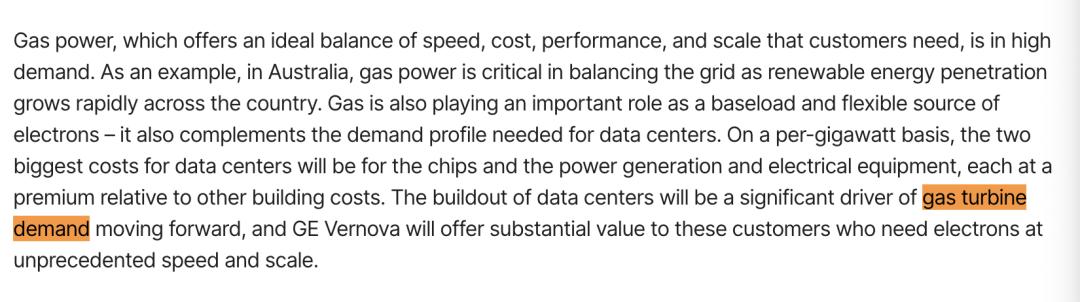
Gas turbine giant GE Vernova even directly listed data centers as an important driving force for the growth of gas turbine demand in its 2025 annual report.
As a result, the expansion of AI data centers has been transmitted all the way upstream:
After the shortage of GPUs comes the shortage of transformers, after transformers comes the insufficient capacity of the power grid, and when the power grid cannot keep up with the construction speed of data centers, enterprises begin to look for power directly on the power generation side.
Gas turbines have therefore become popular again.
Simply put, a gas turbine burns natural gas to generate high-temperature gas, which drives the turbine to rotate, and then drives the generator to generate electricity together.
To improve the efficiency of gas turbines, there is a very simple way: burn hotter.
In thermodynamics, the higher the gas temperature, the more opportunities there are to further improve the efficiency of the gas turbine. But the problem is that when the temperature rises, the turbine blades cannot withstand it.
So, in order to make the turbine blades more heat-resistant, yttrium, one of our protagonists today, comes into play.
At present, the industry mainly uses yttria-stabilized zirconia (YSZ) as the thermal barrier coating.
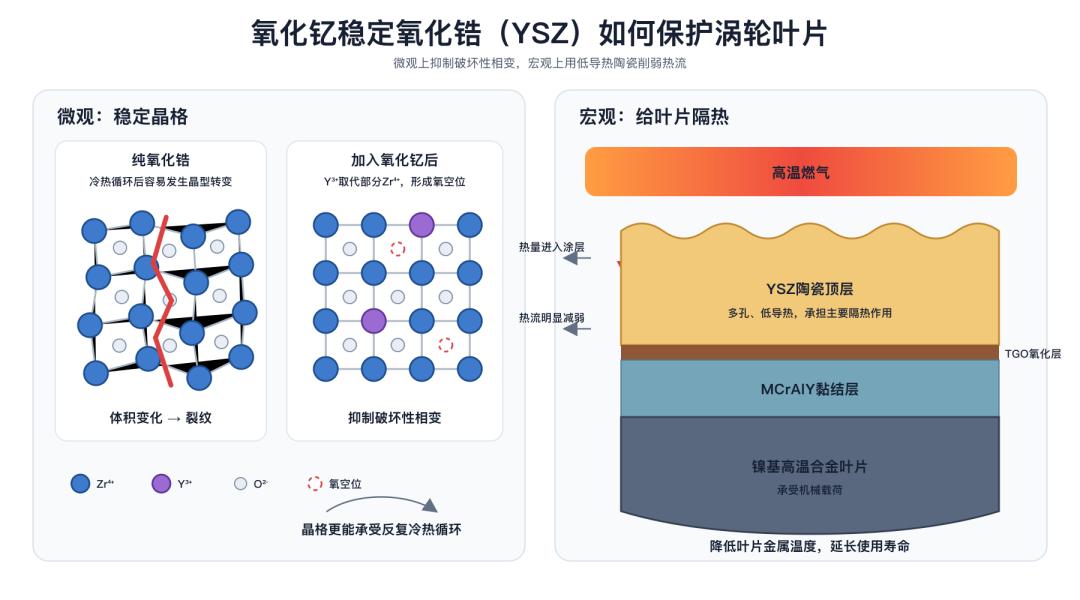
The principle is to add about 6%-8% yttrium oxide to zirconia.
Although pure zirconia has low thermal conductivity and is very suitable for heat insulation, it will undergo crystal transformation when the temperature rises and falls continuously, accompanied by volume change. After repeated cycles, the coating is very easy to crack or even peel off.
After adding yttrium oxide, Y³⁺ will enter the zirconia lattice and form an appropriate amount of oxygen vacancies, thereby stabilizing the high-temperature crystal structure of zirconia, making it maintain better stability in repeated thermal cycles.
The final YSZ can not only insulate heat, but also withstand long-term high temperature and repeated thermal cycles, which is equivalent to putting a layer of ceramic heat insulation armor on the gas turbine blade.
This coating can reduce the actual temperature borne by the underlying metal blades and reduce cooling air consumption, thus allowing the gas turbine to operate at higher temperatures.
Early NASA comparative tests compared yttria-stabilized zirconia, magnesia-stabilized zirconia and calcia-stabilized zirconia, and finally clearly pointed out that considering comprehensive durability and processing cost, yttria-stabilized zirconia is the best of the three schemes.

Therefore, to sum up, the logic of yttrium benefiting from data centers is:
The more power shortage data centers face → the stronger the new power generation demand → the more gas turbine orders → the higher the demand for high-temperature blades and thermal barrier coatings → which is further transmitted upstream to yttrium oxide.
Of course, this chain is longer than that of erbium.
Moreover, not every data center will be equipped with its own gas turbine, and gas power generation is only one of the new power sources for data centers.
At the same time, magnesium oxide, calcium oxide and more advanced new thermal barrier materials can all try to replace YSZ.
But for now, yttrium oxide still retains the threshold of testing and engineering verification in the short term.