China's AI Model Monitoring: Accelerated Upgrading, Surging Usage, Cloud Computing Sector Enters a New Round of Upward Cycle
China's AI model market is undergoing a round of intensive technological iteration and usage explosion, which in turn pushes investment in cloud computing infrastructure into a new expansion cycle.
The latest monthly monitoring report on China's AI model released by Bank of America Merrill Lynch shows that three main lines including rapid model upgrading in August, tightening computing power demand, and sharp rise in cloud capital expenditure evolved simultaneously, jointly outlining the picture of China's AI industry accelerating its transition from model competition to commercial monetization.
In terms of latest developments, cloud giants such as Tencent and Alibaba, as well as independent AI labs including DeepSeek and Zhipu AI, all launched new versions of models intensively in August, and some manufacturers raised token pricing simultaneously. At the same time, Tencent and Alibaba's capital expenditure in the second quarter reached RMB 530 billion and RMB 680 billion respectively, and the growth rate of cloud revenue also increased significantly — Tencent's year-on-year increase was just over 20%, while Alibaba's reached 45%.
Bank of America Merrill Lynch estimates that the total capital expenditure of the top four cloud platforms in China will increase by 98% and 44% year-on-year respectively in 2026 and 2027. In the past 30 days, the market's consensus expectation for Tencent and Alibaba's capital expenditure in the next 12 months has been revised up by 25% and 29% respectively, and the upside space of cloud business is being repriced by the market.
01 Model Upgrade Wave: The Sino-US Gap Narrowed, Domestic Models Lead in Usage
In August, China's AI model market ushered in a new round of intensive upgrades. On the cloud vendor side, Tencent launched Hy4 preview, Alibaba released Qwen 3.8 Max and Flash versions; on the independent lab side, Zhipu AI launched GLM5.3 Flash.
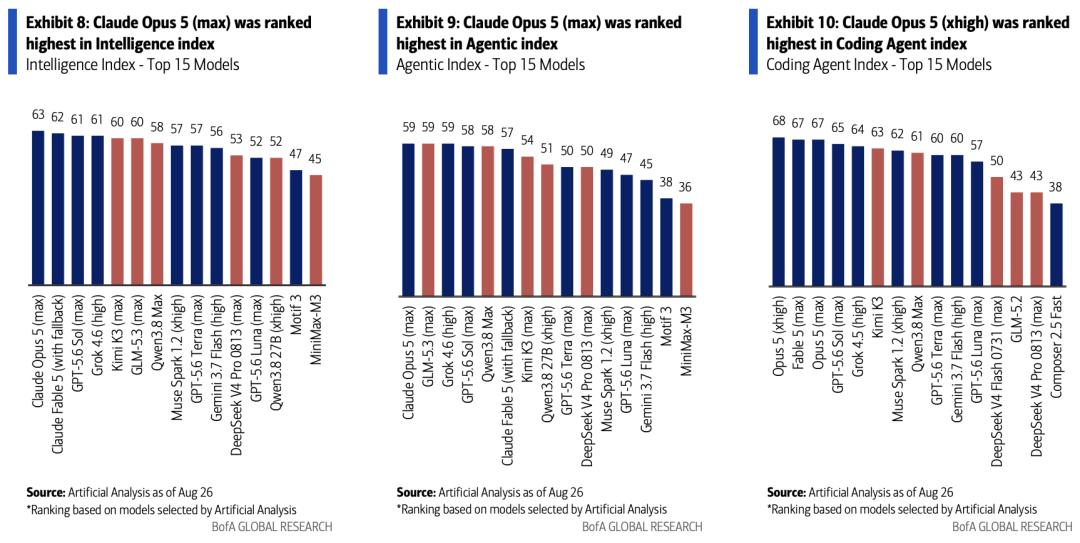
From the perspective of capability evaluation, the gap between domestic models and the world's top level continues to narrow. According to Artificial Analysis data, Anthropic's Claude Opus 5 ranks first in the intelligence index with 63 points, followed by Claude Fable 5 (62 points) and OpenAI's GPT-5.6 Sol (61 points). Among Chinese models, Moonshot AI's Kimi K3 ranks fifth in the world with 60 points, reaching 95% of Claude Opus 5's score, and Zhipu AI's GLM-5.3 also ranks sixth with 60 points. In terms of Agentic Index, GLM-5.3 and Claude Opus 5 are tied for first place with 59 points each; Alibaba's Qwen 3.8 Max ranks fifth with 58 points.
In the front-end web development programming evaluation (Code Arena WebDev), Claude Opus 5 takes the lead with 1691 points, followed by Kimi K3 (1674 points) and Qwen-3.8 Max (1669 points), and Tencent Hy4 preview ranks sixth with 1633 points.
The usage data also confirms the strong momentum of domestic models. OpenRouter data shows that as of August 17, DeepSeek V4 Flash ranked first with 31.6 trillion accumulated tokens for the month, followed by Tencent Hy3 with 26.2 trillion tokens, and Xiaomi MiMo-V2.5 ranked third with 19.1 trillion tokens. By vendor, DeepSeek leads with 22% of weekly token usage share, up 4.7 percentage points from the same period in July.
On the Vercel AI platform, DeepSeek's average monthly token usage share is 29.7%, further up from 26.0% in July, and Anthropic ranks second with 24.7%. It is worth noting that although DeepSeek leads in usage, Anthropic still occupies an absolute dominant position in expenditure share with 64.8%, reflecting the significant difference in pricing between Chinese and American models.
02 Pricing Differentiation: Tightening Computing Power Drives Partial Price Hikes, Chinese Models Maintain Continuous Cost-Effectiveness Advantages
In August, the LLM token expenditure index fell 26% month-on-month to 1.07 USD (1.45 USD in July), but has stabilized.
Bank of America Merrill Lynch pointed out that DeepSeek raised its token price in August, but the bank attributed this to tight computing power supply rather than a strategic shift — that is, it is not abandoning the "high performance and low cost" route, but caused by short-term imbalance between supply and demand. At the same time, small-size and low-price models such as GLM5.3 Flash launched by Zhipu AI continue to emerge, providing the market with more cost-effective options.
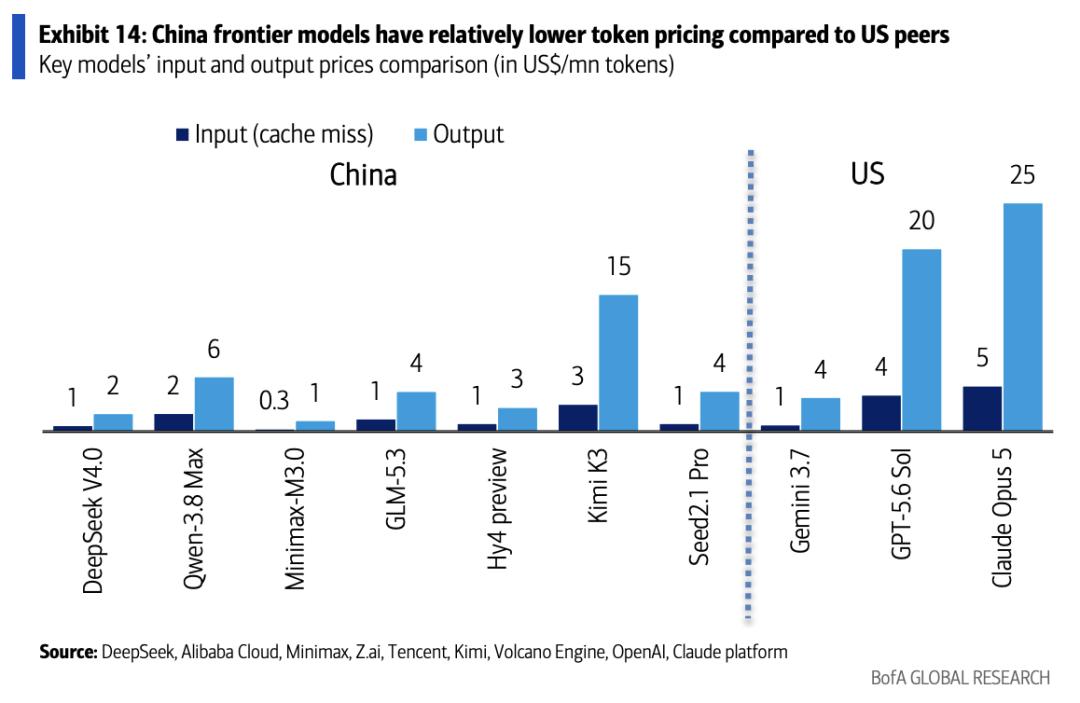
In terms of absolute pricing level, the price difference between Chinese and American models remains significant. The input/output token prices of Claude Opus 5 are 5 USD and 25 USD per million tokens respectively, and GPT-5.6 Sol is 4 USD and 20 USD. Among Chinese models, Kimi K3 has the highest pricing, with input/output at 3 USD and 15 USD respectively, Qwen-3.8 Max at 2 USD and 6 USD, and DeepSeek V4.0 at only 0.7 USD and 2 USD.
In terms of unit task cost, Chinese models also have obvious advantages. According to Artificial Analysis data, the task cost per unit of intelligence index of Claude Fable 5 is as high as 3.14 USD, Claude Opus 5 is 2.34 USD, while Qwen 3.8 Max is only 0.91 USD, Kimi K3 is 0.84 USD, and GLM-5.3 is 0.68 USD.
03 Accelerated Capital Expenditure: Cloud Infrastructure Enters a New Round of Expansion Cycle
The explosion in AI model usage is directly driving investment in cloud infrastructure.
Data from Bank of America Merrill Lynch shows that China's top internet platforms have continued to increase investment in AI infrastructure since 2024. The total capital expenditure of the four major cloud platforms was close to RMB 4000 billion in 2025, and is expected to reach 7260 billion yuan in 2026, and further exceed 1 trillion yuan in 2027.
Specifically for individual companies, Alibaba's capital expenditure for fiscal year 2026 is expected to be RMB 680 billion, ByteDance 3500 billion yuan, Tencent 2100 billion yuan, and Baidu 300 billion yuan. In the past 30 days, the market's consensus expectation for Tencent and Alibaba's capital expenditure in the next 12 months has been revised up by 25% and 29% respectively, and depreciation expectations have also been revised up simultaneously, indicating that the market is incorporating higher investment intensity into the valuation system.
In terms of cloud revenue, the acceleration trend has been confirmed in the second quarter financial report: Tencent's cloud revenue grew by just over 20% year-on-year, and Alibaba's cloud revenue increased by 45% year-on-year.
04 Cloud Market Prospect: AI Drives Growth, MaaS Becomes the Fastest Expanding Track
Bank of America Merrill Lynch predicts that the size of China's cloud market will grow from RMB 3890 billion in 2025 to 1.729 trillion yuan in 2030, with a compound annual growth rate of about 38%, among which AI-related cloud services (MaaS and AI infrastructure) will become the core driving force.
The AI cloud market share is expected to increase from 17% in 2025 to 66% in 2030. Among them, AI MaaS (Model as a Service) is regarded as the fastest-growing segmented track — it is expected to grow from RMB 210 billion in 2025 to 6760 billion yuan in 2030, with a compound annual growth rate as high as 81%. AI infrastructure cloud (including GPU computing power, training and reasoning systems) is expected to grow from 450 billion yuan in 2025 to 4700 billion yuan in 2030, with a compound annual growth rate of 51%.
In terms of market pattern, Bank of America Merrill Lynch expects that internet giants with mature cloud services such as Alibaba, Tencent and ByteDance will benefit more from the growth of AI enterprise service expenditure; while independent AI labs such as Zhipu AI and MiniMax are expected to achieve faster growth from 2026 to 2030 by virtue of smaller revenue base and stronger overseas market layout.
05 AI Application Side: Doubao Continues to Lead in User Scale, DeepSeek Improves User Stickiness
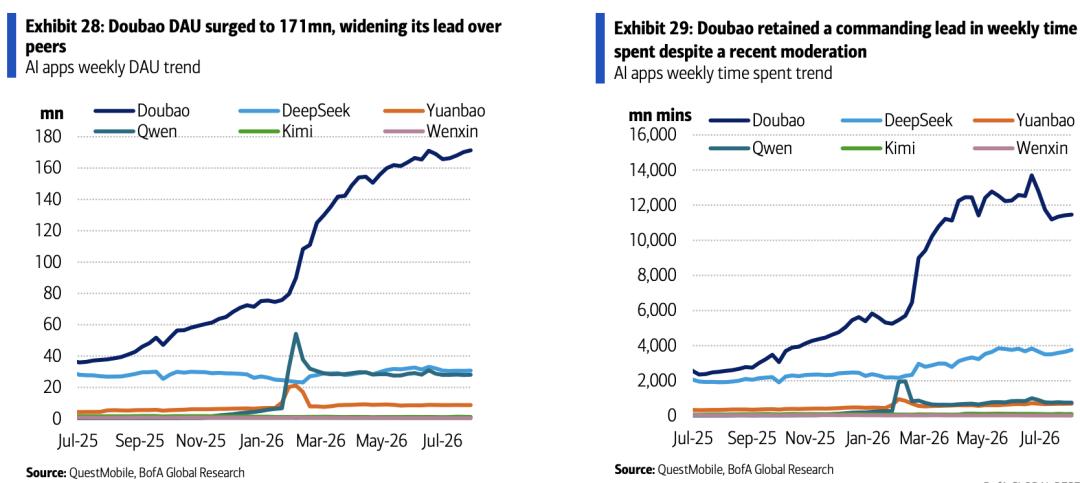
On the consumer side, Doubao under ByteDance reached 171.3 million weekly active users (DAU) in the week of August 3, with a total usage duration of 11.5 billion minutes, maintaining an absolute lead among AI chat applications in China. DeepSeek ranked second with 30.7 million DAU and 3.8 billion minutes of usage duration, Alibaba's Qwen ranked third with 28 million DAU, and Tencent Yuanbao ranked fourth with 8.7 million DAU.
From the perspective of user stickiness, DeepSeek's average daily usage duration per capita increased slightly to 18 minutes with 8 sessions per day in the week of August 3, while Doubao's average daily usage duration per capita and session frequency decreased significantly from June to July.
Looking ahead, Bank of America Merrill Lynch sorted out a number of key events worthy of attention: Alibaba may launch a new version of the model during the Yunqi Conference from September 22 to 24; MiniMax is expected to launch M3.1 and M3 Pro from September to October; DeepSeek V5 and the upgraded version of ByteDance's Seed series are expected to debut in the second half of 2026; the official version of Tencent Hy4 and the preview version of Hy5 are expected to be launched in the fourth quarter. In addition, Zhipu AI and MiniMax will see the expiration of their 12-month lock-up periods on January 7 and 8, 2027 respectively, when 40% and 90% of their shares will be lifted from the ban respectively, which is worthy of investors' attention.
This article is from the WeChat official account "Hard AI", author: a researcher focusing on technology production and R&D, published with authorization from 36Kr.