Claude Desktop Has Been "Secretly Swapped Out": Kimi K3 Is Running on the Opus 5 Slot — Is a Local Ollama Proxy Bypassing Anthropic's Walled Garden?
The feature that was completely blocked four months ago has returned in a new form.
Recently, Ollama quietly launched a new implementation in its v0.33.0 version: a dedicated local proxy for Claude Desktop. On August 26, the official blog made an official announcement — Claude Desktop can configure Ollama as a "third-party gateway provider", so open models including Qwen, DeepSeek, Kimi, and GLM can now run directly in the interface of Anthropic's own application.
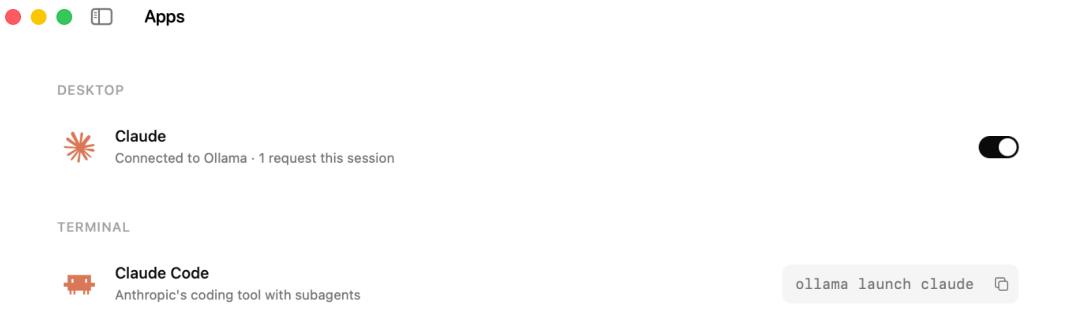
The highlight of this incident is not "another new integration", but how it bypassed the door that Anthropic closed by itself four months ago.
What happened in April: The door was open, but the guard checked IDs
Let's first review the last failed attempt. If we stretch out this timeline, the rhythm of this cat-and-mouse game is very clear:
•January: Ollama supports the Anthropic Messages API, allowing Claude Code to point to Ollama to run local or cloud models — the terminal path was opened first;
•April: Anthropic quietly added a developer setting in Claude Desktop that allows connection to third-party inference gateways. Ollama followed up immediately, launching the ollama launch claude-desktop command to connect the desktop application to itself with one click;
•A few days later: The integration was blocked, and Ollama removed the feature;
•August 21: The v0.33.0 version returned with the local proxy solution.
What happened in those few days in between?
After an update to Claude Desktop, users found that the gateway accepted connections as usual, but rejected all non-Anthropic model IDs. A user on GitHub posted the logs at that time — the gateway's /v1/models interface clearly returned 39 models, but the number of available ones was 0; when the application sent messages, it stubbornly called claude-sonnet-4-6 and then reported an error that "the model does not exist or you do not have access permission".
Anthropic closed the door in a very clever way: the interface remained open, the protocol was still accessible, and it only made changes to the model list. Ollama then removed the feature, acknowledging that third-party integration for Claude Desktop was "limited to Anthropic models only".
How the local proxy solves the problem: The request is rerouted to a different engine before it leaves the local device
The new solution in v0.33.0 moves the detour point from the gateway configuration to the local machine. Ollama starts a dedicated local proxy (source code at internal/proxy/claude_desktop.go), so requests from Claude Desktop first land on this proxy, which then forwards them to any model hosted by Ollama.
Mermaid
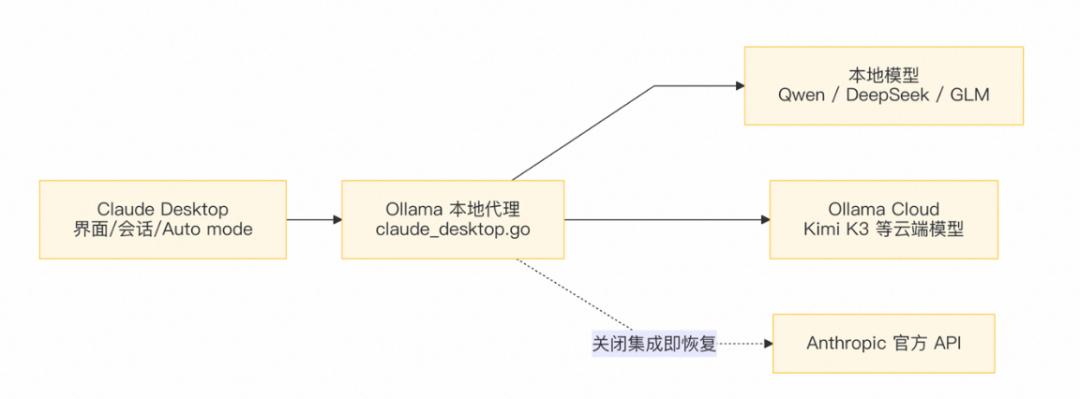
The configuration is simplified to one click: open the Ollama app, select Claude, toggle the switch, and Ollama will automatically complete the third-party gateway configuration for Claude Desktop; a "Use Ollama Models" toggle stays in the Mac menu bar; after turning it off, the original Claude settings will be restored as they were.
Why can the local proxy break the deadlock from April? The key lies in the location of the trust boundary. In the April solution, Claude Desktop connected directly to the gateway, and the verification right for the model list was held by the application, which rejected any unknown model ID it encountered. In the new solution, the application connects to the proxy on the local loopback address. For Claude Desktop, the dialogue object appears to be a "legitimate" local endpoint; where the request goes after leaving the application and which model processes it are all determined by Ollama on the local device. The verification step is moved to the side controlled by the "attacker" — or more accurately, the user themselves.
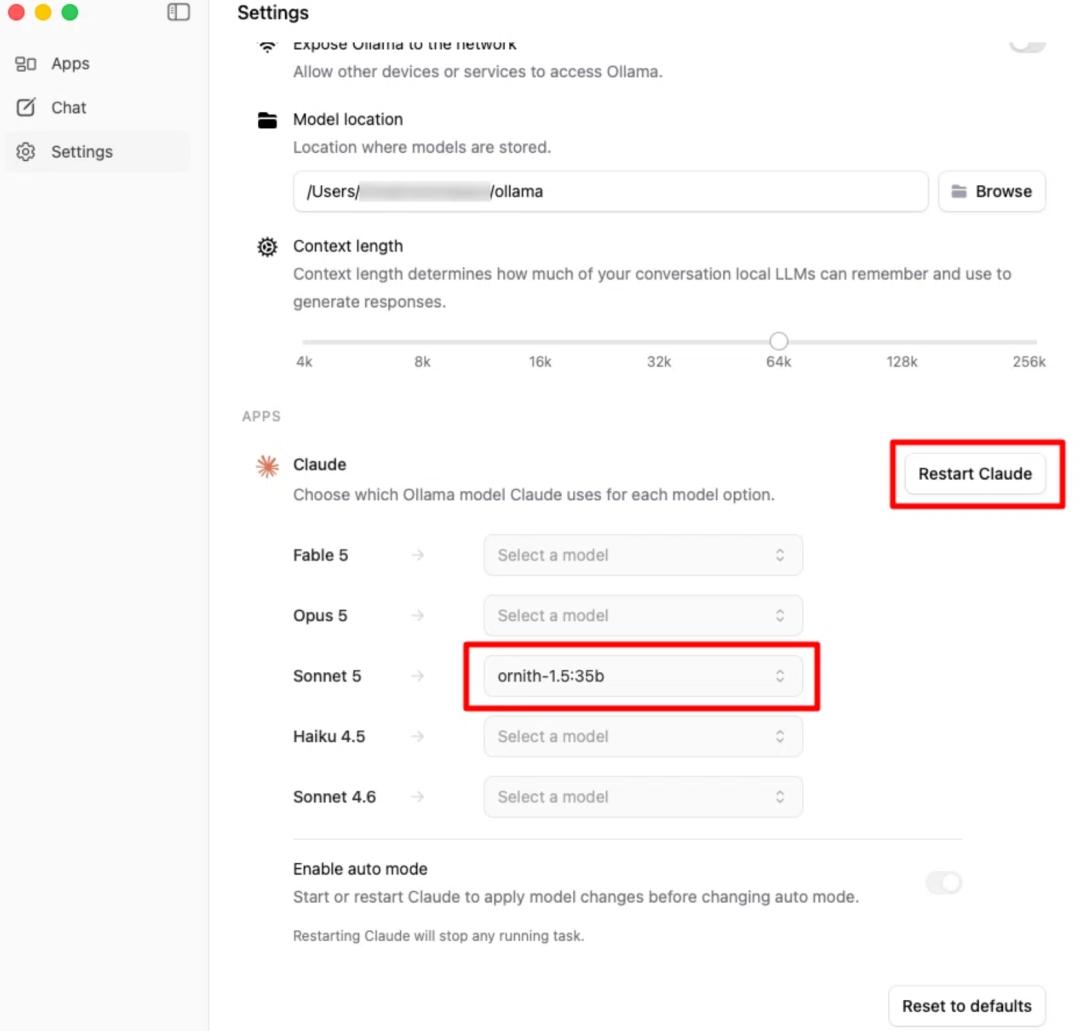
The most interesting design is slot remapping. The interface of Claude Desktop is built around Anthropic's own models, with names like Opus and Sonnet in the model selector. Ollama simply allows users to customize the real model behind each slot: when you select "Opus 5", the request is routed to Kimi K3; when you select "Sonnet 5", it actually runs DeepSeek V4 Pro. The interface remains the same, but the engine has been replaced. The built-in Auto mode of Claude Desktop (where the application decides whether to ask for user permission on its own) is also fully retained.
This approach of "keeping the interface unchanged while replacing the underlying engine" is not new in the Claude Code ecosystem: gateways like LiteLLM and Bifrost can remap the three slots of Sonnet, Opus, and Haiku to any provider, which is already widely used among developers. This time, Ollama brought the same idea from the terminal to the graphical interface, and reduced the configuration threshold to one click.
On the privacy front, Ollama clarified two points: telemetry is disabled by default, and a zero-data retention policy is implemented for all models and services — prompts will not be sent to Anthropic, nor will they be stored by Ollama.
Why do some people want to run other models inside Claude
The most frequently asked question on X is this: Since you already have Claude, why go through all this trouble?
Ollama's answer is four words: cost, speed, portability, and customization. Local models have zero call cost and no network latency; models fine-tuned with your own data can be integrated into your daily workflow; heavy tasks are handed over to large models on Ollama Cloud, light tasks run locally, and you can switch back to Anthropic's cutting-edge models at any time.
There is another unstated reason that all developers understand: data never leaves your device. Sensitive code, internal documents, and customer data that run on local models mean the entire processing chain stays on your own machine. Coupled with the zero-data retention policy, this is very attractive for enterprise scenarios where people "want to use AI but are worried about compliance risks".
Some people are also confused about the difference between this and connecting Claude Code to Ollama. The difference lies in the usage scenario: Claude Code is a programming agent in the terminal, mainly serving developers; this integration brings the same capabilities to the graphical desktop application — non-terminal scenarios such as conversation, research, writing, and document processing can now run their entire workflow without leaving Claude Desktop. It is clear that Ollama is targeting a much larger group of users.
At present, this feature is only available for the Mac version of Ollama, and Windows support, as hinted by the official team on X, is already in the planning stage.
Signal: The frontend shell and the model engine are decoupling
Putting this incident into the industry context, several public facts are worth looking at together.
In July, Ollama completed a $65 million Series B financing. CEO Jeffrey Morgan made his stance very clear at the time: "The future of AI is that open models run everywhere work happens." In the same period, Ollama was also pushing for native Apple MLX support to improve local inference performance on Mac. The Claude Desktop integration is the latest step in this strategic line: users stay in the applications they are familiar with, and Ollama provides models at the underlying layer.
There are two reasonable deductions. First, this "shell and engine decoupling" approach will spread — there are already mature practices in the Claude Code ecosystem where gateways like LiteLLM and Bifrost remap the three Sonnet/Opus/Haiku slots to any model, and desktop applications will just be the next interface to be decoupled. Second, the cat-and-mouse game may not be over. Anthropic has already demonstrated the "protocol pass, list block" approach in April, and no public statement from Anthropic about this integration has been seen in public materials; if it tightens verification at the application layer again, how long Ollama's local proxy can hold up remains an open question.
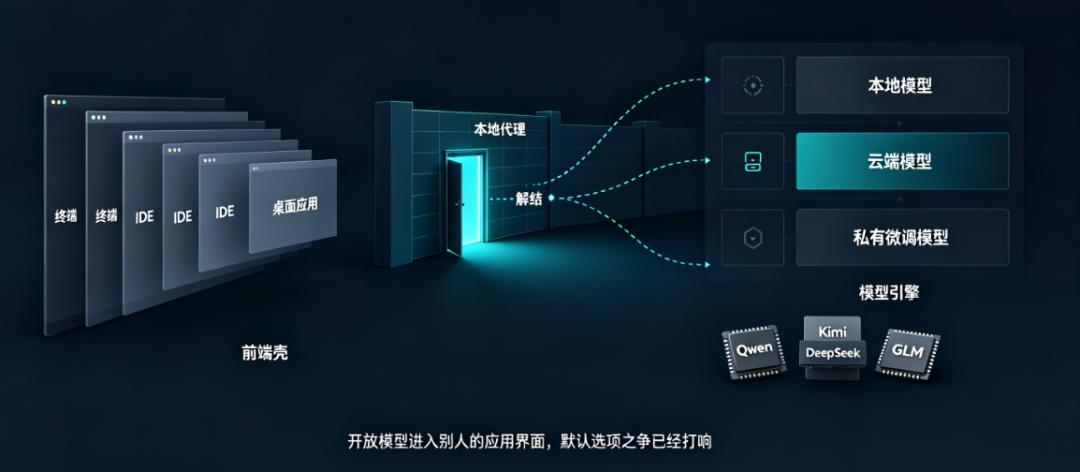
For the open model camp, the significance is more direct: Qwen, DeepSeek, Kimi, and GLM have appeared in the model selector of Anthropic's own application for the first time. The walled garden is still there, but there is a door installed by others on the wall.
Looking back at this product line, Ollama's strategy has taken shape: based on the local runtime, supplemented by cloud computing power, and then knocking on the doors of tools that developers are already using one by one — terminals, IDEs, desktop applications. It does not try to convince anyone to switch to a new interface, it only does one thing: make open models appear wherever work is happening.
Two things are worth paying attention to next: when the Windows version will be launched, and whether Anthropic will take action again. The April block and the August return prove one thing: the competition for the "default option" in the AI model space has already expanded into other vendors' applications.