"Where are my hands? Where are my hands?" Your brain asks yourself this question eight hundred times a day.
As you read this text, your fingers may be gliding gently across the screen. This is so commonplace for you that you may not even realize that picking up the phone on the table with your hand in your pocket and then placing your fingers accurately where you want to touch is an extremely complex process.
Take picking up a phone as an example: your brain needs to plan an appropriate movement path based on the current position of your hand and the position of the phone. Then, the brain sends a series of commands to the muscles of the shoulders, arms and wrists, making them contract and relax in a specific sequence to move the hand along the predetermined trajectory. At the same time, the brain must continuously track the real-time position of the hand and adjust the movement in time according to the feedback information to ensure that it does not deviate from the target.
Just as a navigation app must know "where you are" and "where you are going", your brain must also know the position of your hand in real time. But how on earth does the brain know where our hands are?
Such a seemingly simple question has long puzzled scientists. However, in a recent series of studies, the research group led by Yu Shan from the Institute of Automation, Chinese Academy of Sciences finally discovered a set of neural mechanisms responsible for locating hand positions in the brain of rhesus monkeys (Macaca mulatta), catching a glimpse of this "positioning device".
There is also a GPS in the brain that tracks your hand
As early as five or six years ago, when Cao Shenghao first joined Yu Shan's research group to pursue his doctoral degree, he became interested in the positioning mechanism of hands. In his view, hand position is indispensable information in motion control, but previous studies have paid little attention to this point.
Whether in the field of basic neuroscience research or brain-computer interface, researchers tend to pay more attention to how the brain encodes the movement direction and speed of the hand, but rarely focus on position information. "Everyone seems to be a little path-dependent," said Cao Shenghao.
Cao Shenghao hypothesized that if the brain signals of rhesus monkeys during hand movements can be recorded, hidden position clues may be found from these neural activities. Therefore, he and other researchers in the research group performed surgery on several rhesus monkeys, implanting microelectrode arrays in the motor cortex of their brains to capture changes in neuronal activity.
These devices implanted in the brains of rhesus monkeys look at first glance like tiny flakes with a side length of less than 5 millimeters, but their surfaces are densely arranged with "tips". Each tip is a microelectrode that can capture the electrical signal of a single neuron. By transmitting these signals out, researchers can continuously record the activity changes of these neurons during the movement process.
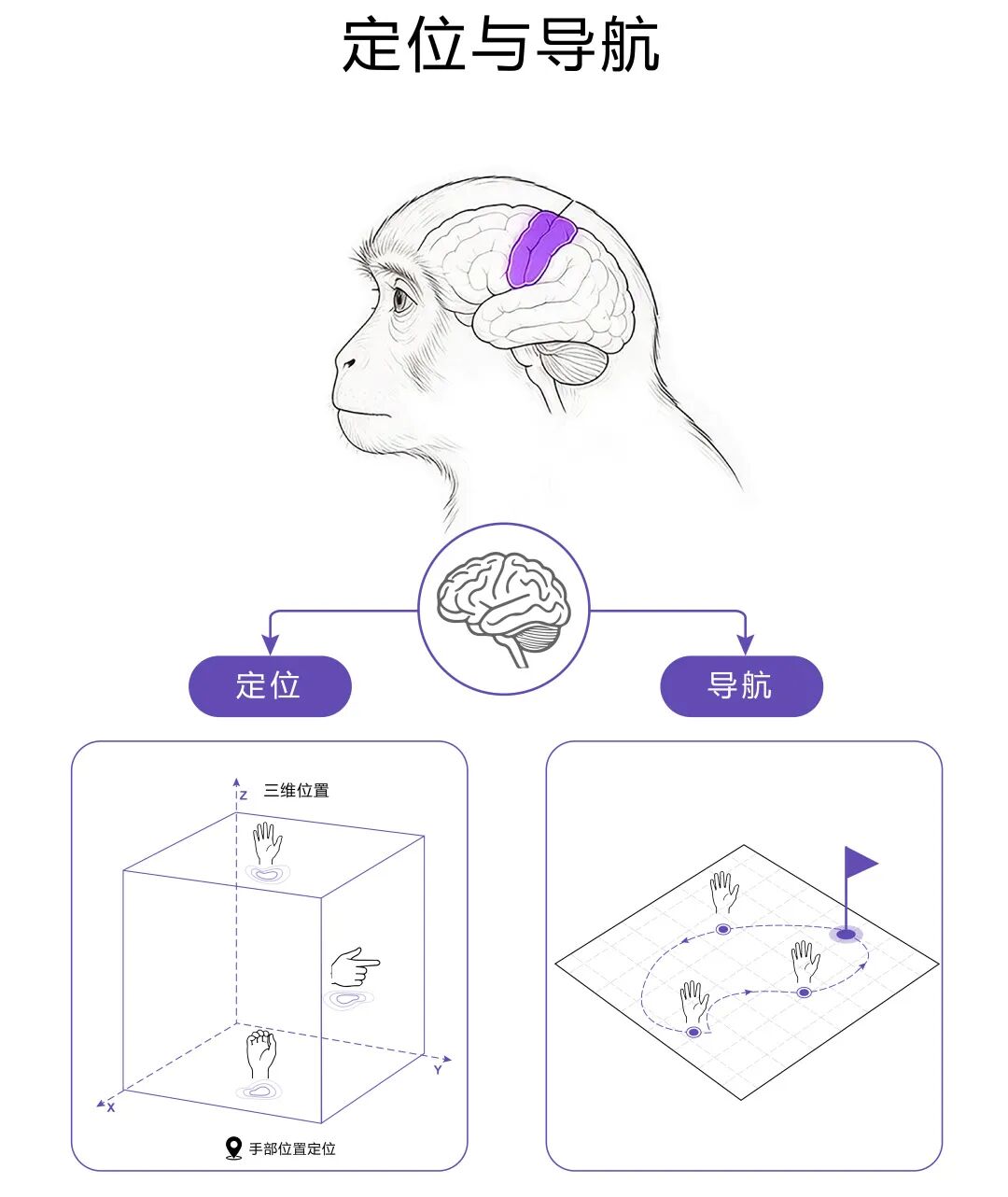
The "positioning" and "navigation" mechanisms of the brain for hands remain to be elucidated | Cao Shenghao & Liang Chen
After the monkeys recovered from the surgery, the researchers let them sit on a special experimental chair and move their arms freely. The hands of some monkeys could only move freely in a two-dimensional plane [1], while the upper limbs of other monkeys could move in a larger spatial range [2]. In order to encourage the monkeys to actively explore a larger activity space, the researchers also used food as a reward to guide them to reach out and complete various movements. During this period, Cao Shenghao would synchronously record the electrical signals of neurons in their motor cortex, as well as the entire movement process of the monkeys.
But the real challenge has only just begun. Hand movement is never a simple process. When a hand moves to a certain position, the changes in brain activity may come from many different factors. For example, the direction and speed of hand movement, and even the posture of the arm itself, may affect the activity pattern of neurons. Researchers need to distinguish from this complex information which neural signals truly reflect the position of the hand. "This is the most difficult point in our entire research process." Cao Shenghao said.
After excluding various factors, Cao Shenghao finally found from the complex neural signals that in the motor cortex of rhesus monkeys, there is a special type of neurons whose neural activity is highly correlated with hand position, and he named them "hand position-tuned cells".
These cells are hidden in two structurally closely connected brain regions, one is the dorsal premotor cortex (PMd) responsible for movement preparation, and the other is the primary motor cortex (M1) responsible for issuing movement commands, the latter is also one of the most commonly used brain regions for reading neural signals in current brain-computer interface technology.
This discovery surprised and delighted Cao Shenghao. "Traditionally, people think that the primary motor cortex is mainly responsible for the actual execution of movements," he said, "But our results show that this brain region can also represent the position of the hand." This means that the existing brain-computer interface devices can not only extract the information of executing movements from the primary motor cortex, but also theoretically extract position information.
Perhaps there is also a "Grand Unified Theory" in the brain
But what really surprised Cao Shenghao was the working mode of these hand position-tuned cells. He found that each hand position-tuned cell has its own preferred "activity area". When the monkey's hand moves to certain specific positions, these cells become extremely active; and when the hand leaves these positions, their activity weakens significantly. In other words, these neurons mark the spatial position coordinates of the hand in the brain.
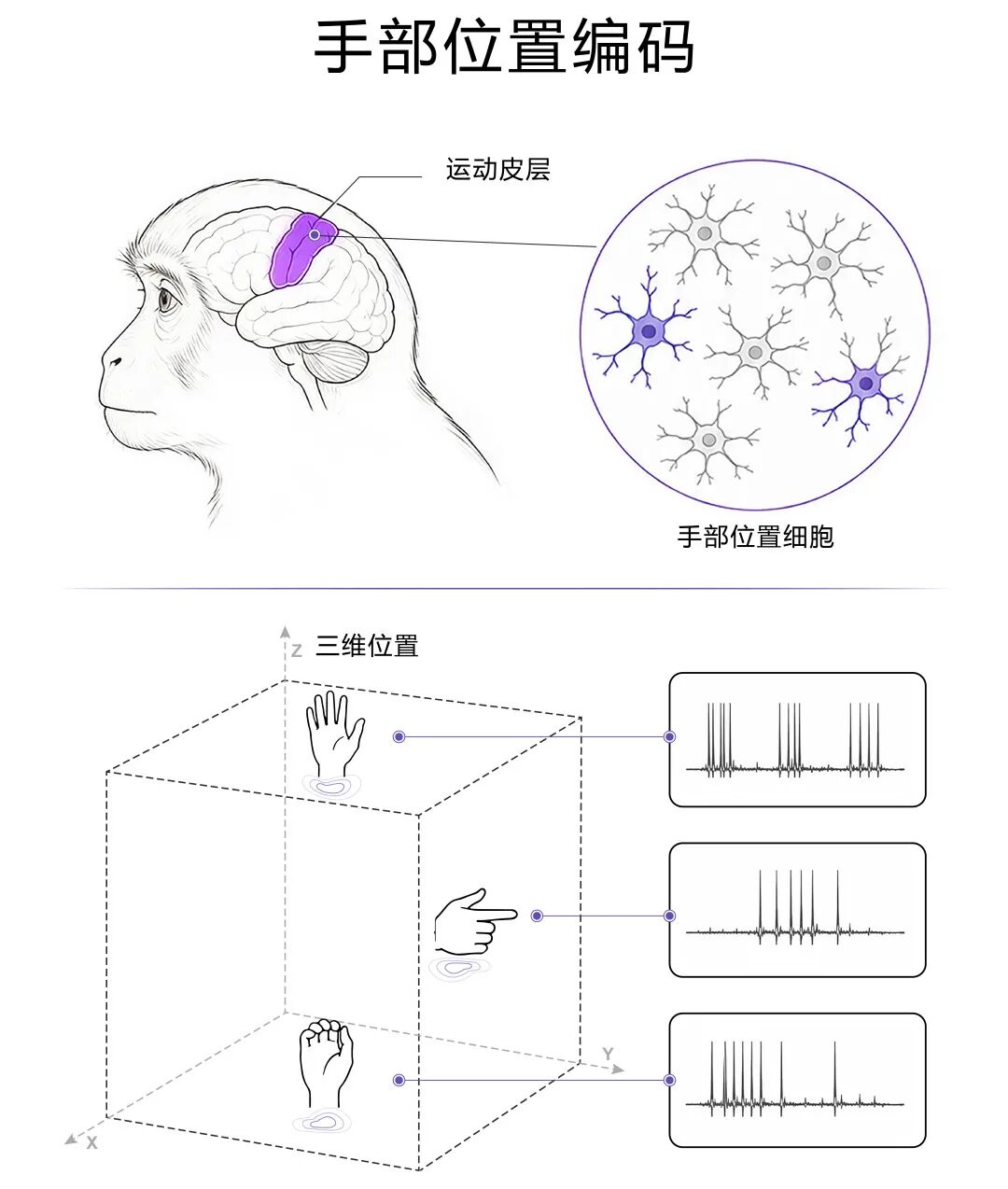
When the hand is placed in different positions, the "hand position-tuned cells" will show significantly different neural activities | Cao Shenghao & Liang Chen
This highly refined position coding pattern reminded Cao Shenghao of a type of cell that has long been well known in the neuroscience community — place cells. These neurons that play an important role in spatial navigation are located in the hippocampus of the brain. When we are in a specific place, certain place cells will be activated, and different positions correspond to different neural activity patterns, allowing the brain to internally construct a "cognitive map" of the external world.
The key point is that although the place cells in the hippocampus are responsible for recording the individual's position in a broad space, and the hand position-tuned cells in the motor cortex only focus on the movement of specific parts of the body within a limited range, the coding methods adopted by the two are so similar.
Yu Shan said that this discovery suggests that the brain may not design a completely different mechanism for each task. On the contrary, for different positioning tasks, our brain may adopt a universal coding framework, but it represents information of different scales in different brain regions. "The cognitive map paradigm established based on place cells in the past may also be extended to other fields," he said.
Faced with such a complex brain, Yu Shan believes that we may be like physicists, trying to find the "Grand Unified Theory" behind it, that is, those universal mechanisms. After all, in the entire cerebral cortex, whether it is the visual, auditory or motor cortex, they all have a similar six-layer organizational structure. When the brain implements different functions on these similar "hardware foundations", different brain regions are likely to adopt similar neural computing strategies.
However, in Cao Shenghao's view, although the coding methods are similar, the "positions" described by these two sets of positioning systems may not be exactly the same. Scientists have previously discovered that when helping us locate our position in the external space, the place cells in the hippocampus rely on a coordinate system referenced to the environment. That is to say, no matter where we stand, a certain table or a certain door in the room has fixed coordinates. But Cao Shenghao speculated that the hand position-tuned cells may adopt a body-centered relative coordinate system. For these neurons, what matters is not the absolute position of the hand in the whole world, but the position of the hand relative to the body.
But if the brain has these two sets of position coding systems with different scales and different reference frames at the same time, how do they work together? Cao Shenghao guessed that in daily behaviors, these two positioning mechanisms may be responsible for different stages of action planning respectively.
For example, when we want to pick up a cup on a table far away, the brain first needs to solve a "large-scale" problem, use the place cells in the hippocampus to plan where to move the body, and then use the hand position-tuned cells to plan the position of the hand relative to the body. When the two are superimposed, the position of the cup is "developed" in the brain.
The next step for brain-computer interfaces may be to understand the brain's planning
In the process of research, Cao Shenghao increasingly realized that this positioning mechanism in the brain of rhesus monkeys may not only be a breakthrough in the field of neuroscience, but also bring application changes. Yu Shan also said that although they focus on how the brain understands the world and how it interacts with the physical world, these underlying principles of spatial intelligence can also be applied to brain-computer interfaces and embodied intelligence.
For a purposeful movement, position is actually the core of the entire action plan: it is about where we are now, where we are going, and how to reach the target from the current position. However, in current brain-computer interface research, scientists and enterprises pay more attention to the "execution" process of movement, that is, how to make the brain-computer interface device understand the movement commands issued by the brain and convert them into specific actions of external devices.
Take Neuralink, Elon Musk's brain-computer interface company, as an example. When users use their devices to control the mouse cursor on the screen with neural signals, they need to continuously pay attention to the position of the cursor, and imagine in their mind which direction it should move next and at what speed. The brain-computer interface device reads the neural activity in the motor cortex and converts these signals into the movement of the cursor.
But Cao Shenghao believes that this method may not make full use of the abilities that the brain is really good at. "What our brain is best at is actually planning," he said. "Just because scientists have a deep enough understanding of the execution process, everyone chooses to let the human brain direct the final execution process, which is actually a waste."
For example, if we want to drive from Beijing to Shanghai, ideally the brain should be responsible for planning the route and deciding which highways to take, while the specific driving process can be completed by the autonomous driving system. However, the most widely used technical route in the field of brain-computer interfaces today is more like letting the brain directly control how the vehicle turns at what speed at each intersection.
In recent years, the rapid development of the embodied intelligence field has shown that machines have great potential in performing tasks. But at the same time, how to understand the environment, set action goals, and plan paths to achieve the goals is still the short board of machines, which is exactly what the human brain is best at. If brain-computer interface devices can read the pre-planned movement trajectories in the brain in the future, and then hand over this information to external devices for execution, it is possible to combine the advantages of both.
However, what Yu Shan's research group has currently analyzed is only the information about the real-time position of the hand in the brain of rhesus monkeys. To further read the movement trajectories planned by the brain, a more complex problem needs to be solved: time. A movement trajectory is a path that unfolds over time, which includes past, present and future positions. Yu Shan revealed that their research group is currently trying to decode these complex trajectory information.
In fact, Yu Shan's research group has been exploring in the field of brain-computer interfaces for many years, and has carried out a lot of research on decoding the "intentions" in the brain. In previous work, they have found that even if only some seemingly simple intentions are decoded, such as "left", "middle", "right", or identifying several specific target objects, and then the external device completes the corresponding tasks through a preset program, the user experience of the brain-computer interface device can be significantly more natural and smoother.
If position information can be introduced when the brain-computer interface device decodes intentions in the future, the operation objects of external devices will no longer be limited to preset objects. "If we can decode the position information in the brains of patients with severe paralysis, they will be able to complete many complex tasks on the desktop with the help of external devices, which will be a huge progress," Cao Shenghao envisioned.
References
[1] https://www.nature.com/articles/s41467-025-58786-3
[2]https://www.jneurosci.org/content/early/2026/08/13/JNEUROSCI.1773-25.2026
This article is from the WeChat official account "Guokr" (ID: Guokr42), author: Huang Yujia, editor: Li Xiaoqiu, published with authorization from 36Kr.