China is set to embrace another urban district with a GDP of 1 trillion yuan.
Tianhe, the largest economic district in Guangzhou, has officially set the target and timeline for becoming a GDP-trillion-yuan-level district.
The recently released outline of the 15th Five-Year Plan by Tianhe explicitly states: to exceed 800 billion yuan in GDP in 2027 and hit the 1-trillion-yuan GDP mark in 2030, accelerating the building of a model district for the Chinese path to modernization.
A simple calculation shows that, taking Tianhe's 2025 GDP of 701.718 billion yuan as the starting point, to reach the trillion-yuan scale in 2030, it needs a nominal annual increase of 59.656 billion yuan on average within five years, with a compound nominal GDP growth rate of 7.33%.
Across the country, there are only three districts with GDP exceeding one trillion yuan at present, namely Pudong New Area in Shanghai, Haidian District in Beijing, and Nanshan District in Shenzhen.
In 2018, Shanghai's Pudong took the lead in breaking the trillion-yuan GDP threshold, becoming the first trillion-yuan district in China; in 2022, Beijing's Haidian followed closely and took the second spot; in 2025, Shenzhen's Nanshan recorded a GDP of over 1.010238 trillion yuan, becoming the third trillion-yuan district nationwide.
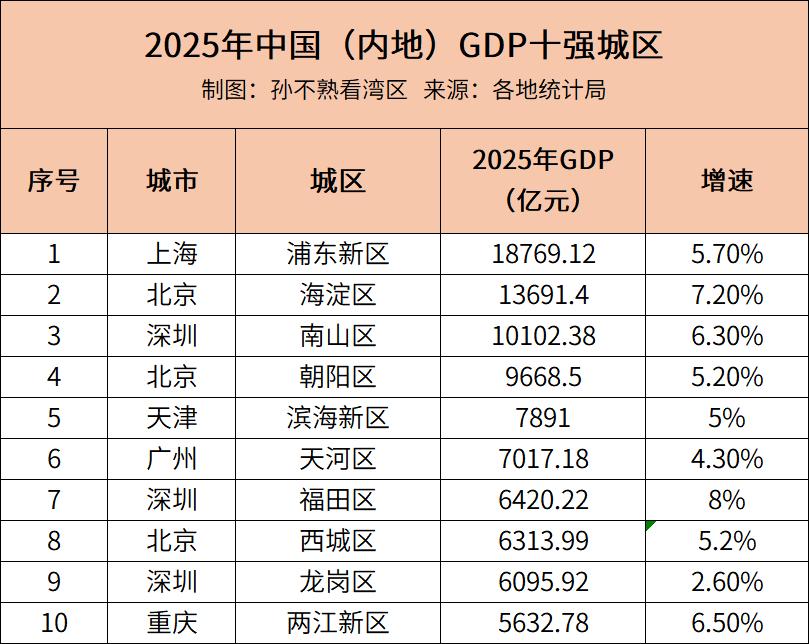
As things stand, in 2025, Shanghai Pudong's GDP reaches 1.88 trillion yuan, Beijing Haidian's hits 1.37 trillion yuan, and Shenzhen Nanshan's stands at 1.01 trillion yuan. Chaoyang District of Beijing posted a GDP of 966.85 billion yuan in 2025, just one step away from the trillion-yuan district mark.
Guangzhou's Tianhe District registered a 2025 GDP of 701.718 billion yuan, ranking 6th among all districts nationwide and 2nd among all municipal districts in China, only behind Shenzhen's Nanshan.
Pudong, Haidian, Nanshan and Tianhe are the core leading districts of the four first-tier cities of Beijing, Shanghai, Guangzhou and Shenzhen respectively, with vastly different inherent development characteristics.
Pudong boasts a far-leading total economic volume, whose economic size has surpassed that of multiple provinces including Heilongjiang, Jilin and Gansu, and is even higher than that of the municipality of Tianjin, truly achieving an economic strength comparable to an entire province.
Shenzhen's Nanshan boasts its edge in the density of listed companies, with more than one listed company per square kilometer. The well-known Yuehai Subdistrict has nurtured a large number of tech giants including Huawei, Tencent and DJI. The whole district has more than 220 listed companies, with a GDP output of over 5.5 billion yuan per square kilometer, featuring extremely prominent industrial vitality.
Beijing's Haidian stands out for its scientific and technological innovation strength. The district is home to more than 260 listed companies, most of which are technology enterprises, 49 unicorn enterprises, and nearly 10,000 high-tech enterprises. It has cultivated 1 trillion-level, 4 100-billion-level and 5 10-billion-level industrial clusters, with a very solid foundation for scientific and technological innovation.
The core highlight of Guangzhou's Tianhe, however, is its extremely strong comprehensive multi-functional integration capability.
It is home to Tianhe CBD, one of the three national-level CBDs in China, serving as the business core of Guangzhou; it is also the city's commercial center, gathering the largest number of large shopping malls; as the birthplace of the local internet industry, it undertakes scientific and technological innovation functions; Tianhe is the district with the strongest financial industry in Guangzhou, whose added value of the financial sector accounts for about 53% of the city's total; there are more than 50 foreign consulates general in the district, making it Guangzhou's window for international exchanges; its education resources are also abundant, with 4 of Guangzhou's 7 Double First-Class universities located in Tianhe.
The superposition of multiple functions including business, commerce, scientific and technological innovation, finance, foreign affairs and higher education forms Tianhe's unique competitive advantage. The driving role of a leading district for a city is self-evident.
Both Shanghai's Pudong and Shenzhen's Nanshan have to a large extent underpinned the economic fundamentals of their respective cities. Tianhe's push to become a trillion-yuan district is not only a development goal of a single district, but will also directly boost Guangzhou's comprehensive status in the national urban landscape.
This article is from the WeChat official account "City War", written by Lao Qiao, and authorized for release by 36Kr.