The all-new da Vinci surgical robot has been granted marketing approval, foraying into Olympus' core stronghold.
Intuitive Surgical has quietly announced a new strategic layout.
Recently, Intuitive Surgical submitted a 510(k) clearance application to the FDA for a flexible gastrointestinal robot. The announcement was made very low-key: no press conference, no official press release, and it was only mentioned during the earnings communication meeting. But anyone familiar with this company knows the high gold content of Intuitive Surgical's new foray into new fields.
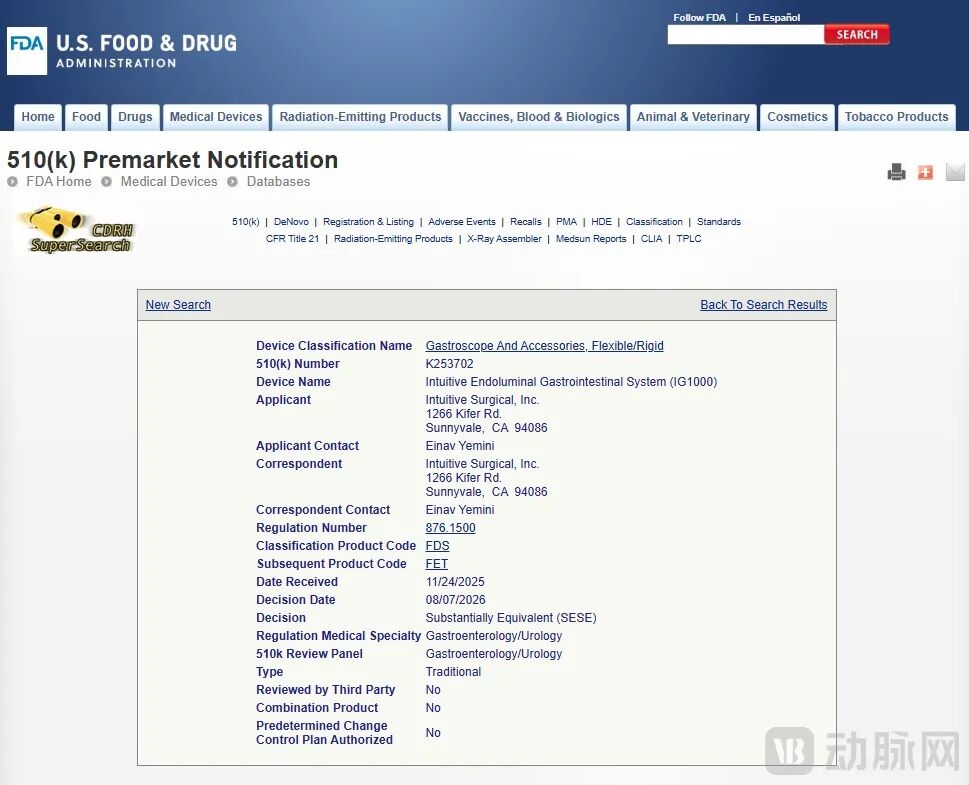
It can be found in the FDA's 510K database that Intuitive's digestive endoscopy robot, IG1000, has been approved for marketing by the FDA on August 7.
Over the past two decades, Intuitive Surgical has brought the da Vinci robotic-assisted laparoscopic surgery from the laboratory to operating rooms around the world. However, Intuitive Surgical has also noticed that customer demands are increasingly segmented, and different products are needed to meet diverse market needs.
The flexible gastrointestinal surgical robot is not a completely untapped market. On the contrary, many enterprises are optimistic about this market. Olympus, the global leader in gastrointestinal endoscopy, has made multi-line layouts in this market, and domestic enterprises have already sold dozens of digestive endoscopy surgical robots.
Intuitive Surgical is directly facing off against Olympus. How will the two sides compete in the field of surgical robots?
01 New Product Patents of Intuitive Surgical Reveal the New Model Is Equipped with Force Feedback
There have long been clinical pain points in endoscopic treatment. For example, ESD (Endoscopic Submucosal Dissection) is performed through a single flexible endoscope, which has high requirements for endoscopic operation skills and a long learning curve; the limitation of single instrument during the operation lacks effective tissue traction, making it difficult to form the operating triangle similar to that in laparoscopic surgery, which increases the risk of intraoperative bleeding and perforation, and to a certain extent limits the popularization of this technology.
The development of gastrointestinal intracavitary surgical robots has two strategic dimensions: on the one hand, it reduces the operation threshold of endoscopic surgery through robot assistance; on the other hand, it breaks through the capability boundary of existing advanced therapeutic endoscopes to complete complex surgical tasks that are difficult to achieve with traditional methods or carry high risks.
The product development in this track is no easy task. Different from the rigid laparoscopic surgical robot of the da Vinci system, the flexible gastrointestinal surgical robot has strict size restrictions on the endoscope carrier, which requires a balance between force and flexibility in narrow and tortuous lumens.
Intuitive Surgical's gastrointestinal robot has finally been unveiled. It is confirmed that this flexible robotic endoscope system named IG1000 is Intuitive Surgical's first intracavitary surgical robot applied to the gastrointestinal tract.
The most core progress is that the company has submitted a 510(k) registration application to the U.S. FDA. What is submitted this time is a "non-commercial version" — that is, the company will obtain the clearance first, but will not sell it for the time being.
Obtaining approval first and delaying commercial sales is a common strategy for large medical technology companies. They get regulatory clearance first, then polish the product and evidence chain through limited clinical use, and launch the official commercial version for large-scale promotion when the time is ripe (for example, after accumulating sufficient clinical data, completing doctor training, and improving supporting devices). This is in line with Intuitive Surgical's consistent prudent style.
David Rosa, CEO of Intuitive Surgical, also sent a clear signal recently. He revealed that the team had in-depth exchanges with gastroenterologists and nursing teams, focusing on understanding which links the robot can bring real clinical benefits and improve the work experience of the nursing team. "We are excited about the improvements that are about to come."
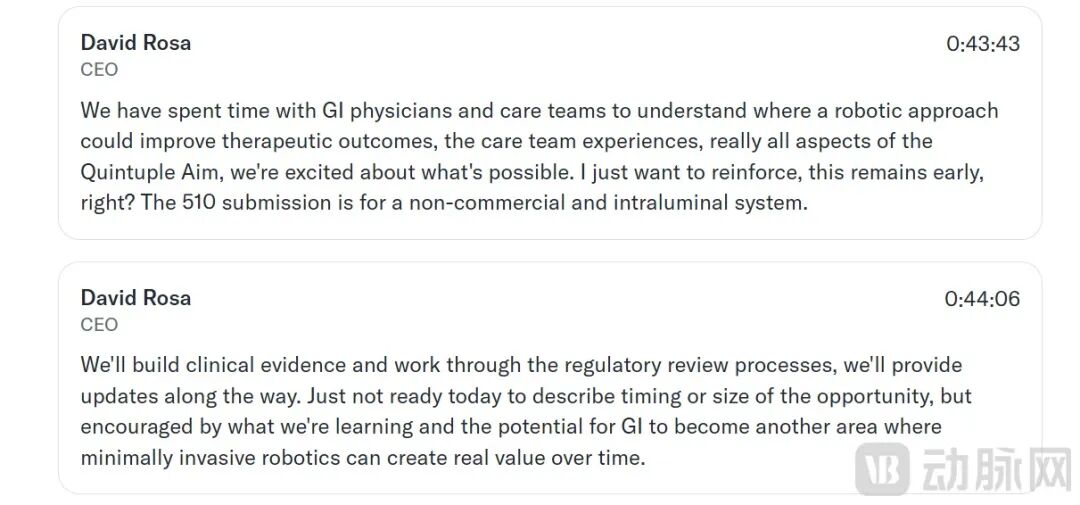
Rosa said that the layout of gastrointestinal surgical robots is a natural extension of Intuitive Surgical's mission, aiming to provide better minimally invasive care for more patients. He also mentioned that Ion, the robotic system for lung interventional procedures, has proved that Intuitive Surgical has the ability to develop and commercialize new platforms beyond soft tissue surgical robots; the company can fully combine the experience of da Vinci and Ion to guide research in the gastrointestinal field.
Although Intuitive Surgical has not announced subsequent milestones and specific product roadmaps, overseas medical device industry analyst Steve Bell has sorted out the technical outline of this product through public FDA information and patent layouts.
From the perspective of FDA classification, the main code of IG1000 is classified as FDS (Flexible/Rigid Gastroscopes and Accessories), and the secondary code is FET (Endoscopic Video Imaging System), which is defined as a Class II device. This classification conveys an important signal: the first version of IG1000 will be an upper gastrointestinal endoscope and imaging platform.
Bell speculates that Intuitive Surgical has adopted the NeoGuide shape sensing and shape locking technology acquired in the early years. Its core logic is that after the flexible endoscope reaches the target position, it can "anchor" itself to form a stable operating platform, instead of requiring doctors to continuously operate with both hands like traditional endoscopes, which is prone to shaking. This strategy of "stabilizing the platform first and then adding functions" is the same as the advancement logic of Ion in the field of pulmonary intervention — let doctors get familiar with the navigation and locking mechanism of the robot first, and then gradually add advanced functional accessories such as suturing and resection.
The patent layout further reveals the technical direction. The international patents published between 2025 and 2026 show that Intuitive Surgical has made great efforts in force feedback and suturing.
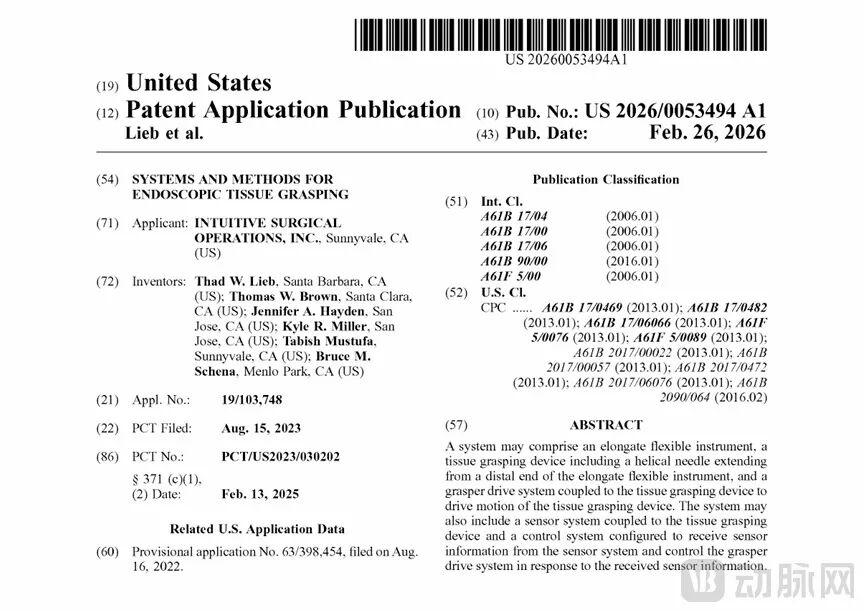
Intuitive Surgical's patent US20260053494A1 involves a set of force feedback systems. The clinical pain point solved by this patent is: when performing minimally invasive endoscopic surgery (such as passing through natural human lumens like the lung trachea and gastrointestinal tract), doctors often need to fix, traction or grasp the target tissue (for example, for biopsy sampling or resection). Because the inside of the minimally invasive channel is very narrow and the path is curved, the traditional straight-head forceps are difficult to exert force effectively or grasp the tissue firmly in places with large curvature, which is very prone to slipping or causing accidental tearing of surrounding normal tissues.
To solve the above problems, Intuitive Surgical has invented a brand-new spiral tissue grasping device, whose core structure and control mechanism are as follows:
● Helical Needle: This grasping device includes a helical (spring-shaped) needle extending from the distal end of the flexible surgical tool. When it is necessary to grasp the target tissue, the needle can rotate like a "wine bottle opener" to drill into the target tissue in a spiral manner. This structure can provide extremely strong anchoring force and prevent the device from slipping during operation.
● Sensor-Based Closed-Loop Control: This system includes a special Grasper Drive System to drive the rotation and forward/backward movement of the helical needle. The key is that it integrates a set of Sensor System, which can capture the resistance, torque when the needle penetrates the tissue, or the tiny deformation fed back by Fiber Shape Sensing in real time.
Overall, Intuitive Surgical's flexible gastrointestinal surgical robot not only adopts the latest force feedback technology of da Vinci 5, but also combines the tissue grasping experience of the pulmonary interventional robot Ion. In terms of design, it is a flexible gastrointestinal surgical robot that can complete the whole process of operation, perform endoscopic suturing, and is equipped with force feedback.
IG1000 is different from existing products. At present, the research on intracavitary flexible surgical robots mainly focuses on the use of end-effectors. During the operation, the navigation of the endoscope's advance and retreat still requires the assistant to manually control to complete the large movement of the lens or the replacement of instruments. There are few endoscopic robot systems equipped with force feedback on the market currently.
From the perspective of clinical experience, the ultimate vision of this product may be: to allow doctors to easily complete the originally complex and difficult endoscopic treatment operations just like operating a game controller.
02 How Will the Flexible Endoscope Leader Fight Against the Surgical Robot Leader?
Intuitive Surgical is not the first player to notice this market. At present, enterprises including Olympus, EndoQuest, EndoRobotics, Swan EndoSurgical, and domestic Robo Medical, Aohua Endoscopy have all entered the track. Leading enterprises in the global digestive endoscopy field are accelerating the commercial implementation of surgical robots, and the entire industry has moved from the proof-of-concept stage to a period of rapid development.
Among them, Olympus has adopted a dual-track strategy of "external cooperation + independent R&D". In terms of agency introduction, Olympus has reached an exclusive global distribution agreement with South Korea's EndoRobotics, incorporating its robotic products into its own product matrix, focusing on improving the accuracy and surgical efficiency of Endoscopic Submucosal Dissection (ESD).
In terms of independent R&D, in July 2025, Olympus announced a strategic cooperation with private equity firm Revival Healthcare Capital. The two sides will jointly invest up to 458 million U.S. dollars (about 3.3 billion RMB) to establish a joint venture Swan EndoSurgical, focusing on the development of a new generation of intracavitary surgical robot systems.
Olympus said that adopting the entrepreneurial operation model in cooperation with private equity can not only maintain organizational flexibility, but also make full use of its own core technology accumulation. The products planned to be developed by Swan EndoSurgical are technically differentiated from most existing products, but the project is still in a very early stage.
In the international market, the digestive endoscopy surgical robot with relatively fast progress comes from EndoQuest. EndoQuest's intracavitary gastrointestinal surgical robot has completed the registration of its key PARADIGM trial Investigational Device Exemption (IDE) study, and officially used the surgical robot to carry out ESD surgery, marking a key step of its product towards commercialization.
The domestic market is also progressing rapidly, and some products have been successfully approved and achieved commercial sales. In March 2025, Robo Medical's digestive endoscopy surgical robot EndoFaster® was approved by the National Medical Products Administration of China, and dozens of units have been sold within the year. Meanwhile, the company is actively promoting the R&D of the next-generation product EndoDreams.
Aohua Endoscopy, the leading domestic flexible endoscope enterprise, has made important breakthroughs in the field of ERCP surgical robots. On May 7, 2026, its ERCP surgical robot officially passed the special review procedure for innovative medical devices of the National Medical Products Administration, and completed the demonstration of practical operation application of the surgical robot in cooperation with Nanjing Drum Tower Hospital at the same time.
According to the disclosure in Aohua Endoscopy's semi-annual earnings communication meeting, this product innovatively uses mechanical means to replace traditional manual operations, realizes remote control and closed-loop control, and ensures surgical safety through the force feedback mechanism. This design can not only significantly reduce the X-ray exposure time of medical staff during the operation and effectively reduce radiation hazards, but also meet the international quality benchmark requirements for ERCP in core indicators such as surgical operation safety, bile duct intubation success rate, and complete common bile duct stone clearance rate, reaching the global leading level.
Aohua Endoscopy's ERCP surgical robot aims for commercialization in the global market. In terms of registration progress, Aohua Endoscopy has cooperated with Nanjing Drum Tower Hospital, Qilu Hospital of Shandong University, Wuxi People's Hospital, the First Affiliated Hospital of Nanchang University and other medical institutions to carry out global multi-center clinical trials simultaneously, and nearly 100 surgeries have been completed so far. The company expects to complete the registered clinical trials and officially enter the application stage in the fourth quarter of 2026, and plans to obtain the domestic registration certificate around the third quarter of 2027. At the same time, CE certification and FDA certification are also being promoted simultaneously, helping the company to achieve a truly global layout.
Gastrointestinal intracavitary surgical robots are at a critical inflection point from "technical verification" to "clinical standard configuration". For a market that is still in its early stage, the entry of Intuitive Surgical is not so much adding a competitor as welcoming the most powerful market developer.
After all, this company has promoted laparoscopic surgical robots from scratch to a cumulative total of 16 million surgeries worldwide, and has accumulated profound and systematic capabilities in commercial implementation, global market expansion, doctor training system construction, and market education. These are exactly what the current track development needs.
* References:
【Special Forum】Research Status and Prospect of Flexible Digestive Endoscopic Surgical Robots — Chinese Journal of Gastrointestinal Surgery
Intuitive Endoluminal Gastrointestinal System (IG1000)—Steve Bell
This article is from the WeChat Official Account "Artery Network" (ID: vcbeat), author: Yang Xue, authorized for release by 36Kr.