Breaking: OpenAI has completely cut off supply to Cursor
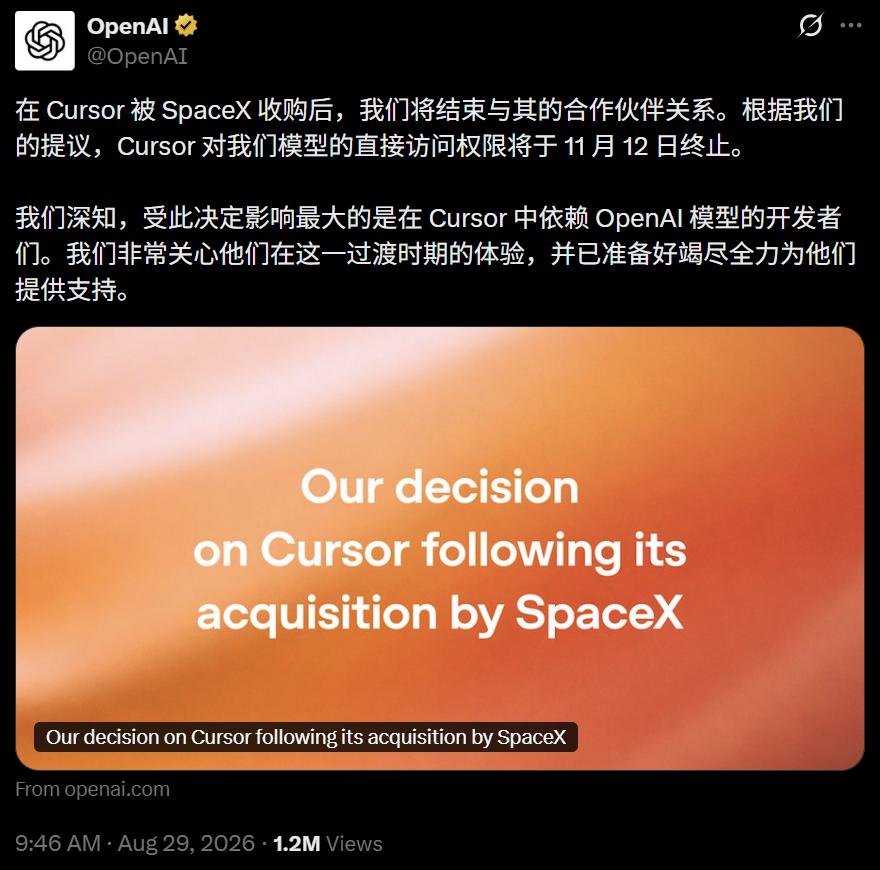
According to the plan, Cursor's direct access to our models will be completely terminated on November 12.
As for Astra, the next-generation most powerful model, it will never be available through official channels.
The reason is very simple.
Your boss has a prior record of breach of contract, we do not trust him.
Fifteen days ago, when Elon Musk bought Cursor for 60 billion, everyone said the exact same sentence —
The Cursor that belonged to global developers is dead.
Sure enough, that was just the opening.
But Cursor is not the worst off. It lost GPT, but still has its own boss's Grok to rely on.
The worst off are the millions of developers who open it every day, and they don't even have the right to speak up about this matter.
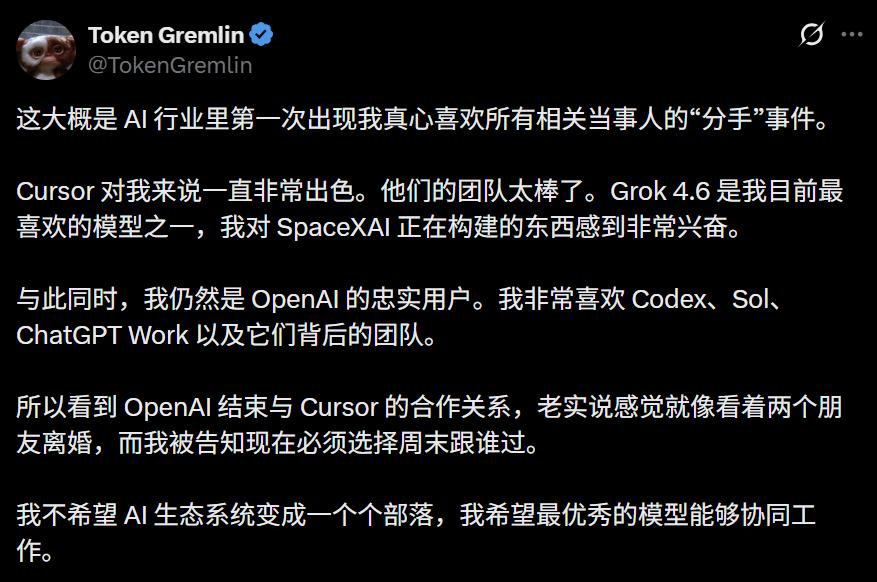
Seeing OpenAI end its cooperation with Cursor, to be honest, it's like watching two friends get divorced and then being told I have to pick who I get to spend the weekend with. I don't want the AI ecosystem to split into separate tribes, I want all the best models to work together.
Developers only have 75 days left
For developers, there are three things that need to be figured out today.
First, the date.
Before November 12, everything about GPT in Cursor will remain as usual, you can keep using it. After that, all official direct connections will be cleared.
Counting from today, that's 75 days.
Second, the most powerful Astra was never intended to be provided at all.
It's not that it won't be provided after the expiration, it's that it won't be provided starting right now. This is OpenAI's unreleased next-generation model, and it is also its most powerful core asset in hand.
Third, two paths of survival are still reserved.
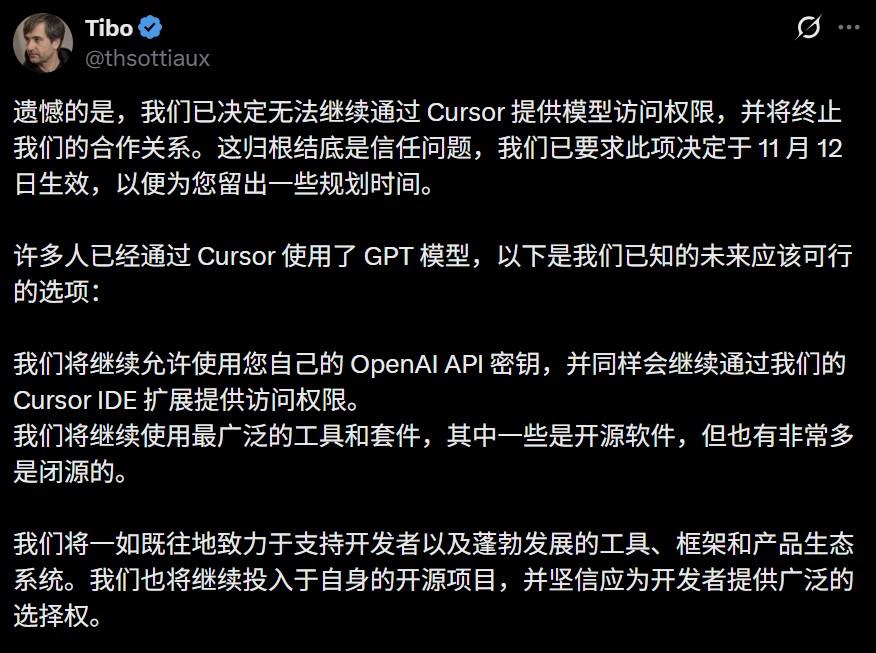
Tibo Sottiaux, known by the nickname "godfather" of OpenAI, later posted on social media saying:
Developers can bring their own OpenAI API Key and continue to use the service.
OpenAI's own Cursor IDE extension will also continue to provide access.
Therefore, GPT will not be physically erased from the Cursor software. What is being cut off is the direct connection contract that Cursor used as an official channel.
The difference between the two modes is:
In the past, Cursor purchased models in bulk from OpenAI, packaged them into its own subscription and sold them to you. You pay a monthly fee, and the quota includes GPT. If you exceed the limit, you renew at Cursor's price, and you turn to Cursor for support if there is a problem.
After that, you have to register an API Key on OpenAI by yourself, fill it in Cursor, and pay OpenAI directly by token. The bill has nothing to do with Cursor, the quota has nothing to do with the subscription, and the rate limiting and service stability are also managed by yourself.
It has changed from an all-inclusive monthly subscription to self-pay. For heavy users, this is a real price increase.
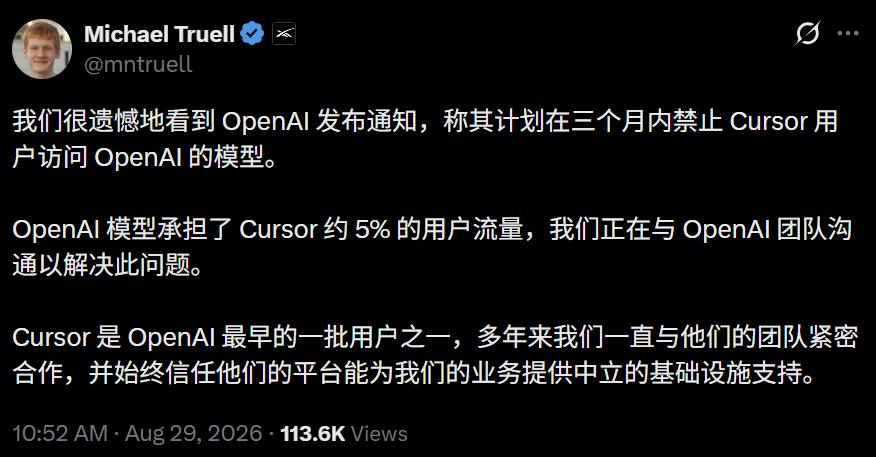
Just one hour after the announcement was released, Michael Truell, co-founder and CEO of Cursor, made an urgent response.
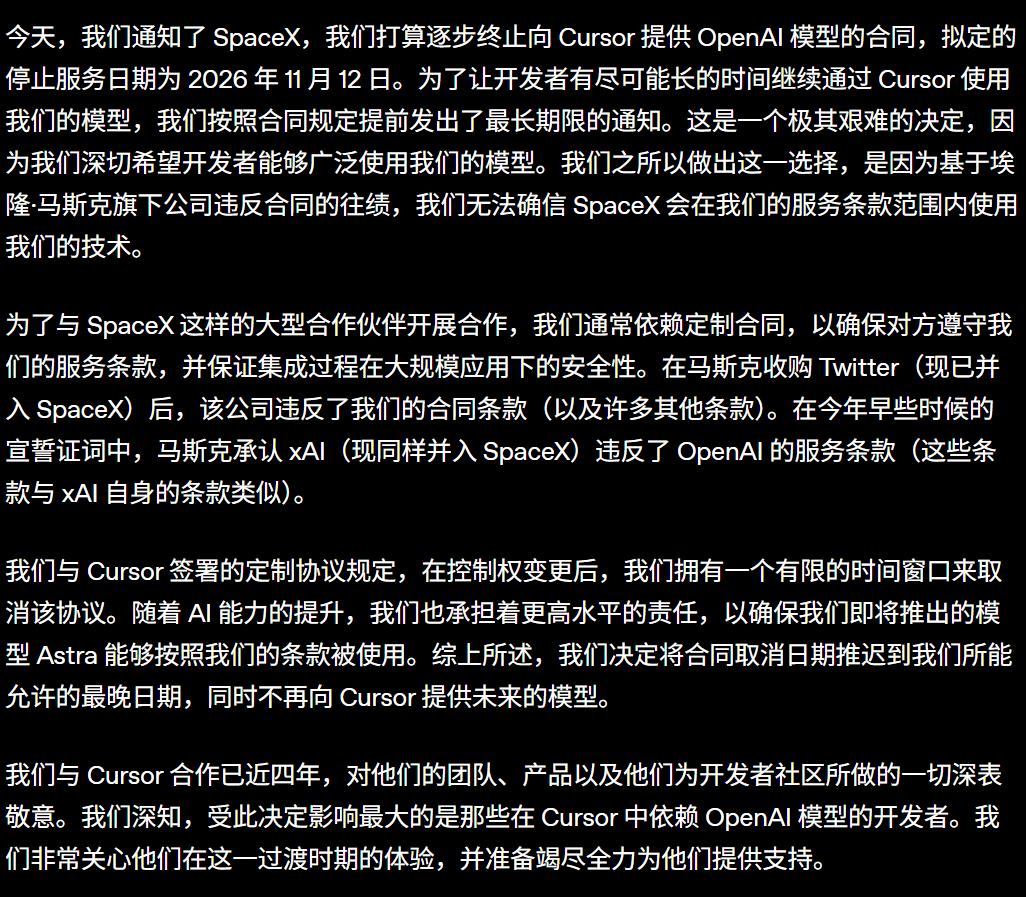
He said OpenAI's models account for about 5% of Cursor's user traffic, and the two sides are negotiating, hoping to resolve this matter.
In addition, this statement directly put OpenAI in an awkward position:
Cursor is one of the earliest users of OpenAI. We have cooperated with their team for many years, and we have always trusted that their platform will act as a neutral infrastructure.
The negotiation has not been completed yet, but this statement has been made public.
The implication is extremely obvious: it is you who are not neutral, not us.
The most powerful core asset will never be given to Elon Musk
In fact, someone warned about this two months ago.
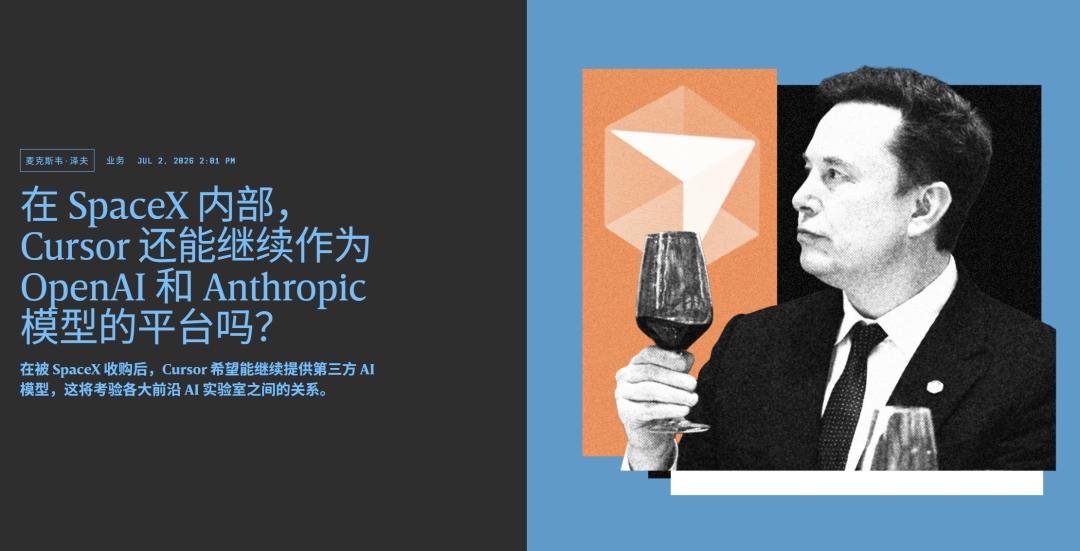
In an article published by WIRED on July 2, two possible scenarios were pointed out:
After the acquisition is completed, SpaceX may be unwilling to divert its business to Anthropic and OpenAI;
Conversely, Anthropic and OpenAI may also be unwilling to sell models through a product owned by Elon Musk.
Two months later, the latter part of the prediction came true.
OpenAI is tougher this time than everyone expected.
Because it has Astra in hand.
On August 7, OpenAI took the initiative to issue an announcement, in which a sentence made the entire cybersecurity circle feel deeply concerned: they cannot rule out the possibility that Astra will reach the "Critical" level of network capability.
In other words, this model can independently identify and develop exploits that compromise real-world critical infrastructure.
For this reason, OpenAI has locked Astra in an isolated test environment, restricted its network and tool access, added extra encryption to the model weights, and suspended a number of non-compliant internal projects.
Such a high-stakes model was never meant to be distributed casually.
What's more, the person waiting to take over this model is Elon Musk.
The long-running feud between Sam Altman and Elon Musk is widely known.
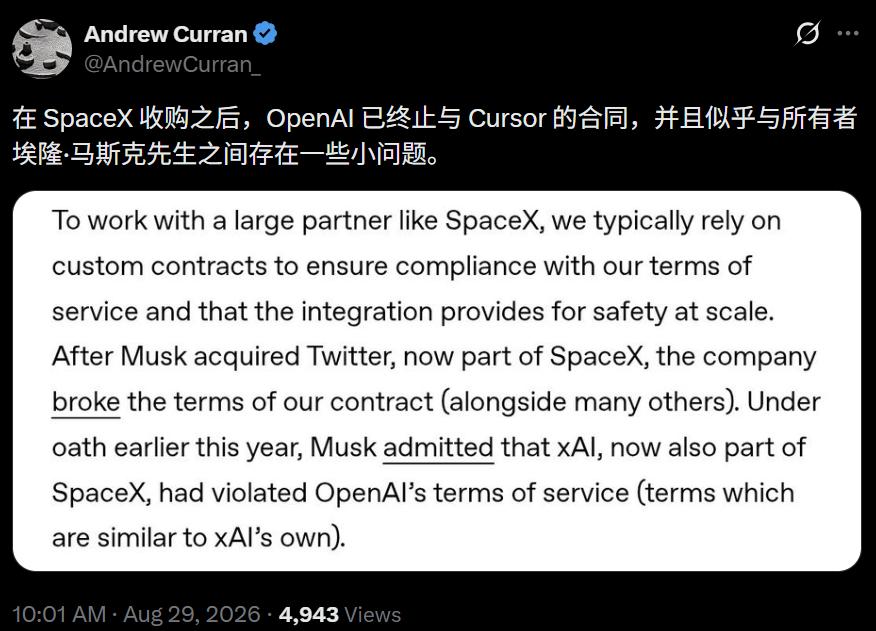
In April 2023, The New York Times reported that after Elon Musk acquired Twitter, the company violated the terms of its contract with OpenAI. Twitter is now part of SpaceX.
On April 30, 2026, Elon Musk admitted under oath in his testimony that xAI distilled OpenAI's data to train its model, which violated OpenAI's terms of service. xAI is also part of SpaceX today.
A person who has a proven record of breaching contracts has just bought your largest distribution channel, and you hold a model that can write zero-day vulnerabilities.
If you were in this position, would you give it to him?
So for Cursor users, what they lose is not just access to today's GPT. Every subsequent capability upgrade of OpenAI will be completely out of their reach.
Can Grok make up for this gap? Elon Musk has already given the answer himself.
On August 15, the day after the acquisition was completed, Musk directly expressed his concern at the first all-hands meeting of Cursor after the acquisition, in front of more than 1000 new employees.
Grok is not the market leader, it is in urgent need of catching up.
Spending 60 billion to buy the most powerful AI programming tool, and admitting the next day that his own model cannot match its performance, is somewhat ironic.
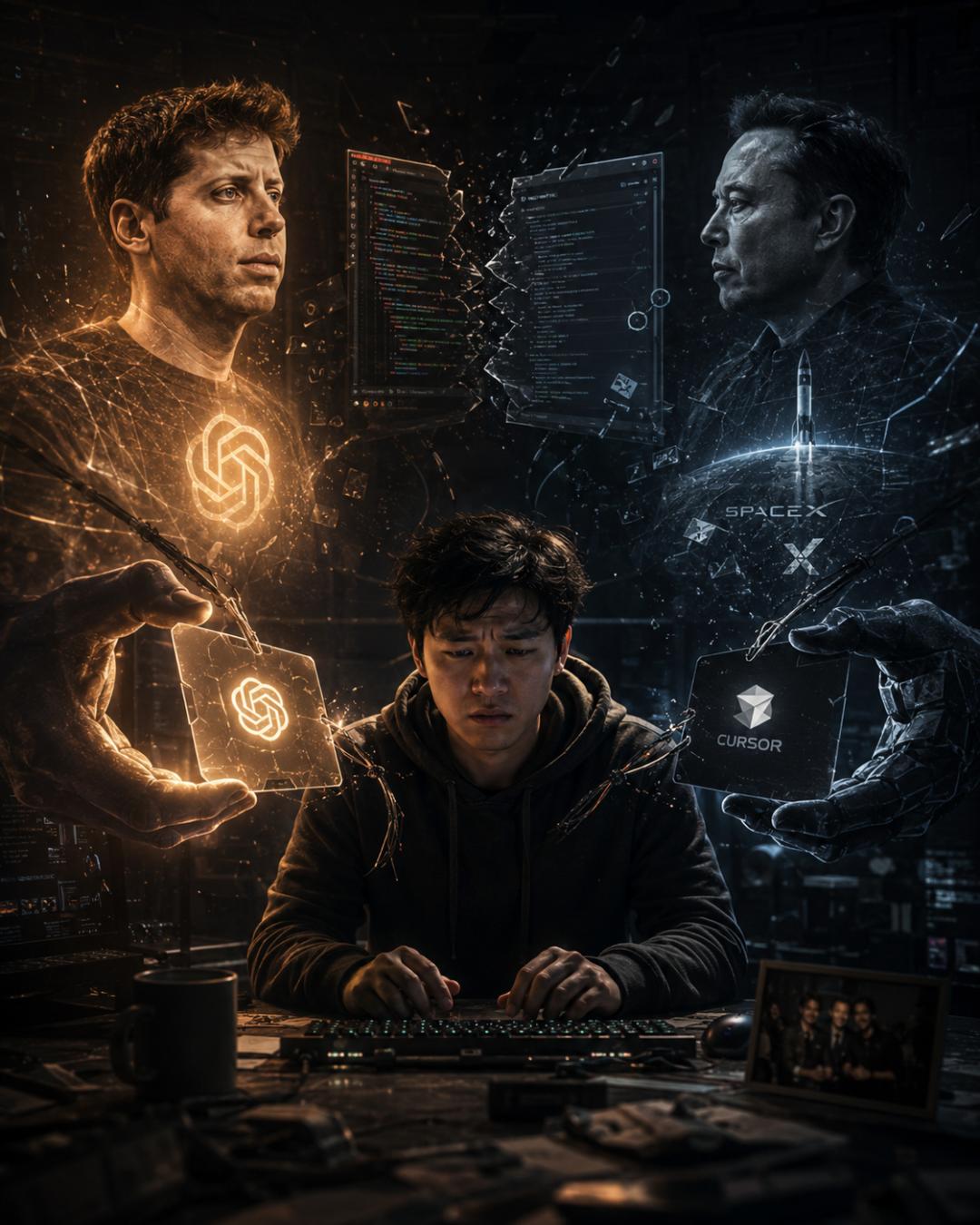
In 90 days, the entire AI programming industry landscape has been reshuffled
What's even more remarkable is that this is not an isolated incident only happening to Cursor.
Sort out the major events in the AI programming circle in the past two years in chronological order, and you will find that the same pattern is repeating itself over and over again.
In June 2025, Anthropic cut off Windsurf's access to Claude.
In August 2025, Anthropic revoked OpenAI's own access permission to Claude.
In January 2026, Anthropic blocked xAI. At the same time, the consumer subscription integration of Claude in Cursor stopped working.
In February 2026, SpaceX fully acquired xAI and merged it into SpaceXAI.
On August 14, 2026, Cursor was acquired by Elon Musk.
On August 29, 2026, OpenAI cut off model supply to Cursor.
Four years ago, Cursor proved one thing: you don't have to own models to build a company worth tens of billions of dollars.
Today, the second half of this statement has been completed — if you do not own the models, you do not have the final decision-making power.
Acquisitions, blockades, and service shutdowns appear alternately, with the interval between them getting shorter and shorter.
Cursor has an annualized revenue of 3 to 4 billion US dollars, and more than half of the Fortune 500 companies are using it. A service of such a large scale can be cut off without any buffer period.
November 12.
Remember this date.
References:
https://openai.com/index/our-decision-on-cursor-following-its-acquisition-by-spacex/
Editor: Moses
This article is from the WeChat public account "AI Era", Author: ASI Revelation, 36Kr published it with authorization.