The hottest new jobs in Silicon Valley have set the clear elimination threshold for the workplace in the AI era.

If a traditional bank wants to use AI to automate the work of its veteran analyst employees, what should it do as the first step?
A company has already purchased AI services and built its own AI system, but reports that the system is not usable at all. Is the problem rooted in the AI model, data, permissions, or a wrong workflow selection?
The management wants the Agent to modify the existing production system directly, but the security team firmly opposes the move. Who should the engineers listen to?
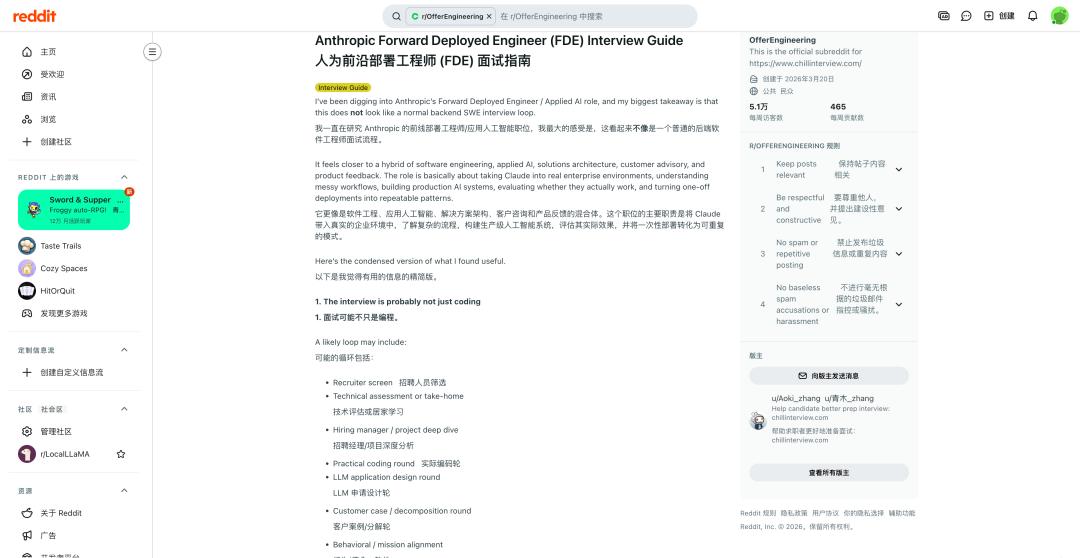
These questions come from an Anthropic FDE interview guide shared on Reddit. The post fully introduces what preparations a candidate had better make to land this FDE position at Anthropic.
What is FDE, this role that has recently risen to fame in Silicon Valley, and why has it suddenly become a highly sought-after entry on AI companies' recruitment pages?
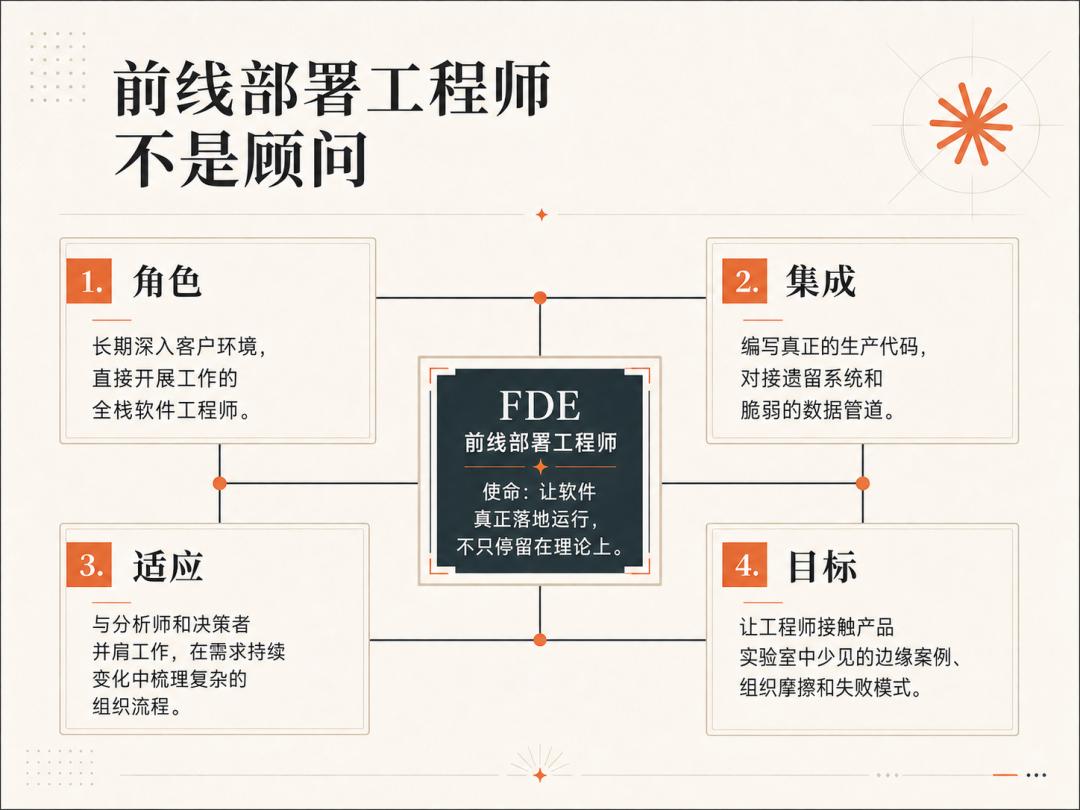
The full name of FDE is Forward Deployed Engineer, often referred to as forward deployment engineer or frontline deployment engineer. This type of engineer not only writes production code, but also has in-depth knowledge of Agent, evaluation and security; they need to work on the customer's site, and also decide which problems are worth solving.
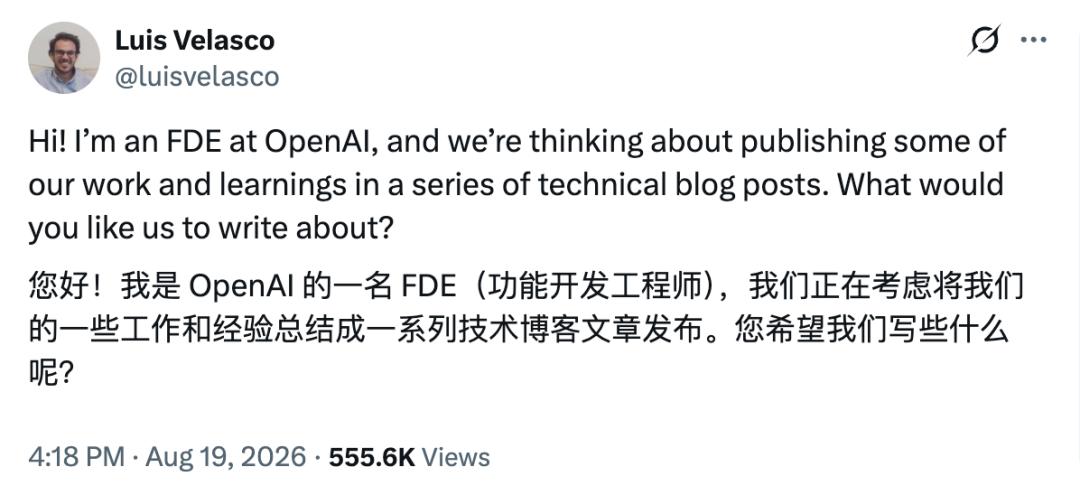
OpenAI has established an independent Forward Deployed Engineering team, recruiting talents in San Francisco, Seattle, Tokyo, Seoul, Singapore and other regions; Anthropic calls its newly joined members "founding FDE".
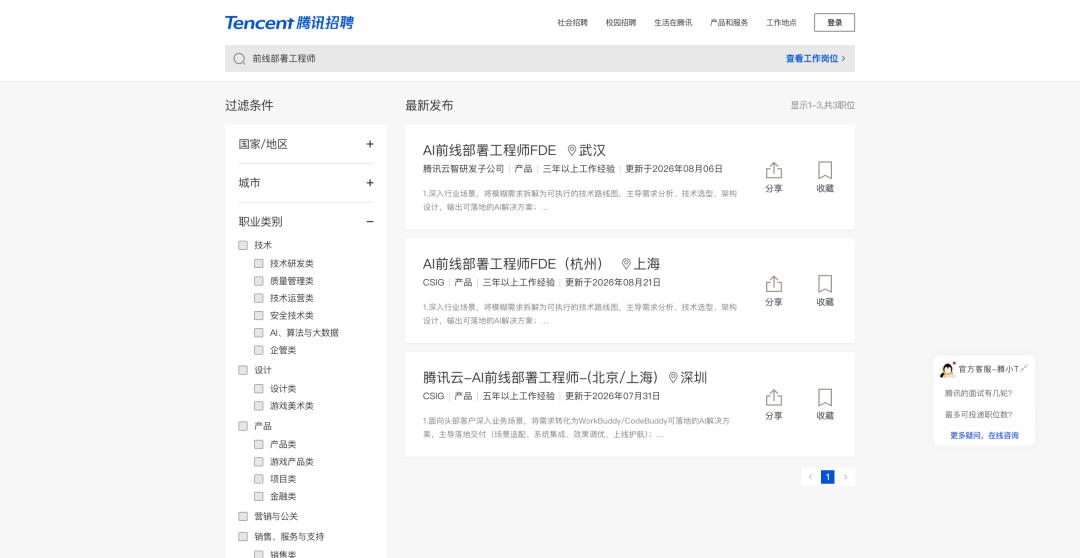
Major domestic tech giants including ByteDance and Tencent have relevant FDE positions. Tencent has released three frontline deployment engineer roles in its social recruitment, all requiring more than 3 to 5 years of work experience, which fall under the product job category.
ByteDance directly names the role AI FDE Engineer, without using similar translations of "frontline deployment engineer", placing it under the R&D job category, and the recruited positions cover Feishu, Volcano Engine, and the data platform.
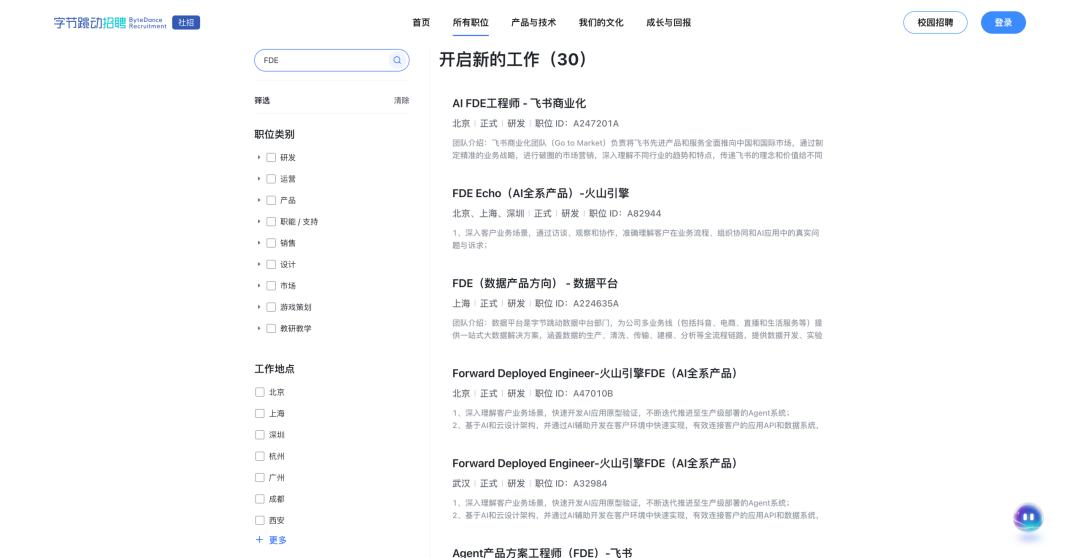
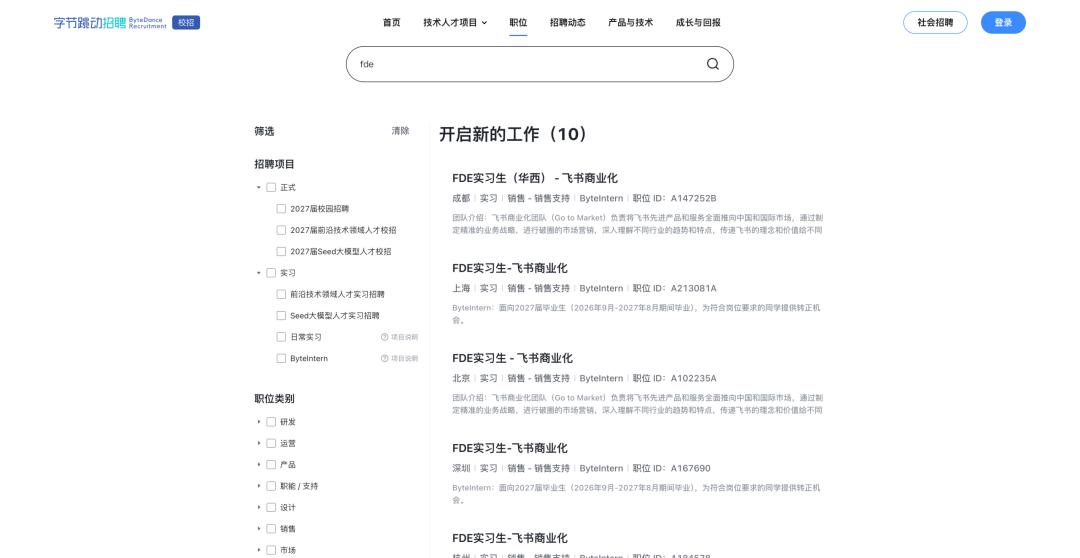
There are even FDE positions for interns, but the FDE intern role at ByteDance falls under the "Sales - Sales Support" category.
People have been saying all the time that AI will only take away human jobs. What exactly is this FDE position that emerged thanks to AI, and can I also apply for it?
Surge by 42 times since 2023
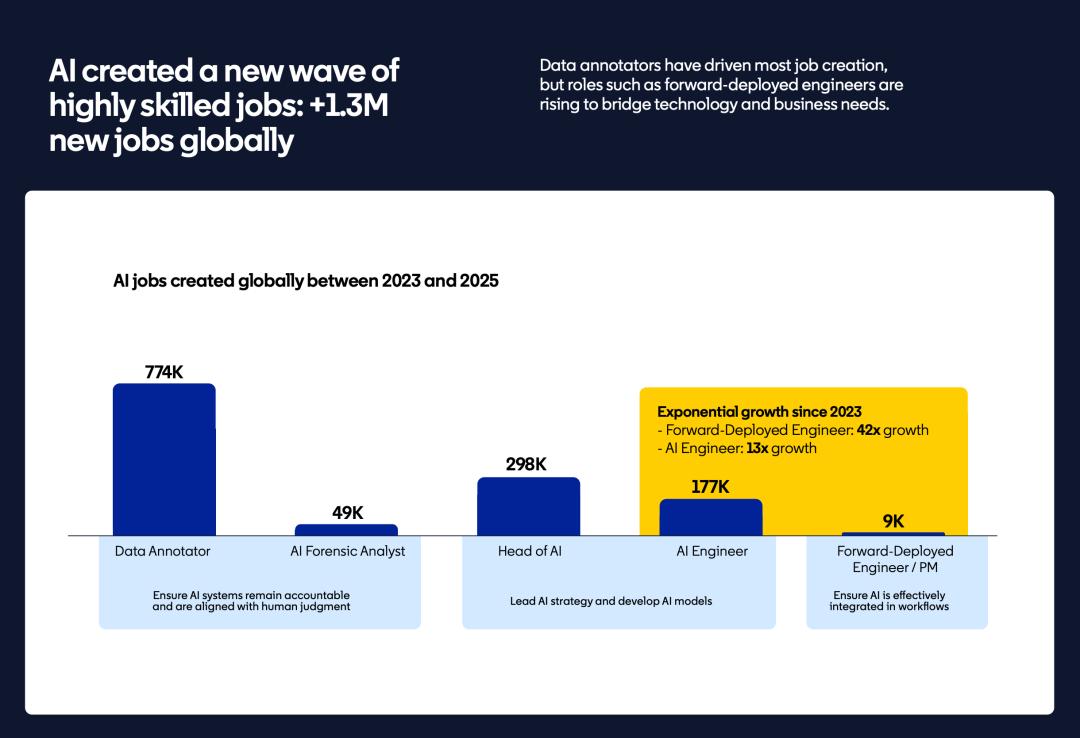
According to LinkedIn's Global Workforce Report released in January 2026, the number of Forward-Deployed Engineer positions has increased by 42 times since 2023, while the number of AI Engineer positions increased by 13 times over the same period.
According to data from recruitment platform Indeed, there were only 643 FDE positions across the platform in April 2025; by April 2026, this figure rose to 5330, more than 7 times over one year. The Wall Street Journal directly called it "the hottest job in the tech industry".
It sounds very trendy, but this position actually has a history of nearly 20 years. It was first created by a US company to address the scenario where customer data required high confidentiality and customers could not clearly state their specific requirements, so the company simply "deployed" engineers at the customer's site.
In their own words, the essence of this position is: Ordinary engineers use one set of capabilities to serve all customers, while FDEs use all their capabilities to serve one customer.
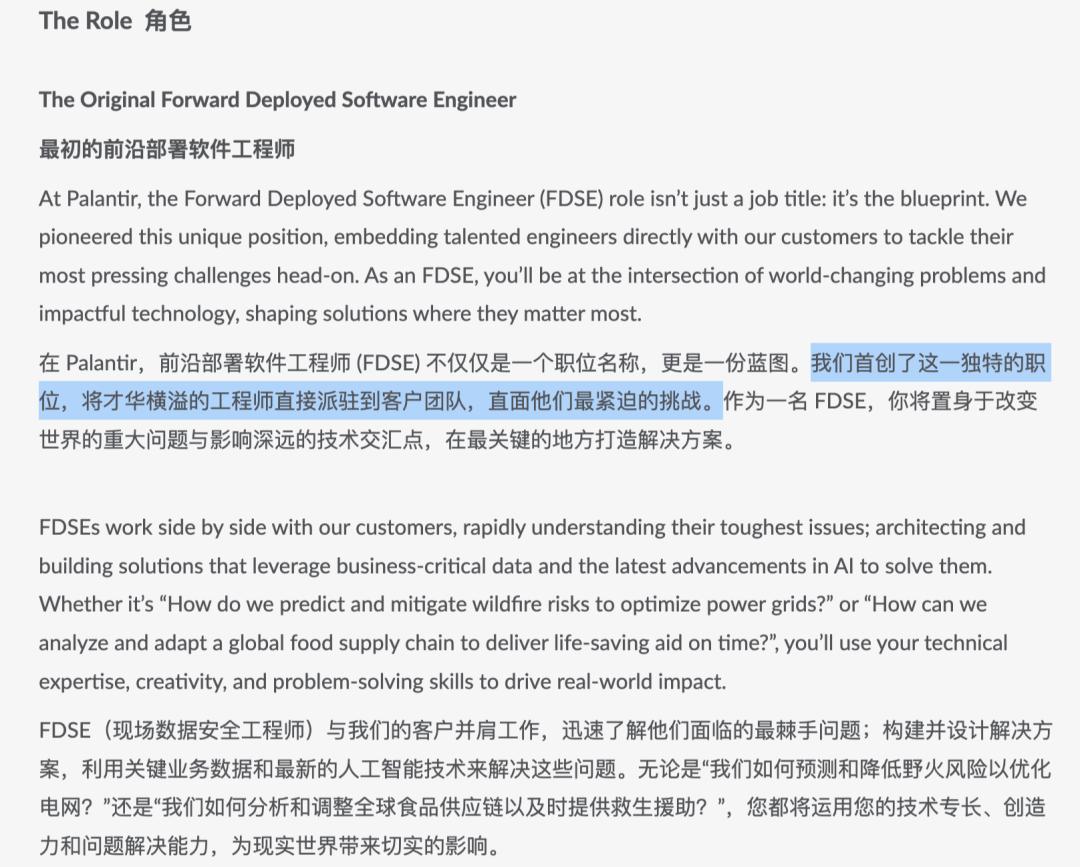
On the company's job recruitment page, it also writes that "we pioneered this unique role to place talented engineers directly on customer teams to face their most pressing challenges head-on."
Twenty years later, various large language models perform flawlessly in demo presentations and for individual users, but they encounter all kinds of incompatibilities once connected to the real systems of enterprise teams. To truly apply AI to a broader market, the "last mile" seems to have become the biggest reason for various companies to recruit FDEs.
Therefore, a full-fledged FDE needs to participate in problem identification, technical scoping, architecture design, development, launch and user adoption. After the project is completed, they also need to judge which content is only applicable to this specific customer, and which content should be turned into shared components, reference architectures or core product capabilities.
This practice used to be somewhat incompatible with the standard SaaS model. Software companies pursue one-time development and repeated sales, but FDEs put expensive engineers back into each customer project. And all of this is made reasonable by AI, which justifies this manpower input.
What will be tested in the FDE interview
We can see the specific job responsibilities, job requirements and bonus points from the JD listed in Tencent's recruitment posting.
Generally speaking, FDEs are required to have a bachelor's degree or above in science and engineering related majors such as computer science, software engineering, mathematics, physics and AI, with more than 3 years of engineering or toB delivery experience.
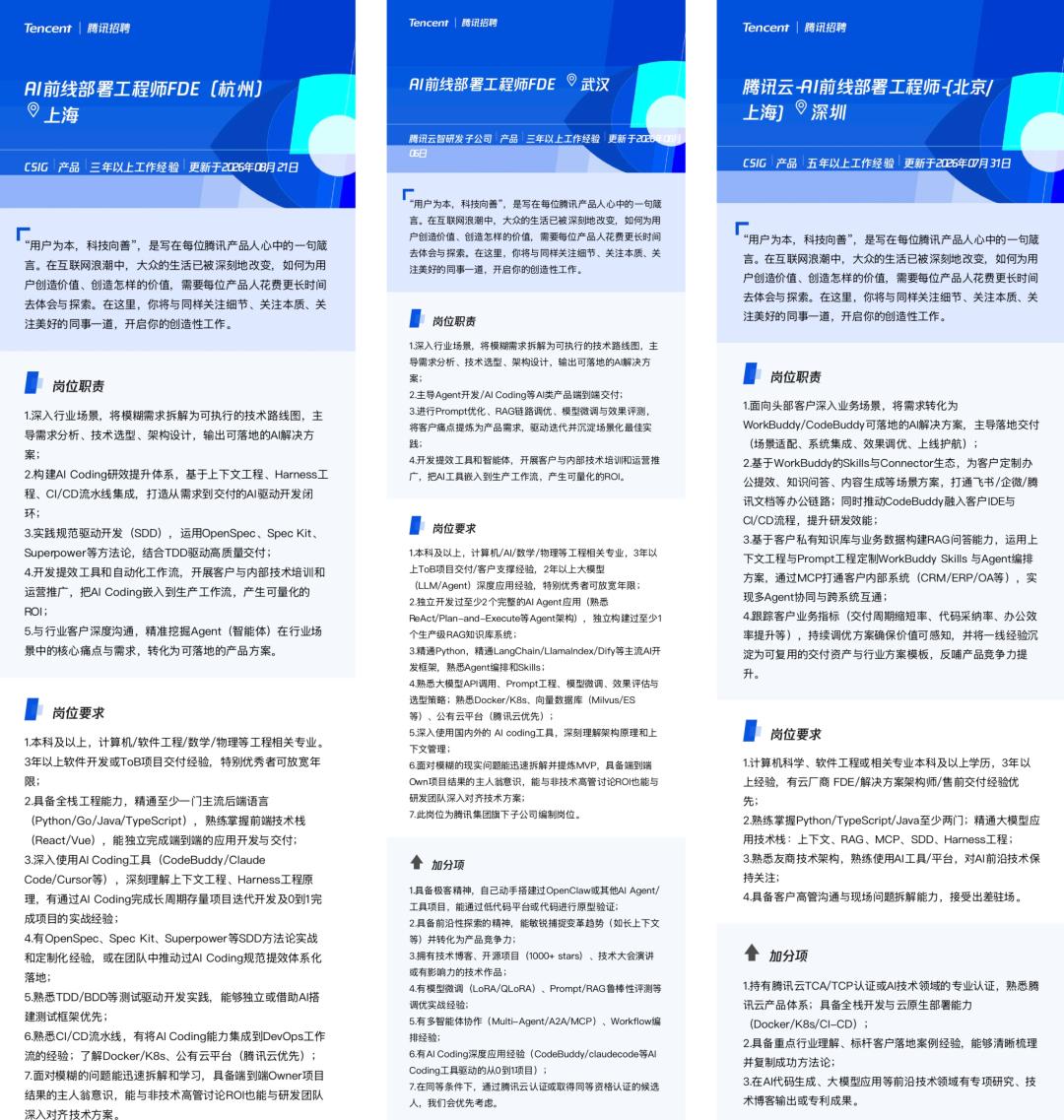
The most important requirement is to master various AI application technology stacks, various Agent products, and be proficient in professional terms in the AI circle such as RAG, Prompt, model selection, Harness, fine-tuning, Skills, MCP, Multi-Agent and so on.
The specific work content is similar to the FDE work details introduced above: FDEs need to go to the customer's site, turn vague business requirements into an AI system that can be launched, promote customers to actually use it, and be responsible for the delivery effect and ROI.
In addition, having hands-on experience in building OpenClaw or other AI Agent tool projects counts as a bonus point. The tutorial we previously wrote covering the whole process from OpenClaw installation to uninstallation can also be of great help.
Swipe up and down to view more content
The interview guide post shared on Reddit directly divides the Anthropic FDE interview process into roughly five stages, and each stage answers the same question: Can you integrate Claude safely into any enterprise's business?
The initial HR screening requires candidates to explain why they choose the on-site position instead of traditional R&D work, where your motivation outweighs everything else.
Then there is the technical scenario interview centered on the deployment deduction of toolchains such as Claude + MCP. This round mainly assesses how candidates manage the context window and how to solve the unreliability problem caused by ultra-long context.
Anthropic may directly grant interview candidates access to Claude, allowing them to answer questions while using the tool.
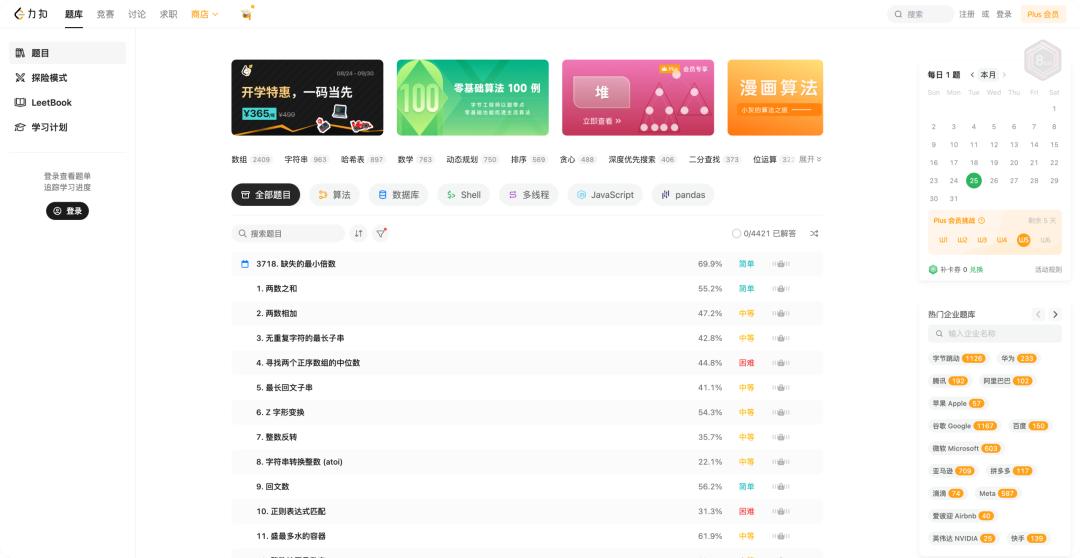
Since the role bears the title of engineer, the coding round interview is essential. In addition to brushing a large number of algorithm questions on LeetCode, this guide recommends doing targeted question brushing, such as building a Claude quota limiter, refactoring a retry queue, building a small connector with a simulated database, and developing a task scheduling system.
After the technical interview comes the customer simulation round, which is widely rumored in the industry to have the most brutal pass rate. Some institutions estimate that about 60% of candidates who pass the technical round fail at this stage.
The interviewer will play the role of a non-technical enterprise executive and a picky architect, and candidates cannot open the code editor, they need to complete requirement discovery entirely through questioning.
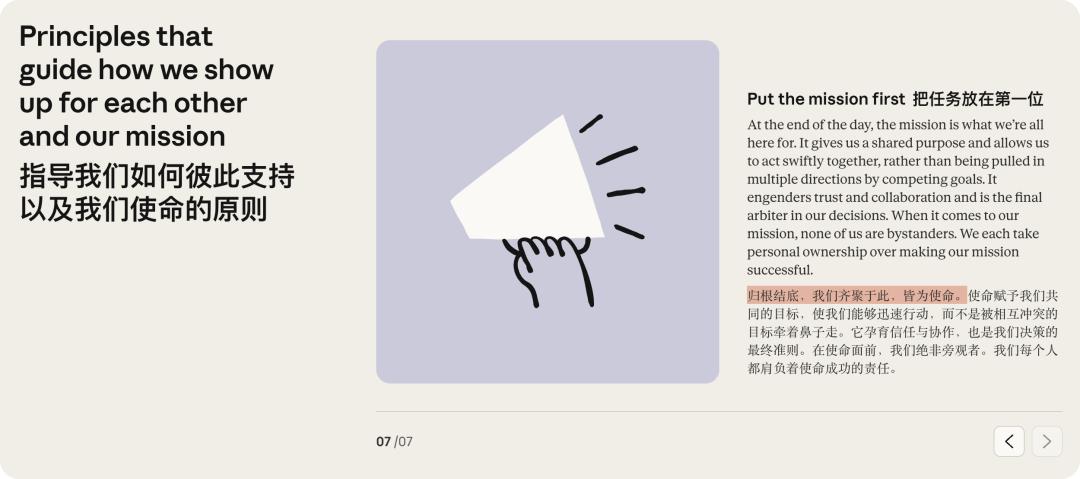
The last round is Anthropic's signature level, which is widely recognized as the most difficult part of the whole interview. It was also widely discussed on social media platforms some time ago: Anthropic's CEO is worried that the people they recruit only care about money and do not recognize the company's mission.
Therefore, the questions in this round will dig deep into moral conflicts, pressure from superiors, and "how did you feel at that time". Some foreign media reported that some interviewees will be directly asked "If there is a conflict between the company's mission and making money, how will you choose?"
How would you feel if the company abandoned its artificial intelligence plan for security reasons one day, and this decision caused the company's stock price to drop to zero?
The Anthropic job seeker interviewed also asked foreign media not to disclose any of his personal information, for fear that it would affect his future employment opportunities.
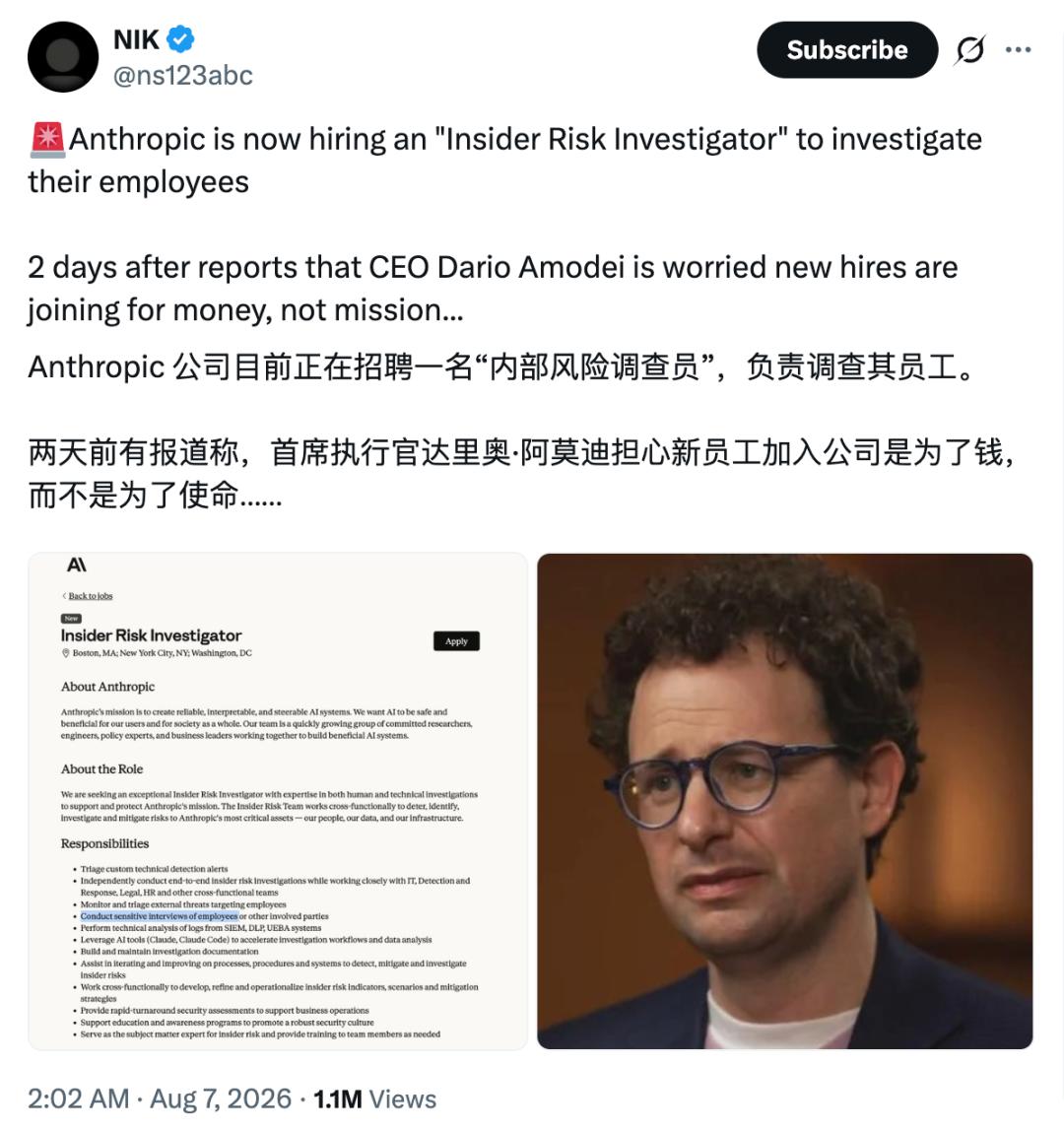
Anthropic is also recruiting an "Internal Risk Investigator" responsible for monitoring and classifying external threats against employees
Apart from Anthropic's pursuit of mission, the FDE assessment actually covers capabilities of algorithm engineers, Prompt engineers and pre-sales consultants, combining different roles including product managers, solution architects, full-stack engineers, and customer delivery leads.
In terms of salary, the annual salary offered for FDE at Anthropic ranges from 1.88 million to 2.15 million, which is at the high end of applied, customer-facing delivery engineering roles, with its upper limit exactly hitting the starting point of senior software engineers and general software engineers; the salaries of research engineering roles for core model, training, and evaluation are still higher.
Talents in the AI era
The talents in the future AI era are not those who are best at writing Prompts, but those who understand the industry and know how to integrate AI into the traditional processes of different industries. They are the FDEs.
There are a huge number of similar comments on the Internet, especially under various popular science and training posts about FDE.
Remember when Prompt first became popular, the most sought-after people were those who could write Prompts; when Harness became popular, the most sought-after people were those who could build Harness. Now it seems that the most sought-after people have become FDEs.
The job titles of Prompt engineer, Harness engineer, and FDE keep changing round