Focus on the Endogenous Value of Space: China's Path and Practical Entry Point for Deploying Computing Power in Space | OpenTalk Review
On August 26, the State Council Information Office held a press conference, where the Ministry of Industry and Information Technology introduced relevant situations about accelerating the advancement of new-type industrialization during the 15th Five-Year Plan period. It was clarified at the meeting that in the next five years, we will accelerate the development of emerging pillar industries such as aerospace and low-altitude economy, speed up the planning and construction of the new-generation communication network and computing power network, and strengthen 6G technology R&D. Policy signals for commercial aerospace and computing power infrastructure have been released intensively once again.
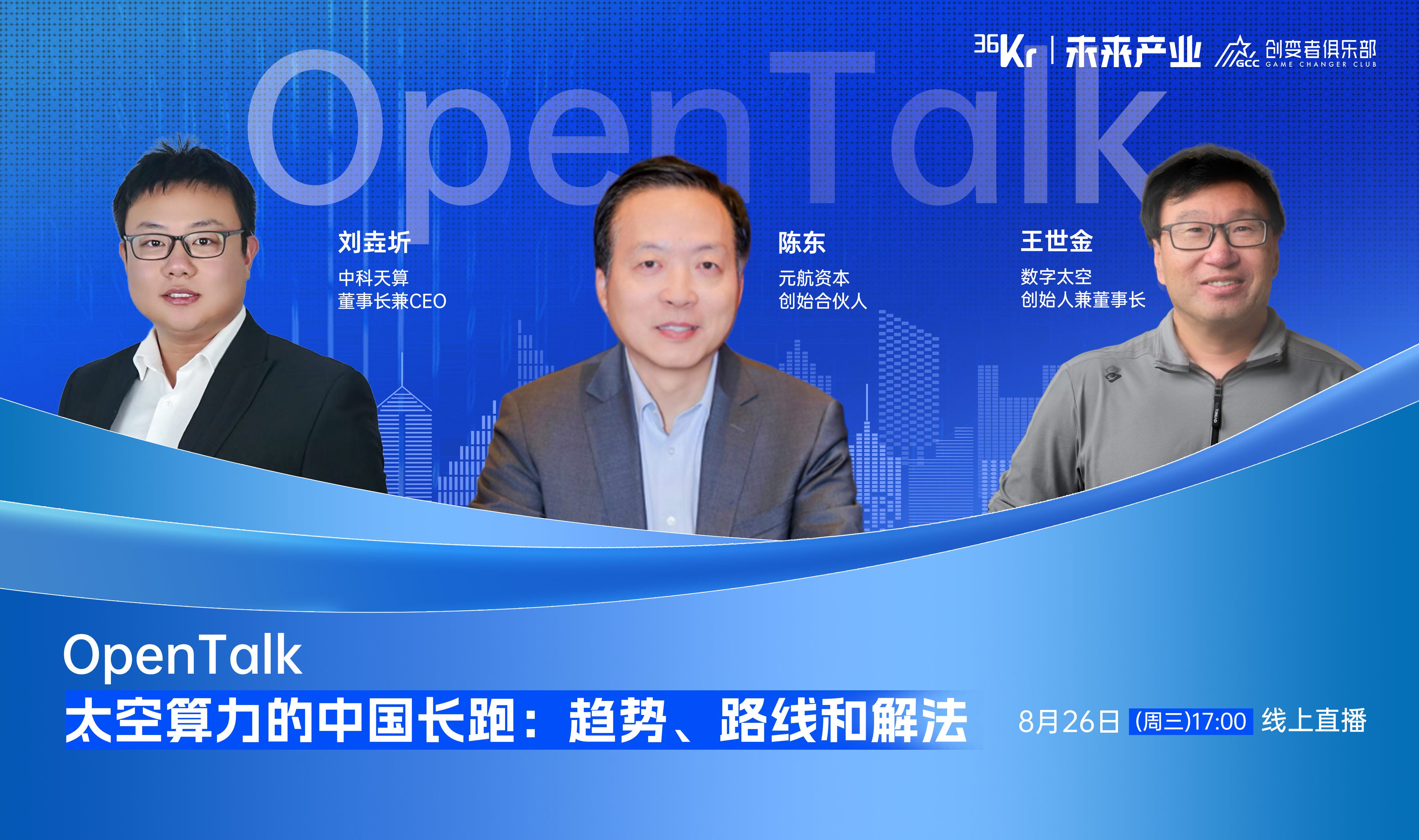
On the afternoon of the same day, 36Kr held an OpenTalk live event themed "The Long March of China's Space Computing Power: Trends, Paths and Solutions". It invited Liu Yaoqi, Chairman and CEO of Zhongke Tiansuan, Wang Shijin, Founder and Chairman of Digital Space, and Chen Dong, Founding Partner of Yuanhang Capital as guest speakers, who conducted in-depth sharing on topics including demand scenarios of space computing power, technical paths, differentiated logic of China's path, industrial opportunities and investment directions, and interacted with the audience online.
The following is a summary of key takeaways from this live broadcast. You are welcome to read, share and bookmark it.
How Far Is the "4G Era" of Space Computing Power
Guest Speaker: Liu Yaoqi, Chairman and CEO of Zhongke Tiansuan, Chief Commander of the "Tiansuan Plan", Deputy Secretary-General of CCF Special Committee on Fault-Tolerant Computing. His research directions are space-based computing and space-air computing power network. He has deeply participated in the design demonstration, standard formulation and test verification system construction of multiple satellite internet systems in China, and completed the development and deployment of the Aurora series on-board computers. He has published more than 100 papers and patents on relevant achievements. He has won the title of "6G Star Young Scientist", and was selected into the New Hundred Talents Program, the "High-Talent Program · Youth Talent Support Project" and other talent programs.
Key Sharing Words: Space-based computing infrastructure, space-based large model, space-based information ecosystem, space-native technology
There is still no industry-wide conclusion on whether space computing power is a real demand or a false proposition. From the demand side, ground data centers are faced with multiple constraints of power, land and heat dissipation; from the capability side, SpaceX has reduced launch costs by a hundred times and is betting heavily on space computing chips and computing power constellations. However, opponents believe that the cost of space data centers is difficult to be equal to that of ground data centers in the short term, and native technologies have not yet achieved breakthroughs. In response, Liu Yaoqi's judgment is: The boundaries of energy, living environment and information infrastructure are all expanding, and space computing power is a natural extension of this logic.
In terms of short-term implementation paths, intelligent remote sensing and intelligent communication are two clear main lines.
Intelligent Remote Sensing: Convert links such as radiometric calibration, reflectivity calculation, coordinate system conversion in remote sensing image processing, as well as intelligent models such as target recognition and change detection, into algorithm tasks. Its core resource demand is parallel computing power, that is, the number of operations that can be performed per unit time.
Intelligent Communication: A ground base station covers about one square kilometer and serves hundreds of users, while the beam of a single satellite covers thousands of square kilometers. The resulting network planning and network optimization problems also need to be solved with computing power.
When the role of satellites changes from data collectors to real-time service providers, the disruptive opportunities for consumer-grade applications are more worthy of attention. He cited an example: In the future, satellites can mobilize hyperspectral cameras and various sensors to locate fish schools for fishermen, and at the same time provide intelligent suggestions on the use of fishing gear, net harvesting time, selling price and other information. Applications like this may grow out of the satellite internet just like Didi and Ele.me in the past, redefining the way people interact with the physical world.
He compares today's satellite internet to the "1G era": when stepping into 2G, stable network and low-cost tariffs will give rise to a huge number of users and data; with the future leap of remote sensing capability and communication bandwidth capability, those seemingly non-rigid fragmented applications may replicate the outbreak path of the 4G era of mobile internet, setting off a new wave of satellite internet.
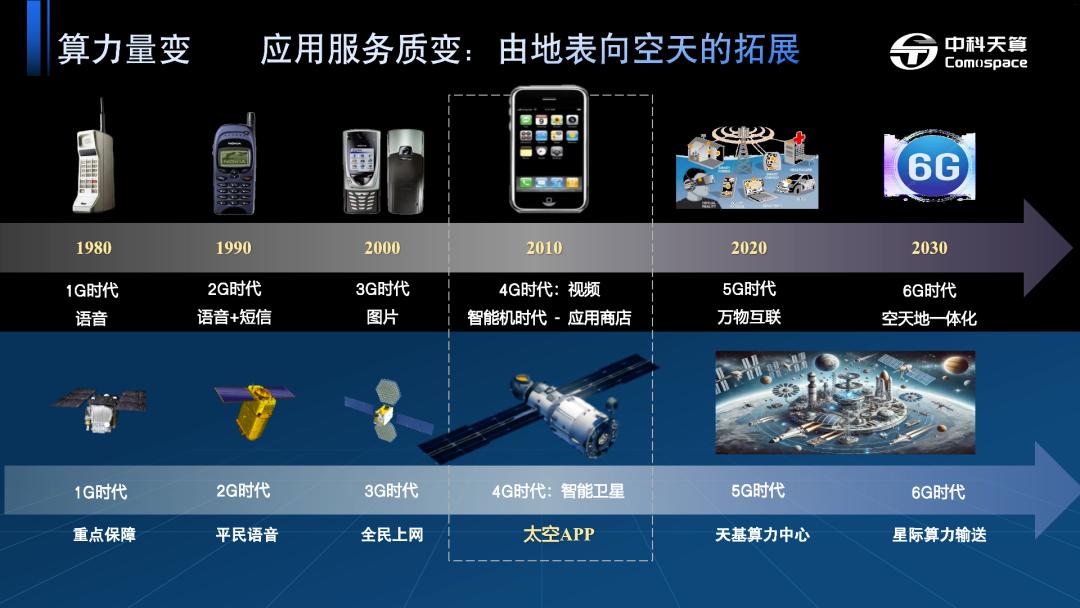
Deduction of the development trajectory of satellite internet
At the technical level, Liu Yaoqi believes that the physical boundary of the space environment is clear, and radiation, temperature difference, vacuum and weightlessness all follow regular patterns instead of being chaotic systems. Therefore, moving computing power to space is an engineering problem that can be broken through step by step, which is essentially "building a stable, reliable computer suitable for space that can output correct results".
Zhongke Tiansuan completed a verification in 2024: it deployed a large model on an in-orbit satellite through remote uploading, and successfully realized in-orbit image recognition and question answering. The significance of this experiment lies in the completion of the full link of "intelligent update" — just like updating apps on mobile phones, satellite intelligence can also be updated in orbit.
At the ecological level, his proposition is open source and open: Use an open technical system to lower the threshold for space application development, and ultimately realize computing power equity in the AI era. Ground computing power output is affected by infrastructure construction and geopolitics, while space has the ability to enable people from different countries, regions and industries to form local characteristic application ecosystems. This is the value that space computing power brings to the world.
China's Path: Do Not Compete on Computing Power, Only Compete on Value
Guest Speaker: Wang Shijin, Founder, Chairman and President of Digital Space, Second-Class Research Fellow, Director of the Joint Laboratory of Space-Air Digital Intelligence Technology. He is an expert of multiple industry associations, academic journals and field expert groups including the Chinese Institute of Electronics and Chinese Society of Management Science. He worked at the Space Center of the Chinese Academy of Sciences for 25 years, and is a leading figure in the field of satellite environment and effect detection in China. He is a national candidate for the New Century Hundred-Thousand-Ten Thousand Talent Project, and has won outstanding contribution awards for manned spaceflight, lunar exploration project and other major projects. He has won 1 second prize of the National Award for Scientific and Technological Progress, 5 first prizes, 1 second prize and 1 third prize of ministerial-level scientific and technological progress awards. He has 50 authorized invention patents.
Key Sharing Words: Endogenous space value, strategical computability, satellite intelligent driving, space brain, computing power migration
The underlying logic of space computing power between China and the United States is completely different. The U.S. narrative of space computing power has specific preconditions: limited power grid, land privatization, superimposed with the possible cost curve brought by Starship, so it has strong motivation to move data centers to space. China's constraints are concentrated on computing chips and launch costs, so it cannot copy the same roadmap. Based on this judgment, Wang Shijin put forward five logics for China's long-term development of space computing power —
1. Endogenous Space Value: Traditional space value is realized relying on the ground, and operation management, data processing and application services all depend on ground measurement and control stations. In the future, target recognition, data fusion, autonomous planning and other functions will gradually form a closed loop in space, and this transformation has taken the lead in the military field.
2. Space System Value: After the communication and remote sensing constellations reach a certain scale, the system value of space can be revealed. In the future, the capability of the space system will depend on the dynamic coupling and system configuration among environment, objects, resources, networks, behaviors, values and decisions.
3. Computing Power Migration: The fundamental reason for computing power migrating to space is time constraint, and the perception-decision chain must be shorter than the risk disposal window. Scenarios such as debris collision early warning, solar storm response, moving target monitoring, and satellite-ground collaboration require rapid decision-making, and space computing power is the infrastructure for such low-latency decision-making.
4. Satellite-Ground Collaboration: The space side handles time-sensitive, high-frequency, clearly regulated tasks, while the ground is responsible for system deduction, rule formulation and major decision-making. The judgment criteria can be summarized into three aspects: value is the goal, latency is the scale, and risk is the bottom line.
5. Space Brain: The satellite brain enables a single satellite to have the autonomous capability of "perception-calculation-decision-action", while the space brain is the system intelligence that connects multiple satellites, multiple networks, multiple tasks and ground systems, including five elements: world model, satellite-ground computing power, ubiquitous network, swarm intelligence and decision closed loop.
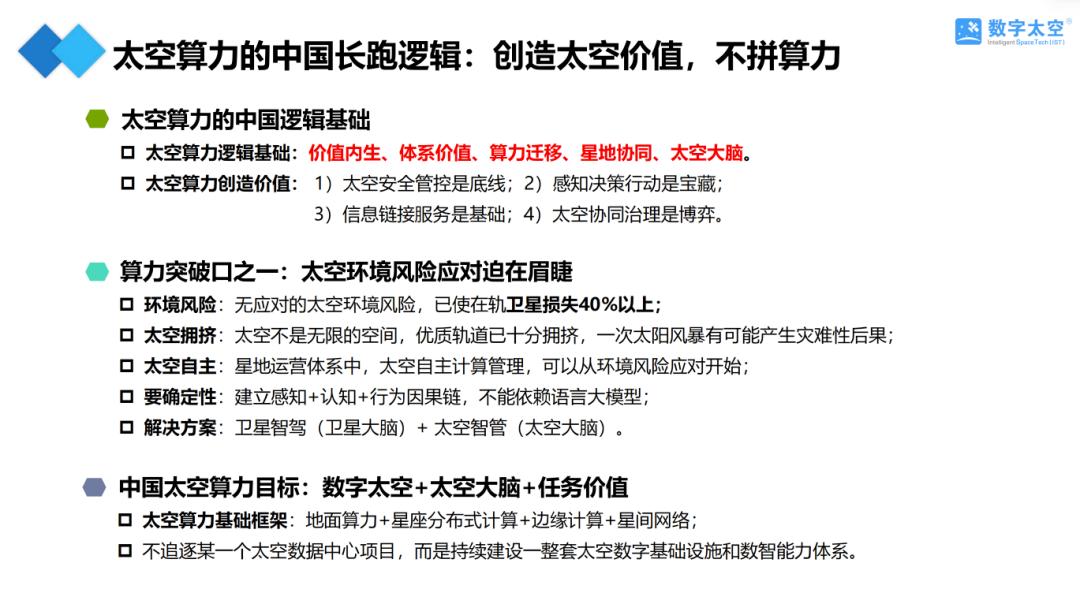
Future Development Logic of China's Space Computing Power
Coping with space environment risks is the most urgent demand at present. In recent years, solar storms have caused mass losses of satellites of various countries. In 2025, Starlink realized that satellites independently responded to solar storms and colliding debris without ground intervention, which proves that "solving space problems in space" is a feasible path. For China, the computing power constellation has not been deployed on a large scale. Building the on-satellite perception and autonomous response capability for environmental risks first is the most pragmatic first step before the implementation of space computing power.
Space is a pure physical world, and the law of causality is the basic constraint. Wang Shijin believes that the brain intelligence in space must be built on the causal closed loop of perception, cognition and behavior, which is the most essential difference between space intelligence and ground AI.
Based on this, Digital Space has been continuously polishing its satellite-ground digital intelligence platform over the past 10 years. Relying on the Digital Space Ontology Large Model, it realizes real-time perception of the status of global in-orbit satellites, space environment and debris situation, focuses on constellation operation management and collision risk early warning, and provides space environment effect assessment and protection solutions. At the same time, it provides satellite-ground collaboration and decision-making services for remote sensing and communication constellations, forming a product matrix of knowing the space, managing the space, safeguarding the space and utilizing the space.
Industrial Opportunities and Investment Value of Space Computing Power
Guest Speaker: Chen Dong, Founding Partner of Yuanhang Capital. He has 30 years of experience in R&D, management, entrepreneurship and investment, covering aerospace electronics, wireless communication and hard technology industries. He has successively worked in large state-owned military groups, Fortune 500 multinational communication technology enterprises, information technology startups and other institutions. He joined Yuanhang Capital as a founding partner in 2015, focusing on aerospace, new generation information technology, embodied intelligence, new energy and other tracks, and has successively led investments in representative projects such as Galactic Energy, Space Vision, Yunyao Aerospace, Space Pilot, and Giant Intelligence Technology.
Key Sharing Words: Commercial aerospace, space computing power, equity investment
Space computing power is the intersection of the two hard technology tracks of AI and commercial aerospace, with huge commercial and investment value. The competition among major countries is shifting from "space dominance" to "computing power dominance".
From the demand side, AI training has led to a surge in global computing power demand, and ground data centers are facing energy supply bottlenecks. Satellite technology itself is also forcing computing power to be deployed on satellites — more than 90% of the data of traditional remote sensing satellites cannot be transmitted back in time due to bandwidth limitations. On-board AI real-time processing can reduce the remote sensing timeliness to the second level, promoting the service mode to shift from "image delivery" to "result delivery".
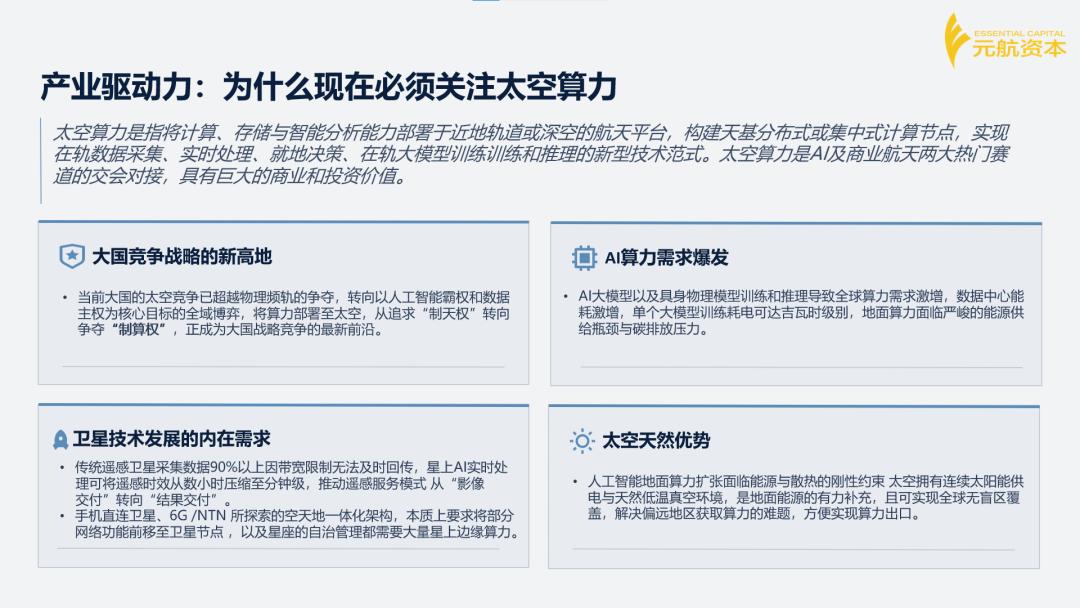
Analysis of Driving Forces of Space Computing Power Industry
In terms of stage division, "space data processed in space" will be the main theme before 2030. Data collected in space will be processed directly, and only high-value conclusions will be transmitted back. "Ground data processed in space" will be gradually carried out from 2030 to 2035, which will use the advantages of space solar power supply and low-temperature vacuum to undertake ground training or inference tasks. After 2035, it may enter the stage of space-ground integrated computing power.
Chen Dong judges that in a short period of time, space-based computing power cannot replace ground computing power. The rate and stability of laser links between space distributed computing power clusters are far less than that of ground optical fibers, resulting in large computing power attenuation. The realistic path is to realize the pooling of space and ground computing power, which can be called on demand and backed up mutually. In addition, ground computing centers may be damaged by natural disasters, while space computing power will form a natural anti-destruction backup.
Rockets are the core variable of the entire industrial chain, accounting for 30%-40% of the total cost of space computing power. At present, the gap in launch costs between China and the United States is still obvious, but the progress of China's reusable rockets is optimistic: the Long March 10B has realized maritime net recovery, the Zhuque-3 has completed land recovery, and multiple reusable rockets will make their first flights intensively in 2026. The next development direction of rocket engines is high-thrust high-specific-impulse closed-cycle engines, and the two routes of liquid oxygen kerosene and liquid oxygen methane will coexist for a long time.
In addition to rockets, on-board AI chips, space energy and heat dissipation systems are also hard nuts that must be cracked. On-board AI chips face three technical challenges: radiation resistance, low power consumption and high computing power density. Domestic radiation-resistant heavy ion experimental devices are scarce, and these infrastructures themselves are also an investment opportunity; in terms of energy, crystalline silicon and perovskite routes have obvious cost advantages; in terms of heat dissipation, two-phase flow heat dissipation, mechano-thermal integrated design, and deployable radiators are key technical directions.
Looking at the commercial aerospace capital market in 2026, more than 10 enterprises in the primary market completed nearly 10 billion yuan of financing in the first quarter, and the cumulative increase of the secondary market concept index exceeded 35%. Many enterprises have made substantial progress in their IPOs on the Science and Technology Innovation Board and the Hong Kong Stock Exchange. It is expected that there will be a small IPO peak from 2026 to 2027, and the A+H dual-track exit channel will be gradually opened.
What Are People Discussing About Space Computing Power?
We have selected some representative questions from the live interactive session and the guests' answers, which are presented after editorial arrangement.
Q1: What problems that cannot be solved by ground computing power does space computing power solve?