The incredibly formidable Zhipu AI has directed its first major strike squarely at DeepSeek.
After serving as the "price butcher" for such a long time, DeepSeek has finally received a blow directed at itself.
The one delivering the blow is Zhipu AI.
The newly released GLM-5.3-Flash from Zhipu AI is none other than the mysterious large model OX Alpha that has gone viral in overseas communities, and it is also the first native multimodal model in the GLM-5 series.
Although its name carries the word "Flash", its performance is not "flashy" at all. Especially on the Artificial Analysis Intelligence Index, it scores 57 points, higher than the 53 points of the official DeepSeek V4 Pro; the official team is also very straightforward, stating that under certain evaluation criteria, its performance can even rival Claude's previous flagship Opus 4.8.
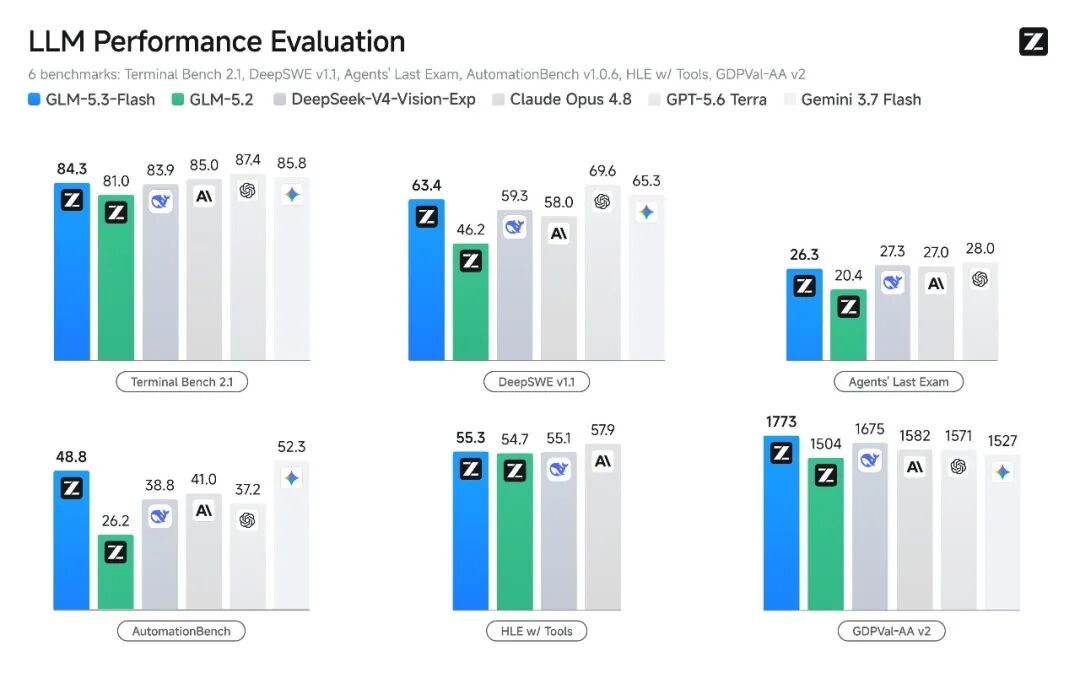
But the most shocking part of GLM-5.3-Flash is that the moment it was launched, it put the label "extremely low price" right on its face.
It costs 0.8 yuan per million input tokens and 2.8 yuan per million output tokens, with a limited-time 50% discount for the first two weeks after launch. Its performance can match Opus 4.8, but its price is only 1/40 of Opus 4.8, even lower than the off-peak price of the "price butcher" DeepSeek.
Who wouldn't be stunned by this price?
And this is exactly the playbook that DeepSeek is most familiar with.
Right after DeepSeek, which focuses on ultra-high cost performance, launched peak-valley pricing with a maximum increase of 1100%, GLM-5.3-Flash pushed its price down to the range of "daily consumables".
Is the throne of the cost-performance king of AI large models about to change hands?
Get Great Results With Tiny Investment
To understand GLM-5.3-Flash, we have to start with a mysterious "ox".
On August 20, the AI aggregation platform OpenRouter suddenly launched an anonymous model named Ox Alpha. No official announcement, no preheating, no developer information, no parameter scale disclosure, and no technical report released, it can be called a "wild unregistered model".
Coinciding with the popularity of the animated film *The Ox Arrives*, and "Ox" itself means bull, Chinese developers borrowed the meme and nicknamed Ox Alpha the "Bull Arrives" model.
Although the "wild model" is unregistered, it is extremely generous: Ox Alpha supports text, image and video input, outputs text, and its anonymous test version provides a 1.04 million token context window, yet developers do not need to pay a penny for calling it, all costs are covered by the model company.
This almost "free of charge" method made Ox Alpha go viral rapidly.
In less than one day after launch, Ox Alpha topped the call volume rankings of both OpenRouter and OpenCode, set a new model release record on OpenRouter, and ended DeepSeek's 56-consecutive-day streak at the top of the list.
Even the founder of Hermes Agent posted in shock: This model is crushing all our internal benchmarks, what on earth is happening?!
For a while, guessing the "parent" behind Ox Alpha became a new pastime in the developer community. After all, any party that can produce a model with such performance and be so generous is almost certainly not a "nobody".
In fact, that is exactly the case.
With a leading large model company like Zhipu behind it, it is easy to explain why it has the confidence to pay for global developers.
But no matter how big the company is, it cannot afford to burn massive free tokens forever. Ox Alpha dares to be so generous also because this "bull" looks huge in size, but its "appetite" is much smaller than people imagined.
GLM-5.3-Flash has a total of 320 billion parameters, but only about 18 billion parameters are activated for each token processed, accounting for only 5.6% of the total. When facing the ultra-long context of 1.04 million tokens, it combines linear attention and sparse attention to minimize the amount of computation required to process massive historical information.
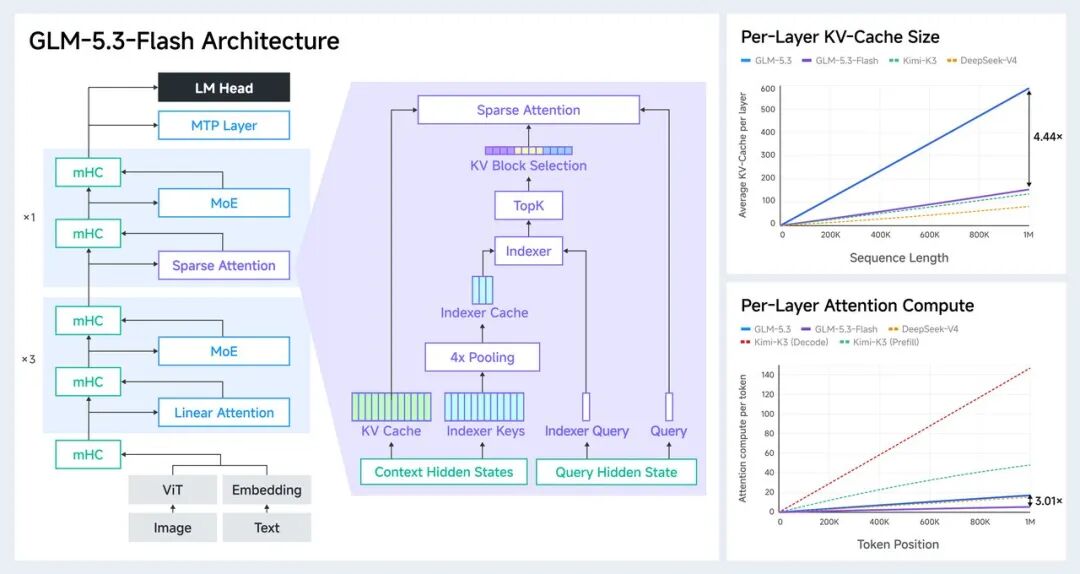
Both designs serve the same goal: the model looks like a huge 320-billion-parameter behemoth, but the actual billing is far lower than the standard for a 320-billion-parameter model.
This is the other layer of Zhipu's confidence to be so generous: The company covers the bottom line, and the model itself has learned to save costs.
Looking back now, the free giveaway during Ox Alpha's anonymous period is itself a kind of "low-cost declaration".
All massive token costs are covered by Zhipu. In addition to testing the model and creating public attention, it also proves to developers that Zhipu dares to fully open the call volume because this model itself is far less costly to run than people think.
The whole logic can be summed up in one sentence: This "bull" really does not consume much resources.
This point is even more critical in Agent scenarios. A single task may call the model dozens or even hundreds of times continuously, and the small cost saved per single call will eventually be continuously amplified by high-frequency calls.
Therefore, the architecture of GLM-5.3-Flash is truly aimed at enabling Agents to treat large models as an infrastructure that can be consumed at high frequencies.
In the minds of developers, labels like "strong performance, low price, reliable for unrestricted calls" used to almost all belong to DeepSeek.
What Zhipu really wants to impact is probably DeepSeek's most valuable cost-performance brand.
Beats "Liang Wenfeng" But Loses to "Liang Wengu"
The release timing of GLM-5.3-Flash is very clever.
After the official version of DeepSeek V4 Flash was launched on July 31, the usage volume on OpenRouter increased by 30% in a single day, and new subscribers of OpenCode Go also increased by 30%. On August 1 alone, the single-day processing volume of DeepSeek V4 Flash reached as high as 8 trillion tokens.
But on August 17, DeepSeek's new pricing officially took effect. The peak period price of DeepSeek V4 Pro increased by up to 1100%; the peak output price of DeepSeek V4 Flash also rose from 0.28 USD to 1.32 USD, an increase of 4.71 times.
The most direct impact of the substantial price increase is that developers started to vote with their feet.
In the previously leaked recording of Liang Wenfeng, he once mentioned that intelligent demand is inelastic. But the reality seems not that simple, especially for lightweight models.
After the price increase, DeepSeek's daily token usage quickly dropped to less than half of its previous peak. The CEO of OpenCode even estimated that nearly 10 trillion tokens of daily demand was vacated on the platform as a result.
It is precisely at this time that GLM-5.3-Flash, wrapped in the "Bull Arrives" coat, arrived.
GLM-5.3-Flash can be described as "cheap and powerful": 0.8 yuan per million input tokens for cache miss, 2.8 yuan per million output tokens, which is equivalent to one-tenth of the price of GLM-5.3.
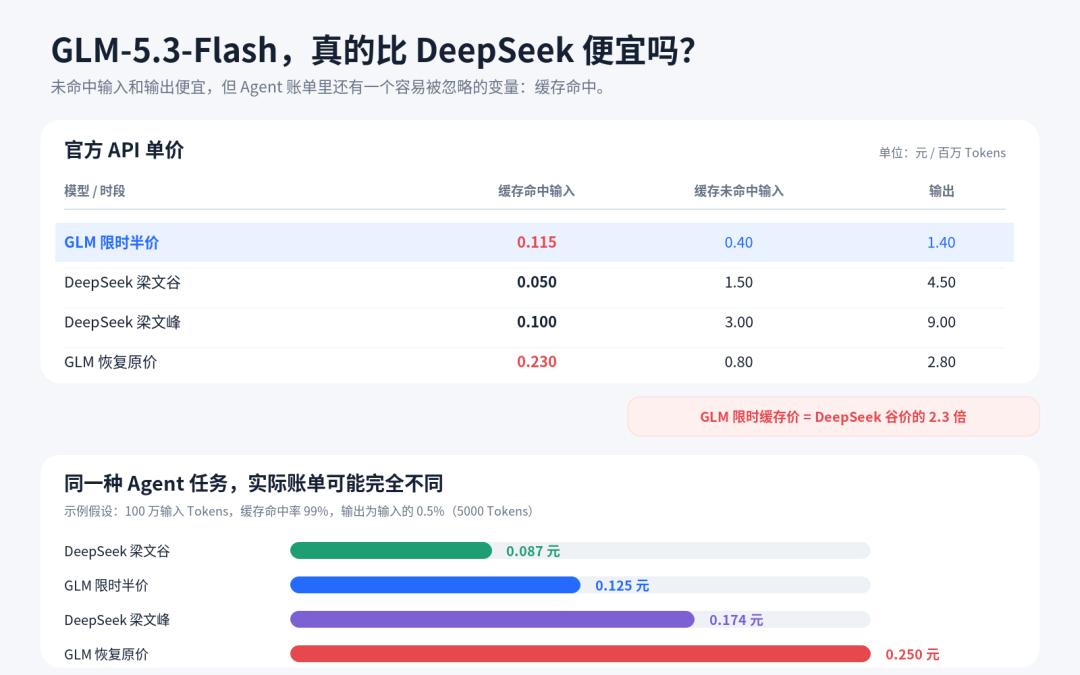
There is also a limited-time 50% discount for the first two weeks after launch: 0.4 yuan per million cache miss input tokens, 1.4 yuan per million output tokens, and 0.115 yuan per million cache hit input tokens, the discount lasts until 24:00 on September 9, 2026.
Judging from this set of very noticeable prices, GLM-5.3-Flash is indeed full of offensive momentum.
But to judge whether GLM-5.3-Flash has really hit DeepSeek, looking only at cache miss input and output prices is not enough.
Because in real Agent scenarios, the cache hit price may become the largest part of the bill.
The so-called cache hit can be simply understood as: When an Agent calls the model repeatedly, it often carries the same system prompt, tool definitions, historical conversations and code. These contents have been calculated by the platform before, and can be directly reused in the next call.
Since you are reusing content that has been processed before, its price is of course cheaper than the "cache miss" price.
This may not be that important in ordinary chat scenarios, but when an Agent completes a task, it often calls the model dozens or even hundreds of times continuously, and the same set of task backgrounds and historical records will be repeatedly fed into the context. Especially for tasks like coding that have long input and relatively short output, the cache hit price will affect the total bill more significantly.
This is also a small hidden detail in Zhipu's pricing strategy.
In its promotion, it focuses on highlighting the price of 0.8 yuan per million input tokens, 2.8 yuan per million output tokens, and the 0.4 yuan and 1.4 yuan after the 50% limited discount. When compared based on cache miss input and output, GLM is indeed cheaper than DeepSeek.
But the standard cache hit price of GLM-5.3-Flash is 0.23 yuan, and it still costs 0.115 yuan during the half-price period. DeepSeek V4 Flash only costs 0.1 yuan during peak hours, and as low as 0.05 yuan during off-peak hours.
Looking only at the cache hit item, even during the half-price period, GLM is more expensive than DeepSeek's peak price; after the discount ends, it is 2.3 times DeepSeek's peak price and 4.6 times its off-peak price.
Assume that an Agent task has a total input of 500,000 tokens, 99% of which hit the cache, and the final output is 10,000 tokens. That is, 495,000 tokens are billed at the cache hit price, and the remaining 5000 tokens are billed at the cache miss price.
After the discount ends, this task costs about 0.146 yuan using GLM-5.3-Flash; using DeepSeek V4 Flash, it only costs about 0.077 yuan during off-peak hours, and about 0.155 yuan during peak hours.
According to this assumption, for the same task, GLM is nearly 90% more expensive than "Liang Wengu" (DeepSeek off-peak), and only less than 6% cheaper than "Liang Wenfeng" (DeepSeek peak).
This also explains why some developers found after actual use that the overall cost of GLM is more expensive than DeepSeek's off-peak price, only cheaper than its peak price: for Agent tasks with high cache hit rates, the money saved by GLM on input and output is easily offset by the more expensive cache hit cost.
More critically, Zhipu's half-price discount only lasts for two weeks, and the original price will be restored on September 10.
Therefore, GLM-5.3-Flash can only beat "Liang Wenfeng", but may not be able to beat "Liang Wengu".
But apart from the cache hit item, the pricing of GLM-5.3-Flash in all other aspects is indeed comprehensively lower than that of DeepSeek.
DeepSeek's price is already very low, how on earth did Zhipu manage to break through the price floor even further while maintaining good performance?
The answer lies in the computing power that supports this "bull".
It Is Also A "Domestic Bull"
Not only is the model developed domestically, but the computing power that supports this wave of massive real global traffic also adopts a domestic solution.
During the anonymous launch period, the single-day processing volume of Ox Alpha once reached about 62 trillion tokens, and all online traffic was supported by 100,000 domestic chips. Some media reported that these chips may come from Huawei, Moore Threads and Haiguang.
Of course, piling 100,000 chips together will not automatically form an efficient inference system.
According to Zhipu, the main bottleneck faced by this batch of domestic chips is memory capacity and bandwidth.
In order to support the maximum 1.04 million token context window, Zhipu built a dedicated inference engine based on SGLang, disassembled multimodal encoding, prompt pre-filling and token-by-token decoding for separate scheduling and scaling, and then squeezed the performance of domestic chips as much as possible through quantization, parallelism and memory optimization.
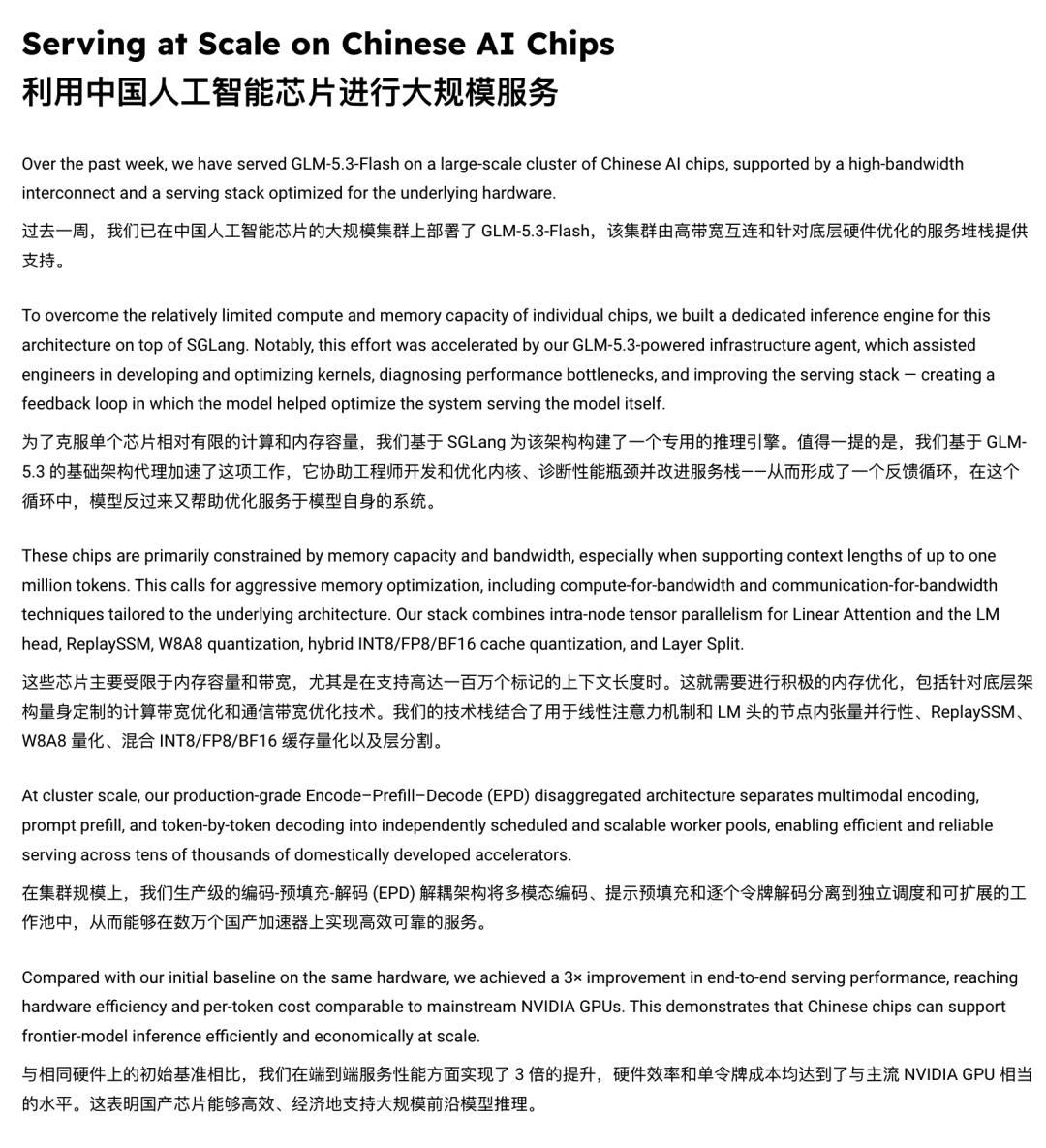
More interestingly, GLM-5.3 itself also participated in the optimization of this system. Zhipu used the Infra Agent to assist engineers in developing and optimizing operators, diagnosing performance bottlenecks, and improving the deployment service stack, forming a loop of "the model optimizes the system, and the system supports the model".
Zhipu stated that compared with the initial baseline on the same batch of hardware, the end-to-end service performance of this system has been increased by 3 times, and the hardware efficiency and single-token cost have reached the level of mainstream NVIDIA GPUs.
SemiAnalysis, a foreign semiconductor research institution, also commented that NVIDIA's moat has once again been put to the test.
The model architecture is responsible for reducing the amount of computation, and the inference system is responsible for maximizing the performance of domestic chips. The combination of the two forms the engineering base for Zhipu to continue to lower prices.
This of course does not mean that domestic chips have fully caught up with NVIDIA.
That 100,000 domestic chips can carry the real traffic of global developers can only prove that this system already has large-scale service capabilities; as for whether the hardware efficiency and single-token cost have really reached the level of mainstream NVIDIA GPUs, the current data is still mainly from Zhipu's own calculation.
But the really tricky part of this "bull" is that behind it, in addition to a domestic model, there is also a complete set of domestic computing power solutions that have been tested by real massive traffic.
For DeepSeek, this is probably more tricky than a simple low-price challenge.
References:
[1] QbitAI: The mysterious "Bull Arrives" model is indeed from Zhipu! GLM's first native multimodal model, powered by domestic chips
[2] TechFox: The "Bull Arrives" model that topped