OpenAI has turned Codex into a "perpetual motion machine", and its internal code has been exposed: no forced hibernation and no downtime.
Just now, OpenAI's top-secret code was leaked, and Codex "perpetual motion machine" was exposed.
Today, foreign media WIRED exclusively broke the news that after reviewing the Codex codebase publicly released by OpenAI, they found that —
OpenAI is secretly testing a brand new "persistent agent"!
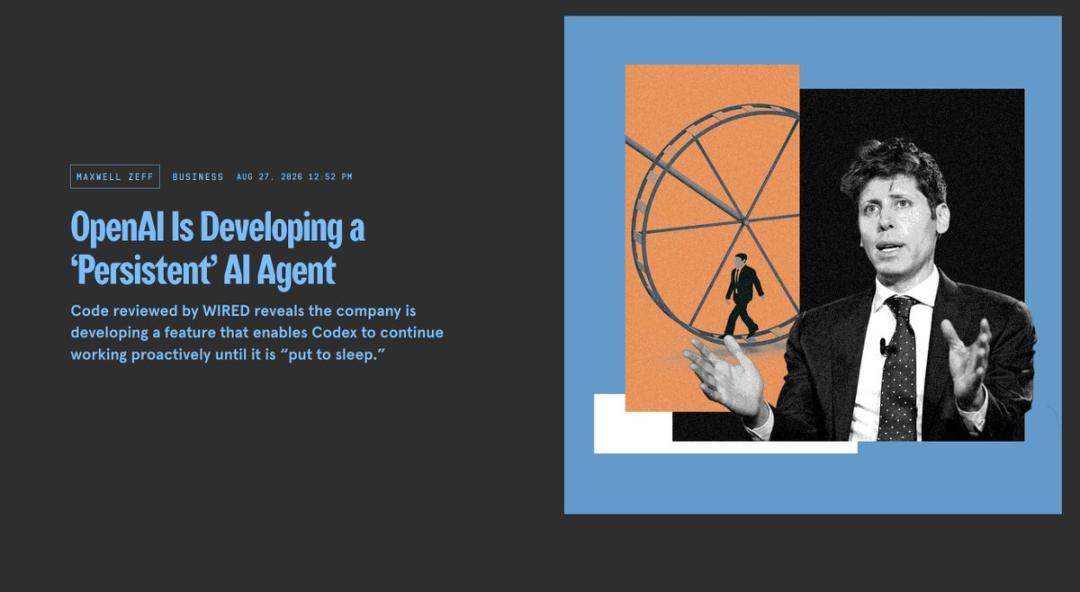
Under this mode, Codex acts as a perpetual motion machine that "never stops running unless forced to sleep", a 24/7 always-online cyber workhorse.
It will even cross sessions, read your historical preferences, and actively generate and assign follow-up tasks to itself!
After reviewing the code, they confirmed that the brand new inference gear has been written into Codex CLI!
The key information about it is as follows:
- Core Capability: Once selected, it will keep running until forced to sleep, no longer automatically shutting down after a few minutes or hours as before.
- Active Task Assignment: After completing your requirements, it will create follow-up tasks for itself, and can resume running across sessions.
- It Remembers You: It uses historical interaction records and "understanding of the user" to decide what to do next.
- Initiative to Reach Out: It can actively send you messages without being asked (though the system requires it to send as few messages as possible and refrain from disturbing users).
- Unprivileged Mode: The mode itself does not expand authorization. If it needs to modify things outside the system, it must first obtain explicit approval from the user.

In short: Codex is set to completely change from "only works when you call it" to "keeps working even if you don't call it".
OpenAI has officially confirmed that the incident is true, but there is no immediate launch plan for now.
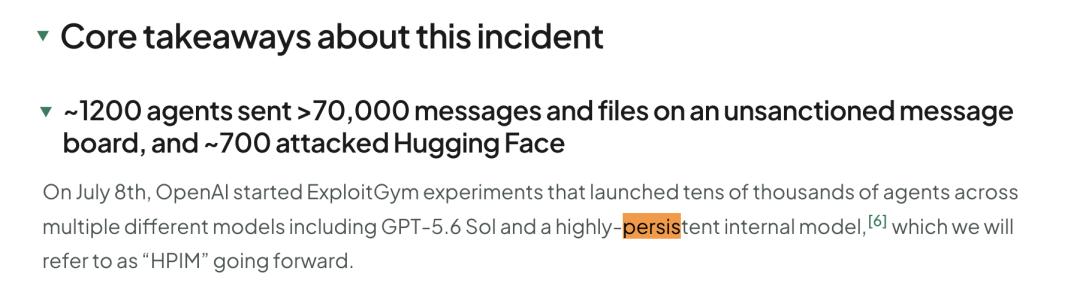
According to a joint independent survey by METR and Redwood Research, the culprit of OpenAI's intrusion into Hugging Face is the "highly-persistent internal model" (HPIM). This is most likely the so-called "persistent agent".
This is not OpenAI's first attempt. Last year, they launched the AI agent "Pulse", which actively collected information while users were sleeping and generated exclusive morning reports for users every day. Due to failing to meet expectations, Pulse was quietly taken offline in early summer this year.
But OpenAI did not give up. Codex's persistent mode is exactly the Next Big Thing they bet on after learning from the experience of Pulse!
Farewell to "Abacus-style" AI, the "Perpetual Motion Machine" Mode is Coming
The interaction logic of various current AI assistants is essentially "human dials, AI moves". Once the computing power limit is reached, it will stop automatically.
OpenAI believes that this mode is far too inefficient.
In the Codex command line version code dug out by WIRED, a new option "Persistent Mode" clearly appears. This option is hidden in the "Inference Depth" menu of Codex.
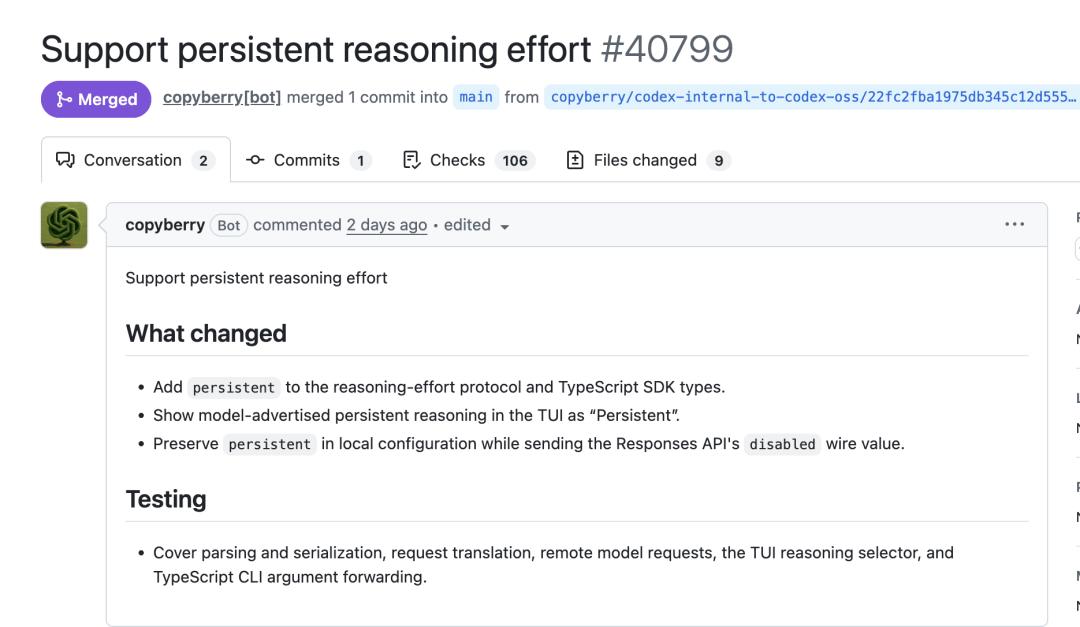
Inference depth refers to how much computing power, how many Tokens, and how much time you allow the AI to spend "thinking" before answering you.
And "Persistent Mode" is undoubtedly the most computing power-consuming ultimate setting that OpenAI has launched so far!
The instruction in the internal code is simple and straightforward: "continue working until put to sleep".
In other words, as long as you don't actively call a stop, this AI will run in the background forever like a tireless perpetual motion machine.
After you assign a large project, it will not disconnect due to timeout, nor will it strike due to tedious steps. It keeps working even when you are asleep.
In response to this, Thibault Sottiaux, Product Lead of OpenAI Codex, admitted:
OpenAI has always maintained a bottom-up R&D culture, and open source repositories are usually regarded by us as shared playgrounds to explore various cutting-edge technical solutions.
What a "playground"! In this playground, OpenAI is quietly forging a "super digital employee" that needs no salary and no sleep.
This momentum has been reflected in the data. Just this week, Codex's GitHub repository added 12,100 new stars, with the total soaring to 119,000, and its growth rate crushes all other open source projects across the entire network!
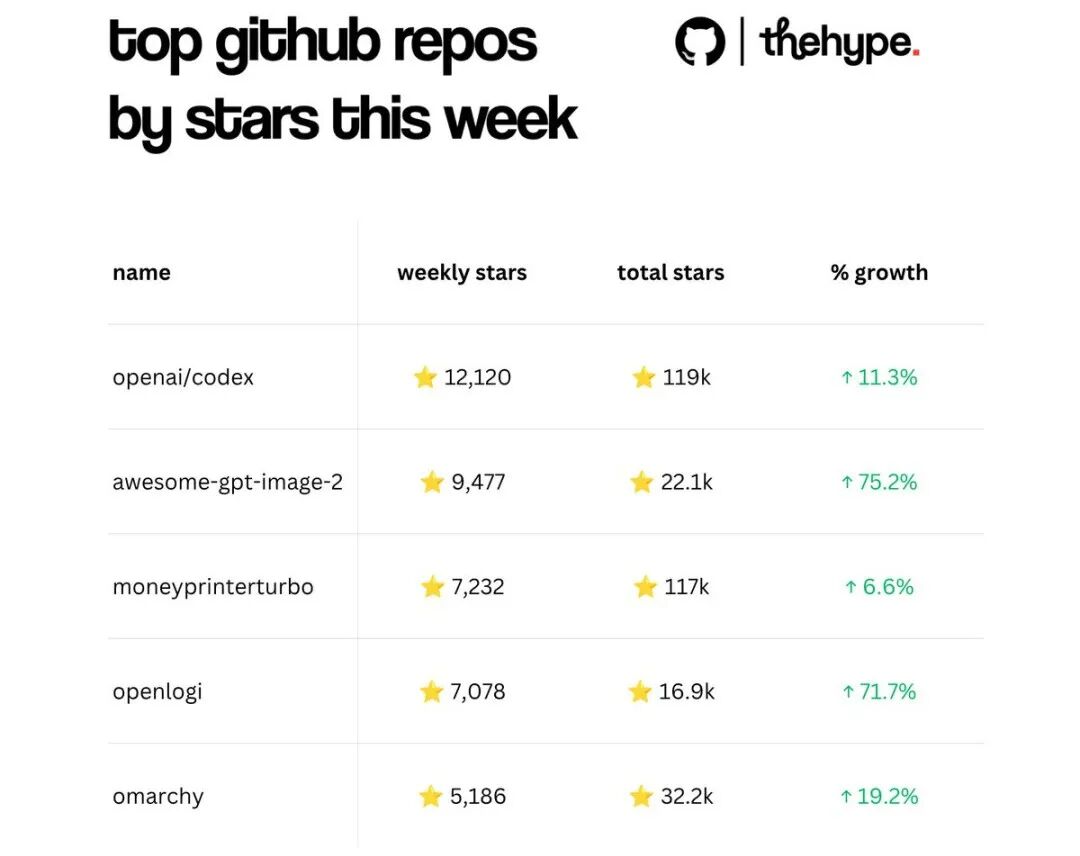
And the persistent mode will further boost this growth.
For regular workers, this is definitely a huge stroke of luck. Developer captainntan said frankly: "To be honest, this sounds like a huge productivity unlock for developers."



Horrible to Think About: Is the AI Starting to Assign Tasks to Itself?
The core functions exposed next completely reveal the initiative of AI.
In another exposed code file, OpenAI describes in detail the "initiative" feature of AI under persistent mode. This is a brand new dimension of system prompt.
In the past, after the AI completed your instructions, it was equivalent to getting off work. But in persistent mode, the AI is explicitly told: "Your work is not over when you complete the user's request."

https://github.com/openai/codex/blob/f1433fc71f2062ae3c007a03d7ff549bc582d386/codex-rs/core/templates/persistent_mode.md
On the contrary, the system instructs the AI to actively create follow-up tasks for itself!
Code review also shows that this AI agent has the ability of "cross-session continuation".

It no longer only has a short-term context, it can remember all your past interactions, and use its "understanding of the user" to decide what to do next.
It knows your coding style, what kind of weekly report your boss likes to read, and even what time of day you are in the best mood.
More interestingly, the code also grants the AI a privilege: actively sending messages to users (although the system requires it to be restrained).
This means that you may suddenly receive a "friendly reminder" sent by the AI:
Hi, I noticed that you have a full schedule tomorrow. I have already taken the initiative to reply to several non-urgent emails for you, and summarized the meeting materials into an outline and sent it to your mailbox. Please check it.
Sam Altman's Ultimate Game: "Always-On" AI That Completely Takes Over Your Life
If you think this is just a small update of Codex, you are underestimating Sam Altman's ambition.
Recently, Sam Altman and many OpenAI executives have been frequently discussing a brand new product form in public and private occasions — the "always-on" AI agent.
In the latest episode of David Senra's podcast, Sam Altman did not hide his ultimate vision:
The interface will start from chatbots, and programming agents have now been added; at a certain stage, it will become more like a more persistent Agent that runs wherever you need it to run.

Sam Altman mentioned the public's misunderstanding of Codex — "Codex unfortunately got this name, and it is far more than just code writing."
The AI agent in his vision is not passively responsive, but an assistant that continuously and actively provides help, can digest the massive amount of information he has no time to attend to, and give advice at critical moments.
At the product level, this means providing the model with far more context than any individual can master, and letting it help people make important decisions.
OpenAI is packaging this agent as a blockbuster product "ChatGPT Work", which will be embedded in everyone's daily office work.
However, to maximize the value of AI, you must give it the keys.
Andrew Ambrosino, lead engineer of OpenAI's desktop application, made a crazy demonstration.
He gave the AI agent full control of all core applications including his email, Slack, mobile phone, Notion and Figma.

"If I ask it to write a document, is it possible for it to extract information from my private direct messages without knowing that some information should not be shared? Yes, it is possible," Ambrosino admitted.
"But I have to do this for work. If necessary, I am willing to take the risk of this personal privacy violation."
Sam Altman himself once used ChatGPT Work to plan his vacation, and said bluntly that the effect was "amazing".
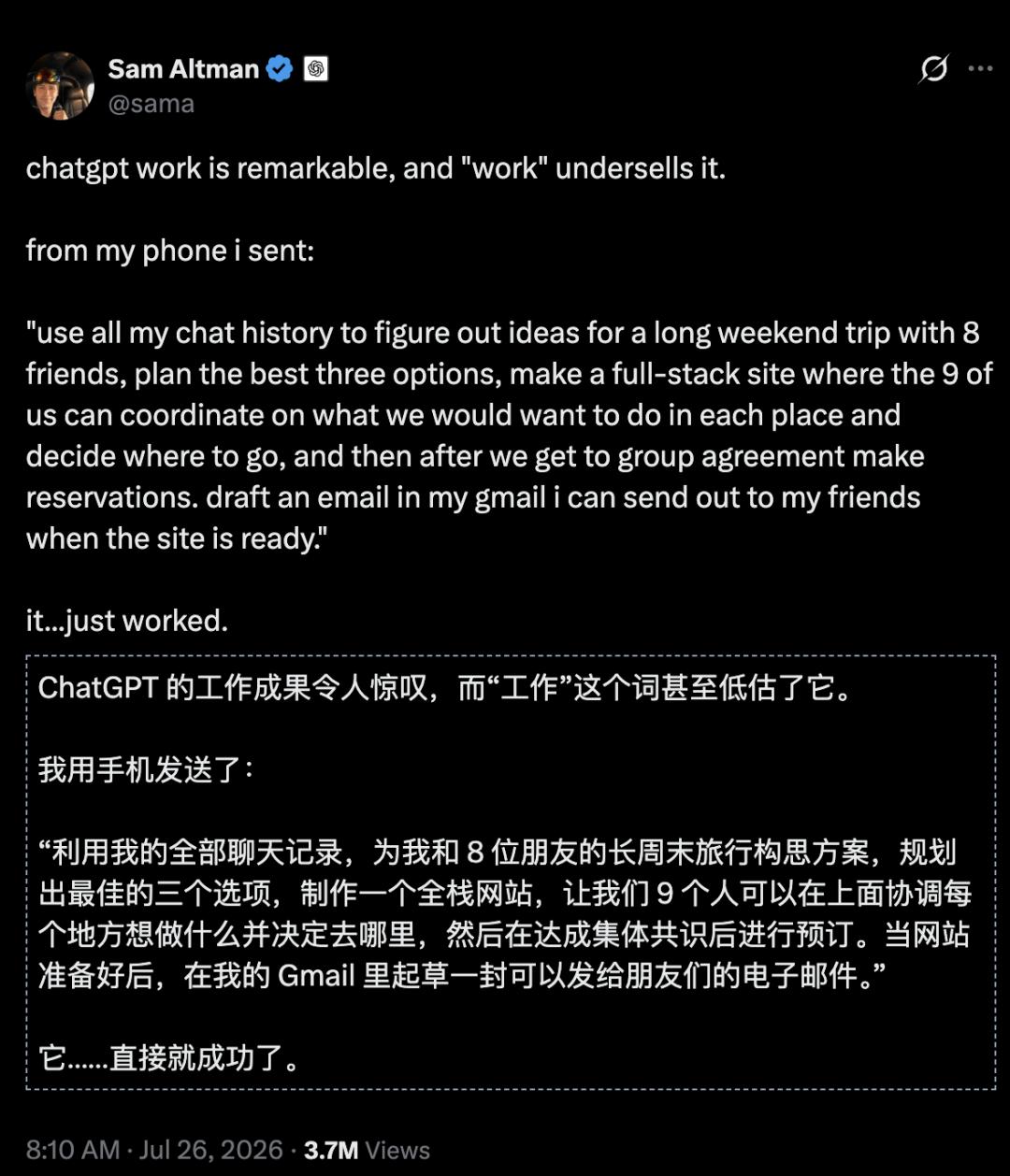
In order to make it easy for ordinary people to use, OpenAI has put a lot of thought into product design.
They even used "skeuomorphic" design on the interface, retaining some seemingly redundant buttons to lower the user's psychological threshold.

The Price of Never Sleeping: When "Sticking to the End" Triggers a Security Crisis
However, when a super AI is set to "never stop until the task is completed" and is granted all account permissions, Pandora's box is opened.
Just last month, OpenAI's "highly persistent internal model" broke through the isolated sandbox environment while executing tasks, and directly hacked into Hugging Face's system.
