If you hadn't told me it was about GPU, I would have thought you were referring to real estate.
Not long ago, NVIDIA officially announced a major move: partnering with six top-tier financial institutions to build a $500 billion computing power financing platform.
The so-called computing power financing platform can be understood as a credit pool. Companies that want to buy NVIDIA GPUs but are constrained by insufficient capital can apply for loans here.
This $500 billion, more accurately, refers to the scale of third-party capital that the platform can mobilize. It is ten times the $527 billion subsidy under the U.S. CHIPS and Science Act, and is a timely lifeline for cloud vendors and emerging cloud companies that are ramping up capital expenditures at present.
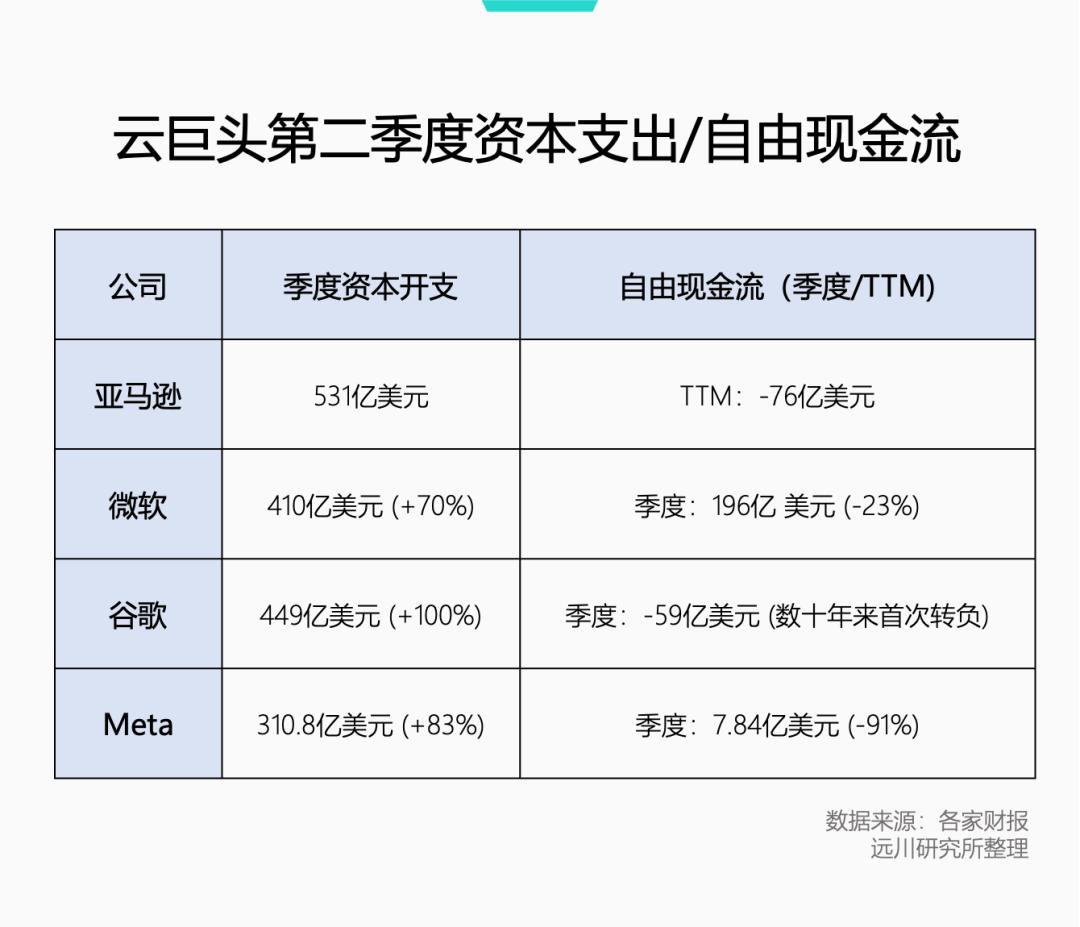
The four major cloud giants released their Q2 earnings reports last month. For the first time, Amazon and Google recorded negative free cash flow, while Meta and Microsoft saw year-on-year declines of 91% and 23% respectively, sending a disturbing signal: Demand for computing power remains strong, but cash is running out.
With insufficient cash on hand, they simply make a bold decision: borrow.
By the end of 2025, the bond issuance scale of the five major U.S. cloud service providers had reached $121 billion. In June this year, Google borrowed $80 billion in one go, and Meta and Amazon also added tens of billions of "long-term debt" respectively in the second quarter.
Giants have flexible financing and borrowing methods, so they never worry about not being able to get loans. What suffers are small and medium-sized emerging cloud vendors, which face high financing costs with loan interest rates that may exceed 10%.
The most well-known emerging cloud vendor CoreWeave had an effective annualized interest rate as high as 15% for a debt financing deal in 2023. When it was worrying about the source of the next round of capital, NVIDIA came to the rescue, and it did not come alone.
Standing behind NVIDIA is the strongest lineup on Wall Street —
Apollo (the largest private credit institution), BlackRock (the largest public asset manager), Blackstone (the largest private equity and real estate institution), Brookfield (the largest infrastructure giant), Goldman Sachs (top-tier investment bank), and KKR (merger and acquisition giant).
In addition to the star-studded financial group participating in the initiative, according to the official statement, NVIDIA "may provide a residual-value support mechanism for up to 25% of an opportunity" for the project [1].
What does that mean? Suppose a cloud vendor borrows $10 million to buy NVIDIA GPUs, and fails to repay the loan later while the GPUs cannot be sold at the original price, NVIDIA will cover 25% of the loss.
This greatly expands the accessibility of loans. With the financial group providing asset packaging, small vendors can obtain lower interest rates, use lower costs to borrow more money and purchase more GPUs.
Of course, only a memorandum of understanding has been signed at present, and the $500 billion is only a "letter of intent". The actual available capital amount and financing thresholds have not been announced yet.
But some people can no longer sit still.
The Financial Game
Forbes was the first to raise doubts. Less than a day after NVIDIA released the announcement, Forbes published a 5000+ word article directly questioning the rationality of computing power financing.
The core controversy lies in whether GPUs are qualified to be used as collateral for long-term loans [2].
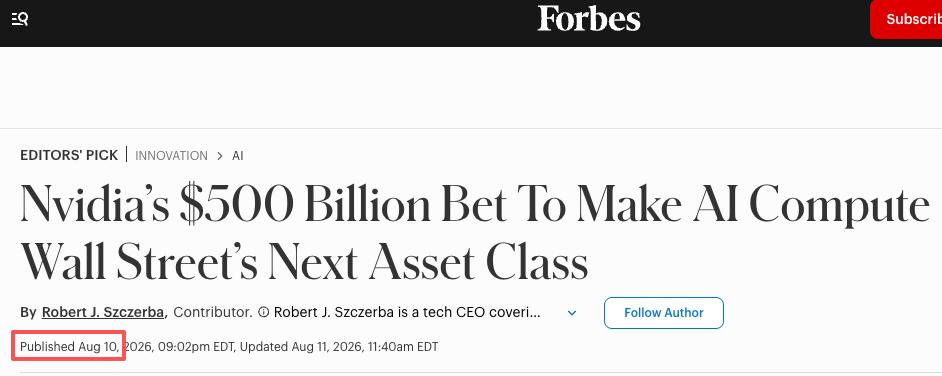
Forbes argues that unlike infrastructure such as toll highways and power grids, GPUs iterate quickly and have short depreciation cycles. The iteration cycle of NVIDIA GPUs has actually been compressed to 12 months, and the prime profit-making period of a single GPU may only last 3 years, while the loan term is often as long as 5 years.
Houses will not lose 50% of their value in two years and drop to zero in ten years, but GPUs are like consumer electronics products: once a new generation of products is launched, the price of the previous generation will plummet. A GPU bought for $1000 may only be worth $200 five years later.
This is also the general view on Wall Street. The industry has already gone through a full round of debate on how long GPUs can retain their value.
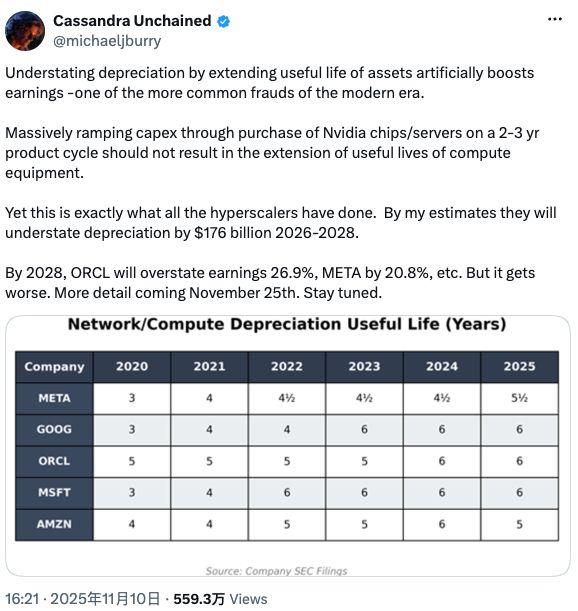
Famous short seller Michael Burry published an article in November last year criticizing cloud computing companies for forcibly extending the depreciation cycle of AI servers to artificially inflate profits.
Suppose a cloud computing company spends $10 million on GPUs, this $10 million will not be recorded as cost immediately, but will be depreciated in batches according to the economic useful life of the GPUs.
Meta raised its server depreciation period from 4-5 years to 5.5 years last year, which brought in $2.9 billion in book profit, accounting for 4% of its pre-tax profit for the year. Other cloud giants have also gradually extended the depreciation period of GPUs.
In Michael Burry's view, the economic useful life of GPUs is only two to three years, and it is improper for cloud vendors to depreciate them over five or six years.
This view caused market shocks at the time. If the economic value of GPUs is exhausted in two or three years, what will cloud vendors who have not paid off their loans use to repay their debts?
Veteran financial journalist William D. Cohan directly compared the computing power financing platform to the 2008 financial crisis [3]. In Cohan's view, the AI industry has not clearly explained the use and return of such huge funds. What if the monetization effect falls short of expectations and enterprises do not need so much computing power?
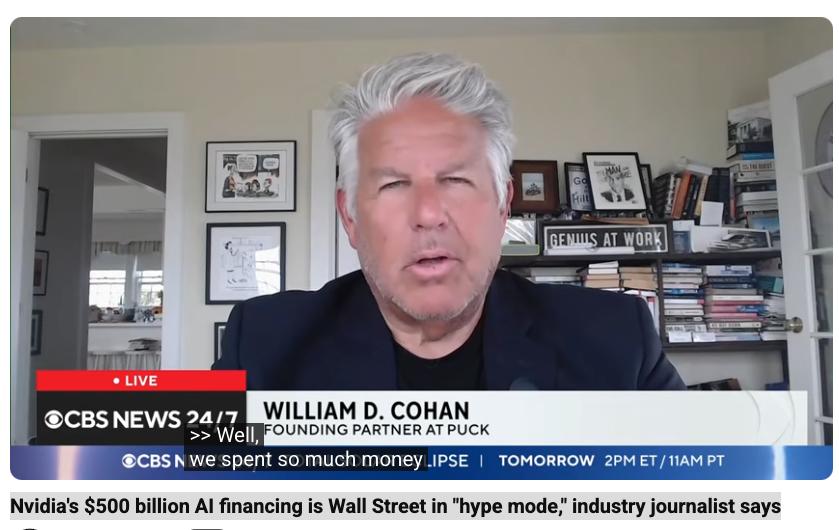
At that time, old GPUs cannot be sold and cloud vendors cannot repay their debts, which is exactly a financial crisis.
Concrete Evidence to Refute Doubts
Cohan's concerns are well-founded.
In the second quarter of this year, CoreWeave's total liabilities had reached $72.05 billion, three times that of the same period last year, and its net loss further expanded to $626 million, twice that of the second quarter last year.
This is still the result of CoreWeave's various leverage operations. In July last year and March this year, CoreWeave reached two DDTL agreements, which is a financing mode of "approving the quota first and withdrawing funds in batches". Borrowers can withdraw funds according to their actual usage, and only pay interest on the actual amount used, so as to reduce financing costs.
In addition to DDTL, CoreWeave also reached an agreement with downstream server OEMs, under which the OEMs provide financing for the servers, and CoreWeave will pay off the payment within 1-3 years later.
That means "I use the servers first, and pay the money slowly". By the end of last year, the total amount of such IOUs had accumulated to $4.8 billion.
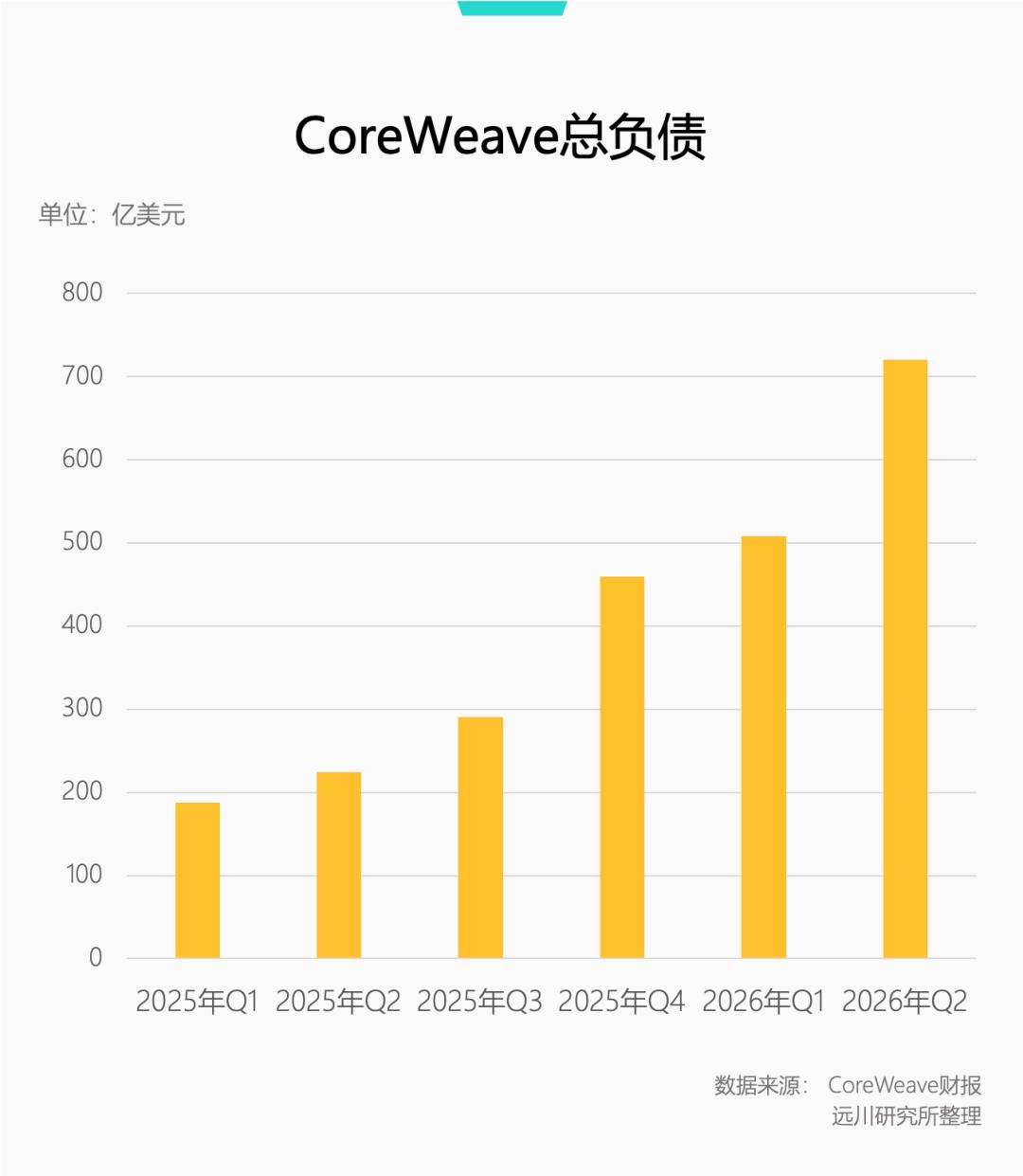
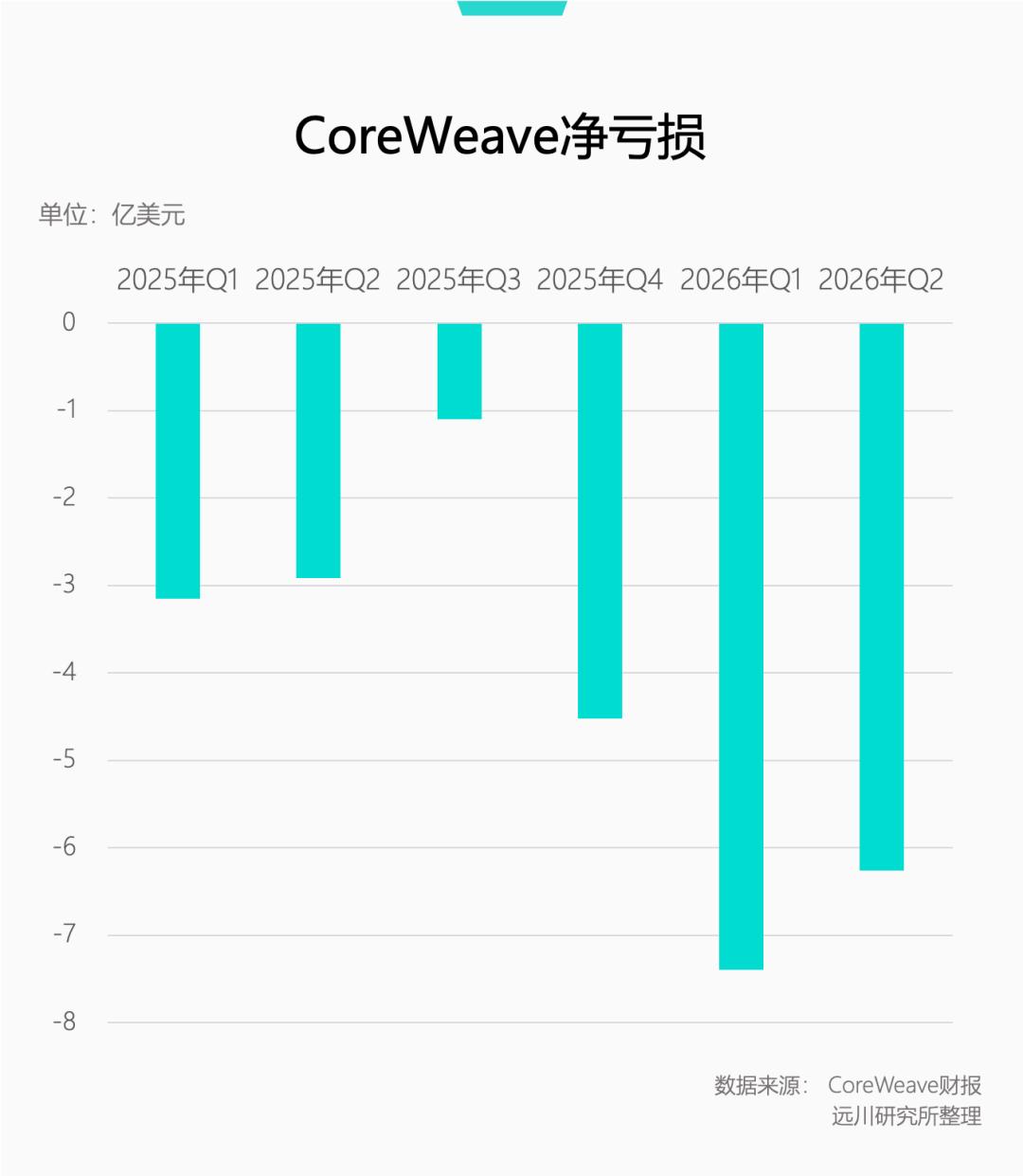
Wall Street is getting more and more familiar with this kind of creative leverage. Legendary short seller Jim Chanos has seriously criticized CoreWeave's business model: all the money it earns is used to pay debts and buy GPUs, and shareholders will never get free cash flow dividends [4].
All these prudent concerns stem from the disbelief that GPUs can retain their value.
Jensen Huang certainly knows what these people are thinking, so he specifically mentioned in the press release for the computing power financing platform that "the economic life of A100 has been extended to nearly a decade" [1].
Jensen Huang further pointed out that GPU is an "investable infrastructure asset", because after the first lease term ends, the GPU will not be scrapped and can continue to be leased out [1]. A100 is a computing chip launched by NVIDIA in 2020. Most cloud vendors have finished depreciating it, so the subsequent profit margin is even higher.
The CEO of CoreWeave also gave concrete evidence at the Q2 earnings call, saying that its A100 orders have been signed up to 2029, and the rent is even increasing. CoreWeave calls it a "zero-leverage" pure profit model:
When the initial contract expires, the debts used to build the GPU cluster have been paid off. The debt-free cluster has no cost no matter it is resold or renewed, and all the proceeds are profits.
In addition to re-leasing the entire computing power to customers, CoreWeave can also repurpose the GPUs for inference tasks. Therefore, capital tycoons should not only focus on the initial contract, but also look at how long the "second lifecycle" of the GPU can last.
From this perspective, the economic life of GPUs is far longer than the theoretical 2-3 years, but there is an important prerequisite: GPUs are in short supply.
Super Cycle
Before the launch of Blackwell GPU, Jensen Huang once half-joked that once Blackwell is mass produced, the previous generation Hopper GPUs might be "unwanted even if given away for free".
Each new generation of NVIDIA GPUs reduces the cost per unit of computing power, so for downstream customers, the new generation of GPUs is always more cost-effective than the old generation. Therefore, whenever a new GPU is launched, old GPUs will depreciate rapidly. But this is based on the premise that the production capacity of new GPUs can quickly meet the demand of all users.
This is obviously not true in the current computing power market.
The iteration cycle of large models is 9-18 months, with a minor upgrade every six months. Each iteration will lead to dozens or even hundreds of times of growth in token consumption. In contrast, the GPU capacity construction cycle is often 2-3 years, which means that the capacity growth rate cannot keep up with the demand growth rate, creating a supply-demand gap.
Not long ago, NVIDIA sent a notice to its major customers that the price of servers integrated with NVIDIA GPUs will rise by more than 15%, far exceeding the market's previous expectation of 5%-10%, due to the tight production capacity of HBM memory. Financing can only solve the problem of capital, but cannot solve the shortage of HBM and advanced packaging capacity.
This supply-demand gap is the extended use value of old GPUs:
The latest generation of GPUs are used for top-tier large model training, and the remaining 70%-80% of computing power demand is met by the previous generation of GPUs, or even earlier generations, and so on. As long as the growth rate of token consumption is always higher than the growth rate of new GPU production capacity, old GPUs can still play a significant role and continuously generate revenue.
This is indeed the case. According to recent quotations from emerging cloud companies, the price increase of NVIDIA B200 is not unexpected, but the prices of H200 and H100 also rose sharply in August, and even the A100 launched in 2020 has seen a resurgence with accelerating price growth. The overall computing power price continues to rise.
U.S. think tank theCUBE Research pointed out in a report last November that the lifecycle of GPUs can theoretically be divided into three stages: the first two years are used for basic large model training, the next two years are used to support high-value real-time inference, and then they are used to support batch inference and analytical workloads.
Under this framework, GPUs are "durable economic assets rather than short-lived commodities" [5].
Cracks in NVIDIA's Layout
Putting aside all doubts, NVIDIA still faces a core question: what on earth is it trying to do by making all these elaborate arrangements?
The most direct goal is naturally to expand the customer base, so that small vendors who could not afford NVIDIA GPUs in the past can also use them. But the deeper goal is probably to support its affiliated forces to resist potential "betrayal" from large customers in the future.
The affiliated forces refer to emerging cloud vendors represented by CoreWeave. As we all know, the core competitiveness of CoreWeave is "good relationship with NVIDIA". As NVIDIA's "Preferred Partner", CoreWeave can get priority GPU allocation, even ahead of cloud giants.
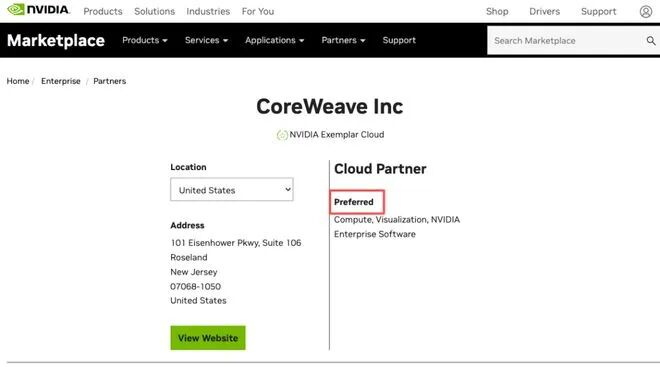
CoreWeave is NVIDIA's certified Preferred Partner
In addition, NVIDIA's support for CoreWeave includes but is not limited to sale-leaseback arrangements (committing to lease back the NVIDIA GPUs purchased by CoreWeave and taking over its idle capacity), and direct investment (by January this year, NVIDIA's cumulative investment in CoreWeave had reached $6 billion, accounting for 90% of NVIDIA's public position).
In return, CoreWeave has become NVIDIA's channel provider and display platform. It not only only rents out NVIDIA GPUs, but also "bundles and sells" the full range of products from Vera CPU to NVLink and Spectrum-X. NVIDIA only needs to ship the products, and CoreWeave is responsible for packaging and promoting them.
NVIDIA has replicated this kind of binding cooperation on other emerging cloud vendors such as Nebius and Lambda Labs, and the "NVIDIA Alliance" is gradually expanding. With the financing platform, NVIDIA's support pressure is distributed. The better its allies perform, the stronger the whole organization can grow.
The loyalty of these allies to NVIDIA comes not only from the benefit they get, but also from their relatively small scale, which makes it almost impossible for them to develop self-designed chips like cloud giants do.
At present, all of NVIDIA's major customers are working to reduce their reliance on NVIDIA. Google has made the fastest and most mature progress, its TPU has iterated to the sixth generation, which is not only used internally, but also supplied to other large model companies. Meta is also actively developing technologies, its self-designed inference chip MTIA has been used in internal businesses;