36Kr Exclusive | The team from ShanghaiTech University that develops embodied world model infrastructure has completed a multi-million US dollar seed round of financing
Author | Qiao Yujie
Editor | Yuan Silai
This article is approximately 3200 words, with a recommended reading time of 7 minutes
Hard Krypton learned that embodied intelligence infrastructure company "InstAdapt" recently completed a multi-million US dollar seed round of financing, jointly invested by institutions including Xiechuang Smart, Yunhui Capital, Pudong Venture Capital and Wuyue Angel, with Xinpai Capital acting as the exclusive financial advisor. The funds from this round will be mainly used for the construction of physical AI data infrastructure, the R&D of embodied world models and the expansion of the core team.
Founded by the team from ShanghaiTech University, InstAdapt is positioned as the Embodied World Model Infrastructure in the era of Physical AI. The company aims to solve a long-standing core bottleneck in the embodied intelligence industry: when robots face new environments, new tasks or even new ontologies, how to quickly acquire the required experience instead of collecting data and training from scratch, and continue learning during the deployment process.
Dr. Shi Ye, founder of the company, is currently an assistant professor and doctoral supervisor at the School of Information Science and Technology of ShanghaiTech University, and also the head of YesAI Lab (Trustworthy and General Intelligence Laboratory). He has long been engaged in the research of diffusion models, generative reinforcement learning and embodied intelligence.
After the rapid growth of ontology, what robots lack is not just another VLA or WAM, but a system that can continuously generate experience and support rapid adaptation and continuous improvement. It further moves towards: who can convert a new real task into the world and experience that robots can learn faster. A single model only determines the immediate action, while the experience system can convert limited real data into usable training experience, supporting cross-task, cross-scenario, cross-ontology migration of robots and continuous learning after deployment.
The recent acquisition of robot simulation company SceniX by World Labs also reflects the future trend of integration between world models and robot simulation. "SceniX is more like expanding from simulation to world model, while World Labs extends from world model to robotic simulation. Since its establishment, InstAdapt has hoped to stand at the intersection of these two paths to build the underlying infrastructure of the world model." Shi Ye said.
Focusing on the implementation of Physical AI and the R&D of robot world models, InstAdapt has built a four-layer Physical AI infrastructure.
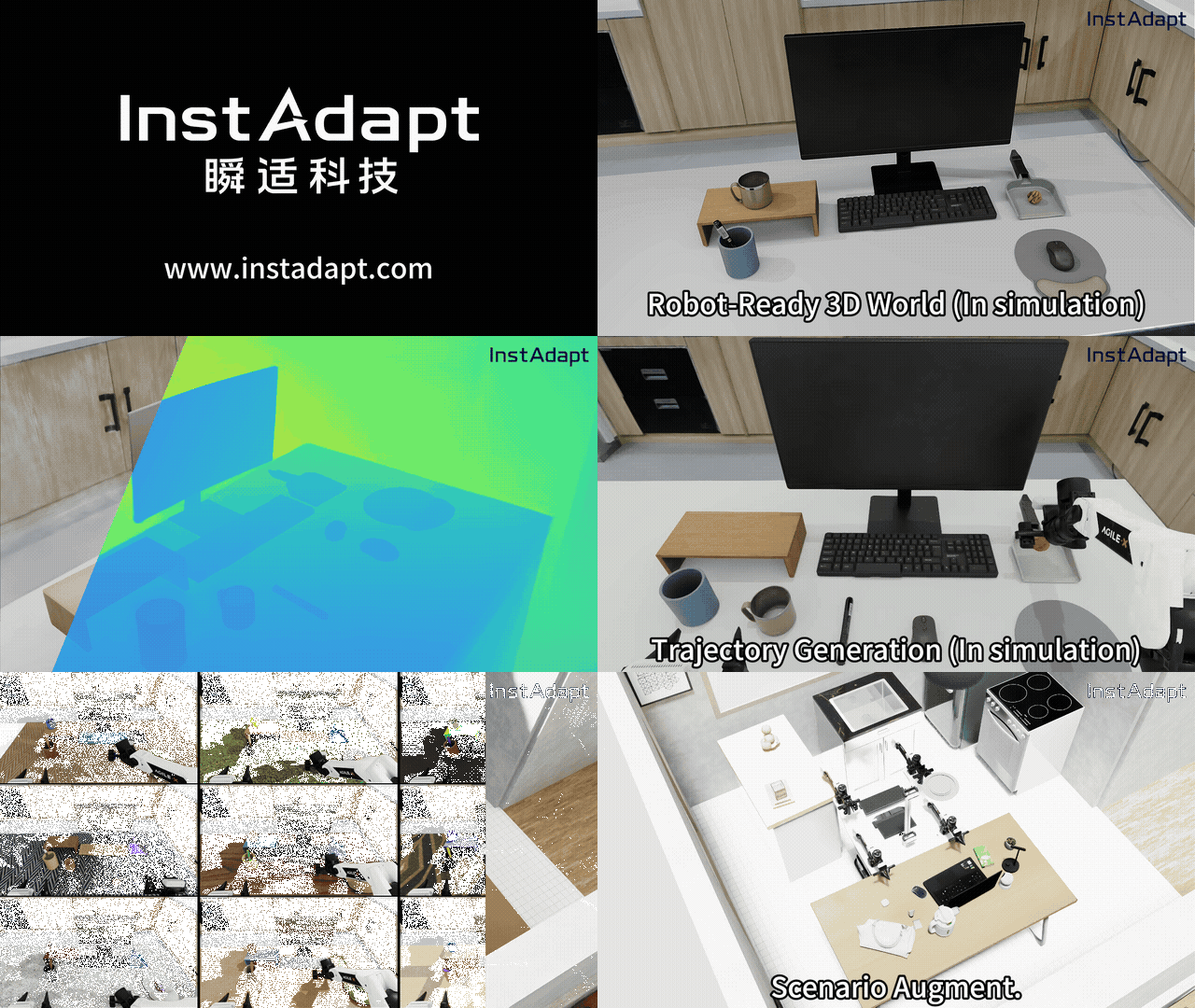
The first layer is robot data acquisition and governance. Compared with ordinary first-person perspective data collection, InstAdapt pays more attention to the real three-dimensional interaction relationship between robots and the environment, especially the spatial relationship, object state and contact changes during the hand operation process. Through first-person human videos, robot interaction data, 3D reconstruction and hand-object relationship modeling, the company quickly converts objects, spaces, actions and contact relationships in the real environment into Robot-ready data.
Shi Ye introduced to Hard Krypton that although much current robot data contains 3D information of the human body or robot, the objects themselves still remain at the two-dimensional level. When this type of data is used for training, the model may think that the robot has completed the grasping, but in the real 3D space, the object is not actually grasped correctly. InstAdapt has established a data production process from first-person video segmentation, 3D space reconstruction, to modeling of the interaction relationship between hands and objects, aiming to quickly convert new real problems into learnable and reusable experience for robots.
The second layer is 3D physical asset generation and scene reconstruction. Through inputs such as photos and videos, InstAdapt quickly reconstructs new real environments into trainable, interactive and editable 3D task environments, and further introduces physical attributes and contact relationships to form 3D physical assets that can directly serve robot training. A real experience can be extended to a large number of controllable training scenarios by changing object positions, scene conditions and task parameters. Thus, a Real-to-Sim-to-Real pipeline of "real data → Robot-ready data → 3D physical assets → simulation training → post-training → real robot deployment" is formed. These replayable and editable 3D physical environments are not only used to train robots, but also provide an experience generation basis for failure recurrence, counterfactual experiments and subsequent recursive self-improvement.
(Image source from the enterprise)
The third layer is the unified world action model and robot strategy training. InstAdapt explores a unified multimodal world action model: the same model not only generates robot actions, but also predicts the visual, state and contact changes after the action is executed, which not only answers "what should be done now", but also deduces "what will happen after it is done", and uses the prediction of future results to constrain action generation in turn.
In terms of action generation, the team conducts research around the diffusion world action model, emphasizing trajectory continuity, state transition reliability and controllability of the generation process; in terms of contact understanding, InstAdapt further introduces visual and tactile information, so that the model can understand states that are difficult to judge solely by vision, such as grasping stability, slippage, jamming and improper insertion. The prediction of future consequences not only helps generate actions, but also can be used to diagnose the cause of failure, evaluate counterfactual results of different actions, and decide which experiences should be generated and learned in the next round.
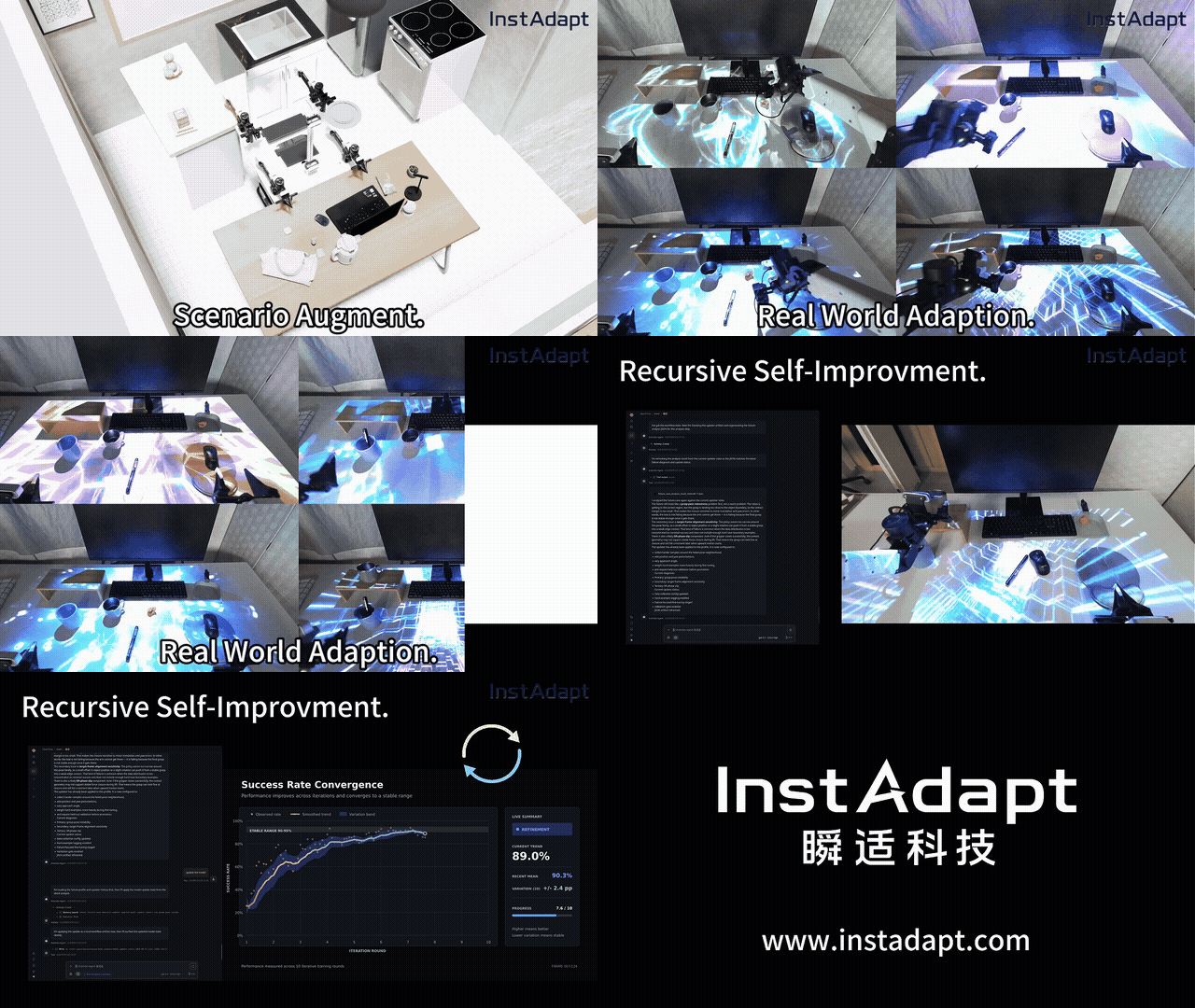
The fourth layer is generative reinforcement learning and embodied recursive self-improvement (RSI) driven by world models. Through the closed loop of "simulation deduction → gap identification → experience generation → strategy training → real robot verification → mechanism update", experience is converted into capabilities to achieve low-cost adaptation, and various cases are used to continuously identify gaps and update strategies. Each round of learning simultaneously optimizes the model and evaluation mechanism to improve the self-adaptation efficiency in new scenarios.
(Image source from the enterprise)
At present, InstAdapt has built a complete technical pipeline covering data production, physical asset generation, model training and robot deployment, and completed scenario verification for dexterous hand operation and refined tasks. The company's relevant technical solution was invited to share at NVIDIA GTC 2026, and it is the only enterprise on site that jointly demonstrates the technical progress in the direction of Physical AI infrastructure with NVIDIA.
After the completion of this round of financing, InstAdapt will continue to promote the construction of Physical AI infrastructure, focusing on investing in high-quality robot data systems, world model R&D and commercial implementation for actual scenarios.
Excerpt of founder communication:
Hard Krypton: What is the differentiation of the company's vision-tactile fusion?
Shi Ye: The moment when tactile sense is truly valuable is after the robot has already made contact with the object. We do not use tactile sense to replace vision, but take tactile sense as a key supplementary modality to enhance the understanding of contact state and interaction process. Traditional tactile data mostly arranges sensors on specific objects to record signals under preset states; what robots really need is 3D interaction information during continuous operation.
We have built a 3D hand-object interaction data system to record the complete state of the hand, objects and the contact process, which includes both 3D spatial information and tactile interaction information. The goal is to convert tactile sense from isolated sensing signals into training data aligned with vision, action and 3D geometry, and map it to different forms of robot systems. In preliminary verification, after introducing the tactile-visual world model in some operation tasks with rich contact, the success rate increased by more than 30%.
More importantly, tactile feedback not only improves the success rate of current tasks, but also helps the system judge why the robot failed — whether slippage, jamming or improper contact occurs. For new objects, new assembly tasks or new operation environments, this information significantly improves the pertinence of failure diagnosis and the next round of training, and speeds up task adaptation.
Hard Krypton: Why does InstAdapt regard "unified world action model + generative reinforcement learning" as the foundation of embodied recursive self-improvement?
Shi Ye: The unified world action model not only generates robot actions, but also deduces the future state after the actions are executed. Generative reinforcement learning converts task rewards, failure cases, simulation experience and real robot feedback into strategy update signals, so that robots can not only reproduce existing data, but also continue to learn during interaction.
However, the real recursive self-improvement is not just to repeatedly train the same strategy. The system also needs to continuously improve the world model, reward evaluation and task generation mechanism according to the execution results of each round. For example, if the world model has a large prediction error on a certain type of contact state, the system will generate more relevant simulation scenarios; if the robot repeatedly has a certain type of failure in the real robot, the system will generate counterfactual tasks around the capability gap; after the new strategy is evaluated by simulation and verified by the real robot, higher-quality experience is generated for the next round of training. This mechanism first solves how robots adapt to new tasks faster, and then further solves how to continuously evolve during long-term deployment. We hope to establish an RSI mechanism controlled by task objectives, safety constraints and real feedback, so that after each round of learning, the robot not only has stronger task capabilities, but also improves the efficiency of identifying problems, generating experience and completing adaptation when facing new tasks next time.
Hard Krypton: Compared with other companies that build world models, robot data or post-simulation training infrastructure, what is the biggest difference of InstAdapt?
Shi Ye: We do not split data, simulation, model training and deployment into independent products. What InstAdapt builds is not a single-point model, but a continuous learning closed loop from real data, 3D physical assets, simulation experience, unified world action model, generative reinforcement learning, to real robot deployment and feedback return.
Our starting point has always been very clear: the world model will not just be a "simulator" externally attached to the strategy. The more possible form is that the world model and the action strategy are gradually unified. The same model not only answers "what should I do now", but also deduces "what will happen after it is done", and then uses the prediction of future consequences to constrain action generation in turn. On this basis, new environments and new tasks are quickly converted into Robot-ready data and 3D physical assets, expanded into large-scale controllable interaction experience in simulation, and then continuously post-trained through cloud fine-tuning and generative reinforcement learning, and finally integrate world models, simulation experience and a small amount of real robot data to adapt to specific ontologies and scenarios. The closed loop runs continuously. Each round of real robot feedback makes the next round of simulation more targeted, and each round of model update shortens the time and amount of real data required for the next adaptation. The ultimate goal is: let robots quickly learn when facing new environments and new tasks, continuously evolve after entering real deployment, and adapt faster next time.