Competing for both growth and delivery, where will the two leading giants in the AI office sector head next?
At the Baidu Dazi launch event on August 27, product architect Li Jingqiu did not spend much time introducing parameters and stacking features, but repeatedly emphasized one sentence: "Deliverance that stuns at first sight".
This is likely one of the most notable signals in the 2026 AI office track, pointing to the biggest difference between agents and previous products. After a year of transition from "who can generate content" to "who can get work done", the competition is now entering its third stage: who can deliver more professional results, and whose outputs can further exceed user expectations.
To understand this change, we first need to look at the table of players.
The competitive landscape of AI office is rapidly converging. Tencent has brought WorkBuddy to the forefront, with Ma Huateng personally endorsing the product in a high-profile push; Alibaba has merged QoderWork, Wukong and MuleRun to launch its Qianwen Office suite; ByteDance, iFlytek and Yonyou have all entered the track from their respective advantageous positions.
All players are making moves, while Baidu Dazi has maintained high growth five months after its launch. The latest AI product desktop ranking shows that it ranks second among AI office agents with 6.74 million monthly active users, with a 1063% month-on-month increase in MAU, taking the first place on the growth list. WorkBuddy, which ranks first, has 11.15 million MAU, but its growth rate has entered a relatively stable range.
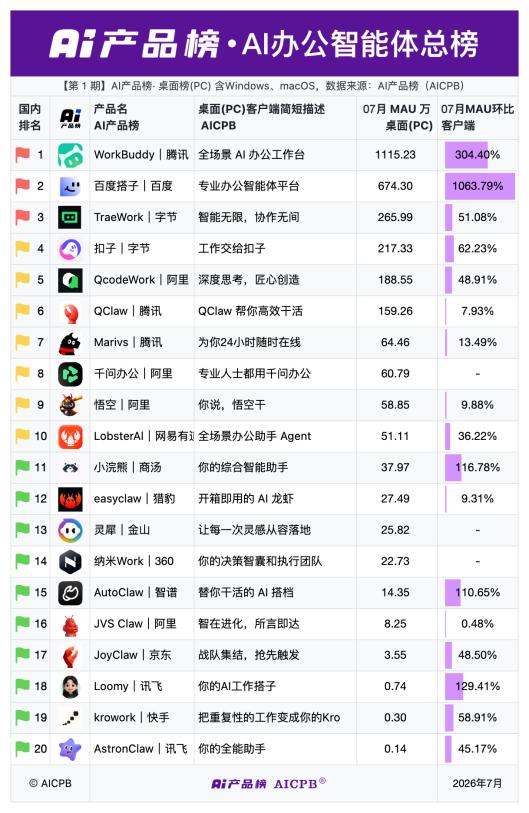
Since its release in March this year, Baidu Dazi has iterated 150 times in the past 5 months. With the boom of the office track, its user base has increased nearly 9 times in the past month. At the launch event, Shen Dou, Executive Vice President of Baidu Group and President of Baidu Intelligent Cloud Business Group, stated that the rapid growth of user scale indicates that the product has hit user demands, but whether the product experience is extreme and whether the delivered results are stunning determines whether users are willing to stay. This judgment also represents the evolutionary core of Baidu Dazi: it is committed to allowing agents to directly deliver more professional, more expectation-exceeding results, which may not even be limited to daily office scenarios.
The phased landscape has emerged: Tencent has secured the top position in user scale relying on its traffic and ecosystem, while Baidu is growing at a high speed with its continuously iterated product strength. The AI office track has evolved from a chaotic melee to a duopoly pattern.
Behind this lie two completely different product routes, whose differences may deserve more attention than the outside world imagines.
01
Simultaneous Iteration: One Focuses on Breadth, the Other on Deliverables
WorkBuddy and Baidu Dazi have one thing in common: both iterate very fast, but in different ways.
WorkBuddy's playing style is more in line with Tencent's consistent style - high-profile push and rapid volume expansion. Ma Huateng made public statements to set the tone, the team was merged and upgraded, and the product quickly penetrated various segmented demands in office scenarios on the desktop end. It pursues building user awareness on the largest scale, equating the concept of "AI office" with WorkBuddy. Tencent has taken this path smoothly, and its user volume has proven its success.
Baidu Dazi's iteration logic is completely different. In the early stage of launch, it released a new version almost every day at its peak, which can be described as frantic speed. But behind the frequent releases, the product direction has never changed: all iterations are carried out around one core goal, which is to let AI truly complete the work.
Starting from its MVP version, Baidu Dazi has put "deliverability" at the top priority. One month after launch, it began to be competent for complex tasks that require multiple expert capabilities; in May, it topped two execution evaluation lists, PinchBench and DeepResearchBench, and its PinchBench score surpassed similar products from Anthropic and OpenAI; in June, it reduced the Token consumption for task execution by 75%; in July, it released the self-media suite and enterprise version; in August, the design suite and financial suite were launched one after another, with the Miaoda Workbench integrated.
If you stretch the timeline, what Baidu Dazi has done follows a continuous logic: first make the Agent executable, then reduce the execution cost, so that the capabilities can enter specific industry scenarios, and finally expand to organizations.
In this way, every step is steadily built on the basis of the previous step, without skipping stages.
This product idea was refined at the launch event as "Deliverance that stuns at first sight". It points to a very specific question: are the outputs delivered by AI office products semi-finished products? When a user gets a PPT, how much time do they still need to spend modifying it? When they get a research report, can the data pass verification? When they get a video, can they post it directly?
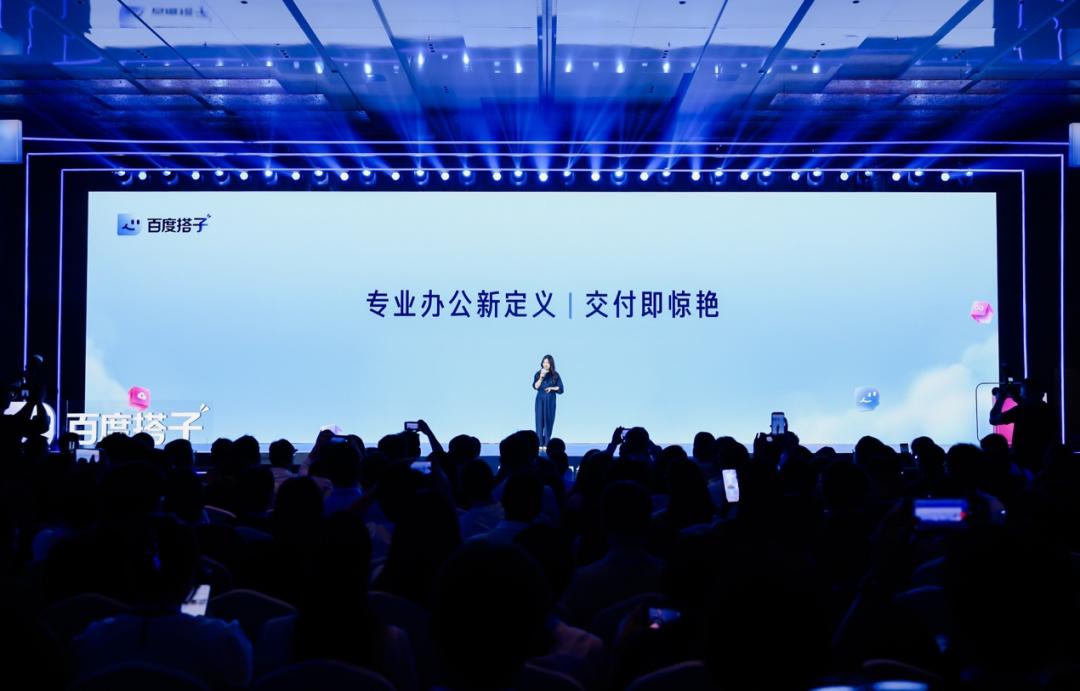
A demonstration at the launch event gave the most intuitive answer: before the event, Baidu Dazi was connected to the live stream, speech PPT and related materials, continuously recorded and processed on-site content during the event, understood the speech in real time, and extracted product upgrade information and guest viewpoints.
Before the meeting ended, it generated a review video, a long image of product upgrades, posters of guest highlights and a press release. The whole process was not a one-off Q&A, but a continuous task running through the whole event - what users saw was not fragmented demonstration features, but complete deliverables.
A more relatable example is 70-year-old Lao Wan, a wildlife photographer in Changbai Mountain. He uses infrared cameras and field monitoring equipment to record wild animals in Changbai Mountain all year round, accumulating more than 100TB of materials. The most troublesome part in the past was filtering: the footage returned by infrared cameras and monitoring devices 24 hours a day could only be viewed frame by frame by human eyes.
"Now reviewing materials is more tiring than shooting. It's not easy to go through them one by one, and my eyesight is not good at 70." Lao Wan has no programming experience and cannot configure complex parameters. He only said one sentence to Baidu Dazi: Help me pick out the footage with wild animals in this video, create a new folder, and organize a monitoring log according to my usual habits.
Baidu Dazi broke the task down into four steps: video recognition, clip extraction, classification and archiving, and log generation. It screened out the footage of animals from hours of materials, and sorted out the monitoring records according to his habits. In the end, what Lao Wan got was a folder that could be archived directly and a log that could be used immediately.
This is the difference between "deliver" and "generate". Generation gives you a piece of text, while deliverance gives you a sorted folder and a ready-to-use log. The former is raw material, the latter is a finished product.
Content creator Hong Ling also felt this difference. She runs a content brand called "Hong Ling's Tavern", and completes the full closed loop from research, writing to publishing and operation all by herself. In the optical communication industry research, Baidu Dazi helped her sort out the entire industrial chain from materials, optical chips, optical devices to final applications, and she then formed logic, viewpoints and judgments based on the research results. "I am responsible for sensibility, Dazi is responsible for rationality; I am responsible for creativity and judgment, Dazi is responsible for research, verification and execution." Hong Ling introduced the division of labor between herself and Dazi this way.
For what kind of deliverance can be called "stunning", Baidu Dazi gives three criteria: professional core, beautiful presentation, and usable results. These three criteria together point to a more essential change - the competition in AI office is shifting from "whether the feature exists" to "whether the result is usable".
Tencent educates the market by expanding breadth, while Baidu Dazi improves user experience with better deliverables. The former determines whether users know about the product, while the latter determines whether users will stay.
02
Baidu Dazi's Full-Stack Advantages That Are Hard to Replicate
If the "deliverable-oriented" product strategy is just a choice, what supports the continuous operation of this strategy is Baidu's accumulation in AI infrastructure.
Baidu is one of the few domestic giants that independently develops the full link from chips to applications. The Kunlun Chip project started in 2018, the PaddlePaddle framework has been accumulated since 2016, and the ERNIE large model has been continuously iterated since 2019. This set of full-stack capabilities has been widely discussed in the past few years, but its significance has changed in the Agent era.
The execution capability of a general-purpose agent depends not only on how powerful the model itself is, but also on the degree of adaptation between the model and the underlying computing power, framework, and tool chain.
Why can Baidu Dazi achieve iteration of one version per day, why can it cut Token consumption by 75% within a month, why can its security sandbox be completely isolated from the local environment... The answers to these questions are hidden in the underlying technology stack.
The value of full-stack capabilities is also reflected in search and knowledge integration. Baidu Dazi has built in the technical accumulation of Baidu Search AI API and search Agent, with higher accuracy and less hallucination in information retrieval scenarios. At the same time, Baidu's core product capabilities accumulated over years of deep cultivation in AI - search, Miaoda, Famou, Encyclopedia and more can all be seamlessly integrated into Dazi in the form of Skills. Users only need to give instructions, and these capabilities will collaborate in the background. This level of ecological integration is difficult for single-point products to replicate.
More importantly, full-stack capabilities bring security and controllability. When Agents enter enterprise scenarios, data security is not a module that can be added later. Baidu Dazi has implemented sandbox isolation, folder-level permission control, and mandatory manual confirmation for high-risk operations from the architecture level. The reason why these capabilities can be implemented thoroughly is inseparable from Baidu's control over underlying computing power and frameworks.
"Blue Ocean Blackstone's AI practice is not about adding an independent tool, but making AI part of the existing business system." Zhang Mingjie, CIO of Fujian Blue Ocean Blackstone New Materials Technology Co., Ltd., shared a real experience in an enterprise-level scenario at the launch event.
In the procurement analysis link, Blue Ocean Blackstone uses multiple systems such as SAP, WMS and PLM at the same time. The systems are responsible for recording business facts, but cross-system data integration and trend judgment used to require manual work. After integrating Baidu Dazi, AI is responsible for understanding business problems, integrating internal data and external raw material market conditions, outputting trend judgments, risk warnings and short, medium and long-term procurement suggestions, converting the manual analysis that used to take several days into a verifiable decision report.
"Enterprises connect through Skills, knowledge bases and business systems, precipitate scoring rules, calculation logic, document generation methods and professional personnel experience into reusable enterprise capabilities, and gradually expand single-point verification to organizational-level applications on the basis of permissions, data isolation, manual confirmation and operation audit." Zhang Mingjie concluded at last.
This is how full-stack capabilities land in real enterprise scenarios. Security control is not a promise in the product introduction, but a prerequisite for enterprises to dare to integrate AI into their business systems.
But full-stack capabilities can only explain "why it can be done", not "why it is done this way".
At this year's Create Conference, Li Yanhong defined Token as a cost rather than revenue, believing that the arms race of model capabilities has entered a stage of diminishing marginal returns, and what really determines the value of AI is how many tasks it can complete. In fact, Baidu has repeatedly released this signal since the 2025 World Conference, and by the 2026 Create Conference, this judgment has become a strategic consensus of the entire company.
Baidu Dazi is the productized expression of this consensus - its existence is not to prove how powerful Baidu's model is, but to prove that Baidu can convert model capabilities into quantifiable, deliverable and commercializable assets.
03
The Endgame of AI Office Lies in "Reusability"
Why is AI office a must-win battlefield for all major tech giants?
Because among all current Agent application scenarios, it is one of the few fields that meet three conditions at the same time: a sufficiently large user base (100-200 million office workers using computers in China), strong enough willingness to pay (the value perception of productivity tools is the most direct), and large enough penetration space (the current actual penetration rate is only 10% to 20%).
The cake of this track is large enough, but the way to divide the cake is changing.
In the early stage, AI office competed for feature coverage, and whoever could do more things had an advantage. But the feature level will soon converge - if you release a financial suite today, competitors may follow suit tomorrow. What truly widens the gap is another dimension: whether the delivered results can be continuously reused.
Individual users need stable and reusable confidence in capabilities: when you finish an industry report, can you directly call relevant capabilities when making a similar report next time? When you have a set of working content production processes, can you apply it directly to the next topic? If you have to start from scratch every time, the value of the Agent will be greatly reduced.
A couple of rural teachers in Zhenning Buyi and Miao Autonomous County, Guizhou, initiated the "Weiguang" public welfare organization to promote rural reading through reading courses and official accounts. But the operation of the official account took up a lot of their energy - in order to determine what content to post every day, the two of them had to squeeze more than ten hours every week to collect materials, plan topics, write articles and organize typesetting.
"In the past, people chased content, now content chases people." They described the change after using Baidu Dazi.
Now, they only need to explain the positioning of the official account, public welfare topics and update needs in daily language, and let Baidu Dazi build a topic table based on that, capture and sort out public hotspots, associate hotspots with themes such as rural reading and public welfare education, recommend daily topics and generate article drafts. Within dozens of minutes, a set of continuously usable content creation processes can be built.
This is what individual users really need - not generating an article once, but building a process that can be used next time. If you have to start from scratch every time you create content, the Agent is just a one-time tool; only when the topic table it builds can be continuously updated and the logic of generating drafts can be reused continuously, can it truly integrate into the workflow.
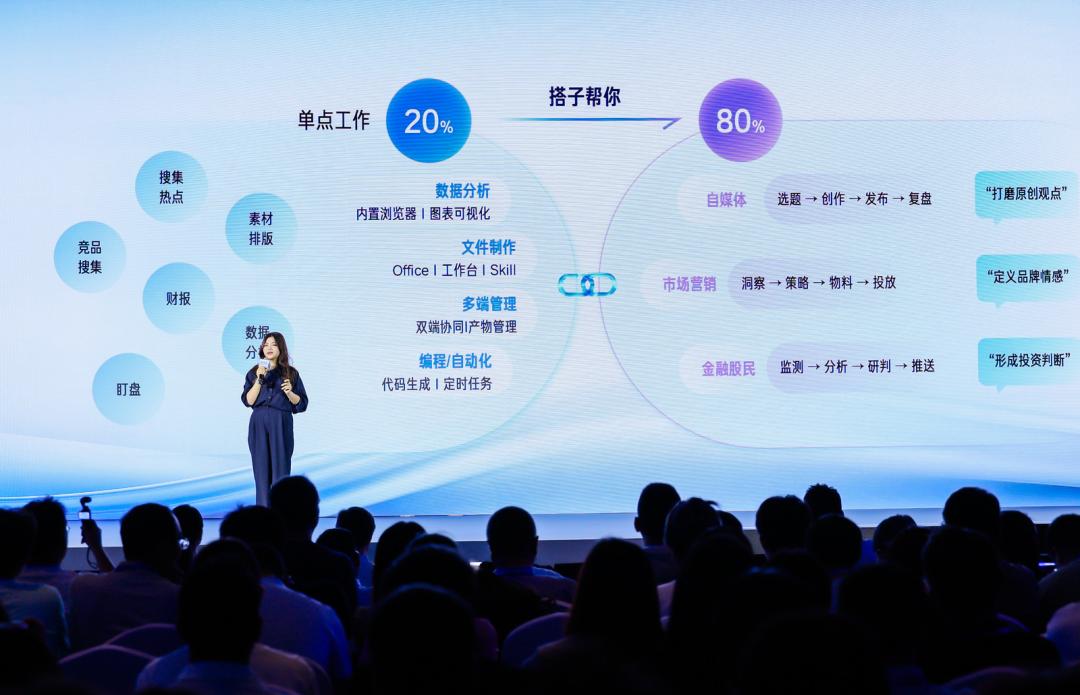
At the organizational level, this logic is amplified. Can the working methods of an excellent employee be precipitated into a standard process that new employees can quickly master? Can a successful project delivery experience become part of the knowledge base and be called directly in the next project?
The enterprise version of Baidu Dazi responds to this question with three core capabilities: industry suites solidify the stunning capabilities of excellent employees into enterprise standards, the knowledge base turns scattered experience into organization-shared capabilities, and the VPC version provides data security and compliance guarantees. The three things combined point to the same goal - to prevent personal capabilities from being lost with staff turnover, and to enable the organization to have the certainty of continuously delivering stunning results.
This is the real watershed of AI office: features can be copied, but the depth of reusability depends on the degree of integration between the product and the user's workflow, which requires time, data accumulation, and continuous use, feedback and optimization by users in real scenarios.
Therefore, the competition of AI office is ultimately not about who has more features or who has a stronger model, but about who can let users hand over more truly important work, and the delivered results can become the starting point for the next work. Once this logic works, the moat will be dug deeper and deeper over time.
Baidu Dazi is running fast enough now, but