High-quality Interview: Two Sigma Discusses How to Empower Investment with AI
I'd like to recommend an interview with Ben Wellington, which is extremely content-rich and features unique insights into AI investment research and AI investing.
Who is Ben Wellington? He is the head of Feature Engine at Two Sigma, the world's top quantitative fund.

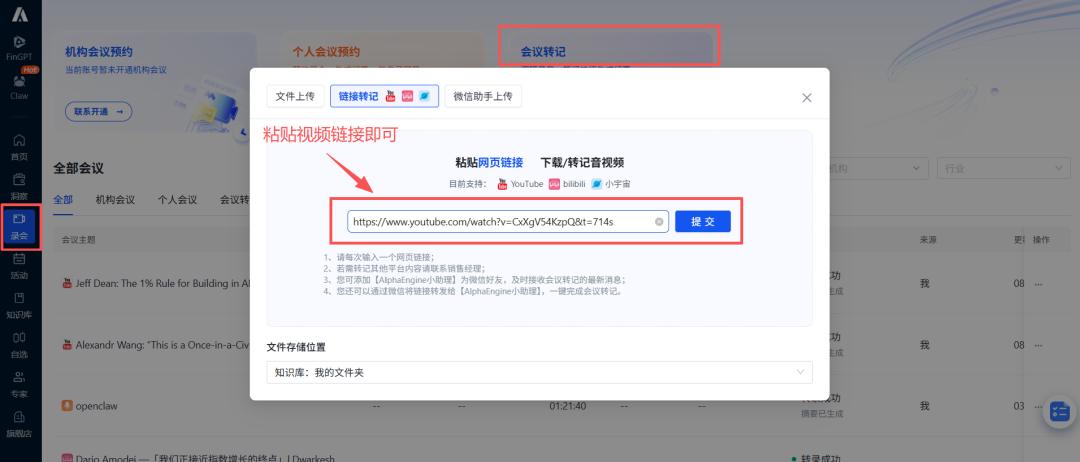
I used AlphaEngine to generate a summary of the video, then studied it section by section.
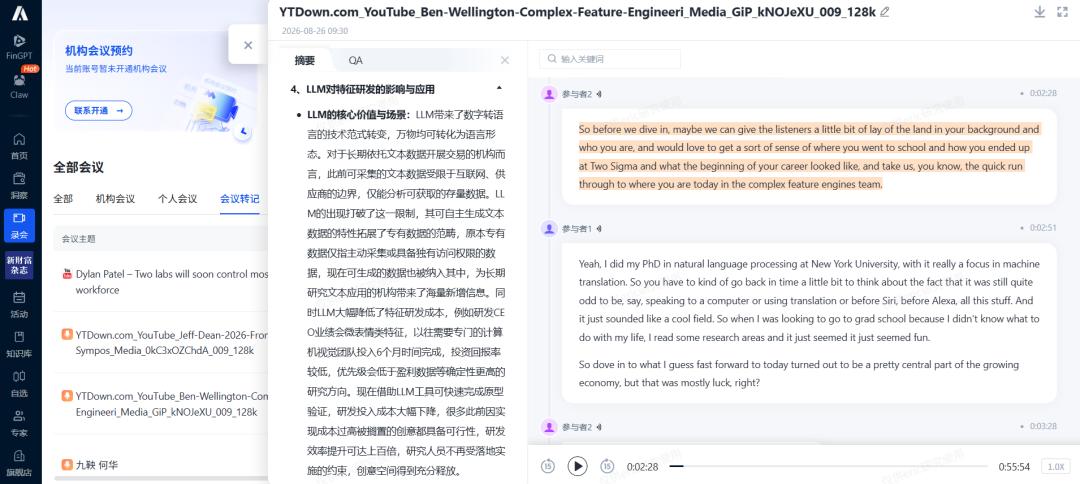
Main contents include:
- The three major sources of Alpha in quantitative investing
- AI is an "amplifier of everyone's unique capabilities"
- Two Sigma's current key research direction: Idiosyncrasy at Scale
- New standards for investment professionals in the AI era
Without further ado, let's get started.
(1) The three major sources of Alpha in quantitative investing
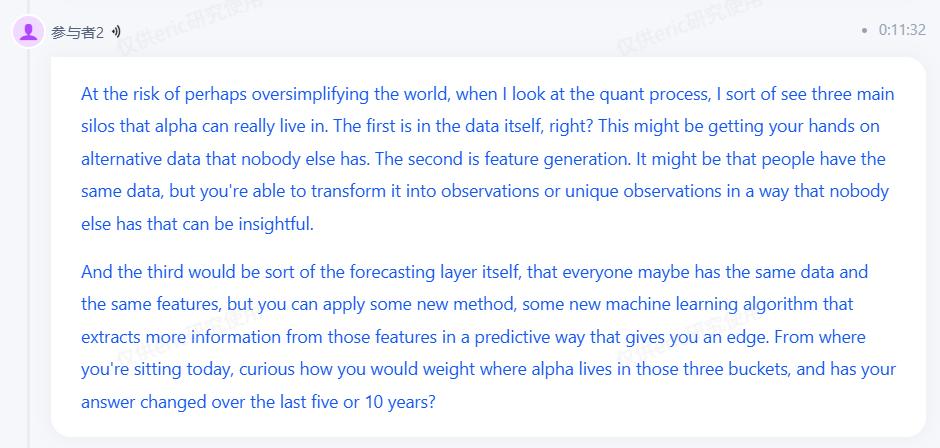
Alpha for AI investing mainly comes from three major sources.
The first is the data layer, which refers to acquiring alternative data that no other institutions have, for example, using satellite image data to analyze the occupancy of parking spaces in Walmart parking lots, using credit card data to track the current quarter revenue of sales companies, and using job recruitment JD to track the pace of capacity expansion of companies, etc.
The second is the feature layer, which refers to distilling unique features that no other institutions have from the same data, for example, extracting the number of evasive answers and irrelevant answers given by company executives through speech recognition technology during the performance exchange meetings of listed companies.
The third is the prediction layer, which refers to extracting more effective predictive information through new machine learning algorithms based on the same data and features, for example, upgrading from the traditional linear regression prediction method to GBDT to capture the non-linear relationship between factors and returns.
(2) Which of the three Alpha sources is more important?
The data layer is very important, but its weight is decreasing year by year.
In the past 15-20 years, data has been greatly commercialized. Two Sigma was one of the first data buyers that required data vendors to cover all underlying assets across the entire market, playing a role in market education. Back then, the relative weight of data advantage was very large.
Compared with the data layer, the feature layer has the largest weight.
Transforming the same data into features in a clever and unique way is the largest source of Alpha.
A good feature often implies underlying economic significance and investment intuition.
For example, "the financial report disclosure time of a listed company" is a valuable feature, especially to see whether a company chooses to issue press releases only after the market closes on Friday.
Behind the features is essentially human creativity.
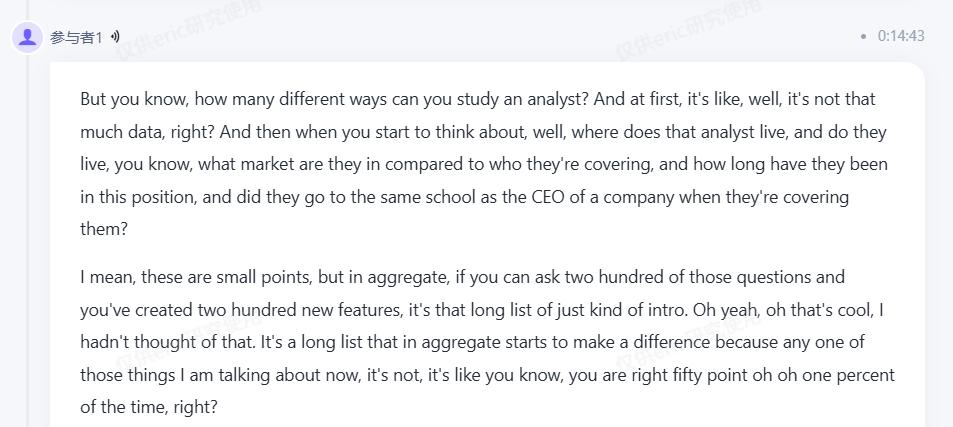
Ben cited "analysts" as the research object to give an example.
To study the relationship between "analysts" and "the stock price of the target company", we cannot only look at the single feature of "analyst rating".
Two Sigma will also pay attention to whether the analyst graduated from the same university as the CEO of the covered company.
The effectiveness of a single feature may be very weak (for example, the win rate is 50.001%), but if you raise 200 similar questions and generate 200 features from different angles, the aggregation effect will be very significant.
The prediction layer is also very important. Two Sigma has specially set up the Techniques team to study how to maximize the effectiveness of machine learning algorithms.
(3) How to conceive features that others have not discovered from highly commercialized data
Ben's answer is very straightforward: Rely on continuity and scientific methods, rather than stacking computing power.
First of all, all factors must go through manual prior screening.
Indicators with obviously low prior probability such as analyst height and pupil color are not worth spending time on, and will instead introduce noise.
Therefore, a good feature is often inspired by some ideas. Ben summarized some valuable sources of inspiration.
The first source of inspiration is academic research results.
For example, some papers infer whether an analyst has children through their social posts, and then use this to predict their stock selection ability.
The second source of inspiration is to build a team with cognitive diversity.
Two Sigma's research team includes physicists, mathematicians, computer scientists, etc. Due to different backgrounds, everyone thinks about problems in different ways, which often leads to the generation of valuable features.
The third source of inspiration is to generalize from real-world individual cases.
For example, when you see news such as "a train derailment in a certain area leads to a drop in the stock price of a related company", immediately think about whether it can be abstracted into a general feature that covers all companies in the entire market and conduct backtests over ten years.

(4) Collinearity is the grave of features
One of the difficulties in feature mining is that the team may produce hundreds and thousands of seemingly independently effective signals that are actually highly collinear.
In factor mining, some seemingly "low-hanging fruits" are actually of no value.
For example, the "news sentiment factor" in many cases only tracks news reports after the release of financial reports. These news are essentially just a "noisy version of earnings data" and do not bring any new information.
At Two Sigma, the modeling team has a clear orthogonality threshold, and new features will only be included in the factor library after meeting the standards.
In addition, each feature has its inherent prediction cycle, which depends on its economic transmission path.
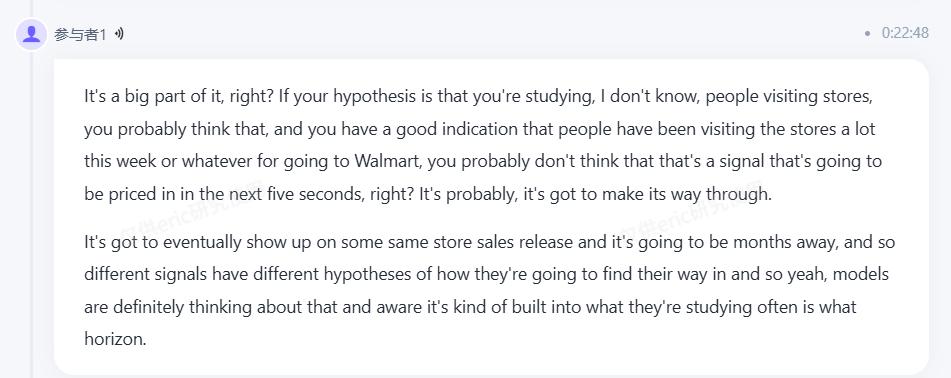
For example, Walmart's foot traffic data cannot be priced by the market in 5 seconds. It must be transmitted through channels such as same-store sales data disclosure, and the cycle is at the level of several months.
Therefore, different features have different "market entry paths", which determine their prediction cycles.
(5) LLM greatly reduces the exploration cost of new ideas
In the past, if you wanted to test alternative features such as "the blink frequency of CEOs at earnings conference calls", a dedicated computer vision team would need to invest half a year, and the ROI would be too low.
Even if you intuitively think that this feature may be valuable, you can only put it aside first and carry out research with higher prior value.
Now with the help of LLM for analysis, the research cost of new features has dropped sharply, and the decision-making balance has been completely rewritten.
This is equivalent to making the experiment budget of scientists unlimited, so they no longer have to worry about "building a particle collider", and the difficulty of implementation is no longer a constraint on thinking.
If you have 2000 unstudied feature ideas piled up on your desk, this is a gold mine in the AI era.

(6) AI is an "amplifier of everyone's unique capabilities"
Ben believes that the core risk of AI investment research tools is "reducing the entropy of investment decision output".
Automation is good for standard production processes (such as carton manufacturing), but the excess return of investment portfolios precisely depends on orthogonality and originality.
If everyone is given a "one-click decision" button, the speed of producing investment decisions will be very fast, but the outputs will be highly homogeneous, which is very dangerous for the investment portfolio.
The correct approach is to position AI as an amplifier of the unique research capabilities of each investment researcher, rather than a substitute.
Through mechanisms such as context and Skill, AI can understand the respective backgrounds and problem-solving thinking patterns of users, which enables different analysts to draw different conclusions even when facing the same problem.

(7) Don't wait for technology to mature, dare to hit a wall
The development speed of AI is very steep. There is a popular saying in the industry: As long as I learn slowly enough, I don't need to learn at all.
Ben advises investors not to have such an idea about AI, and don't give up tackling hard problems just waiting for the technology to mature.
First of all, hitting a wall itself is valuable.
Experiencing the boundary of "what the technology cannot do" in person is equivalent to using a flashlight to clearly illuminate the wall blocking the way.
Otherwise, when new tools appear, you will not know where to use them at all, and you will have to look for the wall temporarily, which will be too late.
It is precisely because you have hit the wall repeatedly for half a year that as soon as new technologies appear, you immediately know what problems they can solve.
In a market with extremely fierce competition such as quantitative investing, 12 to 18 months is an eternity.
Waiting for AI technology to mature may save you the trouble of engineering adjustments, but being the only one in the market to adopt a certain method in advance will make the effectiveness and influence of your signal much greater.
Therefore, as long as you judge that you are in a leading position, you should push the research scope beyond the current capability boundary of AI, and make full use of this window period to obtain Alpha before the market catches up.

(8) AI makes "Idiosyncrasy at Scale" possible
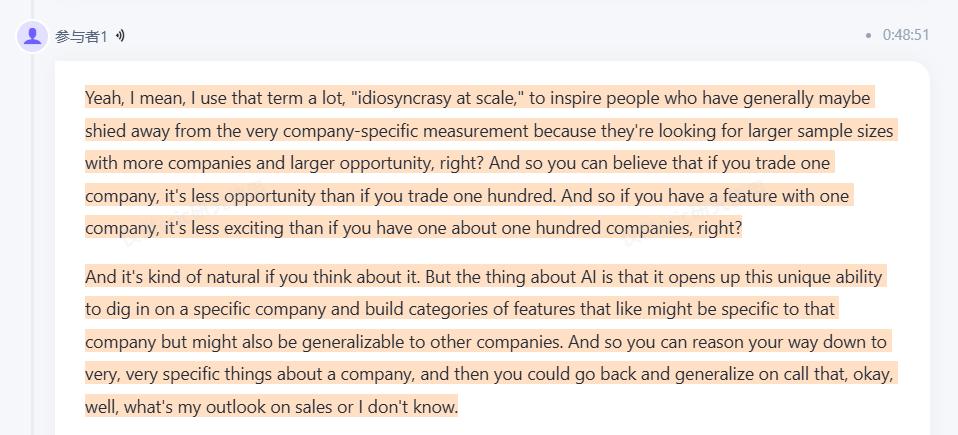
Ben put forward the concept of "idiosyncrasy at scale" in the interview.
Intuitively, a factor that can only cover one company is far less attractive than a factor that can cover a hundred companies.
But AI opens up a unique capability, allowing investors to dig deep into the extremely special details of a certain company, build highly personalized features, and at the same time generalize the "paradigm" of such features to other companies.
The reasoning path of AI can be completely different from company to company, but the end point is a unified problem that can be summarized, such as "what is the company's sales outlook for the future".
This is essentially the advantage of subjective investors.
Relying on in-depth knowledge of the target company, subjective investors can capture unique features that will not appear in financial statements.
This is Two Sigma's most important research direction at present, that is, to let AI go deep into the personalized and hard-to-model corners at the company level, and then use AI to scale these idiosyncrasies.
(9) The standard of future investment professionals: execution is getting cheaper, and it is the idea itself that determines the outcome
Taking Two Sigma as an example, Ben gave the standards for talents in the AI era.
First of all, you need to be familiar with the capability boundary of AI.
The added value of those who "can do things quickly and well as others tell them what to do" in the past is declining, because AI can also do it, and it will be faster and better.
What is really appreciating is the ability to command AI what to do.
To achieve this, you must clearly understand the capability boundary of AI and the effective way to interact with AI.
Secondly, you should treat AI as an amplifier rather than a substitute.
Success requires being different (orthogonality) + scaling at the same time. An excellent analyst should use AI to scale and amplify their unique knowledge and perspectives.
In the future world, execution will become cheaper and