Embodied intelligence is now in a red-hot boom, when will it step out of the "demonstration-level intelligence" phase?
In the global tech circle over the past two years, no other track has been as bustling and full of contradictions as embodied intelligence.
From Tesla, Boston Dynamics, Unitree, Ubtech to a large number of startups launching iterated humanoid robot products intensively, from the full popularization of industrial robots to the pilot deployment of household service robots, embodied intelligence is recognized as the core carrier of the "next-generation AI revolution" and "general intelligence for the physical world".
At major tech exhibitions and press conferences, humanoid robots and quadruped robots take turns to show their capabilities: stable walking, precise grasping, autonomous obstacle avoidance, and intelligent dialogue, with all movements performed seamlessly, as if AI has already fully obtained a "physical body" and is ready to enter factories, settle in households, and replace manual labor at any time.
Capital is pouring into this track even more frantically: valuations of startups are skyrocketing, leading tech giants are deploying across the whole industry chain, and favorable industrial policies are being released continuously, forming a situation of full-scale boom and imminent commercial implementation. Beneath the bustling appearance, we have to face a core question: how far is the currently red-hot embodied intelligence from its ultimate form of large-scale commercial application?
Beneath the Appearance of Technological Breakthroughs
In the first half of 2026, the total financing amount of China's embodied intelligence track reached 935 billion yuan, nearly 5 times higher than that in the first half of 2025, with 322 financing events, a year-on-year increase of 137%. In the first quarter alone, there were more than 50 financing events, with the cumulative financing amount exceeding 200 billion yuan, a year-on-year increase of nearly 60%.
By the end of June 2026, about 18 enterprises in China's embodied intelligence sector have publicly announced a valuation of over 100 billion yuan. At present, more than 20 enterprises are queuing for listing or have made capital arrangement plans.
The shipment volume is also impressive. According to the *2026 Humanoid Robot Industry Development Report*, the shipment volume of humanoid robots in China has exceeded 40,000 units in the first half of 2026, accounting for as high as 97% of the global total. The market size of embodied intelligence in China has grown from 2133 billion yuan in 2018 to 9150 billion yuan in 2025, and is expected to exceed 1 trillion yuan in 2026.
These numbers outline a thriving and prosperous industrial picture. But on the other side of these figures, there is growing anxiety and reflection inside the industry.
The core contradiction of the current embodied intelligence industry is the serious disconnection between the extreme demonstration effect in the training ground and the complex working conditions in real scenarios, which is also the root cause for the seemingly booming industry but actually slow implementation.
The 2026 World Robot Conference provides an excellent observation window.
Grabbing parcels on the sorting table, making coffee at the coffee bar, folding clothes in the home scenario... Working has almost become the standard capability of robots. However, there is still an insurmountable gap between the exhibition booth and the actual factory. Many tasks that run smoothly in demonstrations are actually "custom-tailored" for fixed scenarios and processes. Once unfamiliar materials are used, the process is disrupted, or even the light and shadow are interfered with, the performance of robots will drop sharply. A staff member at the exhibition booth admitted that they collected data on site temporarily before the demonstration and made "fine adjustments".
This "open secret" reflects the unavoidable reality of the current embodied intelligence industry: all smooth and fully automatic operations are essentially optimal solutions under customized scenarios, not general solutions for real-world scenarios. Every perfect robot demonstration is a highly customized performance, not a display of replicable and transferable general capabilities.
Although the embodied intelligence industry has moved past the laboratory concept verification stage, and formed a breakthrough trend of "algorithm advancement, hardware upgrading, and scenario trial operation", which has greatly improved the intelligence level of robots. On the whole, however, the industry iteration shows an obvious unbalanced feature of "fast cognitive algorithm iteration but slow hardware upgrade, strong demonstration effect but weak real implementation", with severely uneven maturity.
The core breakthroughs of current embodied intelligence are concentrated in the field of cognitive algorithms. The VLA (Vision-Language-Action) model has become the industry standard, which can accurately complete natural language instruction understanding, environmental semantic recognition, and long-cycle complex task decomposition, and greatly improve the accuracy of autonomous decision-making in standardized scenarios such as material sorting, object handling, and simple housework. Compared with the early single visual recognition, the VLA model can realize a complete cognitive closed loop of perceiving the environment, understanding instructions, decomposing steps, and executing autonomously.
Relying on the deep integration of large models, world models and multi-modal perception technology, embodied intelligence completely gets rid of the limitation of preset programs and passive response. It can predict object movement and environmental changes based on physical rules, greatly improve the task success rate in standardized scenarios such as material sorting, object arrangement, and equipment inspection, and realize the leap from "stimulus-response" to "active perception, logical deduction, and autonomous decision-making".
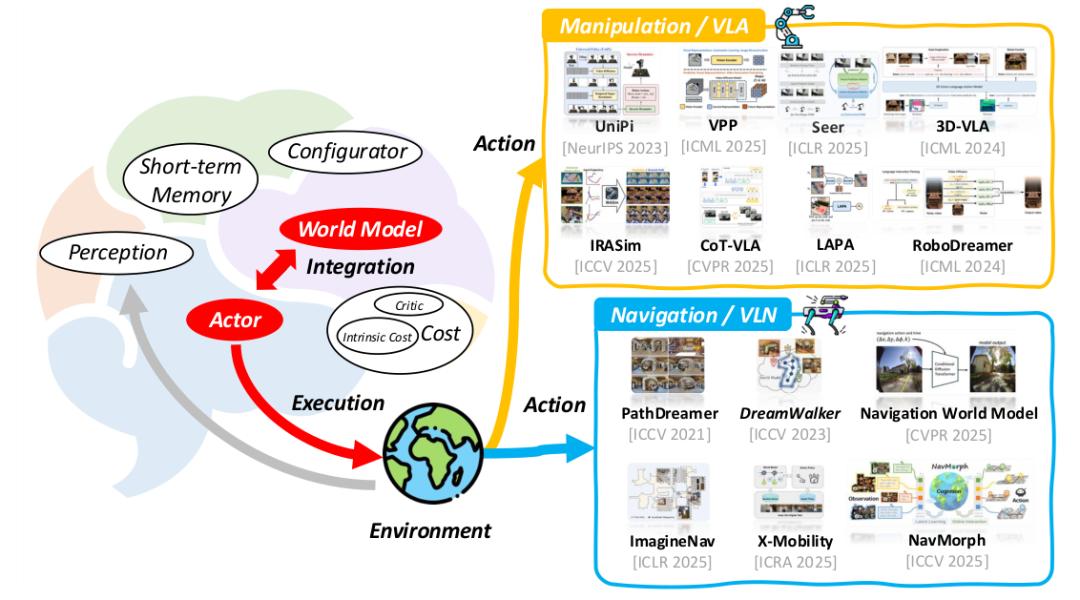
In terms of perception, embodied intelligence has iterated from single visual perception to a multi-modal integrated perception solution of "vision + force sense + tactile sense + inertia + laser". In particular, the large-scale application of high-precision torque sensors and flexible tactile sensors solves the pain points of robots lacking tactile sensation and force control, which can adaptively adjust the grasping force to complete fine operations on fragile and flexible objects, and greatly reduce the operation error rate.
In terms of hardware engineering, the process of localization, lightweight and high-precision of core robot components is accelerating. Core hardware such as servo motors, precision reducers, multi-modal sensors, and dexterous manipulators continue to iterate, and the degrees of freedom of humanoid robots are constantly increasing. At present, 19-23 degrees of freedom have been realized at the engineering end, which can complete basic bionic movements such as walking, grasping, and twisting.
The cost of key hardware has dropped significantly compared with five years ago, and leading enterprises have achieved leapfrog improvement in mass production capacity, breaking through the production capacity from 1,000 units to 10,000 units, and having the basic conditions for large-scale engineering implementation. Mobile robots and robotic arms in industrial scenarios have achieved large-scale commercial application, and a positive cycle between mass production and cost reduction has initially taken shape.
The trend of scenario implementation differentiation is extremely obvious. Structured scenarios in the industrial field have realized commercial application. AGV mobile robots, sorting robots, and inspection robots are widely used in intelligent manufacturing, warehousing and logistics, power operation and maintenance and other fields, with stable revenue and reuse value.
The real world is not a standardized test site. Cluttered sundries in industrial workshops, changes in light brightness, size deviations of materials, messy layout of home scenarios, dynamic obstacles, flexible object operation, wind and rain, slopes, and bumpy road conditions in outdoor scenarios will all have a huge impact on robot performance.
At present, there is a common problem in the industry that the performance of prototypes cannot be replicated in mass-produced products, and the demonstration capability cannot be transferred to actual scenarios. Most of the current demonstrations are exclusive results after engineers repeatedly calibrate, adapt and adjust parameters for the on-site environment, material position and light angle, rather than the robots having the general intelligent capabilities of autonomous understanding, autonomous adaptation and autonomous error correction.
The vast majority of robots can only complete single and simple fixed tasks, cannot adapt to dynamic and unstructured real environments, and their generalization ability, anti-interference ability and fault tolerance rate are far from meeting the large-scale commercial standards. This is also why unstructured scenarios such as household services, commercial companionship, and complex outdoor operations are still in the stage of pilot demonstration and sample testing, and it will take some time to achieve large-scale popularization.
Three Underlying Bottlers to Be Solved
The hype of the capital market, the promotion of public opinion, and the support of policies have greatly advanced the industrial rhythm of embodied intelligence. The technological iteration, scenario verification and cost optimization that originally required 5-8 years to complete have been compressed to 2-3 years, which directly leads to the awkward situation where technological development is disconnected from commercialization in the industry.
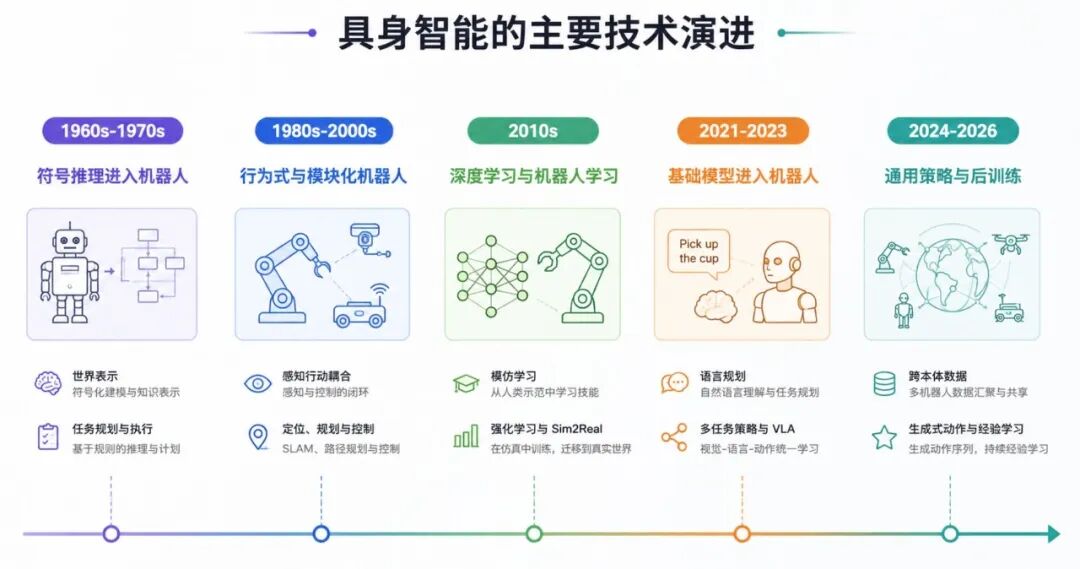
Objectively speaking, the industry is still facing three unavoidable underlying challenges, which are also the core proof that it has not yet truly matured.
First of all, the lack of data closed loop, there is no "physical world ImageNet", and the intelligent iteration is like water without a source.
The rapid maturity of large language models relies on the massive, open-source and high-quality text data on the Internet, forming an efficient training closed loop. However, as an intelligent system connected to the physical world, embodied intelligence has not yet formed a standardized and large-scale physical interaction dataset, falling into a severe "data shortage" dilemma.
Different from static data such as text and images, embodied intelligence requires physical scenario data such as force sense, tactile sense, deformation, friction and dynamic interaction, and a large number of failure case data to support model optimization.
At present, the industry's data sources are mainly divided into two categories, both of which have obvious defects:
The first type is simulation data, which can be generated in batches, but the physics engine cannot perfectly replicate the flexible deformation, fluid movement and subtle friction differences in the real world, leading to an insurmountable "Sim-to-Real Gap";
The second type is real machine measured data, which has high authenticity, but the collection cost is extremely high and the efficiency is very low. In addition, the data of various enterprises are severely isolated, with repeated investment and no data sharing, which greatly increases the iteration cost of the industry.
More critically, the scenarios in the real physical world have infinite randomness. Subtle changes in light, temperature, material and spatial layout will lead to the failure of robot decision-making. Without a unified physical world dataset and evaluation standard, the generalization ability of the model can never achieve a qualitative breakthrough, which is the core root cause why embodied intelligence is difficult to get rid of "demonstration-level intelligence".
Secondly, the dual ceiling of hardware performance and battery life leads to seriously insufficient implementation capability.
At present, the industry generally has the problem of "advanced cognitive system but weak body", and hardware engineering capability has become the biggest short board.
On the one hand, the battery life seriously restricts scenario implementation. The current mainstream humanoid robots only have a single continuous working time of 90-120 minutes, which cannot meet the 8-20 hours of continuous operation demand in industrial scenarios at all. Even the cutting-edge solid-state battery technology still has a technical cycle of nearly ten years before large-scale implementation and breakthrough in battery life. The pain points of short battery life and frequent charging make robots completely unable to work normally on a regular basis.
On the other hand, the dexterous operation and real-time control capabilities are insufficient. The human hand has 27 degrees of freedom, which can complete fine and flexible complex operations, while the current engineering technology can only replicate up to 23 degrees of freedom, and no breakthrough progress has been made in the past 40 years. In scenarios such as flexible object grasping, special-shaped object sorting and fine operation, the fault tolerance rate of robots is extremely low. At the same time, VLA model reasoning takes 50-100ms, while most dynamic operation scenarios require 20-100Hz real-time control response. The insufficient matching degree between computing power and hardware easily leads to problems such as operation lag and decision-making error.
In addition, problems such as poor mass production consistency of core hardware, high cost of high-precision sensors, and insufficient localization stability of core components make the excellent performance of prototypes unable to be replicated in thousands of mass-produced devices. The engineering mass production capability has become a rigid threshold for large-scale development of the industry.
Third, the blank of commercialization and system, unclosed scenarios and imperfect rules, have not yet formed the "self-sustaining" capability.
To judge whether an industry is mature, in addition to the core standard of technological advancement, it also depends on whether a sustainable commercial closed loop can be formed. In the current embodied intelligence industry, the commercial logic of most enterprises is still relying on financing to sustain operations and obtaining subsidies through pilot projects, rather than making profits from products. A positive commercial closed loop of self-sustainability has not yet been formed, and the speed of commercial implementation lags far behind the speed of technological iteration and capital expansion.
Different from large AI models which have clear evaluation benchmarks and compliance systems, embodied intelligent robots as physical carriers that can move and operate autonomously, there are no unified safety standards, scenario adaptation standards and fault liability rules around the world at present. When robot operation errors cause property losses and personal safety hazards, the definition of rights and responsibilities is ambiguous, and the product parameters and performance evaluation calibers of different manufacturers are not uniform.
Shift from "Valuation Story" to "Value Realization"
This round of embodied intelligence boom started with the breakthrough of large model technology in 2023, ushered in a frenetic influx of capital from 2024 to 2025, and entered a critical cycle of bubble differentiation and value screening in 2026.
In the past two years, the core logic of capital was "betting on the track, betting on the future, betting on technological subversion". As long as the enterprise had the concept of humanoid robot and technical team background, it could obtain high-valuation financing.
But in 2026, with the listing of Unitree, the capital logic has been completely restructured, the industry has officially bid farewell to the "valuation-driven" era, and entered a new stage of "delivery-driven". The capital market no longer pays for prototype demonstrations, concept stories and technical gimmicks, and the core assessment indicators have changed to actual delivery volume, scenario repurchase rate, single project profitability and large-scale cost reduction capability.
This also confirms the industry consensus: 2026 is the first year of delivery and the first year of knockout round for embodied intelligence. The problems of homogeneous involution, inflated valuation and resource waste brought about by early capital ripening are gradually cleared up, and industrial resources are rapidly concentrated to leading enterprises with core technology, mass production capability, implementation scenarios and profit models. The industry no longer pursues the "large and comprehensive" general layout, but focuses on the "small but excellent" vertical in-depth cultivation, and pragmatism has become the core keynote of industrial development.
Objectively acknowledging the immaturity of the industry does not mean denying the ultimate value of embodied intelligence. As the core carrier of general artificial intelligence in the physical world, the long-term industrial value of embodied intelligence is beyond doubt. It will eventually become the core infrastructure of the next generation of technological revolution, reshaping the ecology of industry, people's livelihood, services, special operations and other fields. However, industrial growth cannot violate objective laws after all, and the artificially ripened fruits will inevitably require a long period of precipitation to achieve real implementation.
In the next 3-5 years, the embodied intelligence industry will bid farewell to the bubble period of barbaric growth, and enter a rational iteration stage of "removing false prosperity, focusing on implementation, and strengthening weak links". The maturity of the industry will be gradually promoted around three core directions.
First, move from "demonstration intelligence" to "practical intelligence", and make up for the shortcomings of data and generalization. The industry needs to further break data islands, build a standardized physical world interaction dataset, establish a unified scenario evaluation standard, narrow the technical gap between simulation and reality, focus on the fault tolerance, generalization and stable operation capabilities of real scenarios, so as to upgrade robots from "being able to complete tasks" to "stably completing tasks and coping with variables".
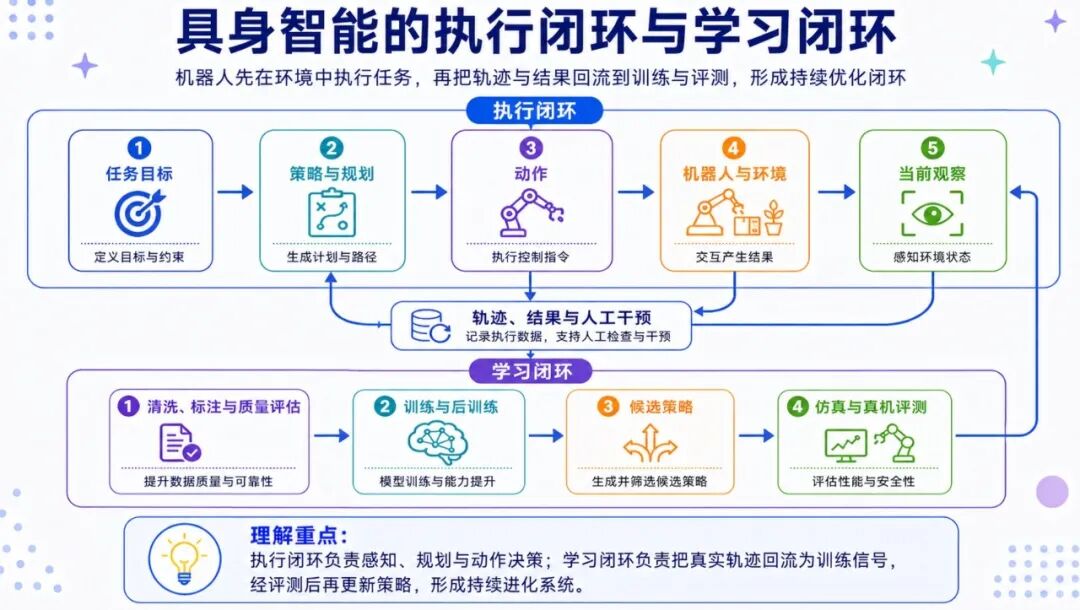
Second, move from "strong brain but weak body" to "software and hardware collaboration", and break through the bottleneck of hardware engineering. Industry competition will shift from a simple competition of algorithms to a competition of comprehensive engineering capabilities including hardware mass production, battery life optimization, fine operation and cost control. With the continuous deepening of the localization of core components, battery technology iteration, and lightweight structure optimization, the battery life, accuracy, stability and mass production consistency