The "GPT Moment" of Embodied Intelligence Has Arrived: Unitree and AgiBot Share a Common "Brain", Achieving 10 Minutes of Uninterrupted Operation, A Rough Video Unveils the Future of the Whole Industry
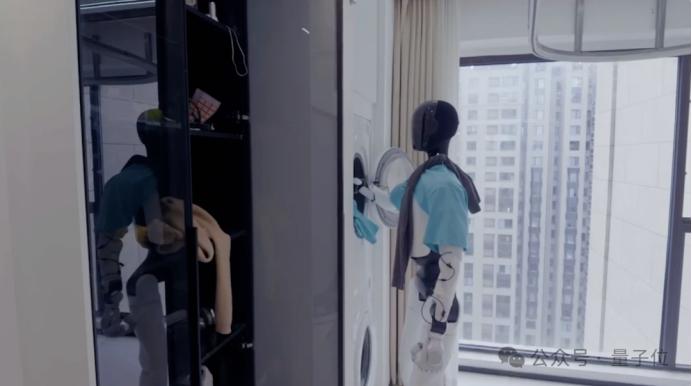
Two competing robot bodies, under the scheduling of the same general-purpose brain, independently plan, collaborate on tasks, back each other up, and achieve self-evolution. While top global teams are still using polished short clips to demonstrate "what robots can do", this mysterious model directly uses an unedited long take to calmly announce the end of the old era — robots can now "decide on their own what to do, how to do it, when to stop, and who to work with to minimize effort".
01. A single video leaves the entire industry in silence
Today, the global tech media circle has been completely stirred up by a video of unknown origin.
Renowned tech media outlet QbitAI published an in-depth report describing a 10-minute, one-shot, uncut, no-retake robot demo video with no off-site remote control and no manual instruction intervention. The footage is even slightly rough: the shooting location is only a small rental house of around 15 square meters, the aisle is so narrow that humans can barely turn around, the camera perspective is limited, and the lighting is far from ideal. Yet in exactly this "hell-level" real home environment, two humanoid robots — Unitree Robotics' G1 and Agibot's Yuanzheng A3, two hardware products that compete fiercely in the market — are sharing the same general-purpose intelligent brain, working side by side with the tacit understanding of a pair of veteran partners who have collaborated for years.
Wiping glass, precisely placing the squeegee back after finishing, taking clothes out of the washing machine, sorting and storing items, opening and closing the refrigerator, judging whether food needs to be refrigerated, taking out ingredients that need to be thawed, tidying up clutter on the table, gently hanging a scarf around the partner's neck, even autonomously finding a box to prop itself up to reach high places... For a full ten minutes, there is no stuttering, no getting lost, no error or crash, only deep understanding of the physical world, autonomous reasoning and decision-making, real-time error correction, dynamic scheduling, and nearly human "lazy" wisdom.
After reading this report and watching the attached video clips, I sat in front of the computer in a daze for a long time. An intuition tells me: this is probably the "GPT moment" in the field of embodied intelligence that we have been waiting for.
02. Why is this time "completely different"? — Paradigm leap from "data intuition" to "physical intelligence"
Before breaking down every detail of this video in depth, we need to calmly look back at what the embodied intelligence industry has been arguing about over the past year, and why the capabilities demonstrated this time make all insiders feel a chill down their spines.
In the past few years, we have seen too many carefully edited robot demos with exquisite lighting and exciting soundtracks. Under the spotlight, they can run, jump and grasp, with smooth movements and tacit cooperation, as if they are only one step away from entering thousands of households. But stripping away those gorgeous packaging, the truth behind it is often embarrassing — preset scripts, green screen matting, remote teleoperation, fixed-point retakes, segmented editing, these are already well-known "open secrets" in the industry.
Once these "demo champions" are thrown into the real world, facing occlusion of objects, changes in light, deformation of contact surfaces, and unknown changes in space, they immediately change from "superheroes" back to "artificial intellectual disabilities", and even the most basic environment adaptation is difficult to complete.
In the past two years, there has been a fierce technical route debate inside the embodied intelligence industry. The two mainstream technical routes, VLA (Vision-Language-Action model) and WAM World Action Model, each have their own supporters, but both have encountered insurmountable underlying bottlenecks.
VLA, the Vision-Language-Action model, can be called the data intuition school. Representative models include RT‑2, OpenVLA, etc. The logic is very straightforward: input image + language instruction, directly output robot actions, essentially learning the mapping relationship of "what picture you see, what action you output", relying heavily on triple training data collected by human teleoperation.
Its advantages are fast reasoning speed and lightweight deployment, but the fatal shortcoming is: it does not truly understand the physical world. What it learns is the probability derived from data statistics, not physical causality. Once encountering new scenes and new interactions that have not been seen in the training set, it is easy to output absurd actions. Errors will continue to accumulate under long-sequence tasks, the further the task goes, the more the action deviates from the target, and the model is highly bound to the body hardware. If you change to another robot, you need to re-adapt and train on a large scale.
WAM World Action Model can be called the predictive imagination school. Its thinking has changed: instead of outputting actions directly, it first predicts what the world will look like after the action is executed, and based on the predicted picture, reverses what kind of action should be output.
It has certain physical prediction capabilities, but there is a fatal "separation of knowing and doing". The model can deduce the changes of the world in the imagination space, but it is difficult to convert the deduction results into robot joint trajectories that meet the real dynamic constraints. It can understand and figure out the logic, but cannot perform accurately. At the same time, the reasoning computing power cost is huge, the delay is high, and it is very difficult to implement it in real time on real robots.
In the final analysis, all current mainstream tracks are essentially "data-driven task fitting". All actions are "probability guesses" based on massive data, not understanding of physical rules. The upper limit of the model's capabilities is firmly locked by the training data; it is extremely easy to fail when facing long-tail scenarios that require real physical reasoning such as occlusion, contact, and deformation; it will crash immediately when encountering new scenes, new interactions, and new hardware. This is why industry demos are always limited to standardized scenarios with short duration, single task, and no interference, because once the duration is extended and the task complexity is increased to multi-objective and multi-step, most models will crash within 30 seconds.
And the 10-minute top-secret long-take demo released by this mysterious team today, from the first frame to the last frame, completely breaks away from the inherent framework of the industry, and bypasses the physical interaction gap that VLA and WAM have been unable to cross for decades from the underlying logic.
It is not a "conditioned reflex" piled up by data, but a real "intelligence" that calculates in real time based on physical rules, evaluates in real time based on body capabilities, and independently plans and makes decisions based on task goals.
In one sentence: other models "guess" actions, this model "calculates" actions, and can keep "learning" after finishing the calculation.
The most shocking detail in the video for me is the robot wiping glass, I think this scene shows that the robot has real "autonomous reasoning"
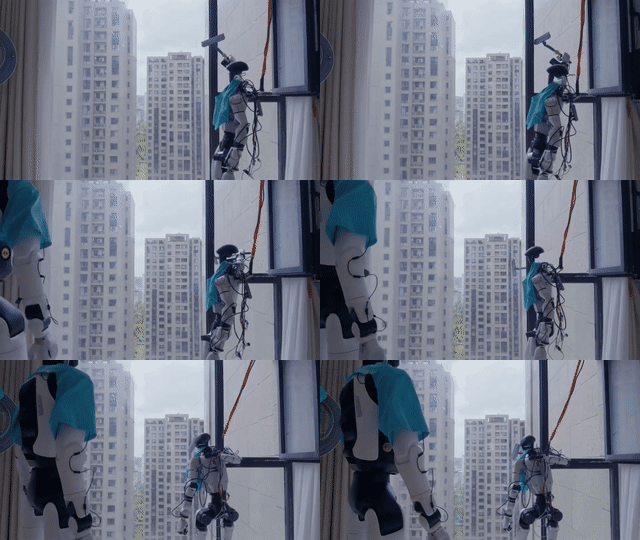
Source: QbitAI
The Unitree G1 robot uses a squeegee to wipe the indoor glass, and after a few wipes, it finds that one spot cannot be cleaned. It does not get stuck or report an error, but "thinks" and makes an inference — the dirt may be on the outside of the glass. So, it turns sideways, leans back, pokes its head out, stretches its arm, and precisely extends the hand holding the squeegee out of the window to complete the wiping on the outer side.
Behind this set of movements is the trinity integration of spatial perception, dynamic solving, and torque control. It knows how long its arm is, where the window frame is, whether it will hit anything when stretching out, and how much force is needed to clean the glass.
This cannot be "fed" by data, it is the deep understanding and real-time application of physical rules by the model.
There is also a scene halfway through the video, the set alarm clock suddenly rings, the two robots immediately interrupt the housework they are doing, and give priority to executing the temporary instruction of "tidying the table and refrigerator". What is even more amazing is that after completing this "priority task", they accurately resume the previously interrupted task — taking clothes out of the washing machine to continue sorting and storing.
This multi-task dynamic scheduling and episodic memory recovery capability is demonstrated on robots for the first time worldwide. Previous demos can only perform a single serial task, and if they encounter interference midway, it is basically a "task crash".
The climax of the whole video appears at the moment when the two robots interact. Facing a pile of clutter on the table, the Unitree robot's hands are full, and it is difficult to move all the items at one time. The Agibot robot "understands" the situation, autonomously decides to hang a scarf around Unitree's neck, and when it finds that the scarf is too long, Unitree even cooperates by bending down to let Agibot wrap the scarf around its head.
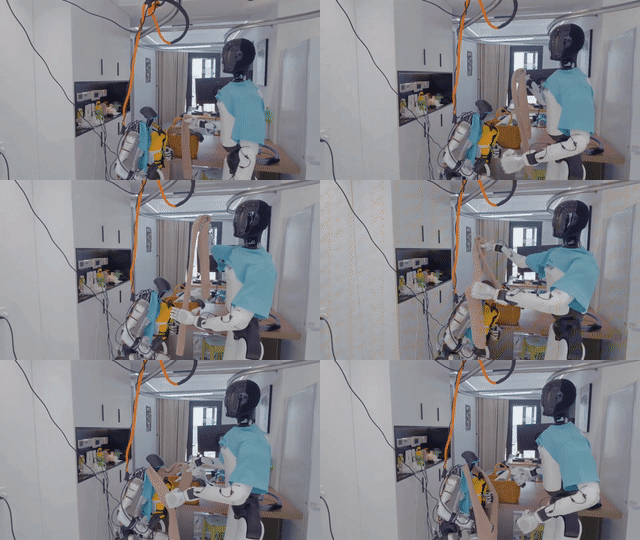
Source: QbitAI
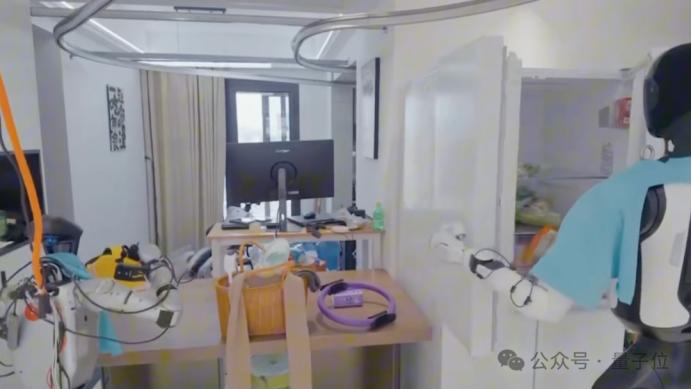
Later, Unitree tries to put the scarf into the high cabinet, but it is 1.3 meters tall and cannot reach it, so it autonomously finds a box to prop itself up. Finding that it cannot bend down to move the box, it "kicks" the box to the side of the cabinet. Seeing the partner's dilemma, the Agibot robot immediately puts down its work, walks over, takes advantage of its 1.7-meter height to take the scarf, folds it neatly, and puts it in the wardrobe.
This is a tacit cooperation without verbal communication, only based on common goals. The world's first real-time interaction and dynamic collaboration of cross-brand humanoid robots. It proves that this set of "general-purpose brain" is completely decoupled from hardware, and can adapt to robots of any brand and any configuration. This will be subversive to the division of labor model of the entire industry.
Although the mysterious team has not yet disclosed the technical details, industry experts can make quite in-depth inferences from the capability characteristics demonstrated in the video. The core reason why this model can achieve things that VLA and WAM cannot reach is the comprehensive innovation of the three underlying technical cores.
Core 1: Physics-constrained dynamics learning — bid farewell to data fitting, embrace real-world reasoning
Different from the pure data-driven training mode of VLA and WAM, the core logic of this model is "physical rules first, dynamics prediction driven".
The traditional VLA model learns the statistical correlation of "seeing picture A, most likely outputting action B", it does not understand why action B is correct, nor does it understand how action B needs to be adjusted if the environment changes slightly. For the model in the video, all action trajectories are not probability fitting of data, but real-time calculation results based on gravity, torque, force, and spatial constraints.
When the robot wipes the glass with a squeegee, it is not recalling "what the action of wiping glass is in the training data", but calculating in real time: how much contact force is needed between the squeegee and the glass surface?
Under the current angle, how much torque does the arm joint need to output?
If there is a stain on the glass surface, how will the friction change?
How should the torque be compensated?
When the arm extends out of the window, how much does the center of gravity of the fuselage shift?
How to adjust the standing posture to maintain balance?
This paradigm of "real-time calculation based on physical rules" makes the model have excellent extrapolation generalization ability. It does not need to see the training data of the specific scenario of "extending out of the window to wipe glass", because it understands the underlying physical laws such as "how much force is needed to wipe glass" and "how to adjust balance when the arm extends out of the window". As long as the physical laws are understood, the optimal action can be derived on site for any new scenario.
Lifting the slipper lanyard, draping the towel over the shoulder, standing on the box to reach high places, kicking the box with feet — none of these actions appear in any training data, but the model autonomously explores these optimal solutions through real-time interaction with the environment and the constraints of physical rules.
Core 2: Cross-body unified modeling — end the era of "hardware-bound algorithm"
The root cause of the deep binding of traditional robot models and hardware is that different bodies have huge differences in kinematic parameters, degrees of freedom, and sensor characteristics. Unitree G1 and Agibot Yuanzheng A3, one is 1.3 meters tall, the other is 1.7 meters tall; one is light and flexible, the other has a larger load; their number of joints, range of motion, and torque output characteristics are completely different. In the past, algorithms developed for Unitree could not be migrated to Agibot at all, and vice versa, everything had to start from scratch.
The model in this video, through a unified action representation space and body adaptive mechanism, allows the same set of models to adapt to two completely different brand hardware platforms at the same time, and completes perfect algorithm coupling of different bodies.
This is equivalent to completing a "hardware-software decoupling" for embodied intelligence. Just like the Windows operating system can be installed on any brand of computers such as Lenovo, HP, and Dell, this set of "general-purpose brain" can be deployed on robots of any configuration. It strips away the differentiated parameters of the hardware, and only retains general physical reasoning, task decision-making, and motion primitives.
The realization of cross-brand collaboration further proves that the compatibility and generalization ability of this general-purpose brain has reached the forefront of the world.
The impact of this breakthrough on the industry division of labor model will be subversive. Hardware manufacturers no longer need to develop algorithms independently, and can focus on improving joint accuracy, battery life, and cost control; AI companies no longer need to bind specific hardware, and can focus on making the "brain" smarter, and the entire industrial chain will be completely restructured.
Core 3: Long-sequence robust closed loop — support ultra-stable real scenario implementation
10-minute uninterrupted long-process operation does not test the execution accuracy of a single task, but the system capabilities of full-link dynamic error correction, error suppression, and sequence planning.
The reason why traditional VLA models cannot handle long-sequence tasks is that small errors at each step will continue to accumulate, and get completely out of control later. It's like walking with blindfolds, deviating by one degree, you will be one meter away after walking ten meters.
The model in the video, relying on the global task scheduling framework, realizes three key capabilities:
First, real-time error correction. After each action is completed, the model confirms the result through visual and force feedback. If a deviation is found (for example, the squeegee does not wipe completely clean), it immediately adjusts the strategy of the next step.
Second, dynamic task scheduling. Switch tasks the moment the alarm clock rings, and resume accurately after completion, behind this is a complete task state management and priority scheduling system.
Third, the combination of long-term planning and short-term execution. The model not only has a long-term plan of "tidying up the entire room within 10 minutes", but also can flexibly adjust short-term actions according to real-time feedback.
The combined effect of these three cores gives the model in the video a generation-gap level advantage.
03. Industry earthquake: End the "body dispute", start the "brain era", a trillion-level market is being redefined
If the authenticity of this mysterious model is confirmed and its