Liu Yiang, Partner of CCV: Token consumption has increased 10 times in half a year, and AI entrepreneurial opportunities lie in the reconstruction of the industrial chain
In 2026, the implementation speed of AI applications is exceeding the expectations of most people.
Token consumption has surged 10 times within half a year, Coding Agent is replacing IDE, and OpenClaw has completed the full life cycle of an open-source project in just four months — from large models to the application layer, every link in the industrial chain is being reshuffled.
Against this backdrop, the logic by which front-line investors observe the track is also changing.
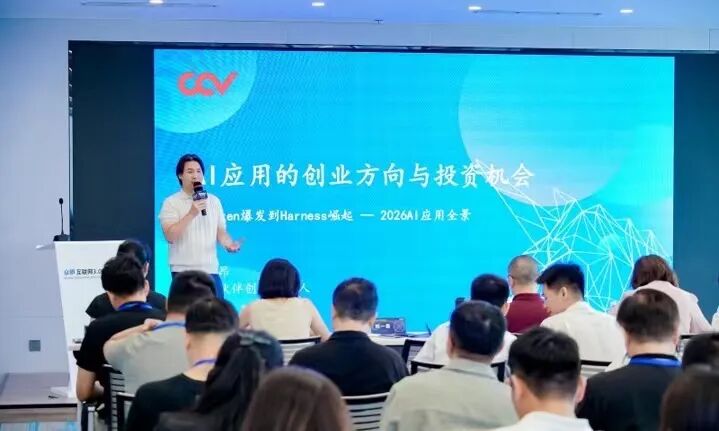
Recently, at the opening ceremony of the third phase of the Space-Earth AI Application Incubator, Liu Yi'ang, Partner of Creation Ventures (CCV), shared in depth around the theme of "AI Application Entrepreneurship Directions and Investment Opportunities".
Starting from the explosive growth of Token consumption, he sorted out the full cycle of OpenClaw from skyrocketing popularity to ebbing, analyzed the path differences of the AI industry between China and the United States, and finally put forward specific suggestions for AI entrepreneurs.
The following is the speech transcript sorted out by TideSurge AI:
01 Token Consumption Surges 10 Times in Half a Year, Inference Cost Drops Sharply
I will first present several sets of figures, but even the figures from two or three months ago may already be outdated today.
From 2024 to 2026, Token consumption has increased by 150 times.
OpenRouter is a famous Token routing and distributor in the United States. Although its market share is only a few percentage points, it has a full view of the entire market. This year, its weekly consumption has risen from 2.1T to 24.5T. In the past, no infrastructure (whether power grid, Internet traffic, or computing power) could achieve such a half-year growth rate. The average daily Token consumption in March has exceeded 140 trillion.
At the same time, the cost is dropping sharply.
When ChatGPT 4 was first released, one megabyte of Token cost about 20 yuan, but now it is only 0.4.
The inference cost of the entire industry is in a channel of rapid decline.
The new 5.6 Luna released by OpenAI at the end of July has its price reduced to 1/5 of the previous one.
More importantly, the consumption structure is changing.
At the earliest time, people used AI just for chatting, and the Token consumption was very low. But now, the consumption of a single Agent task has reached 50 to 100 times that of the chat scenario. The Token consumption of a long-range task (such as AI working for you while you sleep) in one night may be tens of thousands of times higher.
In the field of video generation, Chinese companies (such as Keling, Seedance 2.0) have occupied a very high share in the global market, where the Token consumption is even larger.
Some institutions predict that China's inference market will grow by 370 times from 2025 to 2030, and I think this forecast is relatively conservative.
02 Structural Differences Between the Chinese and US AI Industries
In terms of magnitude, China's overall Token consumption must far exceed that of the United States. However, the US ARR (Annual Recurring Revenue) is far higher than that of China, with a gap of several orders of magnitude.
In the United States, three major players are the main competitors — OpenAI, Anthropic, Google (although Google has fallen behind, it claims to catch up within 6 months). Their direction is to build large-capability models with high pricing.
China has continued our traditional advantages: capable of waging price wars and with strong engineering capabilities.
It is quite interesting that the speed of commercial exchanges between China and the United States in the AI and Token distribution fields far exceeds that of previous waves of technological innovation. China has surpassed the United States in the download volume of Hangingface, and the top six models on OpenRouter all come from China.
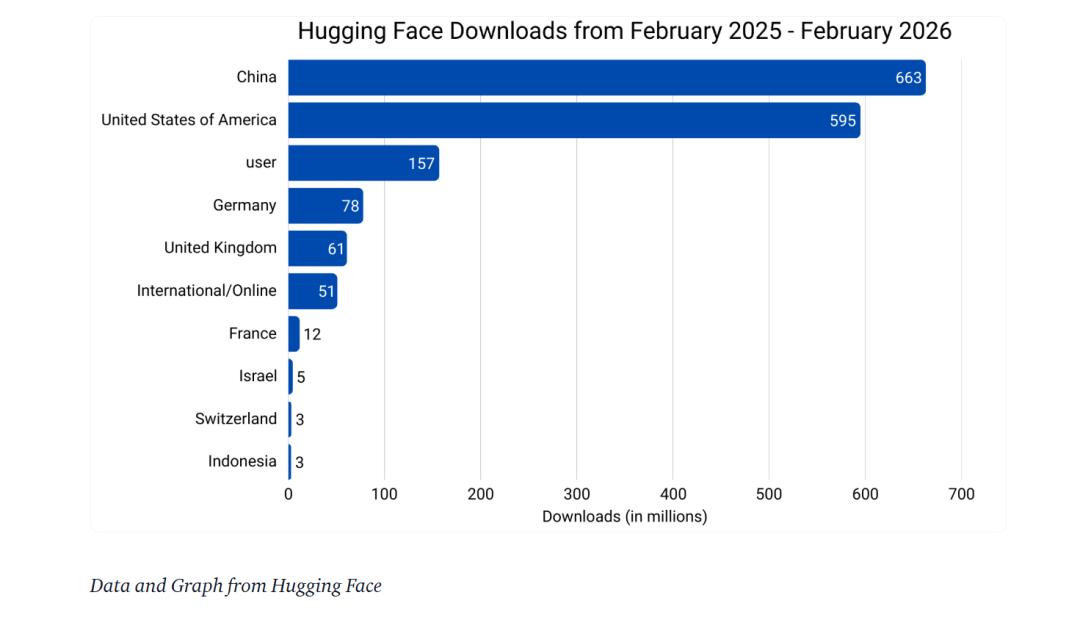
HuggingFace 2026 Spring Report
From the perspective of revenue structure, US vendors focus on the high-pricing route, while the revenue of Chinese vendors mainly comes from enterprise private deployment. The willingness to pay among C-end users and small companies in China is relatively weak, and major customers are concentrated in large companies and state-owned central enterprises.
The industrial chain is also undergoing differentiation.
US model vendors have integrated models and ecosystems into a unified product. Although large Chinese manufacturers are also making attempts, the current business is still mainly focused on "selling utility services".
This means there are still opportunities for entrepreneurs in the industrial chain, and it has not reached the stage where the winner takes all.
03 From Chat to Agent, the Workflow is Undergoing Structural Transformation
One of the biggest themes in the first half of 2026 is the workflow transformation from Chat to Agent.
Coding Agent is the biggest global theme in the first half of this year, and it is also the core track for competition among large manufacturers.
Codex, Claude Code, and Cursor — this company is now in a very delicate situation.
A few months ago, the competition in the IDE field was still very fierce, but now there is a new argument: we no longer need IDE.
New harness tools such as Claude Code and Codex can largely replace IDE. The traditional IDE path represented by Cursor, which does not have self-developed model capabilities, is facing huge crises today.
Video generation is another high-growth direction. Giants are very fond of this direction because of its extremely high Token consumption.
Customer service and marketing OPC have developed from concepts to industrial scale. Many local governments are building OPC industrial parks. A two-person company serving ten clients can make a very good profit. If this trend continues, it may break some of the existing patterns in the SaaS market.
AI for Science is also an emerging direction this year. AlphaFold is developing rapidly, and its latest version no longer allows commercial applications. The team spun off to establish a new company, which raised more than 2 billion US dollars in financing this year. Similar Chinese companies are also advancing very fast.
04 The Rise and Fall of OpenClaw: The Fate of an Open-Source Project
I want to fully review the rise and fall of OpenClaw, because I started using it in February and switched to Hermes in May, so I have gone through the whole process completely.
This is a personal open-source project.
Within four months, it exceeded 300,000 GitHub stars, with a maximum of 17,000 new stars added in a single day — which is an epic breakthrough in the open-source community. It even sold out Mac mini products. At that time, the Mac mini was a product line that Apple was about to phase out, but OpenClaw brought it back to life.
More importantly, OpenClaw drove the development of domestic large models. In the first week after this year's Spring Festival, Kimi's revenue exceeded its total revenue for the whole year of 2025. The transformation from conversation to Agent is a topic that everyone will talk about with relish this year and even in the next five years.
But OpenClaw soon faded out of the spotlight. Security issues may only be one of the reasons. As a user, my experience is:
First, the version was updated once a day in the past, but after the update, all plugins became unusable and needed to be reconfigured, which was a very painful process;
Second, the Token consumption is a black box. You have no idea what it is doing, and a dead loop may exhaust your 5-hour Token quota in just 5 minutes.
I think this is the fate of independent open-source software. The rise and fall of OpenClaw is worth reflecting on for itself, but for our entire industry, it is an alarm — telling us that the industry is changing.
After OpenClaw faded out, the entire Agent industry is still growing.
Anthropic has now become the leading player in the world, with an ARR of 45 billion US dollars, of which the ARR of Claude Code software product alone has reached more than 4 billion US dollars — note that this is not its model revenue, but the revenue of software products, which was released only 14 months ago.
Codex is also updating frequently recently to catch up.
The competition between the two strong players has made this year full of wonderful highlights.
05 Token Distribution Industrial Chain: New Business Logic is Taking Shape
I want to make a judgment: the future AI industrial ecosystem will be built on the business model of Token distribution.
Whoever masters the most critical nodes of Token distribution can reap the biggest fruits in this industrial chain. This follows the same logic as the giants in the Internet era mastering traffic distribution nodes.
However, there are structural differences between Token distribution and traffic distribution:
First, the switching cost of large models is extremely low. You can switch to another model with just one command, which is almost seamless and imperceptible. The large model itself has almost no network effect — unlike WeChat, which you can never switch away from.
Second, the production of Token has clear costs. Although the production cost of each Token is dropping rapidly, the marginal benefit is not that obvious. The scale effect does exist, but it is not as strong as that in the traditional Internet industry.
Therefore, the architecture of the industrial chain is changing now. Model provider → Token routing/factory (Alibaba Bailian, ByteDance Volcano Engine, Silicon Flow) → Agent layer (Work Buddy, Codex, Claude Code, open-source projects) → end application.
End applications are also distributing Tokens. Many applications are essentially "adding a shell" to continue selling Tokens. Whether this model can work still needs to be observed for now.
From the perspective of the Chinese market, Alibaba Cloud is a very typical player in China. Everyone is discussing Zhipu and MiniMax, but in fact, we should pay more attention to Alibaba and ByteDance — they are the largest ecosystem players in China today.
DeepSeek follows a different path: it only focuses on models (it will launch harness recently, but its products still do not pursue comprehensiveness), with ultra-high cost performance, concentrating resources to achieve breakthroughs in specific areas. This is inseparable from the capability and architecture of Huawei's Ascend chips in China.
06 Entrepreneurship Opportunities: In the Gaps of Missing Infrastructure and Between Giant Games
There are still some missing infrastructures in the current architecture, which may be made up in the next one to two years. But in the environment of competition among giants, startups still have opportunities — because it is impossible for one player to take all the market in the end.
First, the interaction layer of Agent.
MCP and ACP have become relatively standard protocols today, but there are still many imperfect parts in between. This also includes the payment protocol between Agents — giants such as Visa and Coinbase are all working on it, but the final pattern has not been determined. Apart from payment, there are many interaction layers between Agents, and between Agents and traditional services, that are worth paying attention to.
Second, the memory layer.
The switching cost of large models is low, but Memory is a very important infrastructure today. No matter the end-side Memory or cloud-side Memory, its switching cost is extremely high. Now when you switch between Codex, Claude Code and WorkBuddy, the memory is very difficult to migrate. A unified memory layer has extremely high value.
Third, the Ops layer.
In the new AI era, the entire software industry will undergo earth-shaking changes. Both the MMOPS layer and the LMOPS layer have very good opportunities.
Fourth, the edge device layer.
Each Token production has a cost, which can be rented on the cloud, deployed on the end side, or placed on the edge cloud. The Qwen 35B model can already solve a large number of problems. The Mac mini was sold out this year, indicating that the computing power demand for running models on the end side is exploding. The improvement of model capabilities, the improvement of end-side hardware capabilities, and the optimization at the KV Cache level — the two-way promotion will bring huge opportunities for everyone in this direction.
Fifth, video generation.
Keling (spun off from Kuaishou) was launched in June 2025, and its ARR has now exceeded 700 million US dollars. Chinese companies have occupied a very dominant position in the global market. This is a high-certainty mid-range track outside the competition between base models and large manufacturers.
Sixth, AI for Science.
This is not the most important direction that giants focus on, and its industrial chain is relatively independent. AI pharmaceutical research and development has developed very rapidly in recent years. Some domestic companies combine AI efficiency with Chinese efficiency, and the number of their under-development pipelines is close to that of top overseas pharmaceutical companies. However, simply using AI as tools and software is too thin, we need to go deep into the industry to replace low-efficiency links.
Entrepreneurs need to remember: Coding has already become a must-win battlefield for giants. If you find any interesting opportunities, you are welcome to communicate, but you must pay attention to the competition from giants.
This article is sorted out and published by TideSurge AI, the content is based on the speech transcript, and some expressions have been polished and adjusted.
This article is from the WeChat official account "Yifan Finance" (ID: finance_yifan), author: Taishi James, authorized to release by 36Kr.