Exclusive from 36Kr: The academician team of Nanyang Technological University has developed a full-domain embodied intelligence system, and its seed round financing is led by Cowin Capital, with Woan Robotics and Xuyuan Capital participating in the investment.
Author | Qiao Yujie
Editor | Yuan Silai
Hard Krypton learned that Interstellar Meta, a supplier of embodied intelligence systems for full-scenario applications, has recently completed a multi-million-yuan seed round of financing, led by Tongchuang Weiye, with participation from home embodied intelligent robot enterprise Woa Robotics and Xuyuan Capital. Its current customer base covers mainstream domestic embodied intelligent manufacturers, as well as clients from the energy, high-end manufacturing and other industry scenarios.
Interstellar Meta was founded in July 2026 by Dr. Wen Mingxing, Executive Director of the Intelligent Perception Innovation R&D Center of Sino-Singapore International Joint Research Institute, with Professor Wang Danwei, Academician of the Singapore Academy of Engineering, serving as its chief scientist. The core team members of the company come from Nanyang Technological University, Harbin Institute of Technology, Beijing Institute of Technology, South China University of Technology and senior executives of domestic listed companies.
As embodied intelligence moves from laboratory demos to real scenarios, the challenges faced by robots have shifted from "whether it can complete an action" to "whether it can operate continuously and stably in dynamic, uncertain and complex working conditions". Changes in illumination, moving objects, human interference, as well as factors such as smoke, dust and low light in the real environment, all put forward higher requirements for the perception, decision-making and execution capabilities of robots.
At the policy level, the Ministry of Industry and Information Technology and the Ministry of Emergency Management recently jointly issued the "15th Five-Year Plan" for the Industrial Development of Safety and Emergency Equipment, proposing that the industrial scale of key sectors will reach 1.4 trillion yuan by 2030, and further promote the development of safety and emergency equipment towards high-end and intelligent directions. The plan puts forward that we will focus on tackling core technologies in scenarios such as chemical industry, mines, energy storage, forest fires, floods, earthquakes, and extreme emergency communications, and promote the integration of cutting-edge technologies such as AI vertical domain large models, rescue robots/drones and other emergency equipment, so as to improve the capabilities of intelligent risk identification, disaster deduction and unmanned disposal in complex environments.
Wen Mingxing, the founder, introduced to Hard Krypton that the team has long been engaged in robot and artificial intelligence R&D in Singapore, and has participated in a number of national-level robot projects, including Singapore's first logistics vehicle, first sanitation vehicle and first fire-fighting robot. These robots have been operating in scenarios such as tropical rainforests, complex urban environments and disaster rescue for a long time, allowing the team to accumulate rich experience in complex environment perception and robot system engineering delivery. In 2023, the team joined the Sino-Singapore International Joint Research Institute and began to carry out technical development around full-scenario applications.
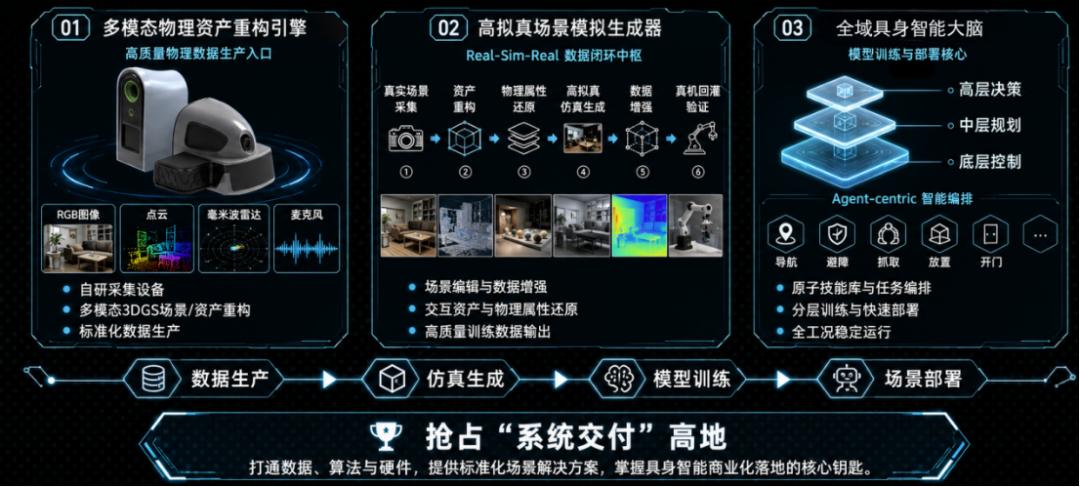
Interstellar Meta's embodied intelligence system plans to develop a self-developed "multimodal physical asset reconstruction engine + high-fidelity scene simulation generator + full-domain embodied intelligence brain" to connect the links of physical data production, full-domain data simulation generation and model training, cognitive decision-making and robot deployment, enabling robots to understand environments and tasks and independently complete complex operations.
(Source: the enterprise)
In terms of data collection, Interstellar Meta has built a multimodal physical asset reconstruction engine. Through self-developed handheld collection devices and multimodal ego devices, it integrates multiple types of sensors such as LiDAR, cameras, thermal imaging cameras, 4D millimeter-wave radars, and uses millimeter-level spatio-temporal calibration algorithms to complete data fusion between different sensors. Compared with the traditional single vision solution, multimodal fusion can significantly improve the perception stability of robots in complex environments such as low light, smoke and dust. At present, the company supports the combined calibration of multiple heterogeneous sensors, and the single calibration process can be controlled within 10 minutes.
In the data generation link, Interstellar Meta adopts the "Real-Sim-Real" data closed-loop route, that is, "real collection - simulation generation - real verification", to solve the problems of insufficient data scale and limited scene coverage in the training process of embodied intelligence models. Specifically, it uses multimodal collection equipment to model and reconstruct real scenarios and physical assets, digitizes the real environment and imports it into the simulation system to build an interactive, deducible and trainable digital twin training field, and then quickly generates a large amount of training data through simulation technology to realize data expansion and evaluation in complex scenarios and long-tail scenarios. This also enables it to repeatedly train and verify different complex working conditions and long-tail scenarios before real deployment, and improve the verification efficiency of models and robot systems before they are put into actual scenarios.
In terms of the brain system, the company will rely on its self-developed VLM², CIRL algorithm and Agent atomic skill system to realize environment understanding, autonomous decision-making and task execution. The system supports multi-sensor fusion perception, and one set of brain can adapt to multiple ontologies such as humanoid robots, quadruped robots, unmanned vehicles, and composite robots, covering complex indoor and outdoor scenarios such as mines, industry, and park inspection.
In terms of business model, Interstellar Meta is expected to focus on two paths. On the one hand, through a project-based approach, it provides robot ontology manufacturers with scenario customization, software and hardware integration, on-site deployment and subsequent operation and maintenance services; on the other hand, the high-value scenario data that has been precipitated is capitalized, and data services are provided to robot manufacturers, large model training teams and solution enterprises through API interfaces or authorization methods.
The following is an excerpt from the exchange between Hard Krypton and founder Wen Mingxing:
Hard Krypton: What is your consideration for choosing the REAL-SIM-REAL data route? How to solve the gap between Sim-to-Real?
Wen Mingxing: In our view, if the Internet did not allow users to produce data "for free", search engines and social networks would not exist, let alone large language models. Following the same logic, for embodied intelligence to succeed, data cannot be "collected for the sake of training", but must be "generated because it is useful". In our opinion, the correct paradigm should be to first let people operate robots to work in real scenarios, and then use the data naturally generated in the working process for training.
However, the demand of embodied intelligence for data scale is difficult to meet only by real data collection. From our understanding of data, data can be divided into two categories: one is synthetic data, and the other is real data. Real data includes teleoperation data, Umi data, ego data, and full-body motion capture perception data. All these data collections are limited by physical time, requiring robots or people to enter the real environment to collect.
The biggest advantage of synthetic data is that it is not restricted by physical time, can quickly generate a large amount of data of different scenarios, and can also well supplement the data required for complex working conditions and long-tail scenarios. Therefore, our core route is to focus on synthetic data, and then combine real data for calibration. However, synthetic data also has a problem of common concern in the industry, that is, the gap between Sim-to-Real. Many simulation data cannot effectively train the model for two reasons: one is the lack of physical authenticity, and the other is the lack of data richness.
Our solution is to first use self-developed multimodal data collection equipment to conduct 1:1 modeling and reconstruction of real scenarios and physical assets, move the real world into the simulation environment, and ensure the high fidelity of the data. On this basis, we take advantage of the advantages of synthetic data such as multiple runs, time acceleration, and perspective expansion to improve the data scale and coverage. Through the Real-Sim-Real closed loop, the data can not only have the quality of the real world, but also have the ability of large-scale production.
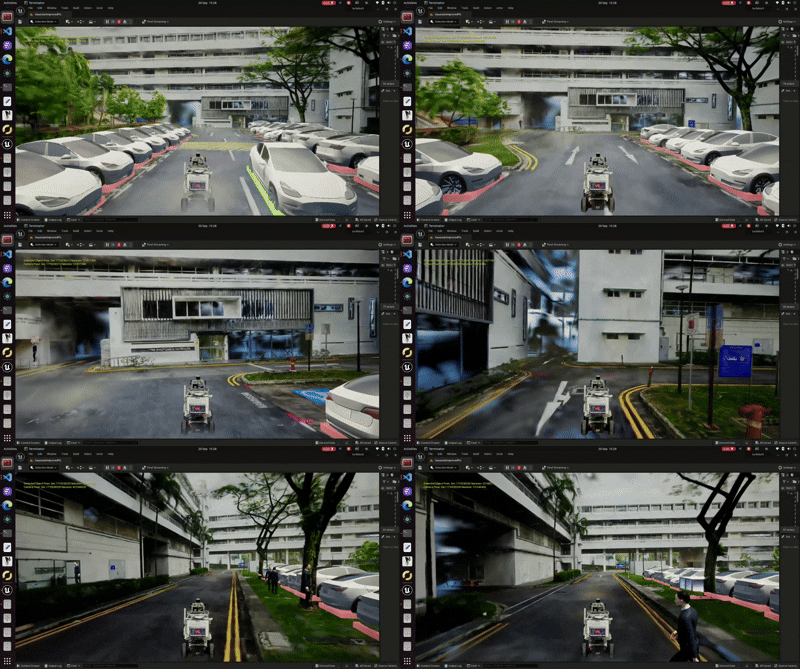
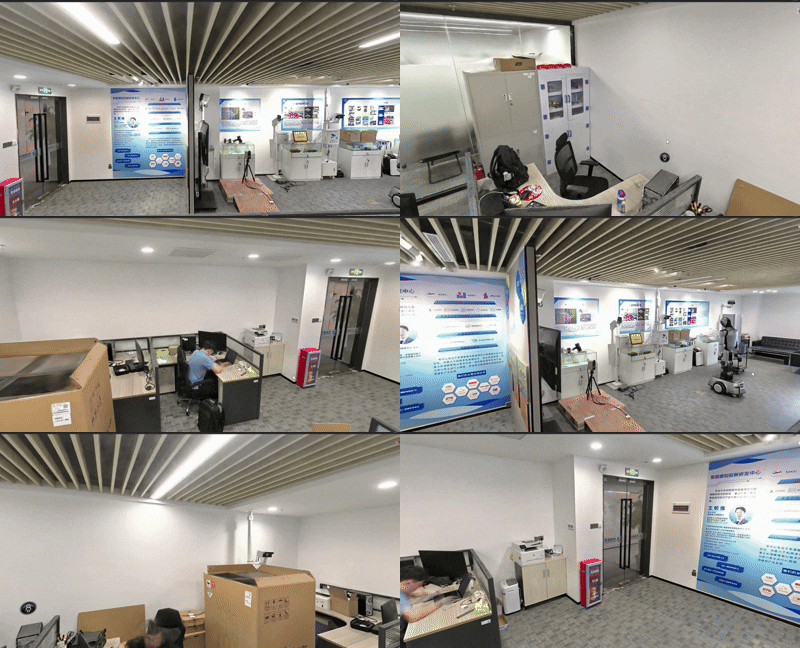
High-precision reconstruction of indoor and outdoor scenarios (Source: the enterprise)
Hard Krypton: From the hardware design to the algorithm level, how to solve the problems of data acquisition and robustness in full-domain environments?
Wen Mingxing: Full-domain scenarios include clean laboratory scenarios and complex working condition scenarios. The requirements of complex working conditions for robots essentially require more dimensional information for environment understanding. Our team has been conducting research on multimodal sensor spatio-temporal calibration and robust perception for the past seven or eight years, and has accumulated certain experience in hardware and algorithms. At present, we have developed some prototypes for different working conditions. At the hardware level, we will select different sensor combinations according to different scenarios, such as LiDAR, vision, thermal imaging, millimeter-wave radar, etc., to improve the environment perception ability through multimodal fusion.
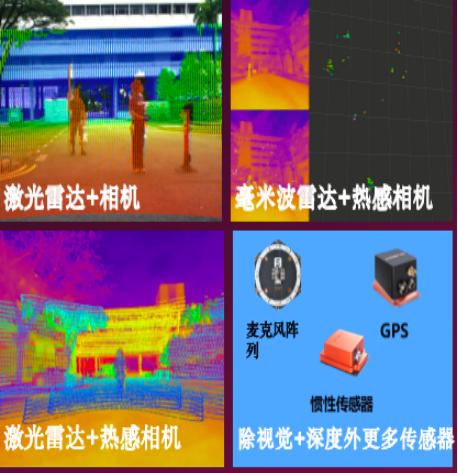
Spatio-temporal precise alignment of multi-source heterogeneous sensors (Source: the enterprise)
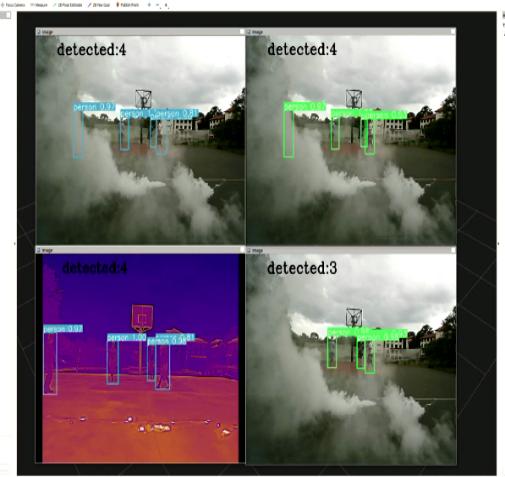
Multimodal robust perception (Source: the enterprise)
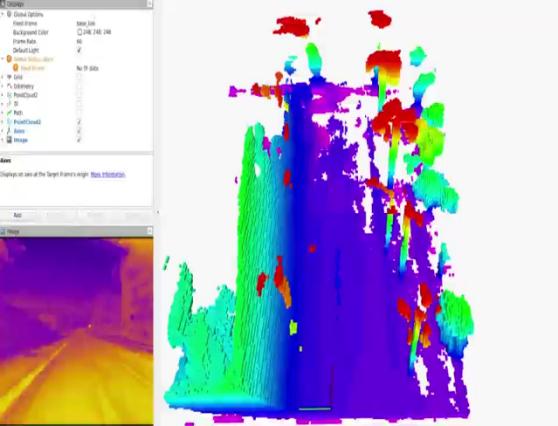
Positioning and mapping under dense smoke and high temperature (Source: the enterprise)
At the algorithm level, the key lies in how to fuse the data from different sensors. For example, in environments with smoke, dust or low light, a single vision sensor may fail, but through multimodal information fusion, the robot can maintain continuous understanding of the environment.
Another challenge is the data coverage of complex working conditions and long-tail scenarios. For example, in a fire-fighting scenario, when a real fire breaks out, it is impossible for people to repeatedly enter the dangerous area to collect data. Therefore, our idea is to build a foundation with a small amount of real data, and then use simulation algorithms to generate complex environments such as smoke and dust, add more long-tail situations to the training, so that the robot has stronger generalization ability in real deployment. Finally, through multimodal data collection, simulation generation and model training, we will form a complete brain development and solution implementation capability.
Hard Krypton: You are one of the earlier researchers studying VLA models. How do you define the relationship between the full-domain embodied brain that Interstellar Meta is developing and the VLA model or the world model?
Wen Mingxing: The full-scenario embodied brain developed by Interstellar Meta is designed to ensure that embodied intelligence can safely, continuously and stably provide value for customers under any environment and operating conditions when it enters the life and production process, which is our goal. VLA, WAM world action model, etc., are part of the technical route to achieve this goal. We believe that in the future, more technological evolution and breakthroughs will bring more surprises to the embodied intelligence industry. When we are developing the full-scenario embodied brain, we will comprehensively consider the advantages and disadvantages of different technical routes in task decomposition, planning and prediction, execution control and other links.
Investor Opinions
Tang Zheng, Investment Director of Tongchuang Weiye, said: Our lead investment in Interstellar Meta stems from our firm confidence in the Real2Sim2Real route. The real threshold of embodied intelligence lies not only in the algorithm framework, but also in the ability to obtain high-quality physical interaction data at low cost and on a large scale — on this point, our judgment is highly consistent with the team: moving the real world into simulation through high-fidelity reconstruction, and then using the large-scale capability of simulation to generate training data in batches, is the most engineering-feasible breakthrough path at present.
What makes Interstellar Meta unique is that it implements this route at the "multimodal" level. Relying on seven or eight years of profound expertise in multimodal sensor spatio-temporal calibration and robust perception, the team can perform physical-level reconstruction and simulation generation on multi-source signals such as LiDAR, thermal imaging, millimeter wave, and vision, rather than staying in pure vision — which is not only the key for robots to operate stably in harsh working conditions such as smoke, dust and low light, but also the most difficult barrier for other teams to replicate.
Pan Yang, CTO of Woa Robotics, said: Woa Robotics has long been deeply engaged in the home embodied intelligence scenario. In the process of product R&D and actual implementation, we are deeply aware of a common challenge in the industry: robots can complete tasks in the laboratory environment, but after entering real homes, changes in illumination, differences in item placement and the uncertainty of user behaviors will all put forward higher requirements for the stability and generalization ability of the system. To solve this problem, high-quality, large-scale and sufficiently rich data is indispensable, especially to better cover a large number of complex situations and long-tail scenarios in the real environment that are difficult to exhaust.
The Real-Sim-Real route proposed by the Interstellar Meta team provides a very valuable technical path to solve this problem. Through high-fidelity reconstruction of real scenarios, and further large-scale simulation generation and real verification, it can effectively expand the richness of training data and scenario coverage, and provide support for more sufficient training and verification of robots before they enter the real environment. Dr. Wen Mingxing's team's long-term accumulated technology and engineering experience in multimodal perception, robot system engineering and complex scenario implementation also make us very optimistic about the team's ability to continue to promote the implementation of this technical route.
As an industrial investor, we choose to invest in Interstellar Meta, not only because of its technical value in data generation, complex scenario coverage and robot training verification, but also because we hope that the two sides can form deeper industrial synergy in terms of data and scenarios in the future.
Peng Shuxue, Founder of Xuyuan Capital, said: At present, the embodied intelligence track has stepped out of the laboratory demo stage, but the robustness in the real environment and the supply of high-quality physical data are still the biggest bottlenecks of the industry. Many robot solutions perform well in ideal environments, but once they enter real working conditions such as mines, chemical industry, emergency rescue, and complex industrial sites, facing interference such as smoke, dust and low light, perception and decision-making are prone to failure, which is also the core point restricting the commercial implementation of the industry.
The core differentiation of the Interstellar Meta team is to break away from the path of pure vision simulation, choose the multimodal Real-Sim-Real closed-loop system, integrate sensors such as LiDAR and millimeter-wave radar into the physical-level simulation reconstruction, and fundamentally narrow the Sim-to-Real gap between simulation and reality. The team has both the scientific research background of Nanyang Technological University and practical engineering delivery experience of a number of national-level robot projects. They not only understand algorithm theory, but also understand the pain points of real scenarios, which is very rare among early-stage hard technology teams.
We are optimistic about the long-term opportunities of the full-domain embodied intelligence system track. Interstellar Meta does not manufacture complete robots, but focuses on upstream data infrastructure and embodied intelligence brains, which can empower multiple robot ontologies such as humanoid robots, quadruped robots, and inspection unmanned vehicles at the same time, covering multiple scenarios such as home, industry, and safety emergency, with strong commercial scalability.