Cook emptied the magazine, 2nm, Tao's Law, the most powerful AI PC
This final swan song of Tim Cook right before his retirement is absolutely a full-out, all-stops-pulled performance with every last round in the magazine!!!
The first 2nm process chip M6 has arrived.
Yet the new-process M6 is not the most powerful one. The real standout is the newly released M5 Ultra, widely recognized as the most powerful M-series chip in Apple's history.
Though built on 3nm technology, Apple specifically emphasized that it adopts the industry-first 4-die stacking technology —
This can also be seen as a practical application of the "Tao Law" proposed by Huawei.
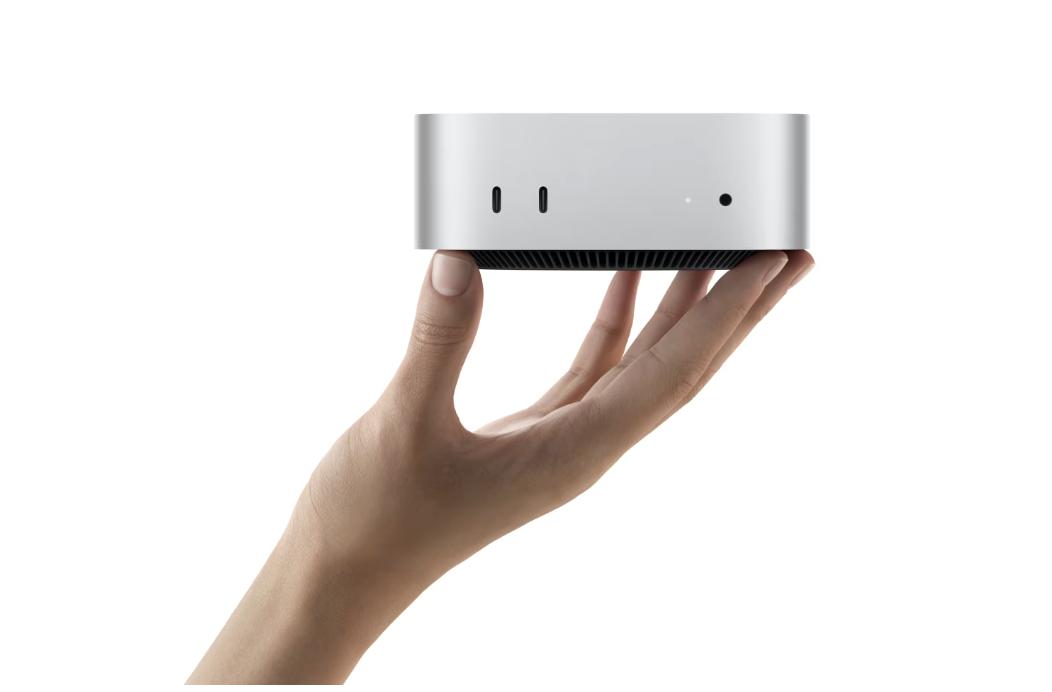
Not only that, these two chips are directly installed in the new Mac lineup —
The Mac mini comes with M6/M5 Pro, with a China launch price starting at 6999 RMB; the Mac Studio is upgraded with M5 Max/M5 Ultra, with a China launch price starting at 19999 RMB.
The outer casing remains largely the familiar design, but the interior has been fully upgraded to deliver far stronger AI performance.
The AI performance of the M6 Mac mini has surged up to 4 times at its peak.
The M5 Ultra Mac Studio is equipped with up to 36-core CPU, 80-core GPU, and supports up to 512GB unified memory.
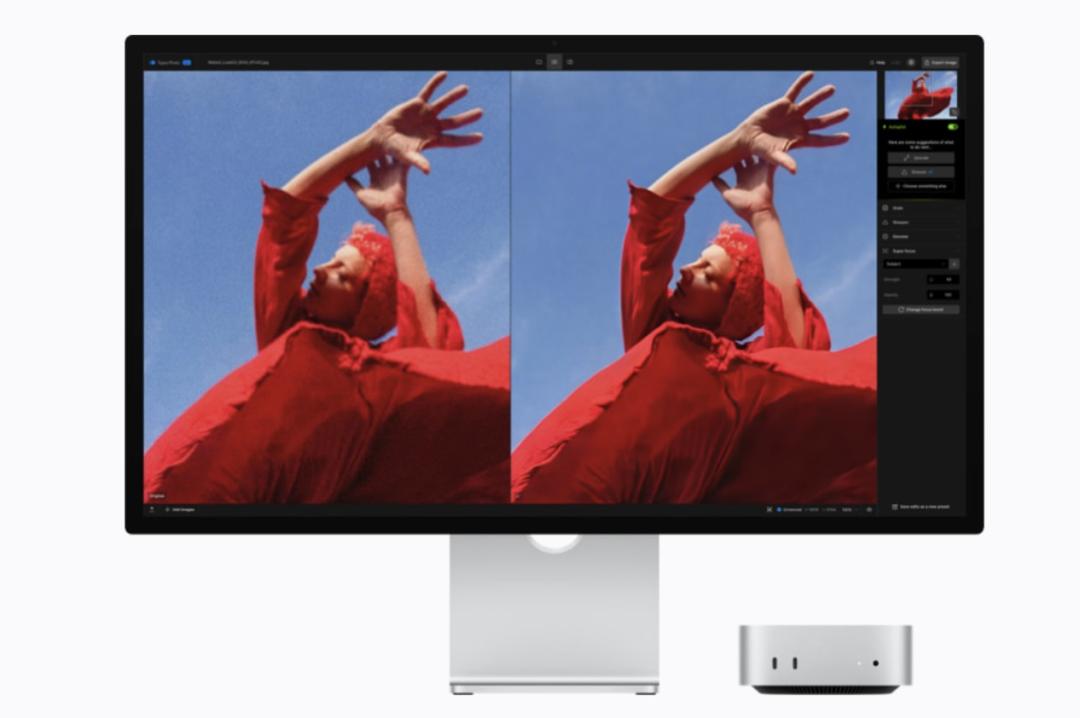
What is more interesting is that right after this wave of AI computing power was released, the memory supply could not keep up at all...
Against the backdrop of global memory shortage, coupled with the skyrocketing demand for large memory brought by local AI, the 512GB version of Mac Studio will not be available for shipment until the end of October.
In addition, purchase restrictions have also been implemented.
This is really... Cook has used up every last resource before retiring from Apple.
He gave the Mac lineup a huge performance boost right before he left!!!
2nm debut: Apple first equips the new M6 with top-tier AI capabilities!
Let's start with the M6.
The reason we highlight it is that the M6 truly brings Apple's chips into the 2nm era!!! (cheers)
The M6 is Apple's first chip manufactured with 2nm process technology, with its CPU expanded from 10 cores of the previous generation to 12 cores.
It includes 2 Super Cores, 4 performance cores and 6 efficiency cores, the GPU is also upgraded to 12 cores, and the unified memory bandwidth is pushed up to 170GB/s.
But the more noticeable change is reflected in the AI capabilities that most people care about —
Every GPU core of the M6 is directly embedded with a Neural Accelerator, paired with a set of Dual 16-core Neural Engine.
This means that the GPU, which was originally responsible for graphics and general parallel computing, now gains dedicated acceleration units specially built for AI computing!!!
You may not get an intuitive feel just from looking at this series of parameters, but the data becomes very clear when applied to the Mac mini —
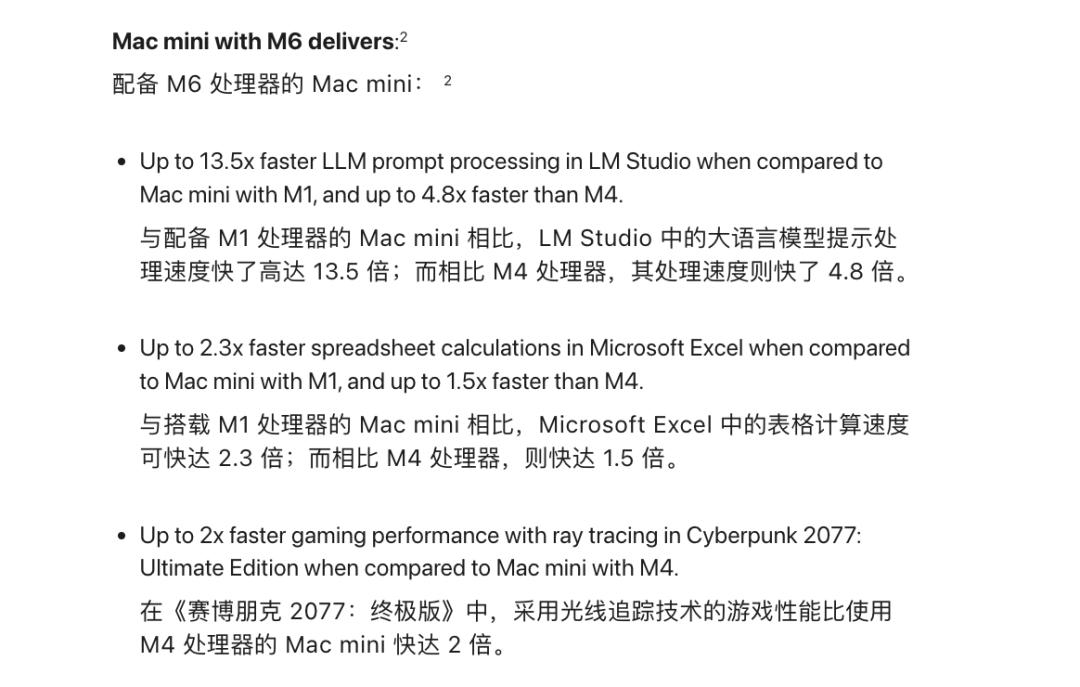
Compared with the M4 Mac mini, the AI performance of the M6 version is increased by up to 4 times, the GPU is up to 2 times faster, and the CPU is up to 40% faster.
When running LLM with LM Studio, the prompt processing performance reaches up to 4.8 times that of the M4, and even up to 13.5 times faster than the first-generation M1 Mac mini.
In addition, the unified memory bandwidth now reaches 170GB/s, about 10% higher than that of the M5.
Although the base model still has 16GB and can be configured up to 32GB, its throughput performance has been significantly improved for running small and medium-sized models locally, running resident agents and AI workflows.
From this we can also see that Apple's positioning for the Mac mini has changed a little bit...
Apple itself directly mentioned agentic AI workflows and always-on agentic computing in its press release.
Johny Srouji even specifically noted that the Mac mini can be used not only as a home computer and professional workstation, but also directly as an always-on agentic device.
The small box that used to cost around 600 US dollars and sit quietly behind the monitor for office work is now being developed by Apple into a small desktop agent server.
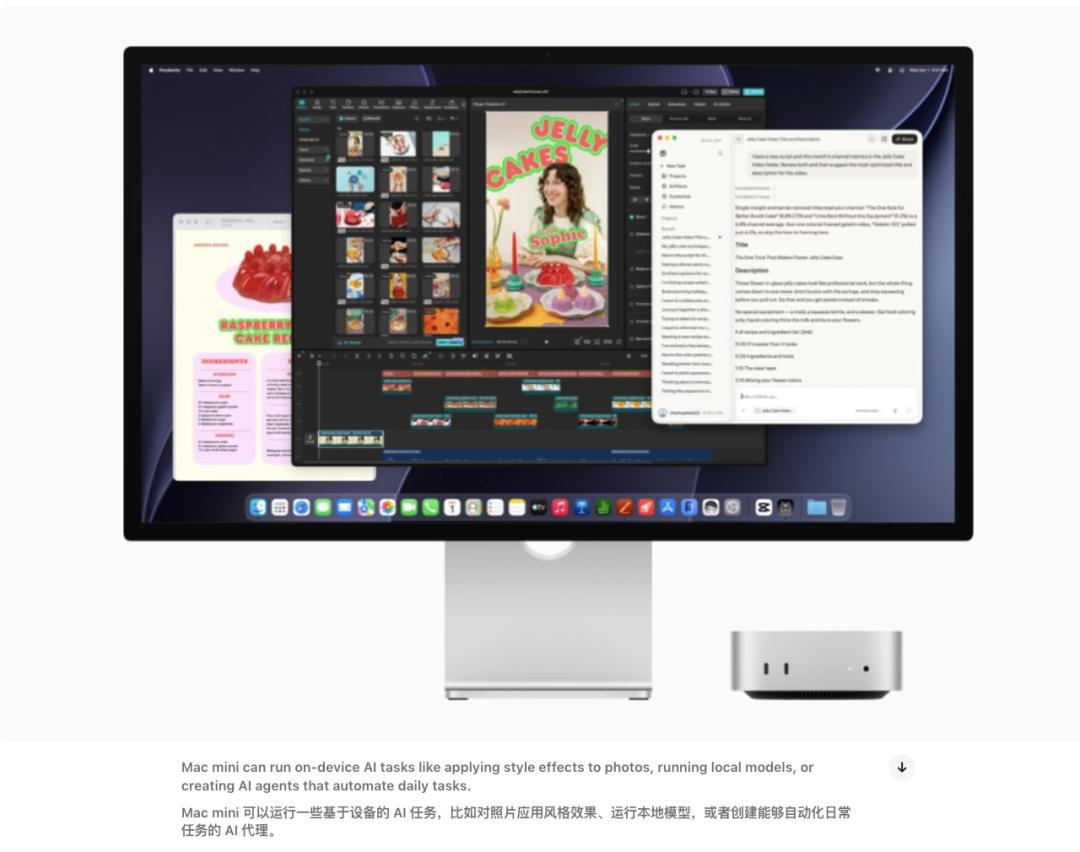
Models can run locally, agents can stay connected all the time, and codes, files and tasks can all be stored on the local device.
Small as it is, it is already performing tasks that are increasingly similar to those of a server.
Of course, the "value" of this small box has also achieved a round of significant increase...
The 2024 M4 Mac mini was priced at only 4499 RMB at its China launch, while the starting price of the current M6 version is directly raised to 6999 RMB.
In two years, the price has increased by 2500 RMB, with a growth rate of over 55%.
With the rapid improvement of AI capabilities, the originally affordable Mac mini is no longer as cheap as it used to be.
Apple's first 4-Die design: M5 Ultra piles up extreme AI computing power on desktop devices
Now let's talk about the real highlight — M5 Ultra.
If the M6 is designed to supplement AI computing power for regular Mac devices, then with the M5 Ultra, Apple has fully targeted the high-end desktop AI workstation market.
It is worth mentioning that this is also the first time Apple has adopted the quad-die architecture in its M-series SoC, the 4-die architecture.
Let's briefly explain what the 4-die architecture is —
According to the official technical description, it connects two sets of dual-die M5 Max chips through the new generation of UltraFusion to form a 4-die system, which is not simply four chips stacked vertically like a mille-feuille.
Its performance is extremely powerful: it is equipped with up to 36-core CPU, 80-core GPU, 32-core Neural Engine, 512GB unified memory, and 1.2TB/s memory bandwidth.
The peak AI performance is up to 4.3 times that of M3 Ultra and 9.8 times that of M1 Ultra; the large model prompt processing performance in LM Studio is up to 4 times faster than that of M3 Ultra.
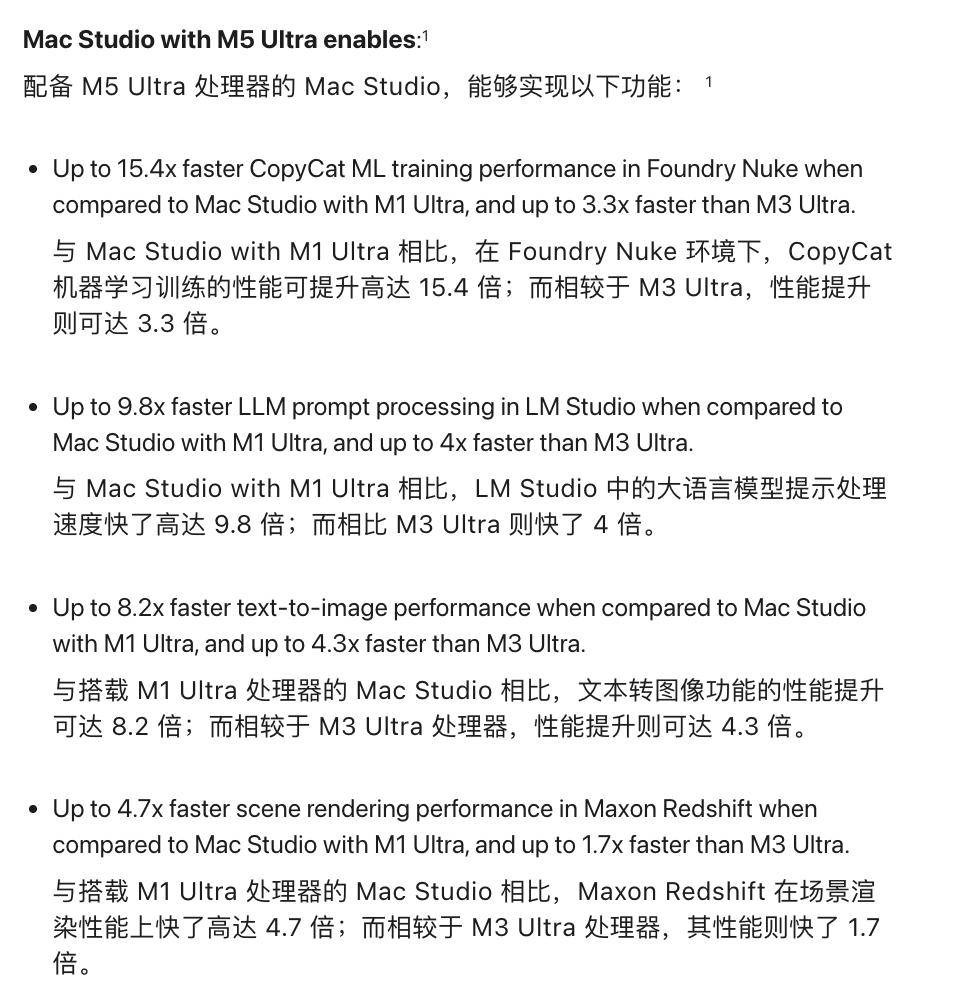
Another very Apple-style feature that is extremely suitable for local AI is the unified memory design.
On traditional PCs, CPU memory and GPU video memory work independently of each other. If you want to equip the GPU with hundreds of GB of video memory, the cost and engineering difficulty are extremely high...
But! The 512GB unified memory on the Mac Studio can be directly shared by computing units such as CPU and GPU.
This means that as long as the model weights fit in the memory, many large models that originally required servers or multiple high-end GPUs to run can now run directly on a single desktop device.
You can even connect multiple devices if the performance of one unit is not enough...
In the WWDC demo, Apple even took an extra-large model as an example: for models that cannot fit in the 512GB memory of a single device, you can split the weights to multiple Mac Studio devices and run them together.
Under the 4-node setup, the distributed AI inference performance can reach up to 3 times that of a single device.
So from this point, the positioning logic of this generation of Mac Studio is already very clear —
Apple is combining Apple Silicon, extra-large unified memory, MLX and Thunderbolt RDMA to form a complete local AI computing stack.
Each device comes with 512GB memory, and you can connect more devices if you need larger capacity.
It turns out that when other manufacturers are still selling AI computers, Apple has started selling desktop-level AI server clusters?
AI pushes up Mac prices and leads to out-of-stock of high-memory Mac units
Problems also come along with these upgrades.
Such powerful unified memory functions happen to collide with one of the most sought-after resources in the AI industry in recent years: memory supply shortage.
The Wall Street Journal mentioned that previous generations of Mac mini and Mac Studio have quietly become best-selling products among AI developers.
Especially with the rise of demands such as local large models, Coding Agent and OpenClaw, the advantages of high-memory Mac devices have been rediscovered —
After you buy the device, you can run models repeatedly without paying for Token counts for every call.
AI companies are snapping up memory, data centers are snapping up memory, and PC manufacturers are snapping up memory.
Now even people who run Agents on Mac are joining the rush for memory, leading to a complete imbalance between supply and demand...
The highest memory configuration of Apple's previous generation even disappeared from the official website for a while. Although the new Mac Studio has re-opened the 512GB unified memory configuration, Apple has already stated in advance —
This version will not be available until the end of October, and other Mac Studio models will be officially launched on September 22.
Not only that, the price is also raised significantly: the previous generation Mac Studio, the M4 Max China version started at 16499 RMB, and the M3 Ultra China version started at 32999 RMB.
This generation is directly priced starting at 19999 RMB for the M5 Max, and starting at 46999 RMB for the M5 Ultra.
This means that the entry-level Ultra model has increased by 14000 RMB in just one generation...
The price growth rate has soared along with the improvement of AI computing power...
Interestingly, the person who launched this product lineup is also about to step down from the position of Apple CEO.
On August 23, Apple just held a farewell party for Tim Cook.
On September 1, John Ternus will officially take over the position of CEO.
So from the timeline point of view, these two chips do have the meaning of Tim Cook's "final swan song" —
In the last days of the Cook era, Apple stepped into the 2nm era, and at the same time upgraded the Mac lineup to become a desktop AI powerhouse with 512GB memory.
This is arguably the best retirement gift he could give himself.
Of course, the foldable iPhone to be released next month will be launched by the new CEO, but its development is theoretically still credited to Cook.
Steve Jobs created the iPhone, and then Tim Cook made it fold...
Reference Links:
[1]https://www.apple.com/newsroom/2026/08/apple-introduces-m6-and-m5-ultra-for-a-big-leap-in-performance-and-ai-compute/
[2]https://www.apple.com/newsroom/2026/08/apple-unveils-a-more-powerful-mac-mini-featuring-the-all-new-m6-and-m5-pro/
This article is from the WeChat official account "QbitAI", author: Meng Yao, published with authorization from 36Kr.