Is Full-Stack AI Actually a Trap?
Full-stack AI has now almost become the standard configuration for major tech companies.
Nearly all tech giants are pushing in the same direction: bringing more and more links in the AI industrial chain under their own control. As a result, model vendors are devoting efforts to chips, data centers and power supply; cloud service providers have begun to train their own models; mobile phone manufacturers are supplementing their AI capabilities; social platforms are also betting on Agents and next-generation terminals.
OpenAI is probably one of the companies with the most obvious "full-stack AI" ambitions today. Downstream, it is deeply involved in chips, data centers, power and computing power infrastructure; upstream, it has APIs, ChatGPT, Codex, and is also looking for new hardware entry points.
But in David Senra's podcast on August 23, Altman began to emphasize another point: OpenAI cannot do everything.
He believes that OpenAI should become a platform company, rather than developing every AI application on its own. With limited resources, the company must voluntarily give up some "good products" and leave computing power, talents and attention to truly important matters.

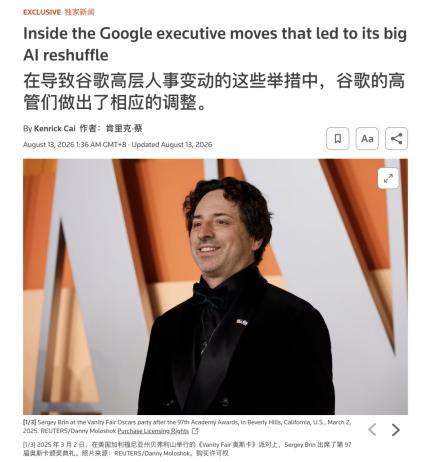
On the other side, Google, which is currently the closest to "full-stack AI", has just carried out a major restructuring of its AI organization.
Demis Hassabis handed over the management of DeepMind and was "promoted" to chairman; four senior backbones including Jeff Dean left to found new companies.
From chips, cloud, models, search, office software to operating systems and terminals, Google has almost everything. But it is precisely because it covers too many fields and holds too many cards in its hands that internal coordination becomes extremely difficult. Its flagship model has been delayed for a long time, and the outside world even suspects whether it is withdrawing from the SOTA model competition.
Tech companies with full-stack ambitions are shouting "All in AI", but the problem is: when chips, computing power, models, Agents, applications and terminals all become battlefields where "no loss is allowed", how much capital, computing power, talents and management attention can a company invest in all of them at the same time?
When all AI opportunities are regarded as positions that "cannot be ceded to others", is full-stack AI a reachable end point, or a self-imposed trap?
1
Platform giants in the Internet era rarely build their advantages by "monopolizing everything".
Microsoft's real moat is the operating system standards and developer ecosystem established by Windows; Google's core advantage is the closed loop formed by search entry, data and advertising distribution; Apple controls the mobile ecosystem jointly constituted by iPhone, iOS and App Store; Amazon occupies the key layer of cloud infrastructure through AWS.
The ideal state for a platform is not to bring the entire industrial chain under its own control. They only need to control a key entry point to form a barrier that is difficult to replicate and bypass.
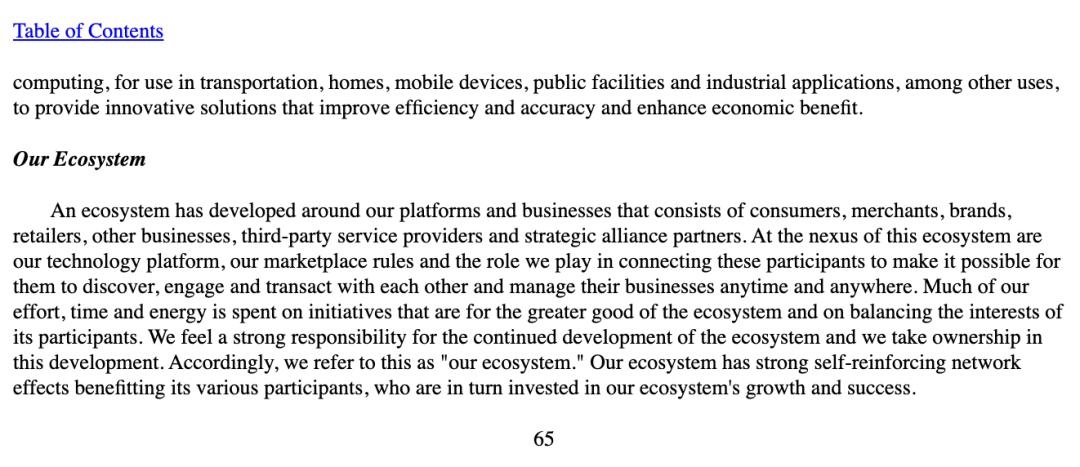
Alibaba even once wrote this model directly into its corporate definition. In its 2018 annual report, it defined the core of its ecosystem as three things: technology platform, market rules, and the role of connecting different participants. Consumers, merchants, brands, retailers and third-party service providers discover, interact and trade with each other around this platform, eventually forming a "self-reinforcing network effect". Alibaba's long-term goal for itself is not to do all business in person, but to "build the business infrastructure of the future", enabling enterprises to "Work @ Alibaba" and build their own businesses and create value with the help of Alibaba's infrastructure and technology.
Theoretically, AI can of course also form a similar industrial division of labor.
NVIDIA has provided a very typical sample. Its current boundaries are continuously expanding around GPU, CUDA, network and the entire accelerated computing platform, but the control points that really bring it excess returns are still highly concentrated. In the first quarter of fiscal year 2027, NVIDIA's revenue reached 81.6 billion US dollars, a year-on-year increase of 85%; among which data center revenue reached 75.2 billion US dollars, a year-on-year increase of 92%, accounting for more than 90% of the total revenue. The GAAP gross profit margin for the single quarter was as high as 74.9%, and operating profit reached 53.5 billion US dollars, a year-on-year increase of 147%.
As long as the GPU and the software and network ecosystem formed around it remain an unavoidable layer for AI computing, NVIDIA is enough to capture one of the most lucrative profits in the industry.
Anthropic also provides a case in another direction. It does not have its own cloud, chips, operating systems and terminals, but has quickly built commercial value relying on the capabilities of the Claude model, especially its advantages in Coding and enterprise workflows. At least at this stage, the layer advantage centered on model capabilities is enough to support a huge-scale company.
Ideally, AI could have followed the same path as the Internet era and formed a division of labor along different tracks: chips, cloud, models, Agents, terminals. Companies can fully choose one of them to continuously increase investment and deepen their advantages.
Every track has the opportunity to build its own moat, and every track also has the opportunity to breed new giants.
But the reality is that AI exploded too fast.
From models to Agents, from cloud to terminals, every track is expanding at a high speed, leaving almost no buffer time for large companies to judge slowly and make trade-offs voluntarily.
In a blue ocean market where industrial boundaries have not yet been fully formed, every layer seems likely to become the next search, the next Windows, the next AWS, and may also give birth to the next NVIDIA. Any voluntary absence may mean directly ceding the market share to competitors.
The Internet era also left these companies with a very strong memory of success.
No matter the "Super Company" pursued by Zhang Yiming, the "no boundary" emphasized by Wang Xing, or the "integrated ecosystem" that Alibaba has long been obsessed with, they all reflect the same instinct of platform companies: when seeing clear market demand, they tend to believe that they can fulfill it with capital, talent and organizational capabilities.
In such an environment, no one knows whether something that looks like a product function today will grow into a new platform entry point in a few years; no one has reason to voluntarily leave opportunities to others when demand has emerged and capabilities seem replicable.
These Internet companies once became giants relying on a core advantage that others found difficult to replicate; but in the AI era, they have developed another impulse: since every layer has the potential to become the next moat, why not go all in?
Therefore, full-stack AI is first and foremost not a technical ideal, but more like a collective expansion impulse when the industrial division of labor has not yet been completed.
Or to describe it in a more radical way, it is more like large tech companies mistakenly regard covering as many layers as possible as an inevitably better, and even ultimately winning corporate form.
2
In a sense, full-stack AI is like a plum tree at the end of the road — it is certainly "thirst-quenching" enough, and may even be the most attractive corporate form in the AI era.
But today's "full-stack AI" actually mixes two different directions of expansion.
One is to pursue vertical integration: model companies move downstream into chips, data centers and power, cloud vendors move upstream to train their own models, and terminal manufacturers supplement their operating system and Agent capabilities. They all seem to cross their original business boundaries, but in essence they are still focusing on their own core competencies and gradually taking the most critical links in the upstream and downstream into their own hands.
This kind of expansion has its own value, and in many cases it is a necessary part of building a moat.
The most direct benefit is that you can be less constrained by others.
If model companies always rely on other people's GPUs and clouds, they will have to bear the uncertainty of price, supply and bargaining power; if cloud vendors are only responsible for selling computing power, they will also worry that the most valuable customer relationships will eventually be taken away by model companies.
Taking one more step towards the upstream and downstream is very reasonable for any single company. After all, one more layer under your control means one less point where others can block you.
Take OpenAI and Microsoft as examples. The cooperation between the two companies in the early stage was almost the most ideal form of AI industrial division of labor. OpenAI was responsible for making the model smarter, and Microsoft was responsible for providing a steady stream of computing power. One worked on intelligence upward, the other laid infrastructure downward. The two companies gave full play to their respective strengths and needed each other.
But as the AI cake gets bigger and bigger, OpenAI began to look for cloud vendors other than Microsoft, got involved in data centers, power and infrastructure on its own, and even extended its reach to chips, launching Jalapeño; Microsoft crossed the boundary from the other side, not only developing the Maia chip, but also starting to train its own MAI model, and introducing other model providers such as Anthropic into Azure.
The two companies are still partners, but both are consciously reducing single-point dependence on each other, avoiding handing over their most critical capabilities and bargaining power to the other party.
From an internal perspective, taking more links under your control also has a very attractive benefit: collaboration that originally happened between companies can be turned into optimization within one company.
When chips, system software, models and applications all belong to the same company, they can adjust together around the same goal. The model does not need to adapt to general-purpose chips, and the chips can in turn be customized for the model; problems found on the application side can be fed back all the way to the underlying system and computing power architecture.
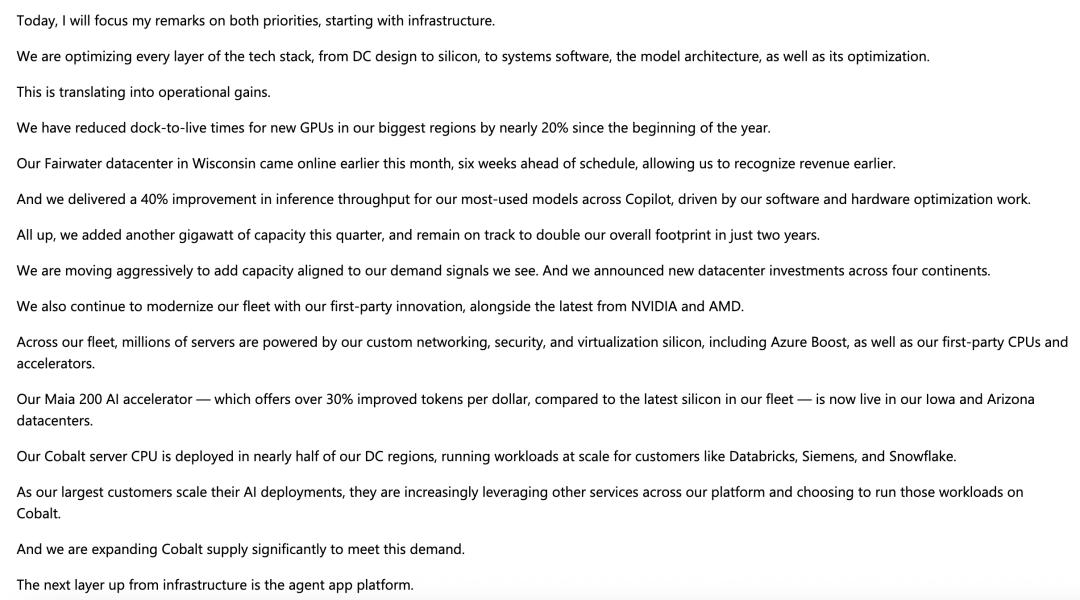
What Microsoft emphasized at its earnings conference this year is exactly this logic: the company is simultaneously optimizing every layer from data center design, chips, system software to model architecture. According to Microsoft's own data, its self-developed AI chip Maia 200 can process more than 30% more Tokens per dollar than its latest existing chip; joint optimization of software and hardware has increased the inference throughput of the most commonly used Copilot model by 40%.
Therefore, simply extending to the upstream and downstream is not enough to form a trap.
The really complicated part is that the expansion of AI companies often does not stop here.
After having the model, they can also develop chatbots, Coding, videos, browsers, enterprise software, Agents, and continue to look for new hardware entry points.
This is no longer a deep vertical expansion around core competencies, but has begun to transform into another kind of horizontal expansion.
As a result, the logic of "being less constrained by others" begins to spread outward continuously.
If you don't develop chips today, you worry that your computing power will be controlled by others; if you don't develop Agents, you worry that your entry point will be controlled by others; if you don't develop applications, you worry that your users will be controlled by others; if you don't develop terminals, you worry that the final distribution right will still be in the hands of others.
Vertical integration solves the problem of key capabilities being constrained by others, while horizontal expansion is more like "no opportunities can be ceded to anyone".
When these two kinds of expansion happen at the same time, "full stack" begins to change from an efficiency choice to a kind of strategic anxiety.
Viewed individually, every company may just want to take more control of its own destiny. But when all companies make the same choice, rational individual decisions evolve into a collective prisoner's dilemma.
Deepening the technology stack requires chips, data centers and power, and widening the business lines also require models, computing power, talents and sales resources. Ultimately, they all compete for the same balance sheet and the same batch of management attention of the company.

No one dares to slow down first. Downstream, chips, data centers and power require several years of advance layout. One less investment step today may lead to being constrained by others in computing power and supply in the future; outward, Agents, Coding, browsers, enterprise software and new hardware entry points may all grow into the next moat, and voluntary absence also means taking the risk of missing the next generation of entry points.
Among all inputs, money is the easiest part to quantify:
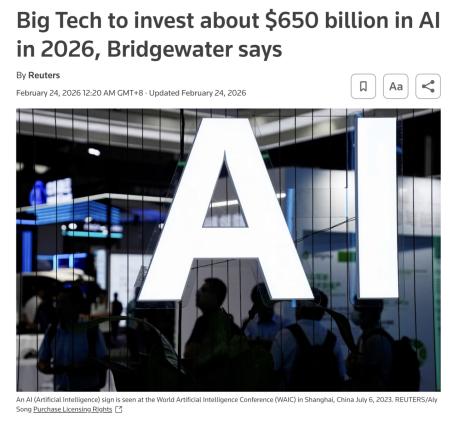
This year, Alphabet, Amazon, Meta and Microsoft are expected to invest about 650 billion US dollars in AI infrastructure, an increase of nearly 60% compared with 410 billion US dollars in 2025; since the beginning of 2026 alone, US companies have issued about 220 billion US dollars in debt related to AI construction, compared with only 12.5 billion US dollars in the same period last year.
However, there is a huge time lag between input and return: money is burned in the front, but revenue and cash flow are difficult to keep up.
Alphabet has increased its capital expenditure to 195-205 billion US dollars this year. Although Google Cloud's revenue in the second quarter increased by more than 80% year-on-year, the company still recorded its first quarterly negative free cash flow since its listing; Meta's free cash flow in the second quarter plummeted 91% year-on-year to only 784 million US dollars.
The same is true in China. Alibaba's capital expenditure in the second quarter increased by 75% year-on-year to 67.68 billion yuan, and Tencent also spent nearly 8 billion US dollars in the same period. Both companies recorded negative free cash flow in the quarter. Alibaba has used nearly half of its 380 billion yuan three-year AI investment plan, and expects that relevant investments will take about 2.5 to 3 years to recover; ByteDance is reported to be seeking about 20 billion US dollars in offshore loans, the largest in the company's history, one of the important uses of which is to continue to increase investment in AI infrastructure.
The benefits of full stack lie in the future, but the cost of maintaining full-stack competition must be paid today.
However, lack of money is at least a problem that can be temporarily solved through financing, bond issuance and other methods.
More complex pressure appears in organizational coordination.