2nm chips to be deployed in vehicles, the foldable iPhone is likely to make its debut. What are the highlights of Apple's autumn launch event?
Apple's 2026 autumn new product launch event has not yet kicked off, but a layout centered on chips and AI computing power has already been rolled out in advance.
On August 25 local time in the United States, Apple officially released the new Mac mini equipped with the brand-new M6 and M5 Pro chips. This update focuses on performance upgrades, especially the substantial improvement of AI computing capability.
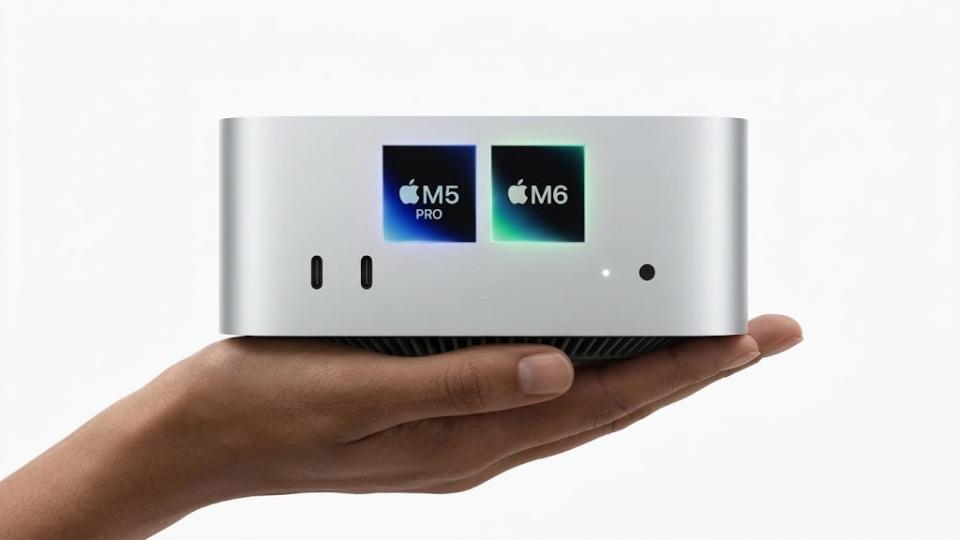
Apple said that the Mac mini with M6 chip sees up to 4 times improvement in AI performance, up to 2 times improvement in graphics performance and storage speed, along with a 40% increase in CPU performance. The M5 Pro-equipped version is further oriented to professional users and enterprise AI workflows.
This round of upgrades further highlights Apple's investment in on-device AI. With the continuous improvement of chip computing power, Mac is carrying more high-load tasks such as local large models and AI Agents, and AI computing has gradually become a key main line of Apple's hardware upgrades.
This main line will also extend to the autumn new product launch event in September.
According to Mark Gurman, a senior Apple analyst, on August 25, Apple may hold its autumn new product launch event on September 9, with key products including the iPhone 18 Pro series, the first foldable iPhone, as well as Apple Watch, AirPods and other devices.
The special point of this year is that Apple is at the node of management transition. Tim Cook will hand over the position of CEO to John Ternus, head of hardware engineering, on September 1. Therefore, this round of new products in September will also become Apple's first important product release after entering the new management cycle.
In addition, Apple is readjusting the release rhythm of iPhone: the iPhone 18 Pro, iPhone 18 Pro Max and foldable iPhone are expected to debut at the September launch event, while the standard iPhone 18, iPhone Air 2 and iPhone 18e may be postponed to early 2027.
Beyond hardware products, Apple is completing the infrastructure behind the AI era, including AI server construction and the layout of the domestic chip supply chain in the United States.
The first foldable iPhone is in charge of opening up new product forms, A20 Pro and Apple Intelligence continue to strengthen on-device AI, while servers and chip supply chains determine whether Apple can further extend its AI capabilities to the infrastructure layer.
01 iPhone begins to rearrange its product lineup
In the past few years, Apple has maintained a relatively stable iPhone update rhythm: releasing the full product line every autumn, and forming different price gradients through the standard version and Pro version.
But this year, Apple is adjusting this strategy. According to reports from tech media Digital Trends, Apple may only release three high-end iPhone models in September this year.
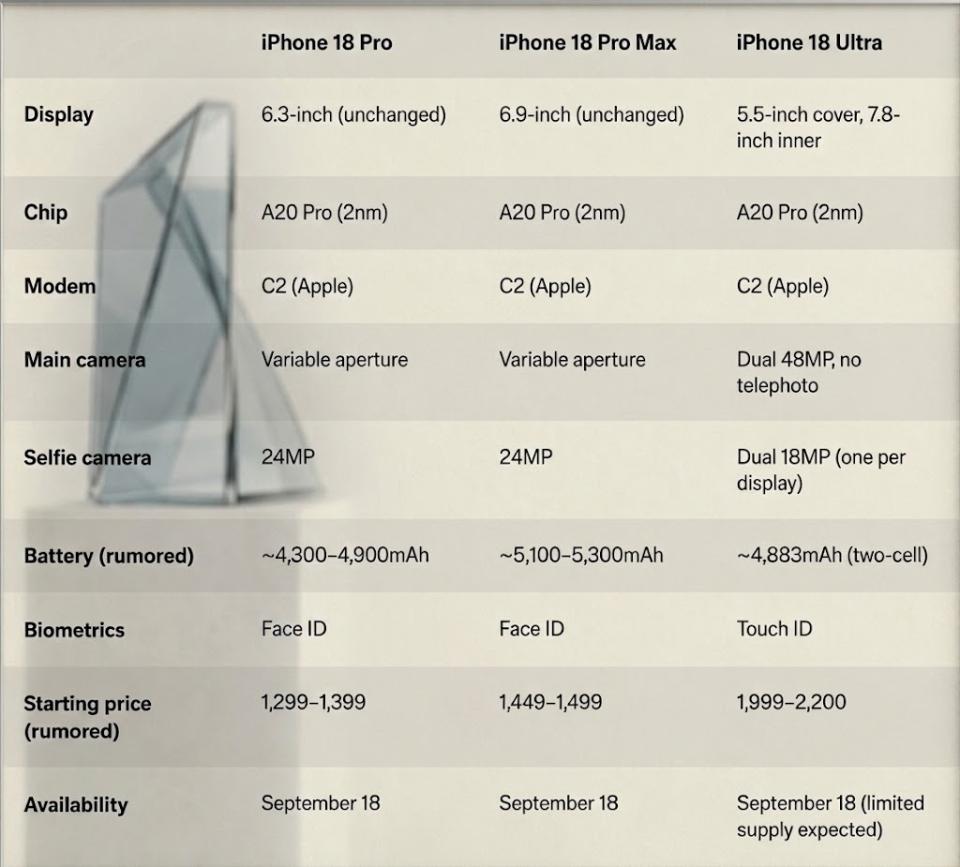
This means that Apple may further widen the release time gap between high-end models and standard models, and concentrate more resources on the Pro series and higher-end products. In the future, the iPhone product line may gradually form a layered mode similar to Mac, and models with different positioning will take different market roles.
Behind this change is that iPhone growth has entered a new stage.
For Apple, the previous model that driven device replacement by hardware upgrades such as screens, chips and cameras is weakening. Apple needs to maintain profit margins through high-end products, and accumulate more space for hardware upgrades in the AI era at the same time. Therefore, the iPhone 18 Pro series undertakes not only a regular update, but also represents Apple's product direction in the next stage.
The iPhone 18 Pro series is not expected to have a major appearance adjustment, and the focus will still be on chips, cameras and AI capabilities. According to disclosures from media including AppleInsider, both models are expected to adopt the A20 Pro chip based on 2nm process, and be equipped with Apple's self-developed C2 modem.
Multiple supply chain sources and analysts believe that A20 Pro will be the core of this generation of upgrades. It is reported that Apple is adopting a new wafer-level multi-chip module (WMCM) packaging method to place the CPU, GPU, Neural Engine and memory more closely, so as to improve performance and AI efficiency.
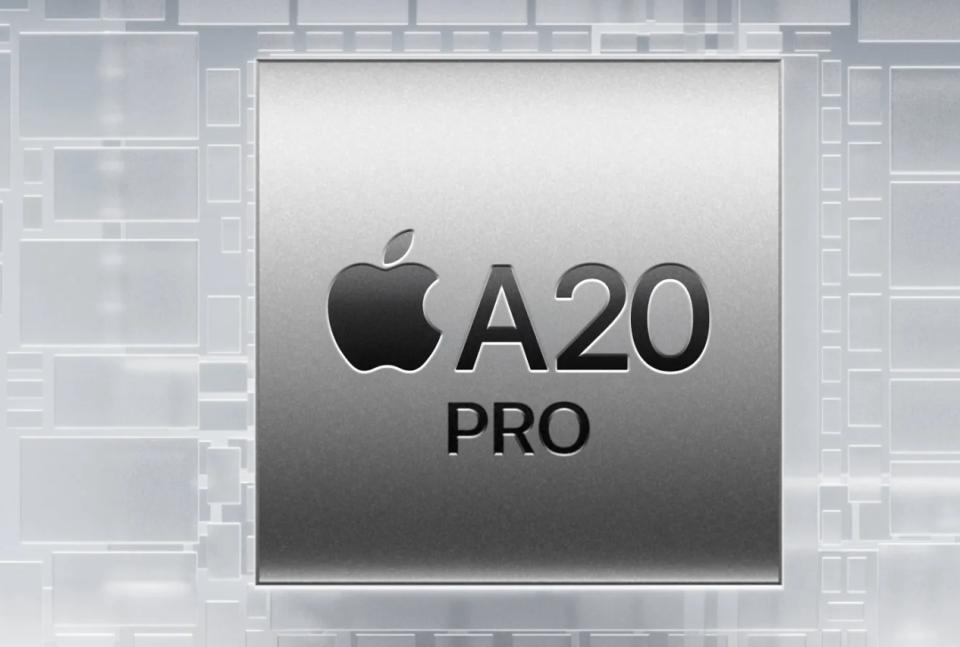
Apple A20 Pro chip
The imaging system may also usher in adjustments. The new phone is expected to add the variable aperture technology for the main camera. Compared with simply increasing the pixel count, this upgrade is closer to the control logic of professional cameras, allowing users to adjust the light intake and depth of field more flexibly.
At the same time, price may become the biggest variable of iPhone this year. Reports from media including The Wall Street Journal show that Apple has raised the prices of multiple product lines this year: MacBook Air increased by 200 US dollars, Mac Studio increased by 500 US dollars, and iPad Air increased by 150 US dollars. iPhone has not raised prices temporarily before, but the new generation of iPhone may become the next batch of price-increased products.
Senior Apple analyst Gurman revealed that Apple is still discussing the final pricing. The plans currently circulating in the public include the starting price of iPhone 18 Pro at about 1199 US dollars, and a higher range of 1299 to 1399 US dollars.
For Apple, the price increase is not only related to cost changes, but also continues its strategy of strengthening the high-end market.
In the past few years, Apple has continuously expanded the gap between the Pro series and the regular version, making consumers willing to pay a premium for stronger chips, better imaging capabilities and longer product life cycles. Relevant analysts said: "After entering the AI era, this difference may further expand".
The focus of future iPhone competition will gradually expand from traditional hardware parameters to AI capabilities and ecological experience. Whether a device can become an important entry point for users to use AI services in daily life may determine the competition pattern of the smartphone market in the next stage.
This is also the core reason for Apple to adjust its product rhythm: by redividing product positioning, let high-end iPhones undertake more technological innovations, and leave space for the future development of the AI ecosystem.
02 The foldable iPhone may make its debut
Among this year's new product array, the most anticipated new category is Apple's first foldable iPhone that may be launched. The general public expects that this product may be named iPhone Ultra.
Digital Trends reports that it adopts a book-like folding structure, presenting a small tablet experience similar to iPad mini when unfolded, and maintaining the form of a mobile phone when folded. What really matters is Apple's intention to cover both mobile phone and tablet scenarios through this device, and its size is only a means to achieve this goal.
U.S. tech media The Information disclosed that people who have actually experienced the foldable iPhone gave high comments on its size, hinge feel and durability, as well as the iPad-like application layout formed by the large inner screen. Gurman also said that early testers responded positively to the device as a whole.
Apple's investment focus on foldable screens has long gone beyond the form itself, and falls on the human-computer interaction mode in the folded state. The hinge is one of the key points. It is said that Apple is using solutions such as liquid metal and ultra-thin glass to improve the hinge and crease problems.
However, Apple's first foldable phone is not without shortcomings, and the most controversial part is the camera. News aggregated by MacRumors shows that the foldable iPhone may only have two rear cameras, without a telephoto lens. For a flagship product whose price may exceed 2000 US dollars, this point is particularly sensitive.
The Information pointed out that this may become a factor affecting sales. Because consumers who are willing to pay a high price for the foldable form and consumers who value high-end photography and telephoto capabilities have a large overlap in the first place.
Another change is Face ID. Gurman revealed that due to the folding structure and internal space constraints, the foldable iPhone will reportedly adopt Touch ID instead of Face ID. This means a regression for Apple users, but it also shows that Apple needs to make trade-offs on the first-generation foldable product.
Price is also a high threshold. MacRumors said that current market rumors indicate the price range of the foldable iPhone is about 2000 to 2500 US dollars. But Ming-Chi Kuo, an analyst from TF International Securities, believes that even if the final price reaches 2300 to 2500 US dollars, the market demand may still remain strong at least until the end of 2026.
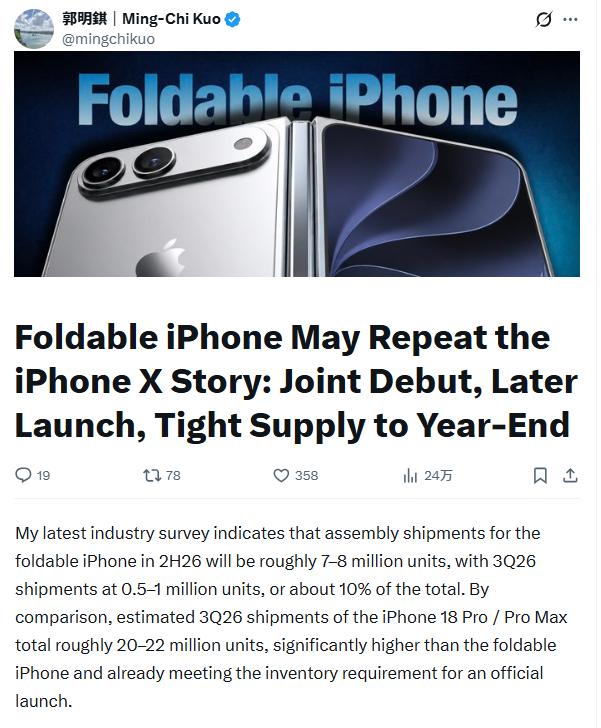
Ming-Chi Kuo also believes that the first foldable iPhone may repeat the supply situation of iPhone X in 2017. His industry survey shows that the assembled shipment volume of the foldable iPhone in the second half of this year is about 7 million to 8 million units, of which only 500,000 to 1 million units are in the third quarter, while the iPhone 18 Pro and Pro Max are expected to reach 20 million to 22 million units in the same period.
This means that even if Apple releases the foldable iPhone in September, it may not be able to achieve large-scale sales at the same time.
If the production preparation is insufficient, the foldable iPhone may have an obvious time gap between release, pre-order and official sales just like the iPhone X in those years. Insufficient supply may instead amplify the launch demand. Ming-Chi Kuo predicts that the foldable iPhone may sell out quickly after pre-order, with a waiting time of 4 to 6 weeks or even longer, lasting until December.
But to truly judge whether this product is successful, we have to wait from the end of 2026 to the first quarter of 2027. At that time, after the launch effect and supply restrictions gradually subside, we can see whether consumers are paying for "the first foldable iPhone" or are willing to accept this product form for a long time.
03 In addition to iPhone, there are these new products
The highlights of Apple's autumn conference this year are not limited to iPhone.
According to foreign media reports, in addition to the two high-end models and the first foldable iPhone, Apple is also preparing to update a series of products, including Apple Watch, AirPods and part of the Mac product lines. Although these devices do not undertake the strategic transformation task like iPhone, they together form an important part of Apple's hardware ecosystem.
Prior to the launch event, Apple has updated the Mac mini in advance. The new Mac mini is equipped with M6 and M5 Pro chips, focusing on improving AI computing capabilities, which also releases signals for subsequent Mac product updates.
In addition to Mac mini, Apple Watch is expected to become one of the important products at the September launch event.
According to news aggregated by media including 9to5Mac, Apple may launch Apple Watch Series 12 and the new generation of Apple Watch Ultra. The new watches are expected to continue to strengthen health monitoring capabilities, and upgrade in terms of battery life, performance and connectivity.
In recent years, Apple Watch has evolved from a simple smart watch to a health device entry point. With AI capabilities gradually entering the Apple ecosystem, Apple Watch may also undertake more functions of data collection and personal health assistant in the future.
AirPods may also usher in updates. MacRumors cited people familiar with the matter as saying that Apple is expected to release AirPods 5 in September to further improve the entry-level and mid-range headphone product lines. At the same time, Apple is developing AirPods with a camera, but this product is not expected to appear this year. However, it may undertake more complex AI interaction tasks, and provide more contextual support for Siri by obtaining information about the user's surrounding environment.
In addition, Apple may continue to update the iPad and Mac product lines in autumn. According to MacRumors, the OLED iPad mini is expected to be launched in October, which is the biggest screen upgrade of this product line for many years. At the same time, the new iMac and MacBook Pro may also be updated in autumn, equipped with the new generation of M-series chips.
Apple is also advancing smart glasses and accessory products with a camera. The latter can input visual data into iPhone, and then hand it over to AI for processing.
From this round of product updates, AI is gradually entering more Apple devices and usage scenarios from a single function in mobile phones. Therefore, Apple's chip upgrades this year also need to pay more attention to on-device AI computing power, as well as the ability of devices to run local models and AI Agents.
A20 Pro emphasizes AI efficiency, Mac continues to promote M-series chips, and camera-equipped AirPods, smart glasses and smart home devices require more complete AI collaboration between devices. There are more and more hardware entry points, and the more critical problem for Apple in the next step is whether Siri and Apple Intelligence can truly become a unified AI entry point connecting all these devices.
04 AI servers are launched, Apple brings supply chain back to the United States
Beyond new products, the chips and supply chain supporting this round of product upgrades are also an important part of Apple's changes this year.
In the PC chip transformation stage, Apple gradually got rid of its dependence on Intel processors through self-developed chips, and established the product advantage of hardware and software integration. After entering the AI era, the importance of chips has further risen. Whether it is Apple Intelligence on iPhone, or local large models and AI applications on Mac, higher requirements are put forward for CPU, GPU and Neural Engine.
Continuously improving on-device computing power has therefore become an important driving force for Apple to advance the Apple Silicon roadmap.
From the A-series chips in iPhone, to the M-series chips in Mac, and to more powerful on-device AI devices in the future, Apple is building a computing system covering mobile phones, computers and smart hardware. But AI competition does not only take place on end devices. With the improvement of model capabilities, Apple also needs more powerful back-end computing power and manufacturing systems.
Reporters from The Wall Street Journal recently visited Apple's supply chain in the United States on the spot. Reports show that Apple has set up an AI server assembly line at a Foxconn factory in Houston, Texas, which can assemble about 10 servers per hour.
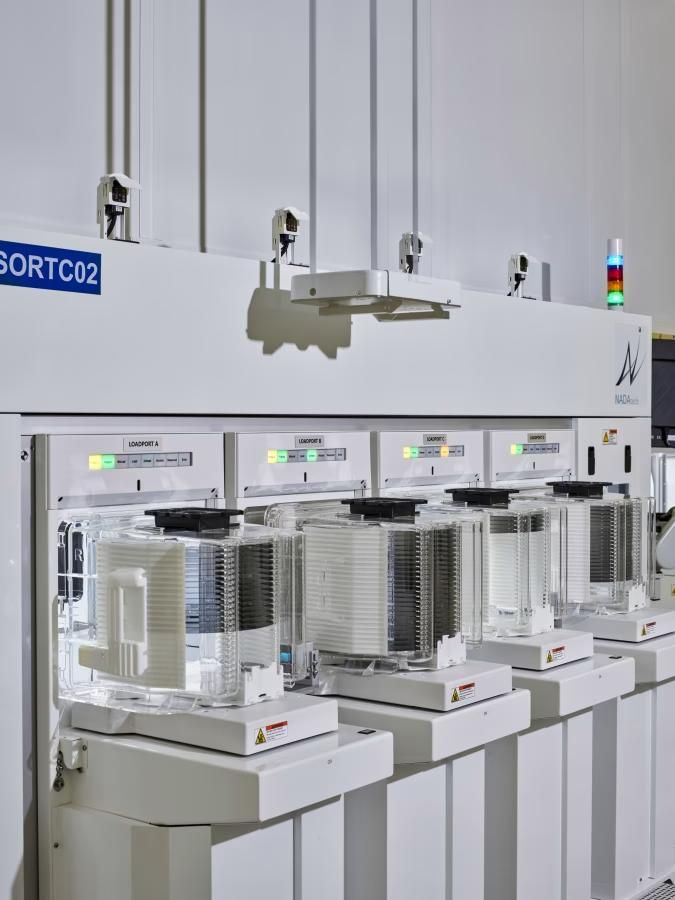
Wafer sorting equipment at the Sherman, Texas factory
The scale of this production line is not large, but its significance lies in that Apple's AI infrastructure has further extended from chip design to server manufacturing.
The Houston factory is responsible for the final assembly, testing and packaging of servers, namely FATP (Final Assembly, Test and Pack). Workers install chips and other components on the production line, and test the servers.
At the same time, Apple is also promoting the construction of the domestic semiconductor supply chain in the United States. GlobalWafers America in Sherman, Texas is responsible for processing silicon raw materials into 12-inch wafers, which