Xiaomi Ring D100 takes the industry by storm, filling the final missing piece for the commercial deployment of L3 autonomous driving. How capable is the 3nm intelligent driving chip?
Following NIO, XPeng, Li Auto and BYD, another Chinese automaker has rolled out its self-developed intelligent driving chip.
A few days ago, Xiaomi released three chips, namely Xuanjie O3, O100 and D100, in a row. Among them, D100 is a high-computing-power AI chip for intelligent driving, the first domestic intelligent driving chip based on 3nm process, equipped with 20-core high-performance CPU, 16-core high-computing-power NPU, and supporting up to 160GB memory and local deployment of large models with 200B parameters.
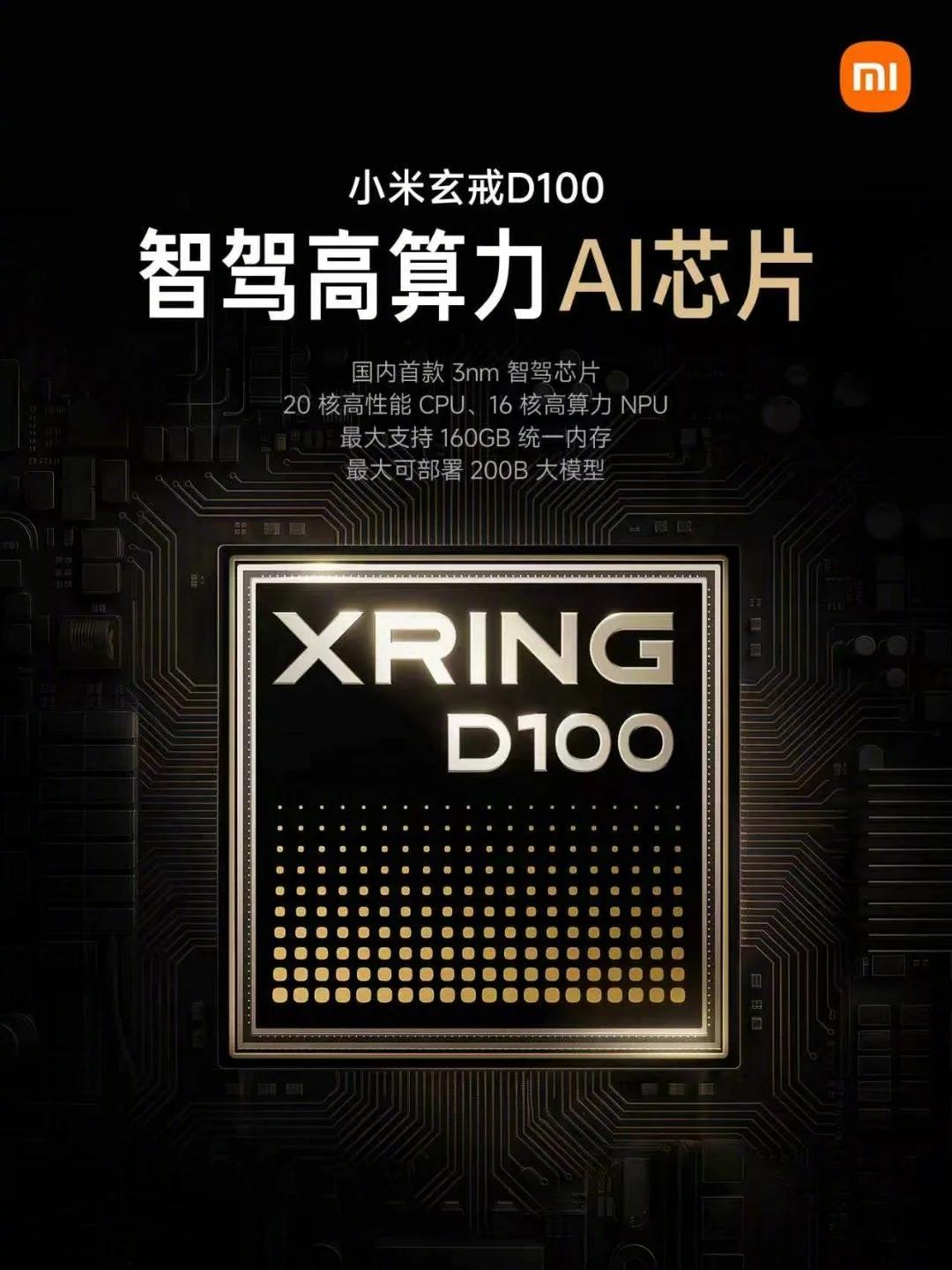
(Source: Lei Jun's official Weibo account)
At the current stage, the Xiaomi SU7/YU7 series models are all equipped with NVIDIA chips, with a high computing power of 700TOPS, exceeding the industry average level, which is sufficient to support the operation of high-level intelligent driving. But why does Xiaomi still invest huge sums of money to polish an intelligent driving chip from scratch?
In the L3 era, self-developed chips are the core competitiveness
On August 25, the revised draft of the Road Traffic Safety Law was submitted to the 24th meeting of the Standing Committee of the 14th National People's Congress for first deliberation, which set up "special provisions for autonomous vehicles", clarifying that if a road traffic safety violation occurs when the autonomous driving function is activated, the autonomous vehicle manufacturer or importer shall be held accountable.
Earlier, multiple departments including the Ministry of Industry and Information Technology, the State Administration for Market Regulation, and the Standardization Administration of China jointly launched "Safety Requirements for Autonomous Driving Systems of Intelligent and Connected Vehicles" (GB 44721—2026), which defines a unified safety access baseline for autonomous driving products. This regulation will be officially implemented on July 1, 2027.
All signs indicate that L3-level autonomous driving is rapidly moving from testing to commercial implementation.
Reflected on the product side, almost all new high-end models of mainstream automakers are doing one thing, which is to pre-embed the L3-oriented hardware platform. Perception sensors, steer-by-wire, dual redundancy of brake-by-wire, and high-computing-power computing platforms are successively pre-installed on vehicles, waiting for the policy to be lifted to unlock L3 functions through OTA.
For example, the recently launched Xianjie G9 is built based on the L3-level autonomous driving architecture. NIO, XPeng and Li Auto have all been prepared for upgrading to L3-level autonomous driving by using a computing power platform with a maximum of over 2000TOPS paired with performance sensors.
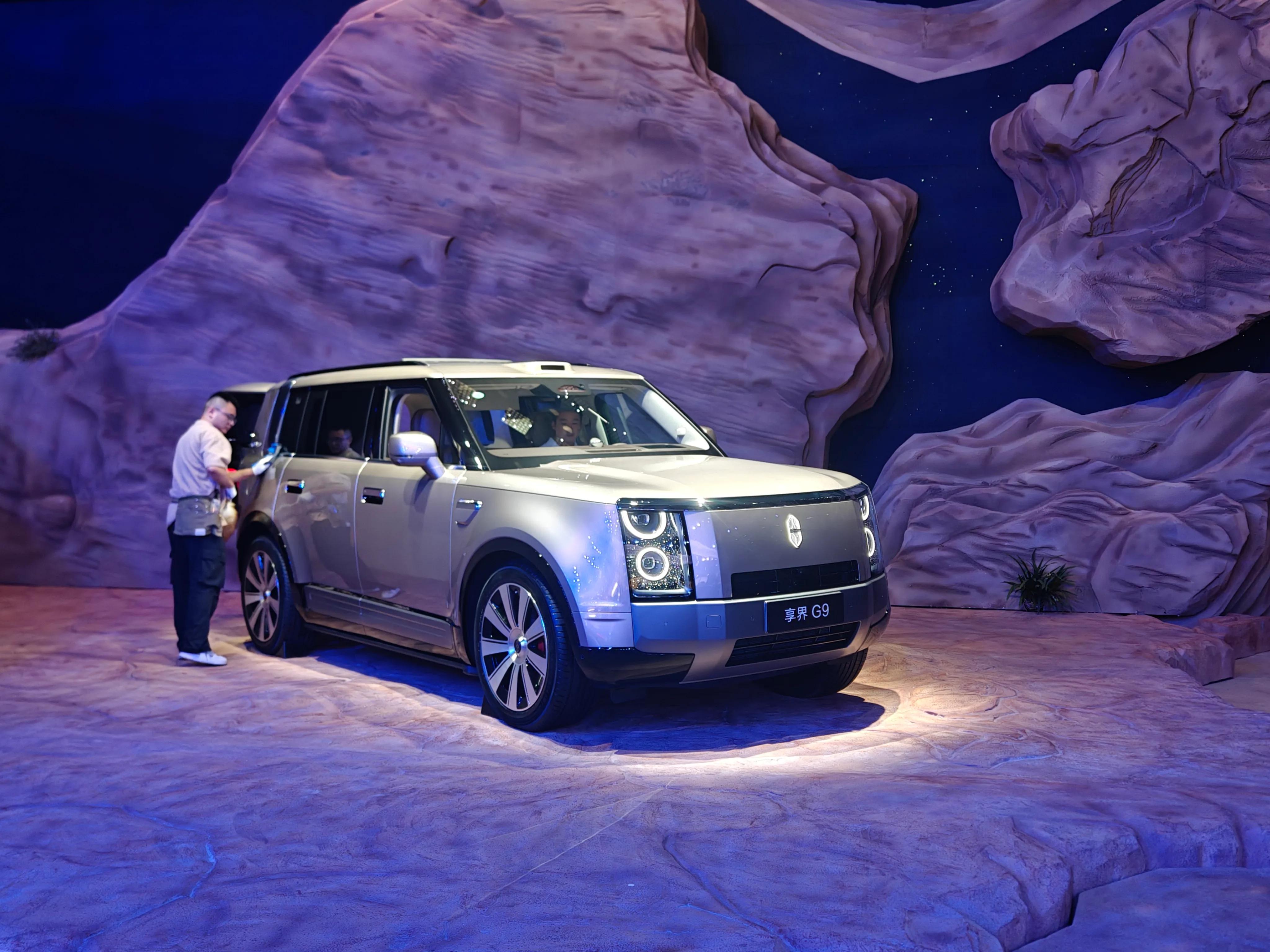
(Source: Dianchetong shooting)
NIO, Li Auto, XPeng, the automakers whose intelligent driving technologies are recognized as being in the first echelon of the industry, all have their high-end models equipped with self-developed intelligent driving chips without exception. Among traditional automakers, BYD and Geely are also investing heavily in R&D of intelligent driving chips.
Pre-embedding L3 hardware will directly push up the BOM cost per vehicle. In the past, the competition of high-level intelligent driving was about "whether you have it or not", but now the competition is about whether the cost can be reduced after large-scale implementation. By launching the Xuanjie D100 at this node, Xiaomi's first target is to achieve independent and controllable cost.
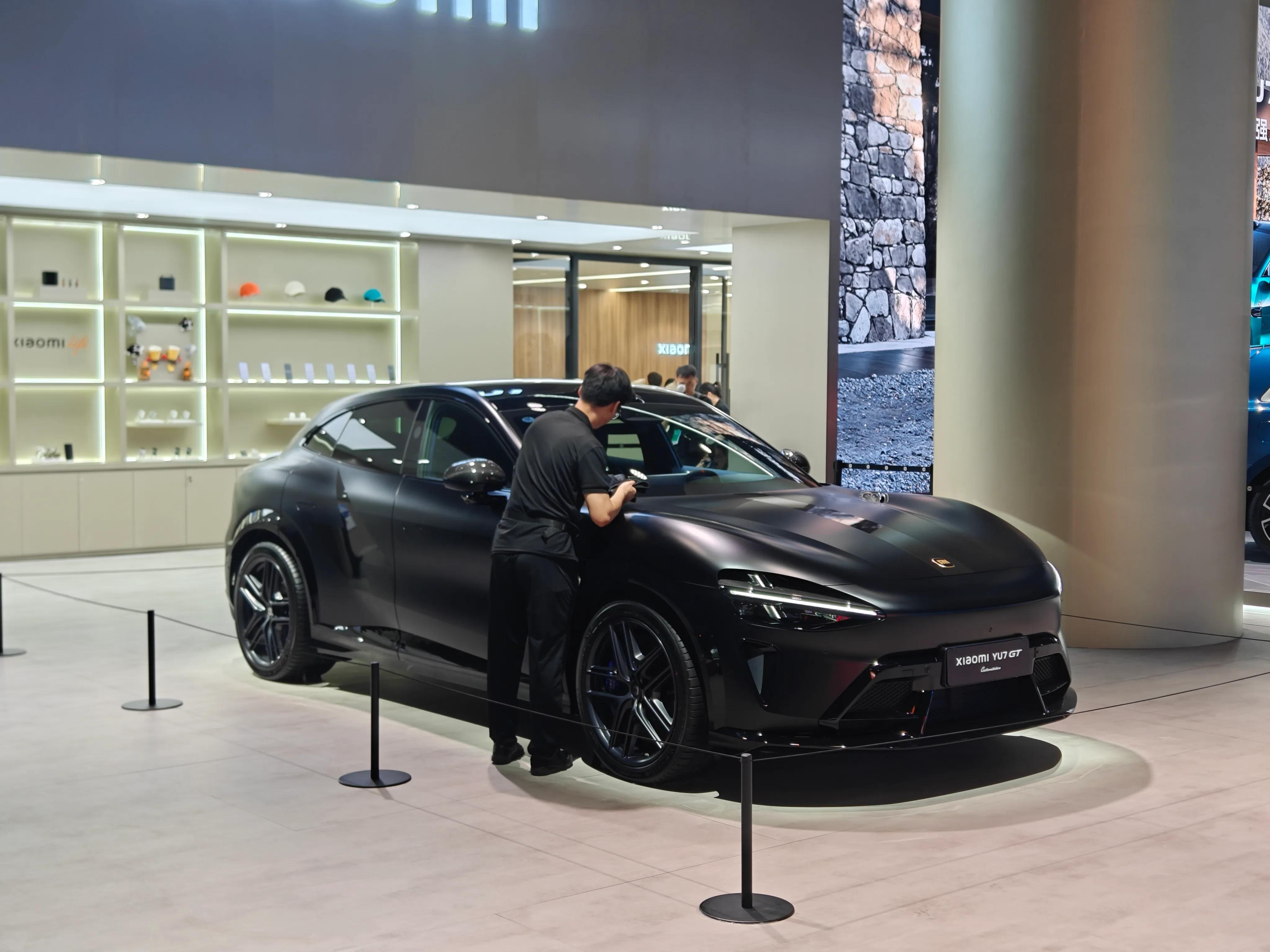
(Source: Dianchetong shooting)
Under the external procurement mode, chip procurement, domain controllers, and supporting toolchains are stacked layer by layer, making it difficult to reduce the hardware cost of the intelligent driving domain. When Xiaomi has self-developed intelligent driving chips, it can integrate chips, domain controller hardware, and underlying BSP software, reducing the premium from intermediate suppliers.
After the future vehicle sales volume increases, the cost of the intelligent driving computing power part per vehicle will continue to be diluted, leaving more room for vehicle pricing. Xiaomi will be more comfortable whether it is to fully equip high-end models with sufficient capabilities, or to deploy high-level intelligent driving to mid- and low-end models.
Secondly, if third-party general-purpose chips are used, the automaker's algorithm team needs to do a lot of adaptation, quantization, and distillation work, modify the algorithm logic to adapt to the chip hardware architecture, and the efficiency of many operators cannot be maximized.
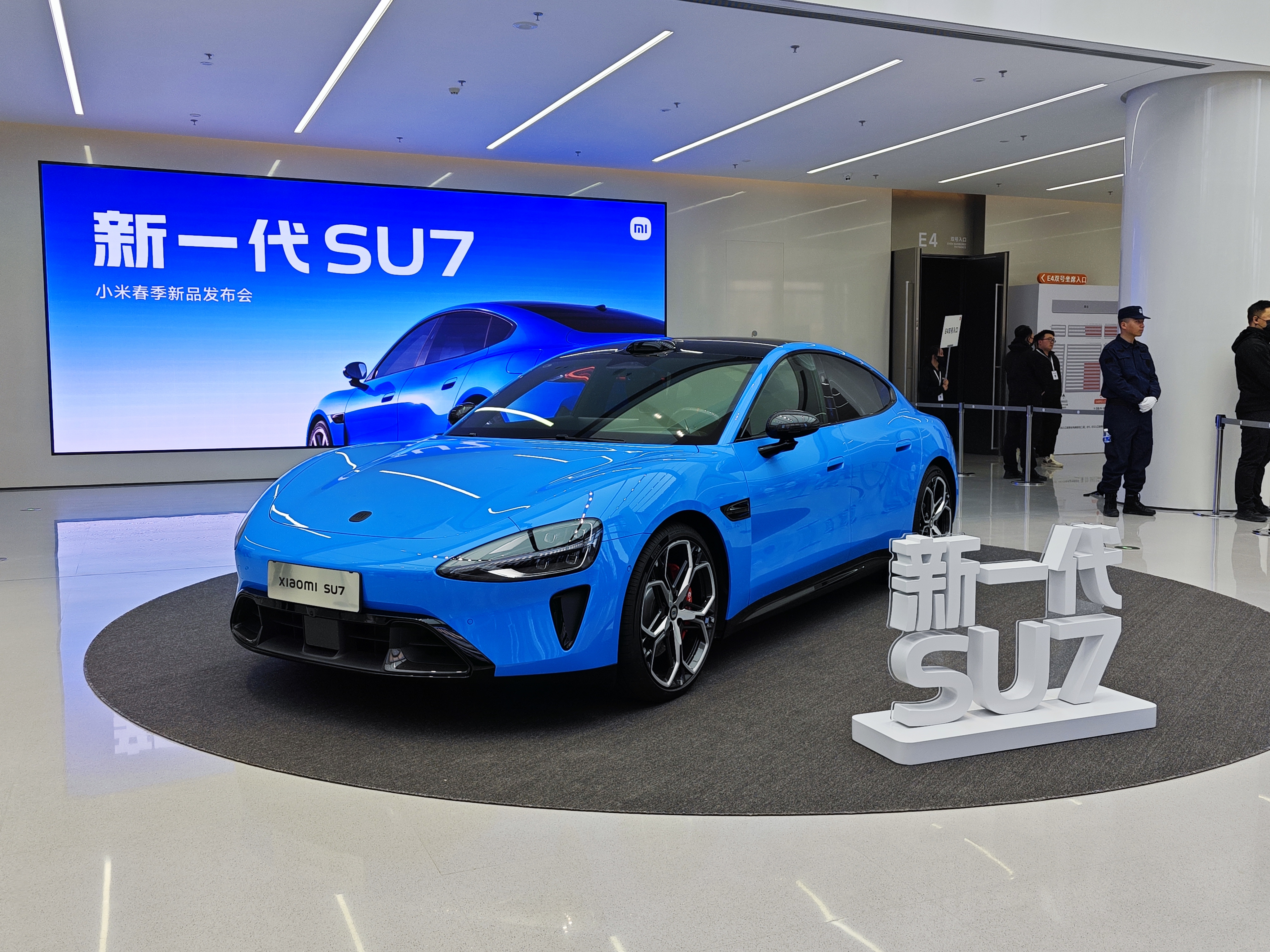
(Source: Dianchetong shooting)
Based on the Xuanjie D100, Xiaomi can design the NPU unit around the operators, data flow, and memory access characteristics of its own XLA end-to-end intelligent driving large model, so that large model reasoning, world model operation, and multi-sensor fusion are all natively optimized at the hardware level, reducing reasoning latency and improving power consumption performance.
The same set of intelligent driving large model running on the natively adapted self-developed chip will have a visible gap in actual operation effect compared with being ported to a general-purpose chip. Especially in L3 scenarios, the requirements for decision latency and system stability are much higher than L2+ assisted driving. The deep coupling of hardware and algorithms is an important foundation to ensure the safe operation of L3.
Only working on upper-layer algorithms is equivalent to building a house on someone else's foundation. The underlying iteration rhythm and upper limit of hardware capabilities are subject to external suppliers. After developing self-owned chips, Xiaomi can master the complete underlying layer, the iteration of intelligent driving will no longer be restricted by the update cycle of external chips, and new algorithm innovations can be reflected in the hardware level at the first time, forming a barrier that is difficult for others to replicate.
Xuanjie D100, the last piece of the puzzle for Xiaomi's intelligent driving?
On December 28, 2023, at the Xiaomi Automotive Technology Launch Event, Lei Jun announced that the intelligent driving technology would enter the first echelon of the industry by the end of 2024. At that time, Xiaomi's first car SU7 had not yet been launched.
More than two years have passed, Xiaomi's HAD intelligent driving has gone through multiple rounds of OTA iterations, the high-speed NOA is mature and stable, the urban NOA performs better and better, and the end-to-end large model has been widely pushed to users. One of our colleagues from Leitech/Dianchetong took delivery of the Xiaomi SU7, and the first thing he did was to drive it to the sections where the intelligent pilot assisted driving is allowed to be used.
However, on the Internet, the companies recognized as the first echelon of intelligent driving are still XPeng, Huawei, Li Auto and NIO. BYD, through the "dual fallback of parking and urban pilot assistance" service, is comparable to the first echelon enterprises in the public view.
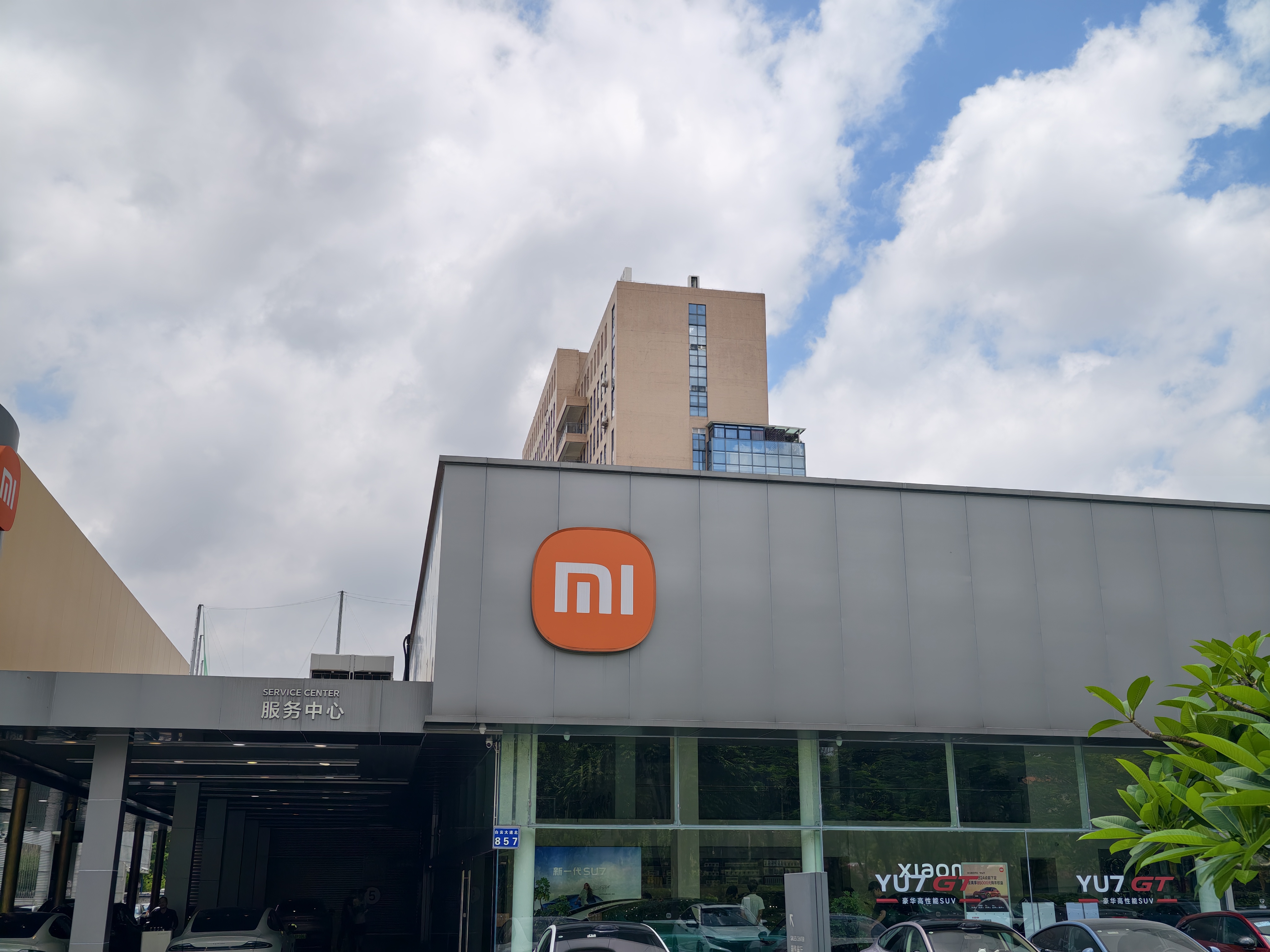
As for Xiaomi Automotive, the biggest label to this day is still "performance". The arrival of Xuanjie D100 has filled the gap of computing power hardware, but it is not the last piece of the puzzle for Xiaomi's intelligent driving, just the most important foundation.
(Source: Dianchetong shooting)
With self-developed chips, Xiaomi can first realize a complete closed loop of hardware and software integration. The entire chain, including chip definition, underlying driver, operator adaptation, upper-layer algorithm, on-board reasoning, road test data backflow, and simulation training, is fully controlled by itself.
The algorithm team puts forward new model requirements, which can be directly fed back to the chip team. The hardware serves the algorithm, and the algorithm in turn fully taps the potential of the hardware, so the iteration efficiency will be significantly improved. This is also the path that Huawei, XPeng and NIO have verified.
Secondly, self-developed chips will release the implementation potential of L3-level intelligent driving. L3 puts forward strict requirements for functional safety, dual redundancy, fault degradation, and multi-model parallel reasoning. Although external purchased chips can also realize redundancy schemes, many safety features require automakers to carry out a lot of secondary development. When Xiaomi launches L3 models in the future, it no longer needs to "patch" the security architecture on top of third-party general-purpose chips.
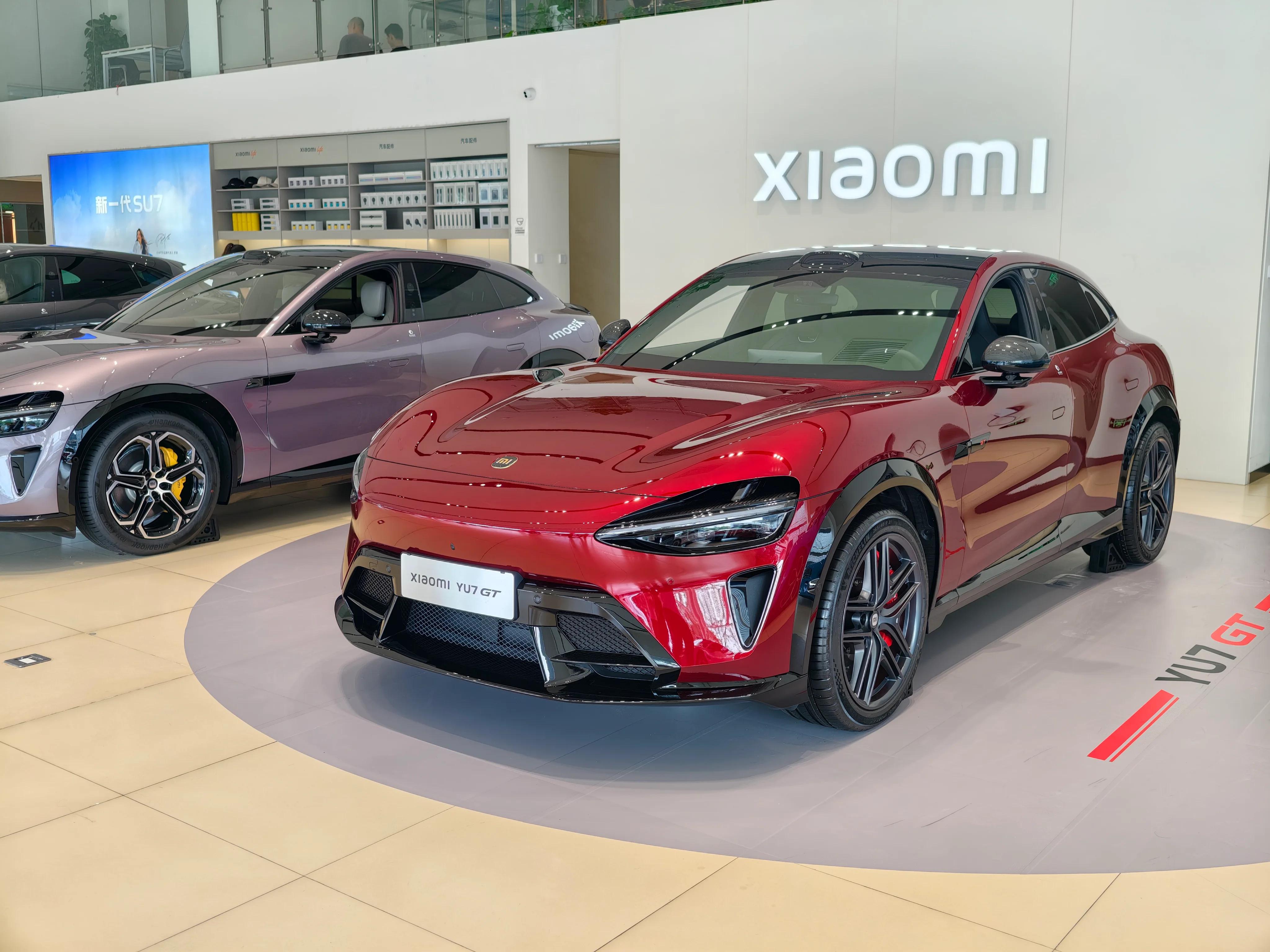
It should be noted that Xiaomi has not announced the specific computing power of Xuanjie D100. Dianchetong (ID: dianchetong233) speculates that the computing power of a single chip is between 700TOPS and 1000TOPS, at the same level as XPeng Turing and BYD Xuanji A3.
(Source: Dianchetong shooting)
However, the chip is only the base, which does not mean that the intelligent driving capability will be upgraded automatically. To give full play to the power of Xuanjie D100, it still needs to go through many hurdles such as vehicle specification certification, massive verification after the chip returns, domain controller hardware development, software BSP polishing, in-depth porting of XLA large models, and large-scale road test verification.
Xuanjie D100 solves the problem of "whether there is a self-developed computing power base", but the continuous evolution of perception algorithms, the accumulation of massive real road data, the processing capability of extreme long-tail scenarios, and the collaborative optimization of the vehicle chassis execution layer still require a long time to polish. The launch of the self-developed chip is a new starting point for Xiaomi to impact the first echelon of intelligent driving, not the end.
Considering that Xiaomi Automotive iterates once every two years, the new SU7 will be launched this year, and the Xuanjie D100 will most likely make its debut on the new YU7 series models next year. The new SU7 and Pengcheng series models may not be able to use the Xuanjie D100 until 2028. Of course, it does not rule out that Xiaomi will launch multiple "self-developed chip version" models urgently next year, or replace the intelligent driving chips of the already launched models with the Xuanjie D100.
Self-developed chip or external procurement, the choice facing automakers
Domestic leading automakers have collectively set off a wave of self-developed chips. NIO, XPeng, Li Auto, BYD, Geely and Xiaomi have all entered the field to develop intelligent driving chips. At the same time, NVIDIA open-sourced the Alpamayo intelligent driving large model, opening the basic model weights, simulation framework, and automatic annotation tools to the industry, allowing automakers to carry out secondary fine-tuning and distillation based on the open source base, greatly reducing the R&D threshold of intelligent driving large models.
On the one hand, automakers are striving to dive into the underlying layer, and on the other hand, chip giants are opening up upper-layer model capabilities to the outside world, trying to bind with automakers more deeply.
Self-developed intelligent driving chips are a bottomless pit of burning money. From IP selection, architecture design, tape-out, vehicle specification certification, to software stack development, the investment starts at billions of yuan, and requires a chip team of thousands of people to continue to invest.
Only leading automakers with annual sales reaching a certain scale can dilute the huge R&D cost. For a large number of second-tier independent brands and joint-venture automakers, the input-output ratio of self-developed chips is severely unbalanced, which is not economically feasible. For them, purchasing mature commercial chips paired with open source or third-party intelligent driving models is still the most efficient route.
In addition, there is a cycle in chip R&D. It often takes three or four years from the project approval to the chip being installed on the vehicle, and there is a risk of failure in the technical route. Even leading automakers generally adopt the dual-track mode of "external procurement + self-development", such as NIO and Geely.
Therefore, Dianchetong believes that externally procured chips will not disappear, but their positioning will undergo fundamental changes, from "the only main force" to "one of the diversified solutions". Completely abandoning external procurement is not a realistic option for the vast majority of automakers.
This article is from "Leitech", authorized for release by 36Kr.