Users who were scolded to tears by AI have propped up a language learning app that generates millions of yuan in monthly revenue.
In the language learning category in 2026, the era where simply integrating AI can help a product stand out is long gone. The track is highly segmented and solidified, with few new products making breakthroughs. However, in the past few months, a product called "Pingo AI" has achieved notable results: at its peak monthly revenue in May, its post-share revenue reached 480,000 USD, equivalent to about 3.2 million RMB (data from other third-party platforms is even higher, at around 4 million RMB).
The counterintuitive facts behind this are that "Pingo AI" was only launched in January 2025, its team has a mere 4 members, it only received 500,000 USD in early-stage financing from YC, and its product is so simple that it only has 2 dialogue entry points. In comparison, ELSA, which was launched in 2015, has a team of over 100 people and total financing exceeding 60 million USD, also only reaches this level of revenue.
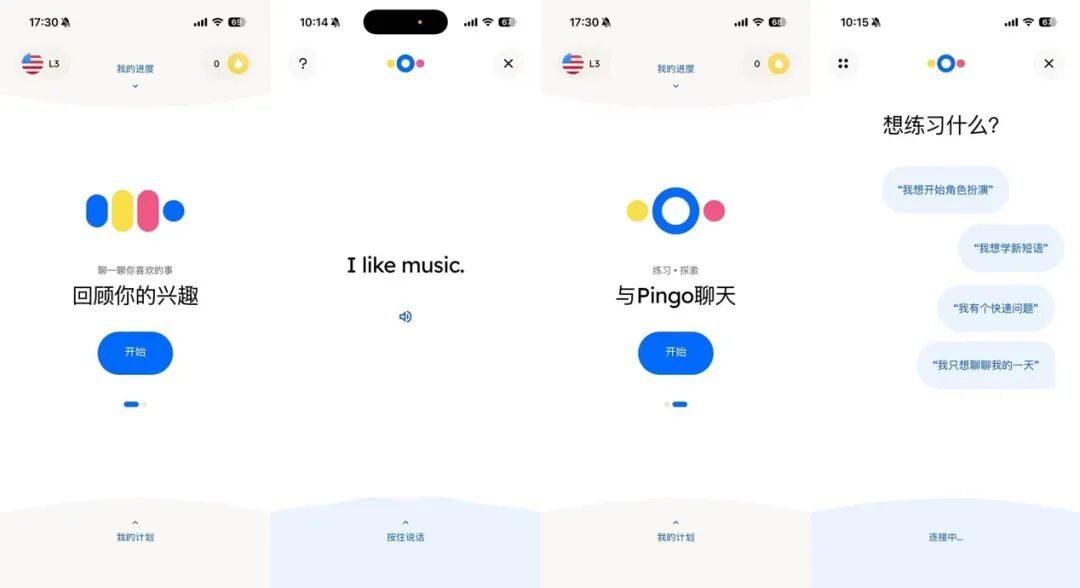
"Pingo AI" has only two core entry points: themed chat (Figure 1, 2) and free chat (Figure 3, 4)
I. Driving 1 Billion Views With Its "Snarky" Personality
Search for "Pingo AI" on TikTok, and in the highest-liked video, a content creator is earnestly following the AI to practice Spanish. The AI asks him how to say "I eat pie", he gives the wrong answer, and the AI on the screen immediately lets out a catchy, quirky laugh before telling him: what you actually said is "I eat feet". The creator breaks down in tears on the spot.
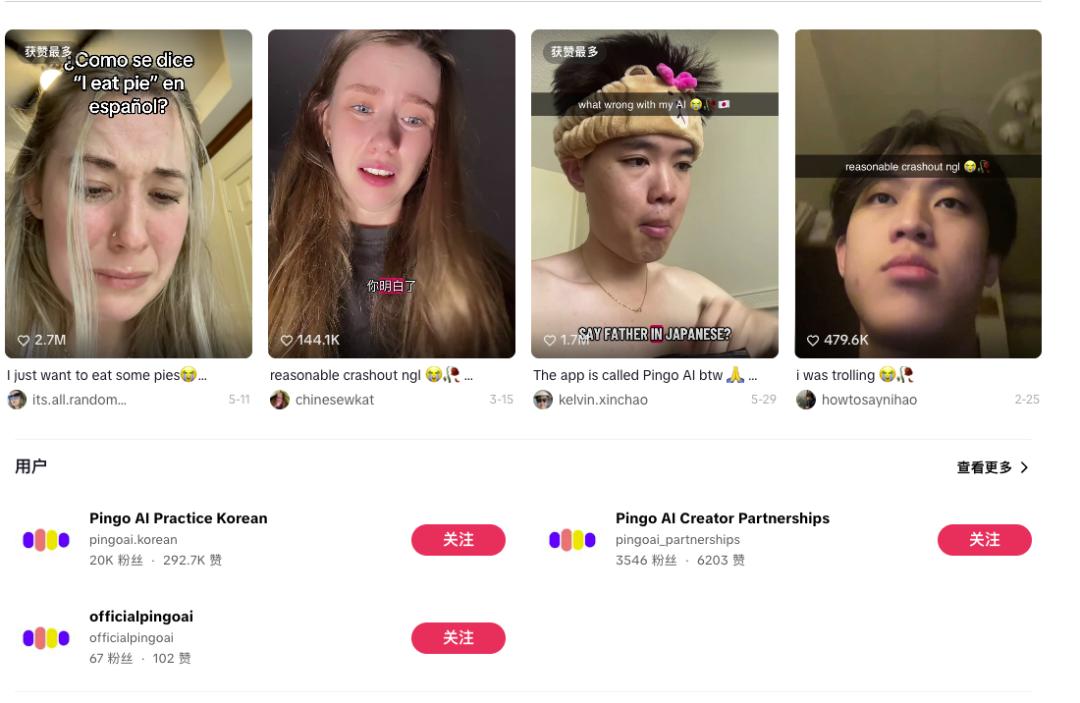
High-performing social media content of "Pingo AI" on TikTok | Image source: TikTok
In the traditional perception, users expect language learning apps to give gentle error corrections, but "Pingo AI" directly teases users for even trivial mistakes, grabbing attention with the absurd sense of "how dare the AI be so rude". The exaggerated crying, filters and quirky laugh turn a plain text AI interaction into a short drama full of emotional tension, while the real UI elements of "hold to speak, instant translation feedback" are fully displayed throughout the video, helping this video get 2.7 million likes. There are several other high-performing contents of similar style, which have accumulated more than 1 billion total views on TikTok and Instagram.
The extremely high social media data points to the reason behind Pingo AI's breakout: viral communication drives downloads, which is reflected in the traffic structure that natural search accounts for 65.1% of total traffic, making it the absolute main source.


Data from Diandian shows that from April to June 2026, the download volume of Pingo AI reached 1.38 million, 1.58 million and 930,000 respectively. In terms of traffic sources, its natural search traffic accounts for 65.1% which is the absolute main source, while the sum of paid channels accounts for less than 4% | Image source: Diandian
The rise of Pingo AI is not a stroke of luck. Its founder Morrie calls this set of strategies the "venture capital portfolio model", which manages creators in the way VC manages portfolios, and the "snarky" gameplay was tested out by creators under the mechanism that the team gives influencers high freedom and huge rewards for hit content.
Specifically, the Pingo AI team has a very standard process for creator screening and management. The VAs (virtual assistants) hired by the team send private messages to creators in batches on TikTok and Instagram, targeting micro-creators with 5000 to 30000 followers who have at least one hit video; those who are language learners themselves will be prioritized.
After the creation starts, the team follows the VC management logic, only retaining the top 20-30% creators with the best performance and cutting off the rest. Since 70-80% of creators are eliminated, the saved budget can be used for "hit content rewards". Correspondingly, the income of creators includes "base salary + tiered commission that increases with the number of views" (ranging from 50,000 to 1 million), to encourage creators to pursue hit works.
In terms of content, the team gives creators maximum autonomy. Scripts and ideas are all decided by creators, the team only provides a Discord channel for everyone to communicate with each other. The only mandatory requirement is that the video must display the real product interface to ensure conversion. In the founder's own words, "meaningful viral communication" must be product demonstration, not just gimmicks.
Co-founder Michael mentioned that the team confirmed from the very beginning that "social media viral communication is the most effective way for growth", so they embedded communication-friendly elements into product design, they believe that "the best marketing insight never comes from the internal team". Therefore, after the initial stage, the team directly abandoned the mode of "generating ideas by themselves", and adopted a VC-like strategy of "casting a wide net, betting on top creators, and stopping losses for mid-tier and low-tier creators". In the early stage, all growth and operation work of Pingo AI were done by the two founders themselves, and the team still only has 4 members now.
This management model is the core reason why this 4-person team can drive 1 billion views, millions of downloads, and a monthly revenue of nearly 500,000 USD. But after the flood of traffic pours in, the real story just begins.
II. Can a Rough Product Retain Traffic?
Similar to other products we observed before that are driven by social media viral communication, after the peak of growth, Pingo AI's monthly revenue dropped from the peak of about 480,000 USD to around 350,000 USD. While the decline after the social media growth peak is a normal phenomenon, careful observation of the data reveals some hidden problems.

Pingo AI's global cross-platform monthly revenue | Image source: Diandian
From the perspective of RPD data, although a wave of "curiosity-seeking traffic" came in May, Pingo AI's RPD is basically the same as other months, with no obvious decline. This data performance proves to some extent that "viral communication" is effective: the incoming traffic has converted a certain proportion of paying users, not just onlookers.
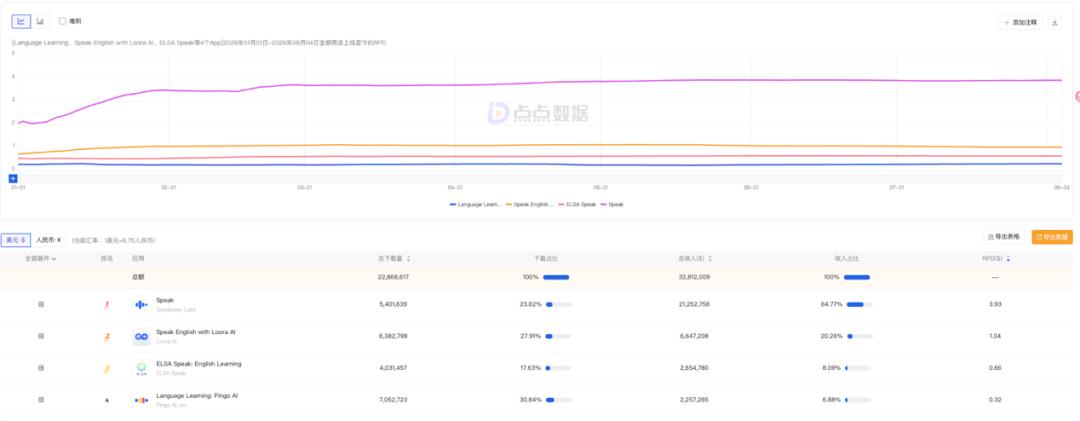
7-day RPD data of Speak, Loora, ELSA and Pingo AI from January 2026 to date | Image source: Diandian
However, when compared horizontally, the problems become prominent. The author selected language learning products with similar functions and different revenue levels including Speak, Loora and ELSA to compare with Pingo AI. Pingo AI's RPD is only 0.32 USD, which is 1/12 of Speak's, and half of ELSA's which has a similar revenue level; while Loora has fewer downloads than Pingo AI, its revenue is three times that of Pingo AI.
In other words, although compared with its past performance, Pingo AI's "viral communication" did bring incremental paying users, the value of a single download is far below the average level of language learning products. After actual experience, the reasons behind this may come from two aspects: the rough product itself and unclear positioning.
First of all, for the product side, Pingo AI only has two entry points: "themed chat" and "free chat". The "free chat" section provides options such as role-playing, phrase learning and casual chat, which are basically no different from other products, while the real problem lies in the "themed chat" which acts as the "course" module.
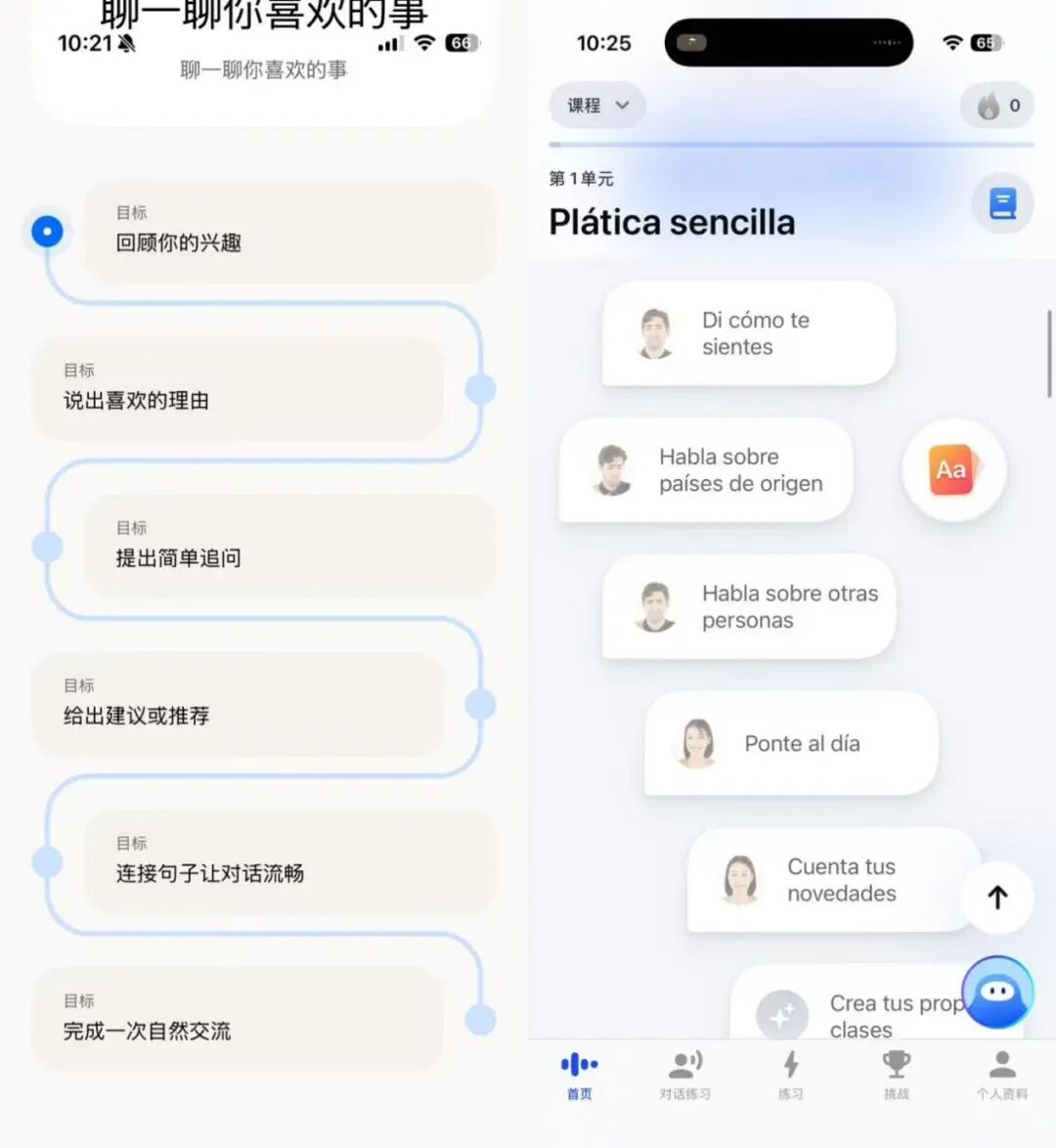
Pingo AI's themed chat is similar to "courses", but much more rudimentary than Speak's
The courses themselves are not bad at first glance, showing a clear goal chain, from reviewing interests and stating reasons, to raising follow-up questions and connecting sentences, and finally completing a natural conversation, with six progressive steps. But in actual experience, the difficulty setting is erratic.
During the test, the author entered as a Spanish learner with zero foundation (the AI will ask about the user's current level), but the first content to learn is the sentence of "asking for the boarding gate". Compared with Speak, there is no basic pronunciation content at all. Without understanding the pronunciation rules of Spanish, it is normal that you can't pass even after repeating a sentence 10 times, which is very discouraging.
The erratic difficulty is also reflected in the app store reviews: many non-beginner users still have a bad experience, even though they marked themselves as non-beginners, the courses still start from the most basic content.

When the author opened the product for the first time and marked zero foundation, the AI still recommended this content to the author
In addition to the "erratic difficulty" problem, the basic speech recognition is also unstable. The most frequent complaint in app store reviews is inaccurate speech recognition. Users generally report that the AI requires near-native pronunciation to pass, and they have to repeat a sentence at least three or four times. There are even more extreme cases where the AI directly misidentifies the language: a French learner said the AI would recognize his answer as a completely different language, making the course impossible to continue.
The situation is even worse for less commonly used languages: Dutch users said they have to read Dutch in a rigid American accent to pass, while Arabic learners reported that the listening function for vocabulary practice does not work at all.
The "snarky" persona built for growth, when mapped to product design, really leads to user frustration.
Going one step further, there is the problem of ambiguous positioning. Pingo AI supports more than 20 languages, but after the author experienced courses for learning English, Spanish and Greek with Chinese as the native language, there is little difference between them, no targeted polishing for specific languages, and no clear target user group for its growth strategy.

In terms of payment sources, Germany, the United States and Brazil rank top 3, and the rest are mostly European countries, Australia, Canada, etc. These markets have different native languages, and the languages they tend to learn vary greatly, without a clear and high-demand user group | Image source: Diandian
In contrast, products with good revenue performance such as Speak and Learna all have clear specific target users: for example, Speak teaches Japanese and Korean users to learn English, and teaches native English users in the US to learn Spanish; while Learna teaches immigrant groups in the US to learn English. When the combination of native language and target language is determined, the course rhythm, common mistakes and pronunciation difficulties can all be polished in a targeted manner.
In our previous observations, almost all language learning products have integrated AI functions to varying degrees, and AI itself is not a moat. Only products that focus on long-term course development, find clear and high-demand target users, and thus have better performance in AI speech recognition and even accent recognition can retain more users and realize conversion value, which Pingo AI is still far from achieving.
This article is from the WeChat official account "Baijing App" (ID: baijingapp), written by Zhang Kairan, edited by Yin Guanxiao, published with authorization from 36Kr.