HardKr Exclusive | A Shenzhen-based embodied infrastructure company has secured nearly 100 million yuan in financing, and has obtained clients that account for 60% of the leading robotics companies valued at over 10 billion yuan.
Source from the official of the enterprise
Author | Xiao Man
Editor | Yuan Silai
36Kr has learned that embodied AI infrastructure firm Pivot Technology has successively completed its Angel++ and Angel+++ rounds of financing. The Angel++ round, totaling tens of millions of RMB, was jointly participated by Lingge Venture Capital, Shenzhen High-tech Investment, and a leading industrial investor focused on smartphones and autonomous driving. The Angel+++ round, as disclosed, amounts to nearly 100 million RMB, with investors including Juwai Capital, Nanshan Strategic Emerging Industry Investment, Suzhou Trends Capital, Energy Conservation Capital, Hangzhou Industrial Group, and West Lake Science and Technology Innovation Investment.
Founded in 2024, Pivot Technology is an embodied AI infrastructure company that bridges professional human behaviors and robotic capabilities. It converts human experience from real-world job positions into data and skills that robots can learn, to promote the large-scale deployment of robots in real scenarios.
In the past, Pivot Technology's main business was data collection. A notable change is that the company aims to position itself as an embodied AI infrastructure provider.
Mu Wei, CTO of Pivot Technology, believes that data is only one of the most prominent bottlenecks restricting the implementation of embodied AI today. The long-term problem to be solved is how robots can make full use of data, convert data into practical capabilities, support more landing operations, and address systematic issues in the deployment process.
At the current stage, embodied AI is evolving from Demo to mass-produced products. The limited scale of real robot deployment makes it impossible to provide sufficient data, which has become a common bottleneck for the large-scale implementation of robots. The professional experience contained in human behaviors in real jobs, including task workflows, operation strategies and exception handling, is the key source to help robots cross this "data gap".
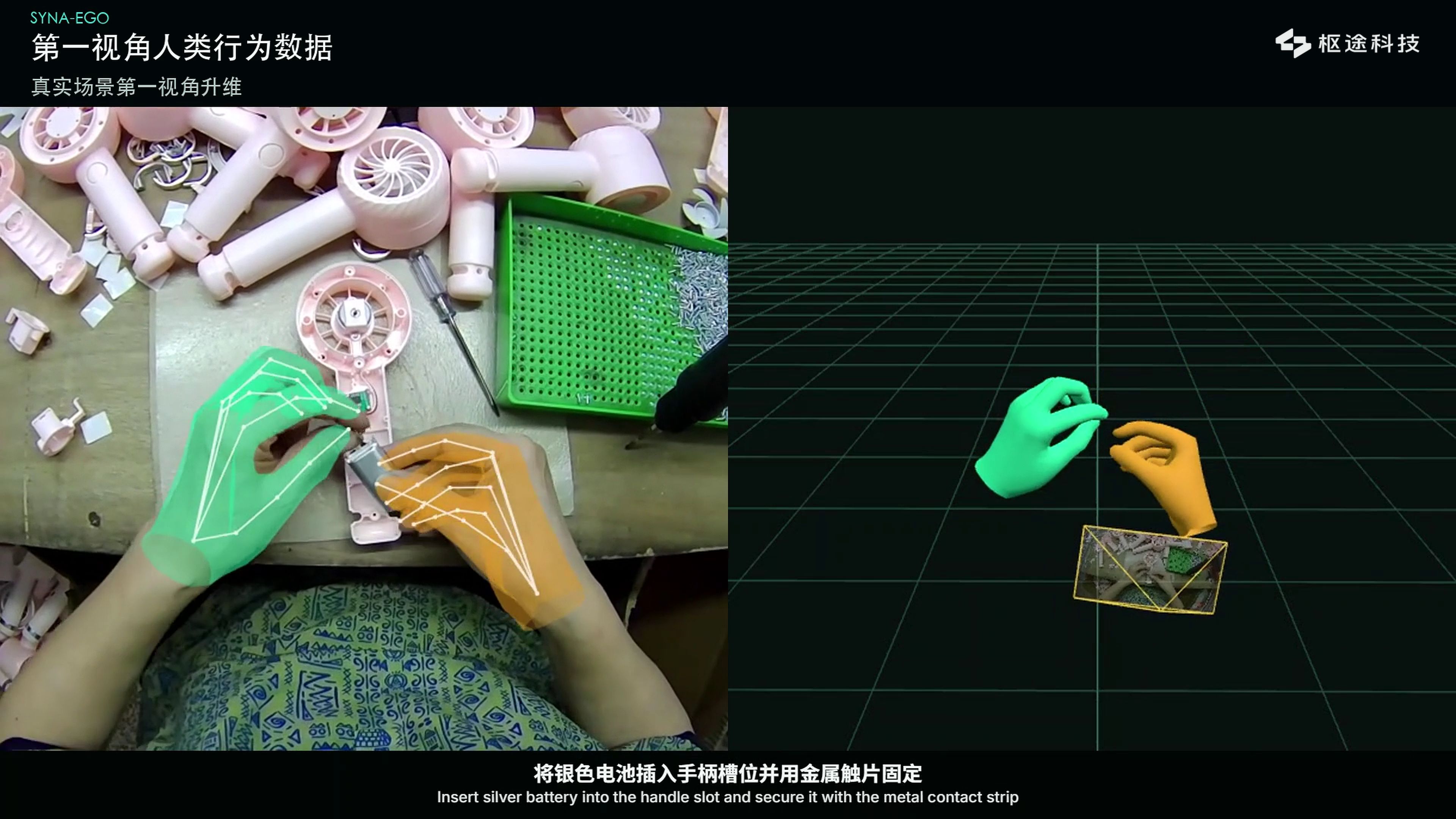
Based on this judgment, Pivot converts professional human behaviors into learnable physical experience for robots through physical information parsing, behavior characterization, and human-robot action mapping, and completes training and validation combined with real robot data.
For human behavior, this key source of experience, the core idea of Pivot Technology is not to simply collect more videos, but to convert professional behaviors in real job positions into physical experience that can be understood, learned and verified by robot models.
Source from the official of the enterprise
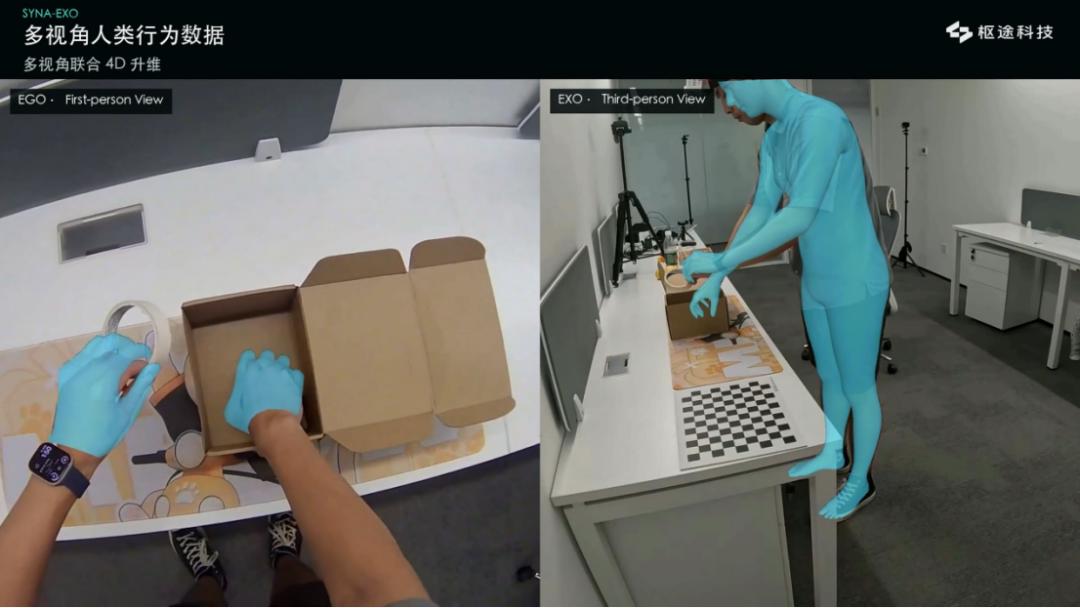
A real operation record not only contains action trajectories, but also 3D spatial relationships, human body and hand movements, object states, contact and interaction, causal relationships before and after actions, task workflows and completion standards. If this information remains at the level of unparsed videos, the increase in data scale will not automatically bring a proportional improvement in robot capabilities.
Pivot believes that the Scaling of embodied AI requires both Data Scaling and Data Representation Scaling, the key of which is to ensure that the physical experience contained in data can be accurately expressed.
This path can be summarized as "Human Action → Learnable Physical Experience → Robot Action". Human behaviors expand the boundaries of tasks, scenarios and strategies that robots can learn, while robot data is used for the adaptation of specific robot bodies and the verification of real effects. The two together form a closed loop from experience acquisition to capability improvement.
Industrialized Delivery System
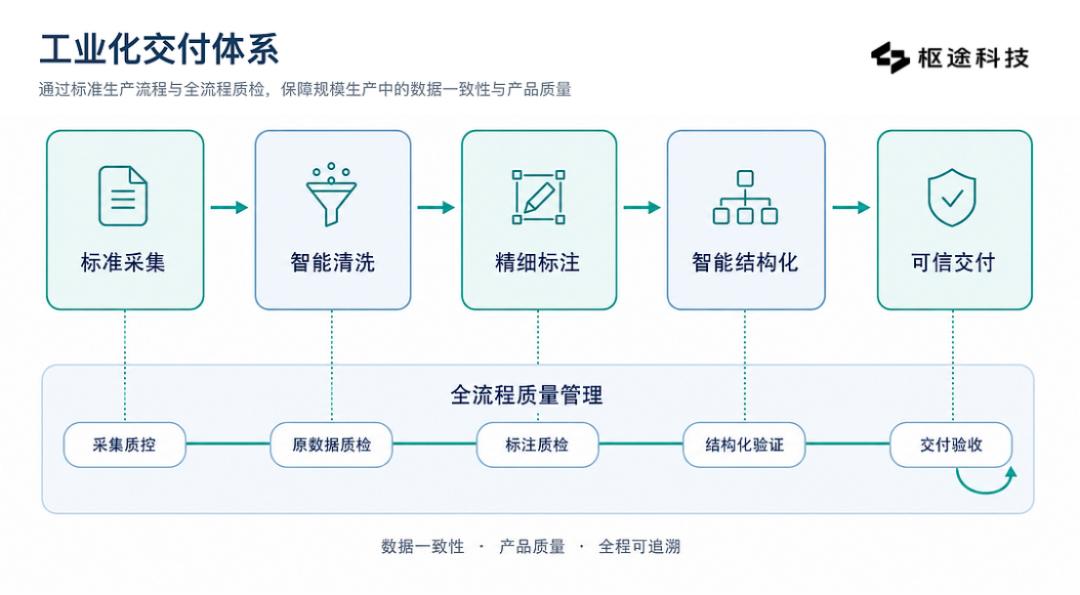
Pivot Technology has built a product matrix covering the above multi-source data forms, which extracts and characterizes the physical information that is truly valuable for robot learning from different sources, and forms data products that can be directly imported into the training process according to the requirements of models, robot bodies and tasks.
These products together constitute the human behavior training base of Pivot Technology. The core goal of the company is not to simply collect data, but to uniformly convert the human experience contained in the data into physical representations that models can learn, so as to serve different robot forms and task scenarios.
It is reported that this path and products have been verified by many leading embodied AI enterprises, large internet manufacturers and traditional robot body enterprises. More than 60% of domestic embodied AI enterprises with a valuation of over 10 billion RMB have become Pivot's customers.
The following is the edited transcript of the communication between 36Kr and Mu Wei, CTO of Pivot Technology:
36Kr: The embodied AI industry is changing rapidly. What changes have taken place in the data demands of the enterprises Pivot has contacted in the past year?
Mu Wei: The real transformation of embodied AI started in 2024. In the early stage, topics focused more on teleoperation and post-training of models based on VLA. Later, it evolved to Ego, and the learning data for operation videos of human videos has been iterated for at least 3 to 4 rounds.
Looking further ahead, what we are doing is not just a mixed perspective or multi-dimensional information restoration, but more about how to combine human movement, hand manipulation, interaction causality and human intention in this process, as well as the pros and cons brought by this behavior.
What our customers need most is to build a human-like behavior learning method through Pivot's data. Therefore, we not only provide basic video data, but also carry out in-depth cooperation with customers in algorithm services in the future.
36Kr: The whole embodied AI industry is talking about data shortage. What kind of data is actually lacking?
Mu Wei: What is lacking is the data that can help embodied AI train model capabilities quickly and efficiently.
Therefore, different enterprises cooperate with Pivot based on their positioning, current development stage, and the scenarios they focus on, which determines their data demands. The demands are diverse, and the data levels they need are getting higher and higher, ranging from the original very low-level information of robot joints and spatial positions to higher-level information such as intention interaction, covering many layers from concrete to abstract.
36Kr: What is the core competitiveness of embodied data in the next stage?
Mu Wei: The core competitiveness lies in the processing capability of high-quality data, which is the most essential competitiveness. That is, who can better and more efficiently process and restore more information contained in the data, which is the first dimension. The second dimension is the ability to continuously help algorithm enterprises understand their demands, and produce the most efficient data in accordance with their demands. I think these two points are the most important, and others are just the effect of short-term operation.
36Kr: Now some robot companies are doing data collection, and model companies are also doing it. Theoretically, they will use their own data in the future. What does Pivot think of this phenomenon? And where do you think Pivot's irreplaceability lies?
Mu Wei: Let me give an analogy. In the digital AI field, OpenAI also has its corresponding team. Every enterprise will have its own data platform, data pipeline or infrastructure team. This is not a problem. But as an independent ecological partner positioned to empower the whole industry, our biggest advantage is that we can empower more companies, and provide higher-quality data with faster iteration and higher efficiency. When we do the same thing, we serve multiple customers, while the data team of each downstream customer only collects data for its own needs, which is a typical efficiency gap. Secondly, each customer has its own optimized data form and method, which is generally only optimized for its own robot form. What embodied AI lacks most today is general understanding and behavior capability, which requires upstream enterprises with higher efficiency advantages to empower, and Pivot plays such a role here. Therefore, the existence of data teams in data companies or model companies will not eliminate the living space of professional data service providers. The two are not contradictory.
Investor Insights:
Shenzhen High-tech Investment: For embodied AI to truly enter real scenarios such as manufacturing, logistics and services, it not only requires algorithm breakthroughs, but also solves practical problems such as high acquisition cost of training data, insufficient coverage of professional tasks, and long engineering verification cycles. Starting from the human experience in real operations, Pivot generates data for robots to learn through physical information parsing, behavior characterization and human-robot action mapping, providing the industry with a technical path that takes into account data scale, quality and production efficiency.
Juwai Capital: The embodied AI industry will gradually form a specialized division of labor, and training data infrastructure that can serve different models, robot bodies and scenarios will become an important platform-level opportunity in the industrial chain. Pivot does not stay in the data collection stage, but further processes real human operations into trainable and reusable data assets, and serves multiple types of customers in the industrial chain with a neutral positioning. The team has both cutting-edge cognition of robot learning and practical industry delivery experience, and is capable of precipitating complex data technologies into products and services that can be widely used in the industrial chain, and promoting more efficient connection of data, models, robot bodies and application scenarios through open collaboration.