Jensen Huang, Li Feifei and Lin Bin have invested in the same robotics company.
Wow, the fundraising progress bar of Generalist is almost running at 2x speed with a cheat code, its development is incredibly fast!

I'm not using any exaggeration. According to Axios's report, less than three months after Generalist completed its $400 million (2.87 billion yuan) Series B financing in June this year and joined the unicorn club, Generalist has quietly closed a new round of $200 million (about 1.44 billion yuan) financing, pushing its latest valuation above the $2 billion threshold (about 14.36 billion yuan).
NVIDIA, Bezos Expeditions under Jeff Bezos, and the "Godmother of AI" Li Fei-Fei are all prominently listed among its shareholders.
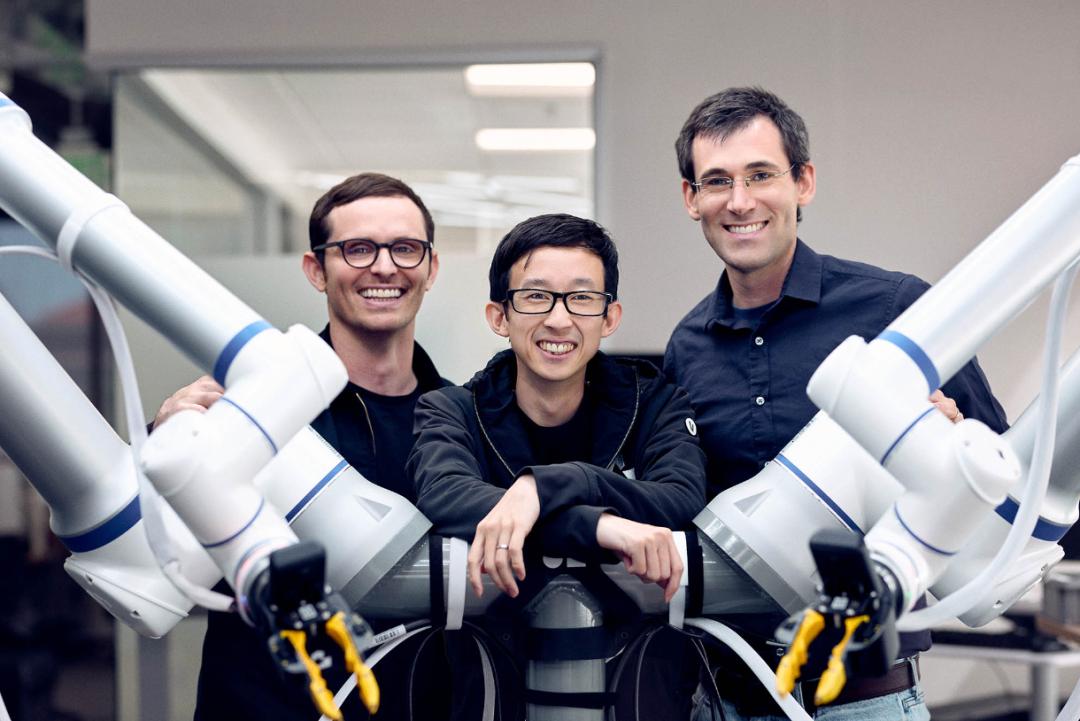
Generalist is an AI company focused on "building general brains for robots", founded in the San Francisco Bay Area, United States in 2024, co-established by former Google DeepMind researchers Pete Florence and Andy Zeng, as well as former Boston Dynamics engineer Andrew Barry.
△
Forge data shows that as of press time, Generalist has completed a total of 4 rounds of financing, with total financing reaching approximately 750 million US dollars (about 5.39 billion yuan). Its investors include NVIDIA, Boldstart Ventures, Lin Bin, co-founder of Xiaomi, Li Fei-Fei, Naval Ravikant, and Eric Yuan, founder of Zoom, among others.
Generalist does not launch cool humanoid robot bodies, nor does it rely on robotic arm orders to create gimmicks. It quickly rose to fame relying only on the team background from Google DeepMind, OpenAI and Boston Dynamics, as well as the powerful generalization capability demonstrated by GEN-1.5 that "allows robots to learn new tasks with one single demonstration without re-training", becoming a highly noticed rising star in the embodied intelligence track, and securing a total of about 600 million US dollars (about 4.308 billion yuan) in financing in just two months.
So what is the origin of this company? Where exactly does the outstanding generalization capability of GEN-1.5 lie? What exactly do investors value about Generalist?
You will find all the answers after reading:
No re-training required, get started with one single demonstration
If traditional industrial robots are chefs who can only cook according to fixed recipes, then the newly released GEN-1.5 from Generalist is more like a new apprentice who can take over the work immediately after watching the master operate once.
In the past, robots had to go through a long period of "pre-job development" before being put into use, and their problem-solving methods basically followed the rule of "one scenario, one strategy": there is one set of programs for screwing on production lines, and another set of programs for sorting parts;
Even if the task remains the same, if only the position, shape of the object or the tool changes, engineers may need to re-collect data, adjust parameters and conduct training at any time.
GEN-1.5 is trying to lower the threshold of robot deployment from "asking engineers to re-develop" to "on-site personnel giving one demonstration".
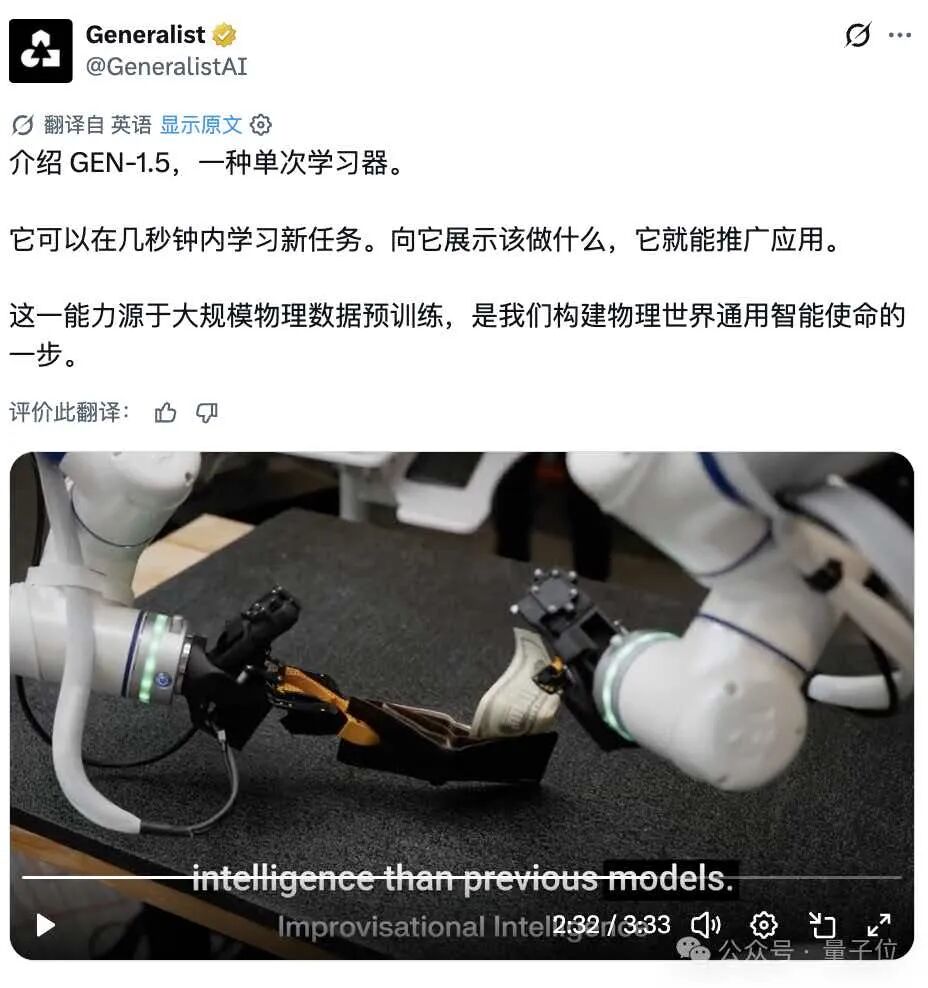
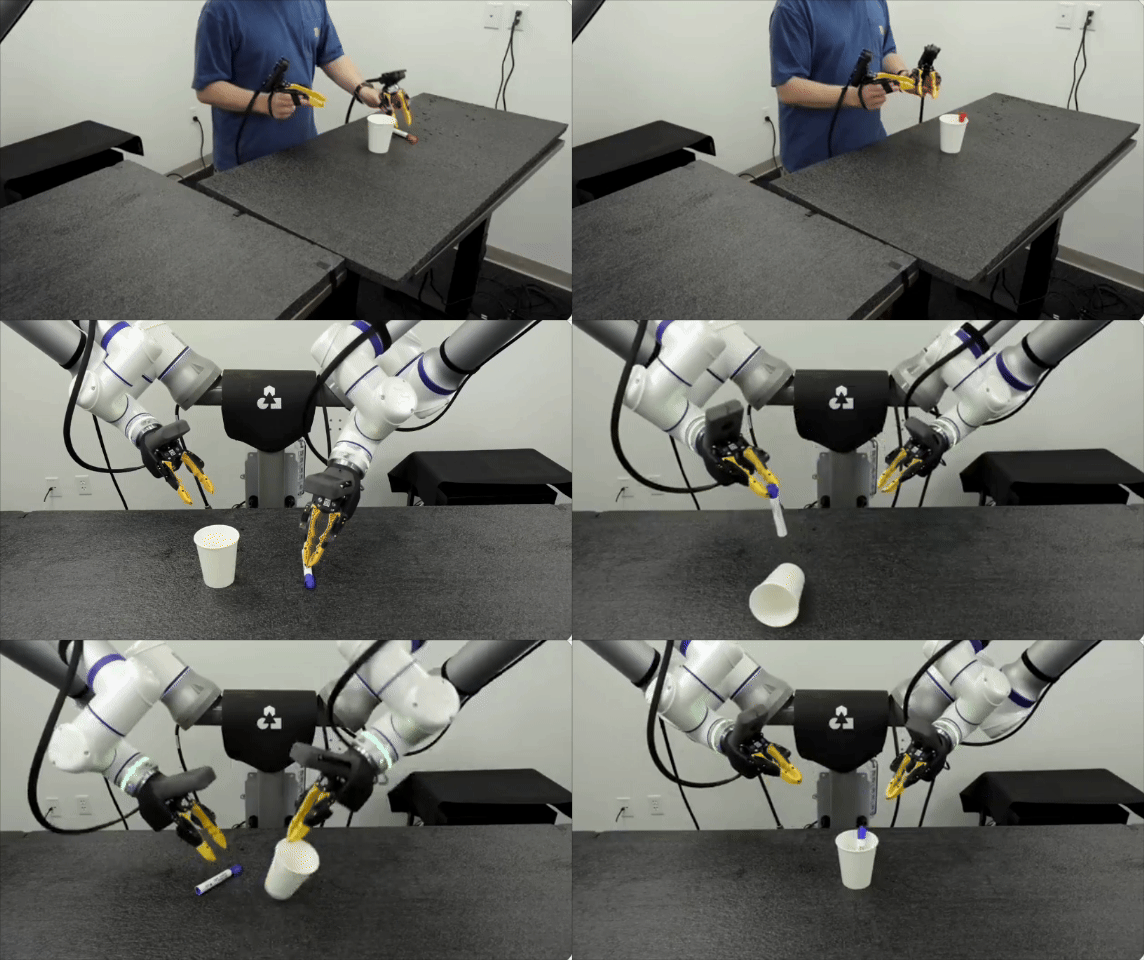
In Generalist's demonstration video, staff only need to demonstrate once with a handheld gripper or the robot, and the model can take 3 to 12 seconds of sensor and motion data as "physical prompts", directly understand the task and start operation, with no gradient update or fine-tuning required throughout the process.
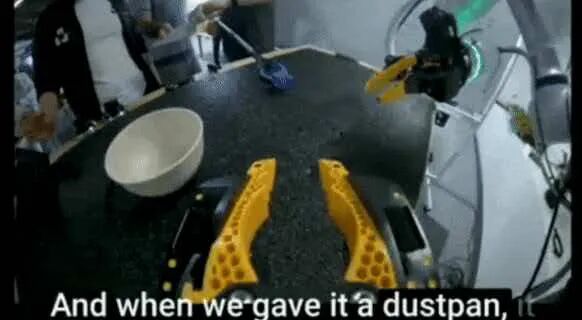
For example, unscrewing a glass jar, unzipping a pencil case, sweeping a block into a bowl, and even using a brush and dustpan that it has never seen before, it can organize movements on the spot according to the demonstration.
Of course, GEN-1.5 is currently not so magical that it can hit every target at first glance.
Official tests show that its average success rate of single demonstration on 10 types of simple short-term tasks is 59%; if fine-tuning is done with about 5 minutes of data and 10 gradient update steps, the success rate can rise to 83%.
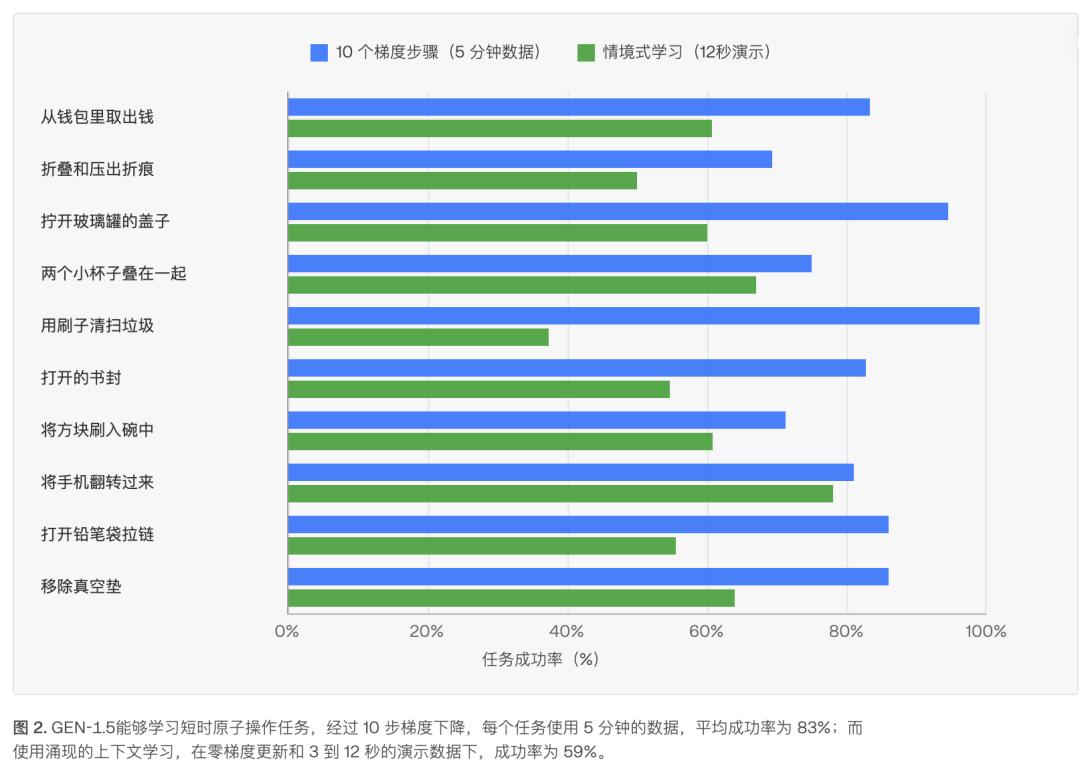
This result is not perfect, but it proves a more important thing: the task adaptation of robots is expected to be compressed from months to seconds.
What the capital values is probably exactly this possibility of becoming the general base for robots.

For customers, the same set of models can be deployed to different factories, warehouses and laboratories faster, reducing the cost of engineering deployment, data collection and line stop debugging.
For investors, Generalist does not sell a certain robot, it sells the intelligent layer that runs on different hardware, so its market boundary is naturally larger.
And for Generalist itself, the general capability can also drive the data flywheel to spin faster:
The stronger the model, the more real businesses it can access; the more deployments are made, the richer the physical interaction data obtained; the new data will in turn train the next generation of models. Ultimately, what GEN-1.5 aims to do is to enable robots to gain the ability to learn and work continuously.
This capability of "second-level adaptation replacing month-level development" does not come out of nowhere, it precisely stems from the founding team's 10 years of insight into the pain points of the robotics industry.
A group of veterans from DeepMind and Boston Dynamics, starting a business to train "robot brains"
The founding team of Generalist has almost gathered the two most critical capabilities in the robotics industry.
CEO Pete Florence holds a PhD in Computer Science from MIT, studied under roboticist Russ Tedrake, and used to be a senior research scientist at Google DeepMind, participating in the creation of vision, language and motion models, and training DeepMind's first multimodal large model.

△
Chief Scientist Andy Zeng graduated from the University of California, Berkeley with a bachelor's degree in Computer Science and Mathematics, and later obtained his PhD in Computer Science from Princeton University.
He used to be a research scientist at Google DeepMind, who not only studied robots that can write code by themselves, but also invented a method for large-scale collection of robot data using handheld grippers.

△
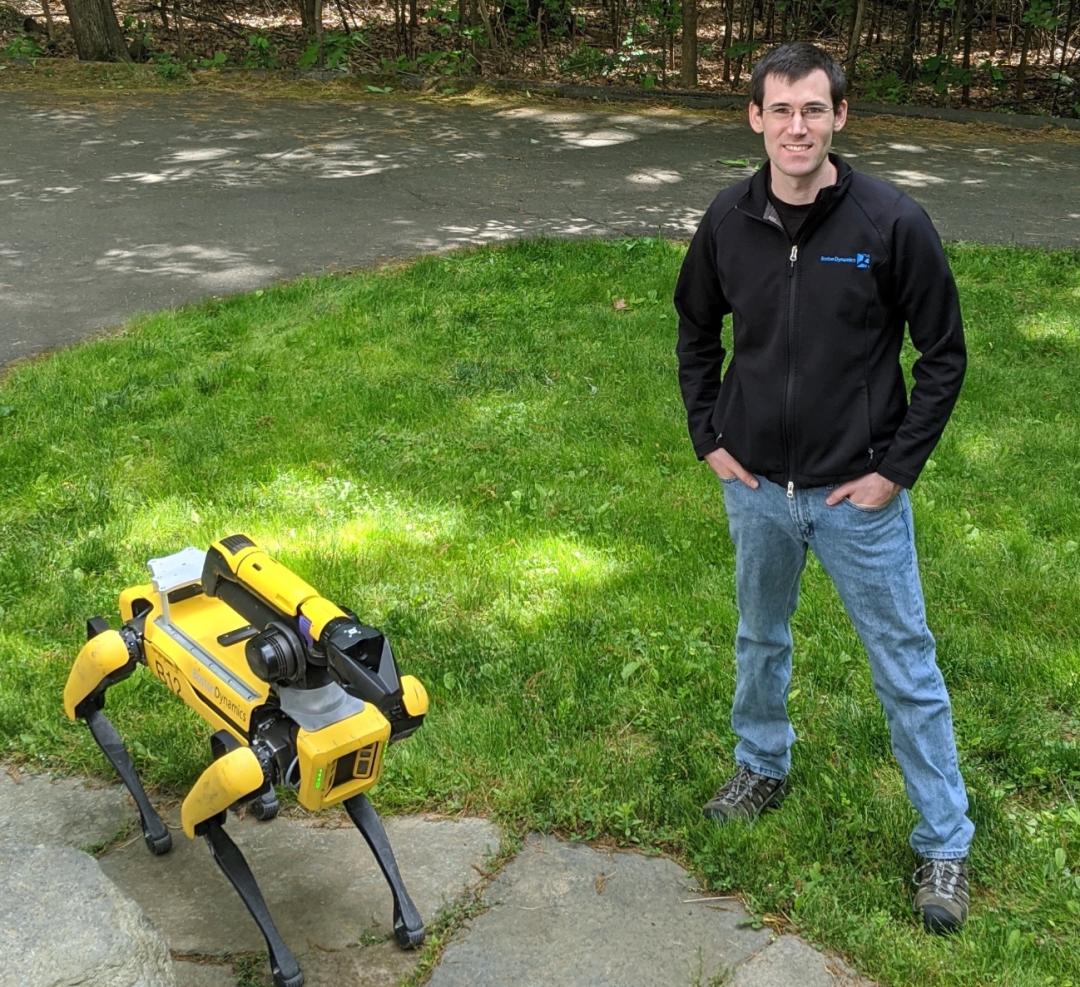
The person in charge of actually putting ideas into the robot body is CTO Andrew Barry.
He graduated from Olin College of Engineering with a bachelor's degree, and obtained his PhD from MIT, with research directions including robot control and high-speed autonomous obstacle avoidance;
Before joining Generalist, he worked at Boston Dynamics for about 5 years as a senior robotics specialist, participating in the development of the robotic arm for the quadruped robot Spot.
In other words, he not only knows what the model should output, but also knows how the robot moves in the real world without falling, shaking or getting stuck.
△
These three people did not form a temporary team to chase the trend when AI became popular. Their work over the past decade has all pointed to the same bottleneck in the robotics industry:
The hardware can already run, jump and grasp, and what really limits the landing of applications is that the "brain" of robots cannot keep up with the "body".
What DeepMind brings is the model's generalization capability for different tasks, objects and scenarios;
What Boston Dynamics brings is the "physical insight" into mechanical structures, control systems and real environments.
This is also the reason why Generalist chose to train general robot brains instead of betting on a certain robot body. They are well aware that only when both the model and hardware meet the standards can robots move from laboratory demonstrations to factories and warehouses.
Otherwise, no matter how excellent the model is, it may only lead to more published papers; no matter how cool the robot's movements are, it can still only perform pre-arranged programs.
However, GEN-1.5 still has much room for improvement at present.
Being able to master a task after watching it once does not mean it is ready for work
However, being able to master a task after watching it once does not mean that GEN-1.5 can already be directly put into work in factories.
Generalist has actively put the brakes on this capability. The official technical blog states that most of the tasks tested by the team currently are simple short-term tasks such as unscrewing jar lids, unzipping zippers, and grabbing objects.
GEN-1.5 has an average single-demonstration success rate of 59% on 10 types of tasks, which still has a clear gap from the long-term, low-failure and stable operation requirements of production lines.
When actually deployed into factories, robots also have to face material differences, equipment wear, personnel interference and unexpected failures, which are far more difficult than laboratory demonstrations.
More importantly, "learning from one demonstration" mainly solves the task adaptation problem, and does not automatically equal low-cost commercialization.
Moreover, the large-scale deployment of robots also depends on hardware prices, operating speed, maintenance costs, safety and system integration capabilities. Even if the model learns very quickly, if the robotic arm is expensive, fails frequently, or a large amount of engineering debugging is still required for each deployment, the commercial operation will not be economically viable.

But the value of GEN-1.5 should not only be measured by its current success rate.
The emergence of GEN-1.5 proves that robots can quickly understand new tasks through a few seconds of "physical prompts", just like large language models understand text prompts.
Although it has not yet put robots on production lines that operate for a long time, it has already promoted to shorten the time for robots to learn new tasks from months to seconds.
Moving from "developing one program for each task" to "learning different tasks with the same model" is the more noteworthy part of GEN-1.5.
It may not already be a qualified worker, but at least it demonstrates the learning method that future general robot brains are likely to have.
In this sense, GEN-1.5 is more like a roadmap leading to general robots at the moment, rather than a mature product manual.
What really excites the market is not only how many things it can do today, but also the possibility it demonstrates that robots can continuously learn more things.
General robots are starting their journey
If in the past, robot companies were all competing to be "single-event champions", what Generalist tells the