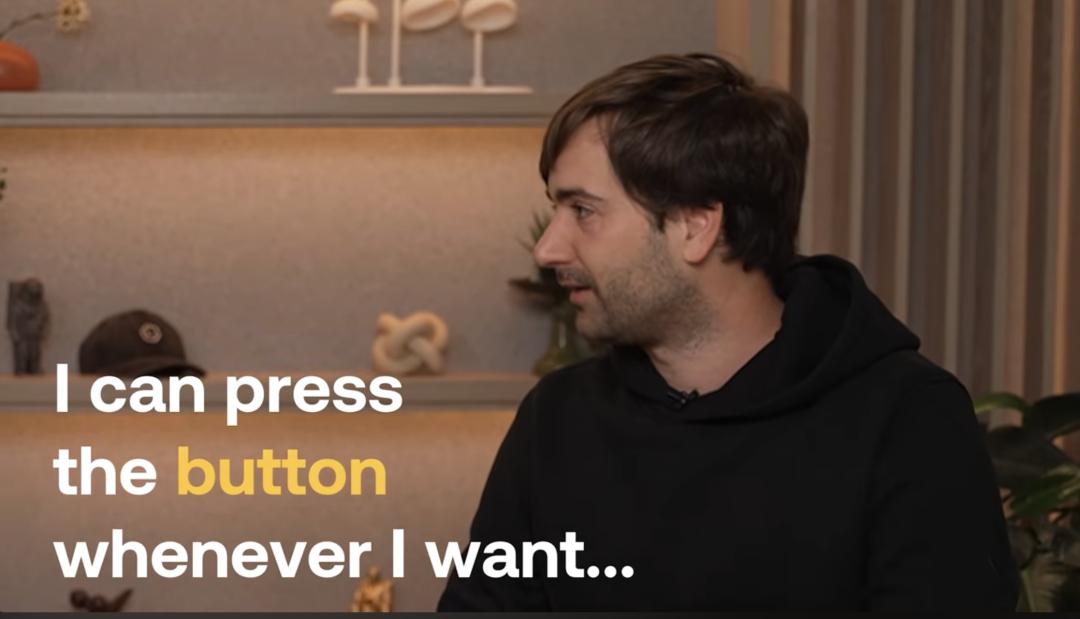
Cyber Godfather Tibo's Latest Interview: A dedicated physical button is designed for reset, "I can reset whenever I want."
"As long as I want to reset, I can do it anytime"
Just now, the "cyber godfather", AKA the god of Codex reset quotas, Tibo stated confidently in the latest episode of his podcast with Matthew Berman~
And the most interesting part is that Tibo has specially made a physical button just for resets.
As the current head of Codex, apart from introducing how to distribute benefits to users, Tibo also reviewed his previous career at Google in detail during this podcast, and revealed several key ongoing work priorities of OpenAI at this stage.
This is a rare opportunity for the public to gain an in-depth look at this new product leader at OpenAI.
The conversation covered almost every topic including OpenAI's product culture, next-generation Agents, the GPT Ultra Fast mode, future human-computer interaction, OpenAI's pause on cutting-edge model training, and RSI, with no topic left untouched...
Tibo's core viewpoints are as follows:
- ChatGPT and Codex will eventually converge. In the future, there will no longer be two separate products of "programming Agent" and "chat assistant", but one highly personalized AGI that automatically adapts its interface according to different users' tasks, capabilities and habits.
- The core of the next-generation Agent is not adding more Skills, Memory or sub-Agents, but making these mechanisms "disappear". What users really want is a partner that continuously understands them, their goals, daily routines and team context, rather than having to constantly manage skill files, memories and Agent networks.
- Laptops will become the new bottleneck for AI Agents, and next-generation Agents will naturally move to the cloud and access larger-scale computing resources.
- Running 10 to 15 Agents at the same time today uses concurrency to make up for slow model speeds. Once Ultra Fast pushes response latency close to the speed of human thinking, workflows will return to real-time interaction and "flow state", rather than constant context switching.
- We do not focus on competition. OpenAI's differentiated narrative from Anthropic is not simply "our model is stronger", but "deliver the strongest capabilities to as many people as possible". OpenAI emphasizes broad distribution, community participation and lowering usage barriers, which is also an important reason for integrating Codex into ChatGPT.
- OpenAI has already been using "recursive self-improvement" in practice. This is not only about letting models research other models, but also letting the most powerful models optimize CUDA kernels, inference stacks and infrastructure, forming a flywheel of "stronger models → higher efficiency → more computing power → even stronger models".
(Tibo's full name is Thibault Sottiaux, he is from Belgium, and he studied applied mathematics at UCLouvain for his bachelor's degree. In 2015, he joined Google, initially working on Google Maps related projects, then moved to Google DeepMind to be responsible for AI research infrastructure construction, and participated in supporting cutting-edge AI projects including AlphaGo. In 2024, he joined OpenAI and began to lead the Codex project. With the explosion of the AI Coding wave, Codex quickly became one of OpenAI's fastest-growing products, and Tibo thus came into the sight of the developer community. Because he often personally replies to user feedback and helps developers reset Codex usage quotas, he is respectfully called "cyber godfather" by netizens.)
The full edited conversation is as follows:
Experience at Google and DeepMind
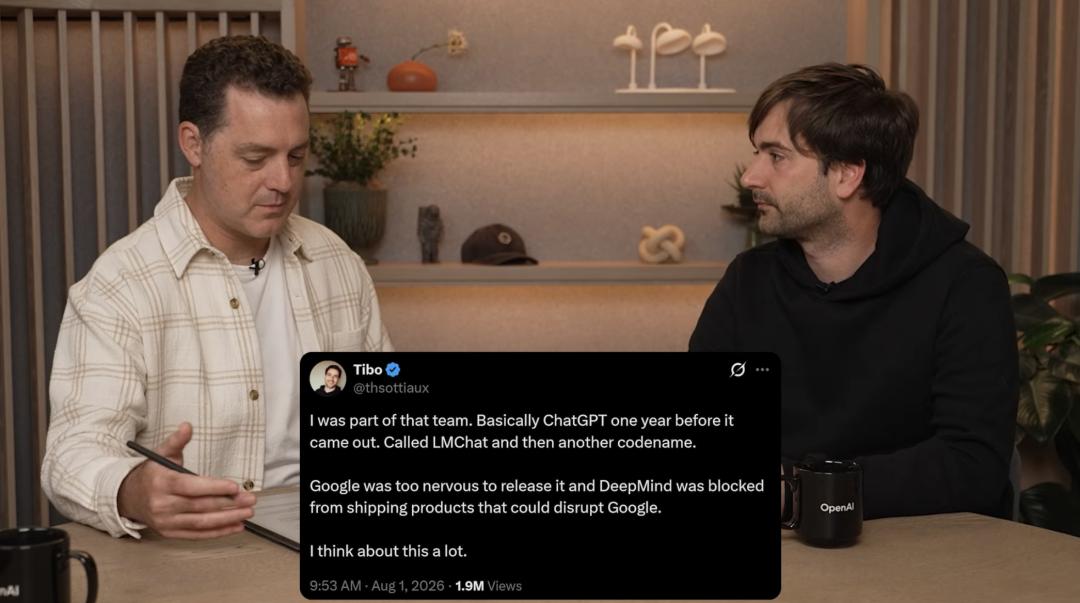
Host: Great, I'm really looking forward to talking to you. I'd like to start with your experience at Google. You were on the DeepMind team back then. Before ChatGPT came out, Google had something called LM Chat.
You once posted that Google was too nervous to release it; DeepMind was also blocked from launching products that might impact Google's existing business. I think about that all the time. You were working on those products long before ChatGPT truly changed the world, what was going through your mind back then?
Tibo: That was a really exciting period. DeepMind was a very creative place.
My personal expertise is building infrastructure and products to accelerate research. Back then there was a team working on language models and their scaling.
Later they got pretty good results, so it felt very natural to think: can we turn this into a product that you can talk to and use for all kinds of things?
So ideas like LM Chat came up naturally. It started as an internal project, and then everyone had the vision to turn it into a publicly accessible tool.
Host: What year was that?
Tibo: About a year before ChatGPT launched.
Tibo: Besides that we were working on all kinds of other projects, which I won't go into detail on. It was indeed a very creative place. The only problem was that DeepMind was not designed as an organization to deliver products;
In contrast, OpenAI is very different in this regard. Our research and product teams collaborate extremely closely right now.
We brainstorm together and co-design a lot of things. We are very eager to push products out and make them accessible to people. I really love that, and that's what attracted me here: the mission, the talent, and the high density of top talent. OpenAI has so many great qualities.
Host: When you were working on LM Chat, did you already know it was special, or that it would become something really special in the future?
Tibo: It did feel very special. That model made you realize for the first time: it can generate coherent text, and it can provide useful help. At first it was just fun, and then it gradually became more and more useful.

Host: I totally get that you keep thinking about that incident. I think Google in many ways tripped over its own feet. What lessons did you learn there that you brought to OpenAI?
Tibo: Yeah, that's exactly why I keep thinking about it. I think about it from the perspective of team culture and OpenAI's overall culture: what good parts we should keep, and what mistakes we should avoid.
OpenAI's culture is very bottom-up and very empowering. People can come up with all kinds of ideas, gather together, and launch things very quickly. There is almost no resistance at all to new product ideas. It's very exciting and fun; everything is designed to positively impact the world. Keeping that is very important to me.
Another equally important thing is not to let it turn into a mess, right? You don't want to end up with a hodgepodge of random new features with no overall direction or consistency. Therefore, it also needs to be balanced by a sense of simplicity, and pride in product quality.
I think the ChatGPT iOS app is one of the best apps on the market. We want to maintain that standard. We invest a lot in delight, performance, efficiency and simplicity. These are the overall principles, while still empowering everyone to try new things and deliver quickly.
Building OpenAI's Culture
Host: If you were to give advice to entrepreneurs on how to cultivate such a culture, what more specific elements or practices inside OpenAI would you suggest they learn from?
Tibo: I think you need to have firm beliefs; at the same time find a way to stay close to users and iterate quickly based on feedback. In addition, you have to be willing to disrupt yourself. That might not seem directly relevant for early stage entrepreneurs, but it's extremely relevant for a company as big as OpenAI.
We constantly have new research and new ideas; being able to judge when to commit to them, even if that means reallocating resources from our core business, is extremely important. It's hard, but it's really, really important.
Host: Exactly. That's exactly what you described Google failed to do earlier.

Tibo: To be fair, they did have plans, but everything was part of a much larger master plan. For me, that wasn't the right place to be.
Host: As OpenAI or any company matures, does it get harder to maintain this culture of fast delivery and willingness to disrupt yourself? Especially when you already have a cash cow business that keeps generating revenue, and on the other side you have a new, potentially cool and innovative project.
Tibo: We are very future-oriented. The future of AI, what it will eventually become, and how humanity will benefit from it, will not stop and wait for you, nor will it care about what you have built in the past one or three months.
Therefore, I think it's very important to commit fully, keep an open mind about where it's heading, figure out how to position yourself, and make sure you can catch that wave.
Even for OpenAI, we only discover the capabilities of models after we train them. Benchmarks don't tell you everything.
We have to spend a lot of time using the models ourselves before we realize: Oh, maybe we didn't think we could use it to get benefits in this specific way before, or wow, it can actually do this.
That changes the way we think about products. For example, right now we have launched new voice features, which are very delightful and natural to communicate with. It can also use tools.

That changes a lot of things. Now I spend more time talking directly to it. Another thing I've been doing is voice dictation, because the transcription quality is very, very good; it's far more efficient than typing prompts.
So in the morning, I'll sit there with my phone and say a long message: "I want ChatGPT to do several things..." and it will go complete them; it has access to all my tools. That wasn't possible before we had really excellent voice models. So it completely changes the way you think about products all of a sudden.
The Future of AI Agents
Host: Okay, let's move on to new models and new harnesses. A few weeks ago, I want to reference another great post of yours: "Codex will look primitive in two to three months. We are about to go through another major evolution. The next generation of models will need more than just your laptop." So let's start with harnesses. As models get more powerful, what aspects of harnesses still have huge room for innovation?
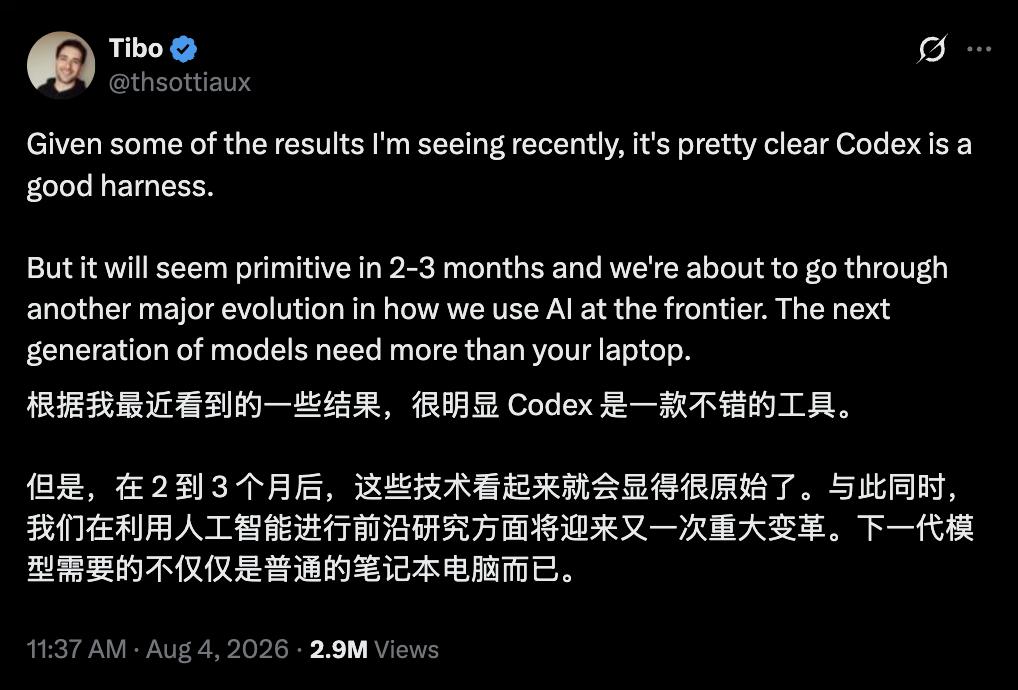
Tibo: There's so much, really so much. Like the voice feature I mentioned earlier. Right now, if you're a power user of Codex or other coding agents, you're kind of used to the clunky experience, right?
You have to manage skill files; that's one way to teach it things, but I think many people also realize that those files are hard to maintain over the long term. Memory is also an issue: it doesn't always remember everything; if you have sub-agents, you have to manage them and build some kind of small network. At every step of the interaction, the illusion that "it's a complete partner" breaks.
All you really want is something that deeply understands you, your goals, your daily routine, and what your team is working on. Ideally, it can also react, take the initiative, help you in your daily life, and never break the illusion that it's the perfect little partner by your side. That's exactly what we're working towards.
Another thing is that when you have very, very powerful models, you'll find that the laptop itself becomes a limitation. The workload a laptop can handle is designed for humans.
It's roughly designed to accommodate the amount of work you can produce, your typing and thinking speed, how many apps you need to open at the same time — all these are human limitations.
Models don't have the same limitations. For example, a model might be able to handle 100 open apps at the same time in the future with no problem at all. Therefore, from the perspective of resource access, it's obvious that future models will need more resources than a single laptop can provide.
Host: You mean, I guess, cloud-based agents? And once we have Ultra Fast which we'll talk about later, the token speed is reportedly 10 to 14 times faster than Fast, then bandwidth constraints will change. CPU will become the new bandwidth; literally, tool calls, network, any tools and any overhead in the tech stack will become limiting factors.
Tibo: But you can also compensate by doing multiple things concurrently. You can explore, write tests, compile, and verify a new hypothesis all at the same time. That keeps shifting the bottleneck position, because you can handle more things concurrently, and the model can think and progress very efficiently and very quickly.
Host: At current token speeds, I find myself spinning up 10 to 15 agents in parallel, which creates quite obvious cognitive load for me: I have to constantly switch contexts, keep launching them, and you expect a task to return results 30 to 45 minutes later.
Now with Ultra Fast, this workflow will change significantly; I don't think I'll need to run 10 or 15 agents at the same time anymore, which is probably a good thing. Maybe I only need