Must-read for telecom practitioners: Latest updates on the global mobile communications market
Some time ago, Ericsson released its latest edition of the *Mobile Market Report*.
In today's article, I will conduct a comprehensive interpretation based on the data from this latest report, hoping to help you quickly understand the current development status and future trends of the global mobile communication market.
█ 5G Subscriber Count Continues to Grow
According to the data from the Report, around 660 million new 5G contracted subscribers were added globally in 2025. As of now (June 2026), the number of 5G contracted subscribers has exceeded 3 billion, and half of the global mobile data traffic is carried by 5G.
By region, North America has the highest 5G penetration rate at 79%, followed by Northeast Asia at 60%, Western Europe at 54%, and Gulf Cooperation Council (GCC) countries at 53%.
It is estimated that by the end of 2031, the number of 5G contracted subscribers will reach 6.4 billion, accounting for two-thirds of the total mobile contracted subscribers.
As contracted subscribers migrate to 5G, the number of 4G contracted subscribers continues to decline. In the first quarter of 2026, the number of 4G contracted subscribers decreased by 77 million, dropping to below 4.6 billion. In the same period, the number of 3G contracted subscribers decreased by 18 million, while the number of 2G contracted subscribers decreased by 23 million. 2G and 3G networks are being phased out at an accelerated pace.
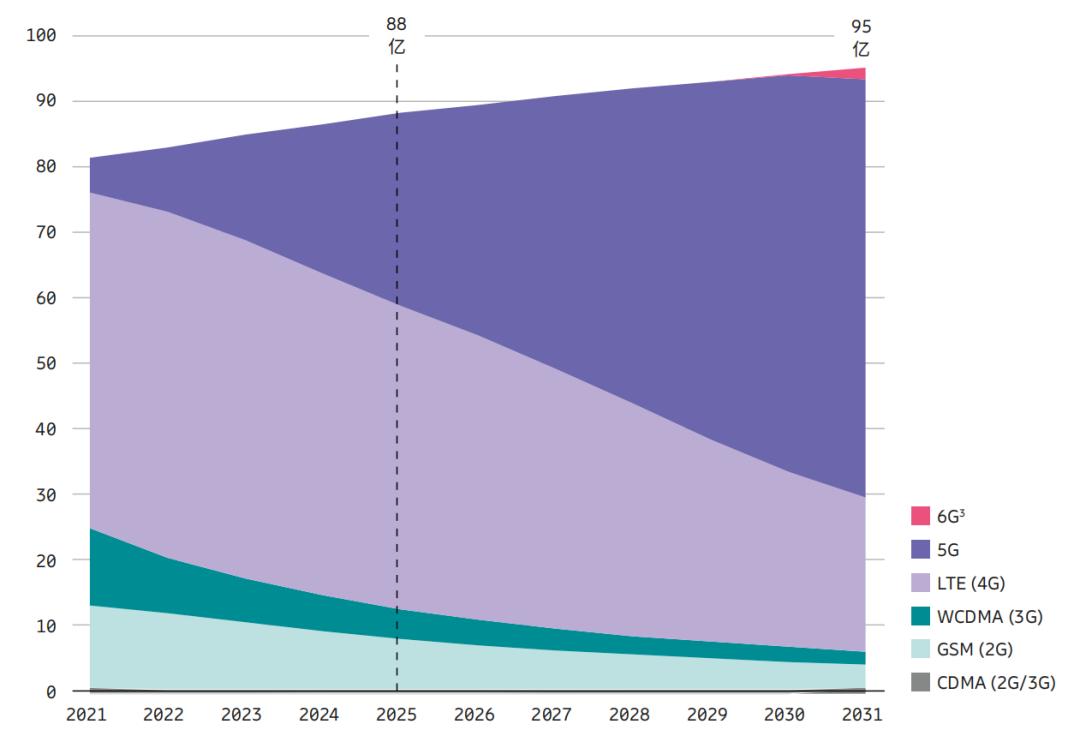
Mobile contracted subscribers by technology (in 100 million)
The Report also conducts specific data analysis for all regions around the world.
In Chinese Mainland, the number of 5G contracted subscribers reached 1.2 billion by the end of 2025, and about 70% of mobile data traffic is carried by 5G networks. In 2025, over 90% of smartphone shipments were 5G terminals, and 5G Advanced has achieved nationwide commercial deployment. At present, around 2 million 5G sites in Chinese Mainland have been upgraded to support the RedCap function, and high-order carrier aggregation (such as 3CC, 2CC) has been activated in more than 300 cities.
In North America, the number of 5G contracted subscribers reached approximately 370 million by the end of 2025, accounting for 79% of the total mobile contracted subscribers. It is expected to increase to around 460 million by 2031, with the 5G subscriber proportion reaching 92% by then.
In Western Europe, the number of 5G contracted subscribers is also growing strongly. It reached around 300 million by 2025, with a penetration rate of about 54%. There is a large disparity in 5G penetration rates among Western European countries. By 2031, the 5G contracted subscriber proportion in Western Europe will reach 95%.
It is worth noting that the global growth forecast for 5G contracted subscribers has declined compared with six months ago, mainly due to the slowdown in the growth of 5G SA subscribers in India, and the slower adoption of 5G SA in Latin America, Eastern Europe and the Middle East.
█ 5G Network Count Increases Slightly
In terms of the number of 5G networks, about 390 operators have launched commercial 5G services at present, of which more than 90 have launched 5G Standalone (SA) services.
For comparison, six months ago, about 360 operators around the world had launched commercial 5G services. In other words, 30 more operators have joined the 5G camp within half a year.
At present, 838 4G networks have been deployed globally, of which 359 have been upgraded to LTE-Advanced. By the end of 2025, the global 4G population coverage outside Chinese Mainland has reached 90%, and it is expected to exceed 95% by 2031. (Indeed, 4G will remain a long-term underlying network.)
The Report points out that by the end of 2025, the global 5G population coverage reached 60%, with about 400 million new people covered by 5G networks throughout the year. In regions outside Chinese Mainland, the 5G coverage rate is expected to rise from 50% in 2025 to about 85% in 2031.
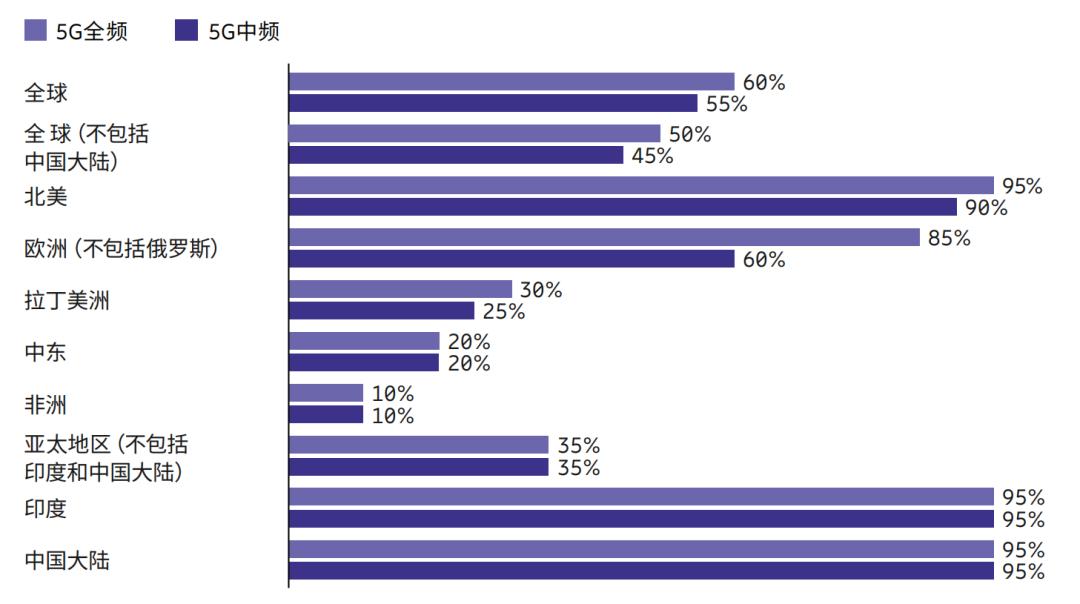
Full-band population coverage and mid-band coverage by region (by the end of 2025)
The 5G population coverage in Chinese Mainland, North America and India is as high as 90-95% at present, directly driving the global 5G coverage rate.
In regions outside Chinese Mainland, half of the world's population is still not covered by 5G networks, and only about 35% of sites have been upgraded to 5G mid-band. This also indicates that opportunities for 5G supplementary coverage and site upgrading continue to exist.
█ Data Traffic Grows Strongly
In the first quarter of 2026, mobile network data traffic continued to maintain strong growth. Over the past year, global mobile network data traffic increased by 22% year-on-year, slightly higher than previous expectations.
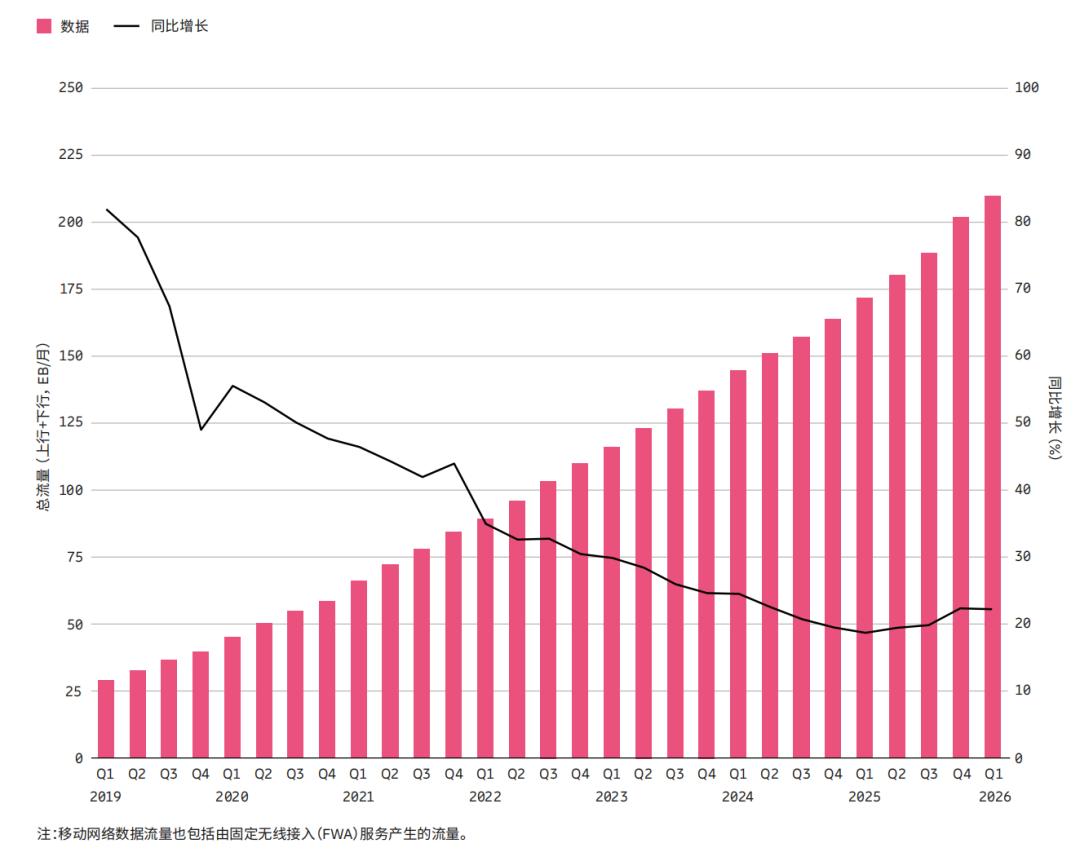
Global mobile network data traffic and year-on-year growth
By the end of 2025, the average monthly mobile data traffic per active mobile phone in the world reached 22GB. At present, the global monthly mobile network data traffic reaches 210EB. The sustained strong growth in markets such as India and North America has brought obvious driving effects.
The growth of mobile data traffic comes from the increase in the number of smartphone contracted subscribers on the one hand, and the improvement of average data usage per subscriber on the other hand. Among them, the growth of video content consumption is the main driving force. By the end of 2025, video traffic accounted for about 75% of the total mobile data traffic.
In 2025, global mobile data traffic and total mobile network data traffic including FWA (Fixed Wireless Access, which converts mobile communication signals such as 5G into indoor wireless or wired local area networks) were both slightly higher than expected, reaching 146EB per month and 203EB per month respectively by the end of the year.
Looking ahead, mobile data traffic will grow 2.2 times by 2031, reaching 328EB per month. In the same period, the total mobile network data traffic including FWA is expected to grow by about 2.5 times, reaching 515EB per month.
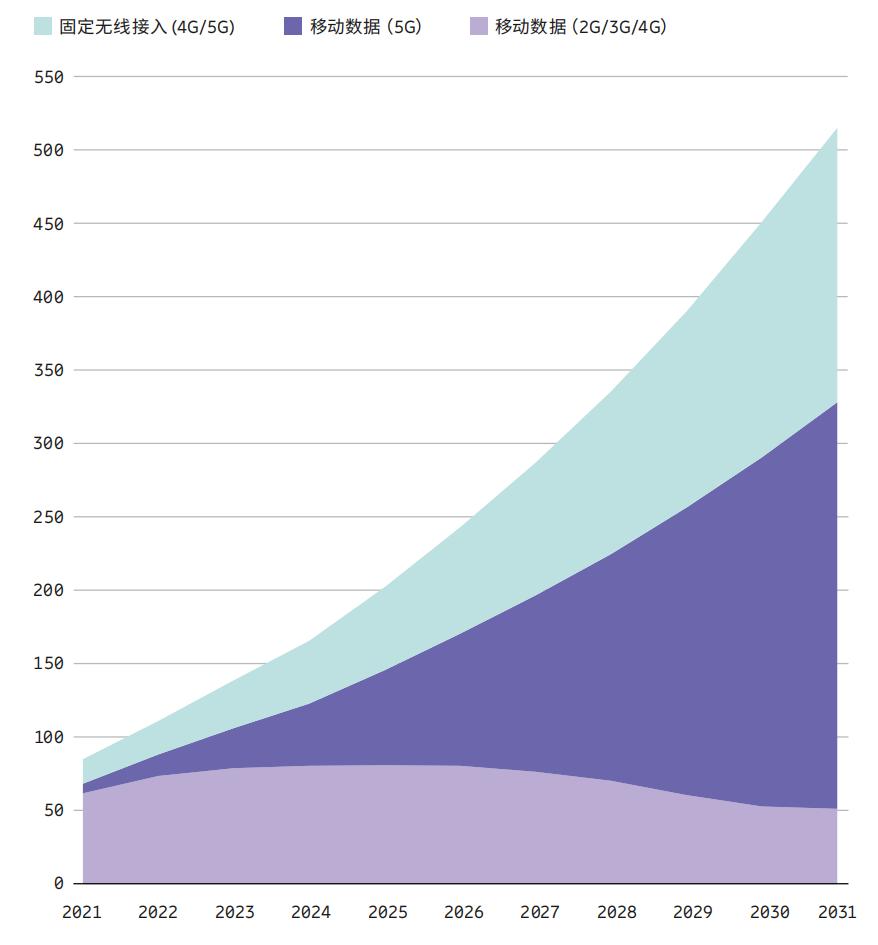
Global mobile network data traffic (EB/month)
It is worth noting that 2025 is the year with the highest annual net increment of mobile network data traffic so far.
In 2025, the proportion of mobile data traffic carried by 5G increased from 34% to 48%, and it is expected to reach 85% by 2031. The total mobile network data traffic is expected to grow by 14% year-on-year by 2031, with a compound annual growth rate of 17% throughout the forecast period.
The Report also points out that traffic growth is not evenly distributed within the network of the same operator. For example, in densely populated urban areas, traffic demand can be up to 1000 times higher than in rural areas. (The disparity is very obvious.)
█ FWA and Satellite See Significant Growth
The Report particularly emphasizes that the combination of optical fiber, FWA and satellite technology will become the key to supporting an increasingly digital world.
Globally, the number of satellite broadband contracted subscribers is expected to increase from about 10 million at the end of 2025 to about 33 million at the end of 2031.
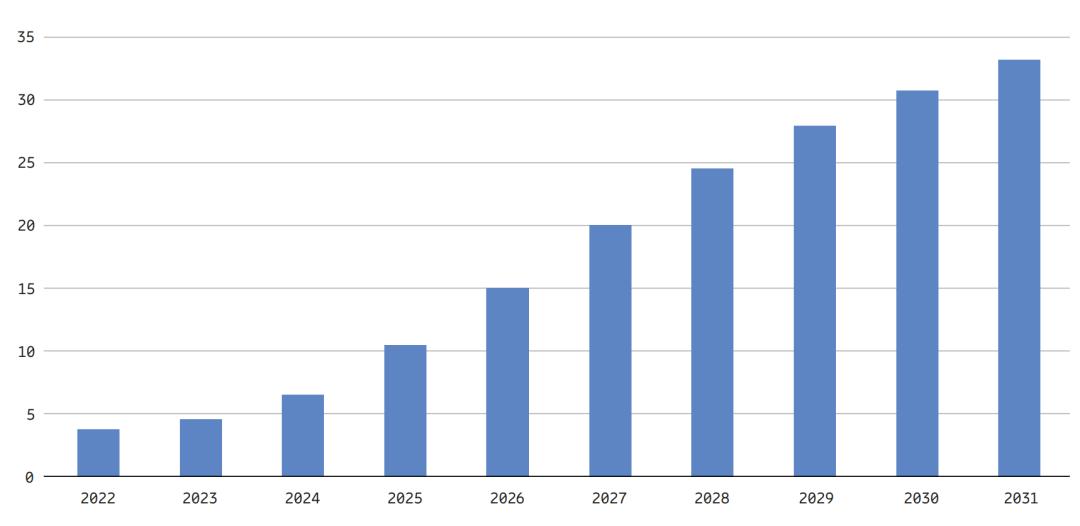
Satellite broadband contracted subscribers (in millions)
Optical fiber broadband is relatively developed in Chinese Mainland, so FWA has not received much attention. In fact, the development of FWA abroad has far exceeded expectations and has become a popular direction.
According to the data, 83% of operators provide FWA services, of which 175 operators provide FWA services through 5G networks, accounting for 71% of all FWA operators.
The global number of FWA connections is expected to grow from 185 million at the end of 2025 to 350 million at the end of 2031, accounting for 17% of the total fixed broadband connections. Among these 350 million connections, nearly 85% are expected to be based on 5G networks.
In the same period, the total number of all types of fixed broadband connections will reach about 2 billion.
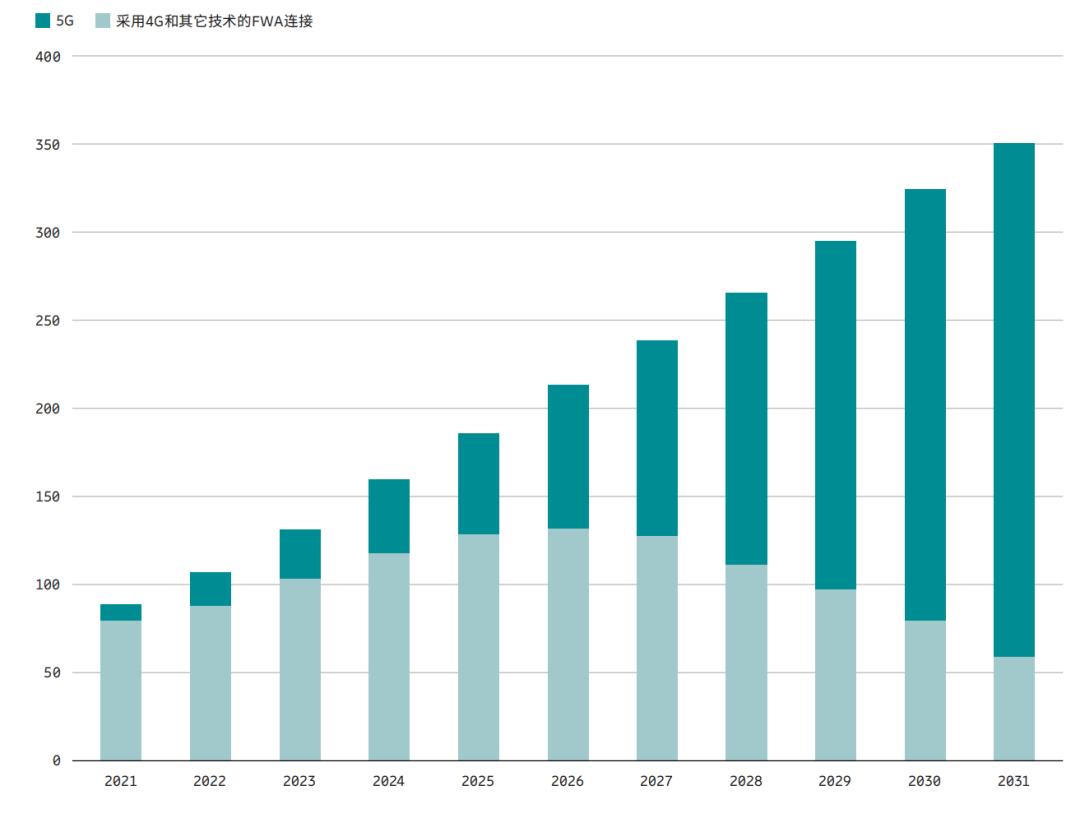
FWA connections (in millions)
█ Internet of Things Advances Steadily
Next, let's look at the data on the Internet of Things.
The Report points out that by the end of 2025, the total number of cellular IoT connections is about 4.5 billion, and the compound annual growth rate (CAGR) is expected to be about 10% by 2031, when the number will approach 8 billion.
By the end of 2025, the number of Broadband and Critical IoT (based on 4G/5G) connections is about 2.6 billion. It is expected that this type of connection will continue to account for the largest share of cellular IoT device connections by 2031.
In terms of the number of cellular IoT connections, Northeast Asia is still in the leading position. By the end of 2025, its connections accounted for about 70% of the global total.
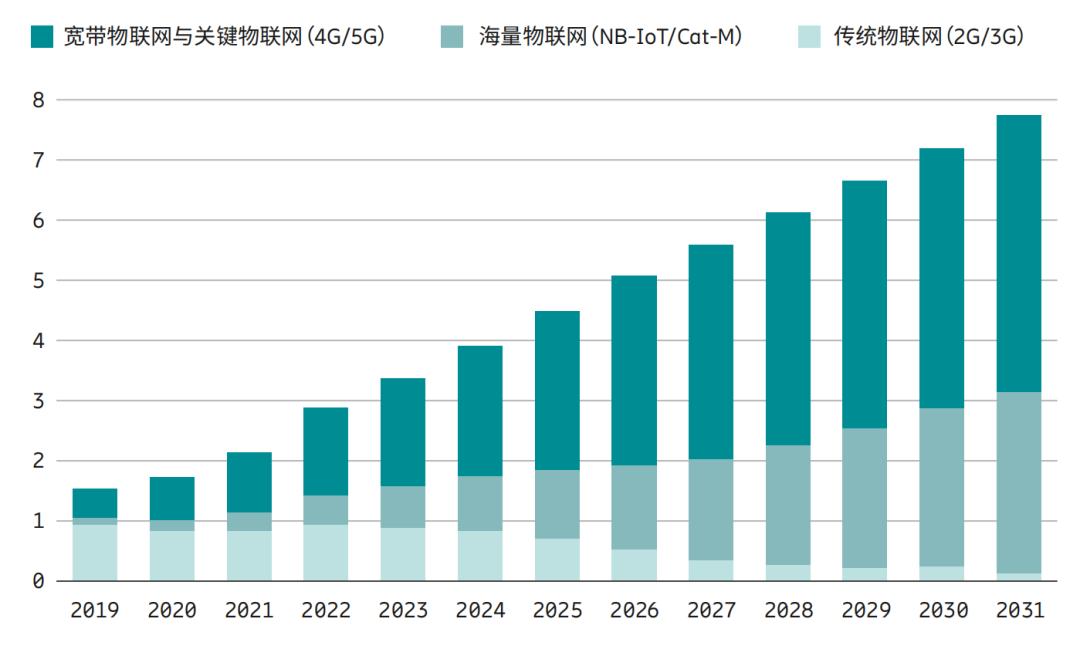
Cellular IoT connections by segment and technology
The Report focuses on the progress of RedCap and its latest enhanced evolution eRedCap.
At present, 14 operators in the global market have launched commercial RedCap services. In addition, 42 operators in 27 countries are investing in the deployment of 5G RedCap technology. Laboratory tests for eRedCap will start this year, and it is expected to enter the full commercial stage in 2028 and beyond.
█ 6G is Fully Launched
The Report also briefly mentions 6G.
Discussions on 6G standardization have already started. AI-native 6G is expected to bring a series of new capabilities, including full support for Integrated Sensing and Communication (ISAC), realization of seamless integration of terrestrial and satellite networks for the space-ground integration to reduce coverage gaps, and significant improvement of energy efficiency.
According to forecasts, 6G is expected to adopt a core network built on the architectural principles of 5G SA, with a brand-new Radio Access Network (RAN) architecture and new air interface. For traditional use cases such as Enhanced Mobile Broadband (eMBB), Fixed Wireless Access (FWA) and Internet of Things (IoT), 6G will greatly improve performance and realize service differentiation through strong guarantees.
The first batch of implementable 6G specifications (standards) is planned to be completed by the end of 2028 or early 2029. The first batch of commercial 6G services is expected to be launched one after another around 2030, with the specific time varying by region and country.
Industry forecasts believe that, like 5G, the United States, China, Japan, South Korea and GCC countries will become the first markets to deploy 6G.
By the end of 2031, the global number of 6G contracted subscribers is expected to reach 180 million. This figure does not include the early subscribers of AI-enabled terminals such as autonomous driving vehicles, smart glasses and drones.
█ Conclusion
The above are the key data provided by the Ericsson Mobile Market Report.
In addition to these data, the Report also makes special comments on the current development trend of the entire mobile communication industry, mainly including the accelerated commercial deployment of differentiated connections, AI-driven uplink traffic growth, mobile connections enabling enterprise AI digital transformation, and so on.
This article is from the WeChat public account "Fresh Date Class" (ID: xzclass