Tencent is frantically cramming to finish its overdue "assignments".
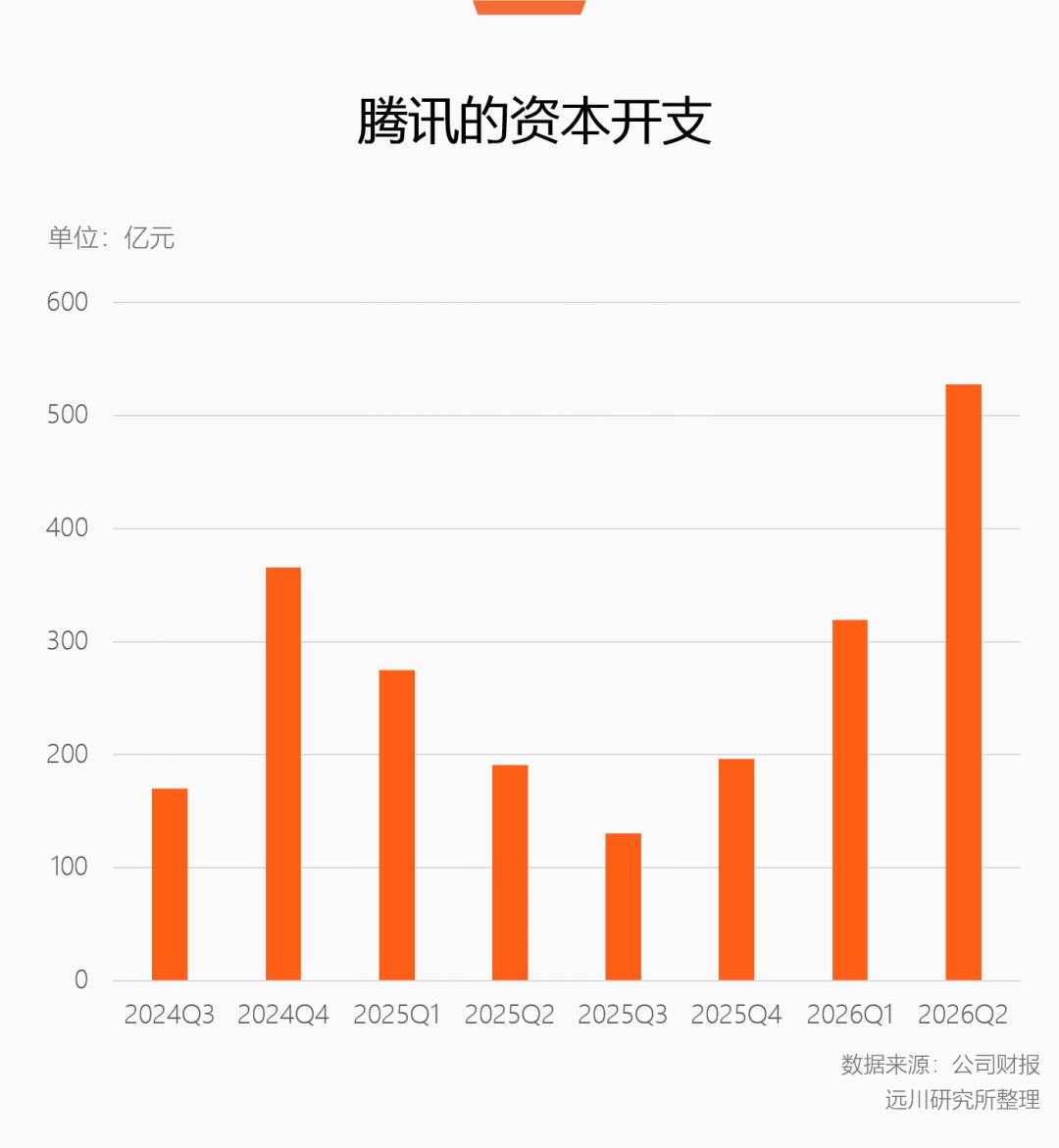
After Tencent released its Q2 financial report, the market did not respond positively, and the core reason lies in the persistently high capital expenditure.
Capital expenditure refers to the funds that enterprises spend on purchasing high-value fixed assets. For Tencent specifically, it covers the cost of purchasing computing power chips and building data centers, and it is also a key indicator to measure the intensity of an enterprise's investment in AI.
In the second quarter of this year, Tencent's capital expenditure surged 176% year-on-year and increased by 65% quarter-on-quarter.
Throughout the first half of the year, the market's doubts about Tencent all centered on the fact that it spent too little. At the Q1 earnings call, a UBS analyst raised a pointed question:
We observe global peers, who have invested 80% or even 100% of their operating cash flow in AI-related capital expenditures; in contrast, Tencent only invested about 35% in the previous quarter.
The gist of the question is that other enterprises are spending almost all their revenue on purchasing computing power, but Tencent only allocates 30% of its funds to this area — are you really sincere about AI development? We just want a clear attitude from you.
Therefore, in the second quarter, Tencent showed its sincerity, shifting from saving money for wealth management to making heavy investments. Its book capital expenditure reached 59.3 billion yuan, plus a 51.4 billion yuan prepayment for AI computing power procurement. The sum of the two items exceeded 100 billion yuan, far exceeding market expectations.
Since the 51.4 billion yuan is a prepayment and the purchased chips have not been delivered yet, it cannot be included in basic expenditures. But the money has already been paid out, which needs to be recorded in the change of free cash flow, resulting in Tencent's free cash flow hitting -13.8 billion yuan, shocking investment institutions.
After all, the last time Tencent's cash flow turned negative was 20 years ago. Therefore, Tencent specifically noted in its financial report that if the prepayment is excluded, its free cash flow would be 37.6 billion yuan, which remains at a healthy level.
The market obviously did not take Tencent's explanation on board, worrying that aggressive investment will erode profits and cash flow.
It is you who accused Tencent of not spending enough, and it is also you who accused Tencent of spending too much. On behalf of Martin Lau, I would like to ask: Is everything I do wrong?
Betting heavily on the future
Seeing Tencent's situation, Google on the other side of the Pacific must have a strong sense of resonance.
Google's Q2 earnings report was very strong, but a single sentence from the management at the earnings call that "capital expenditure will increase significantly in 2027" immediately crashed its stock price. Capital markets in capitalist countries move extremely fast, and they cannot even wait until the next day.
The market predicts that Google's capital expenditure in 2027 will reach 350 billion U.S. dollars, which means that Google will not only spend all the revenue it receives, but also borrow additional funds to invest in AI infrastructure.
In June this year, Google borrowed 80 billion U.S. dollars in one go, which was more decisive than small countries issuing national debt.
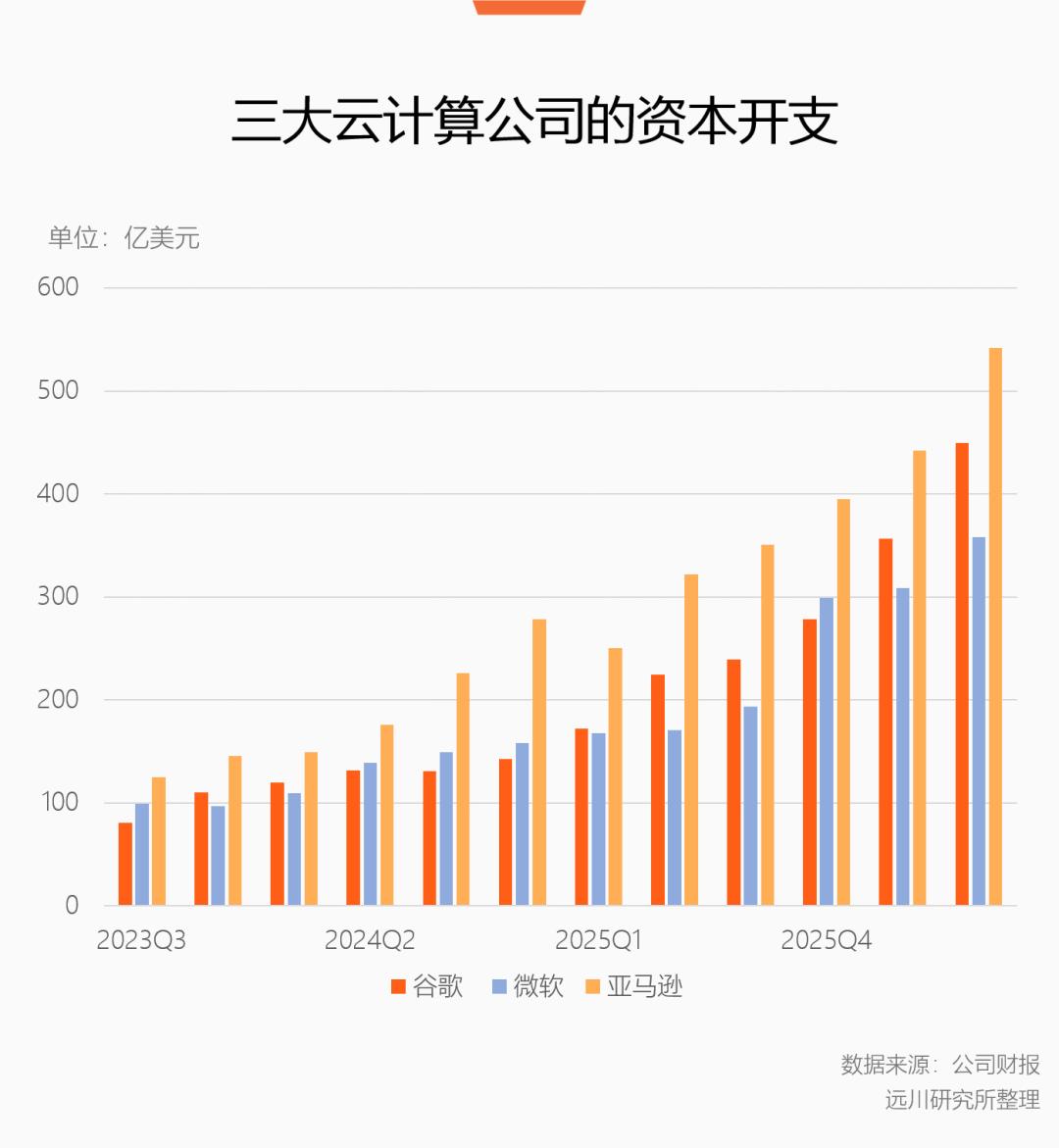
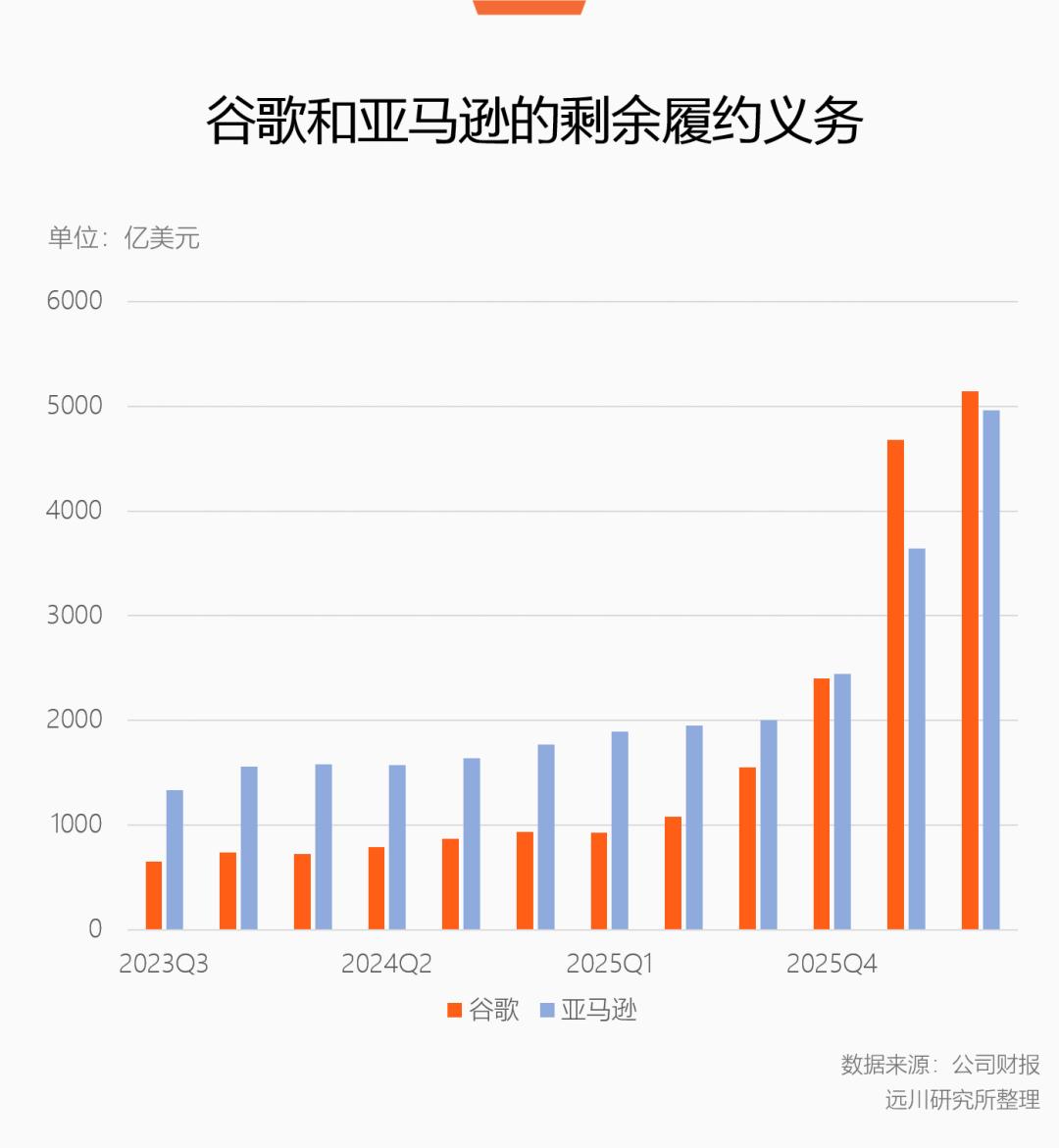
Google is not leveraging blindly. As of the second quarter, the remaining performance obligations on Google's books exceeded 500 billion U.S. dollars.
The so-called remaining performance obligations refer to the unfulfilled orders of cloud computing companies. Once the computing power is built, it can be delivered to customers, and all the money spent can be converted into future revenue. In other words, cash flow records when the money is spent, while remaining performance obligations record when the money will be received.
The growth rate of remaining performance obligations of major Silicon Valley giants far outpaces the growth rate of capital expenditures. Therefore, Microsoft, Amazon, and META are all claiming that computing power is in short supply, while sharply increasing their capital expenditures.
However, the attitude of the capital market has undergone tremendous changes.
In the first half of this year, everyone was telling growth stories, and the market was chasing capital expenditure — the more money you burned, the higher your stock price rose. In the words of "Big Short" Michael Burry: As long as you announce an additional 1 U.S. dollar in capital expenditure on AI, your market value will increase by 3 U.S. dollars.
In the second half of the year, investment institutions have taken out their abacuses to calculate returns one after another. After all, although the money spent on buying chips and building computing power affects free cash flow, the costs are hidden in construction in progress and will not immediately affect profits, which can be ignored temporarily under accounting rules.
Once the data center is delivered and starts to generate depreciation, you will immediately realize the old adage that what goes around comes around. Whether the company's AI business can generate sufficient incremental revenue to cover the huge depreciation cost at that time is the top concern of the capital market.
On this issue, Google and other companies are facing two completely different situations.
Microsoft and Amazon are pure cloud computing companies that do not invest much in self-developed models and chips. The built computing power can be immediately leased to large model companies such as OpenAI and Anthropic.
At present, computing power is in short supply, so there is no lack of customers once the data center is completed. In the second quarter, Amazon's AWS grew by 37% with a record-high profit margin, while Microsoft Azure's year-on-year growth rate reached 43% with healthier cash flow. As a result, both companies were rewarded by the market.
Google's situation is different. Google adopts a full-stack strategy for AI: it not only provides external cloud services, but also maintains its own Gemini model and TPU chips, with every business line expanded on a large scale, resulting in far more spending areas than its peers.
However, the progress of Google's Gemini model is unsatisfactory. The long-rumored Gemini 4, which was supposed to be a game-changer, has been stuck in development, and the launch of Gemini 3.5 Pro has been repeatedly delayed. Meanwhile, the revenue of OpenAI and Anthropic on the other side is rising steadily, making people see no hope for Google's AI business.
In other words, Microsoft and Amazon have more certain revenue, which is equivalent to investing money in wealth management products; while Google spends most of its money opening restaurants, and it is uncertain whether it can make a profit. Its current state is very close to the situation of the catering industry described as hard to make profits.
The problem Tencent is facing is exactly the same.
Making quick money or making big money
Like Google, Tencent is in a stage of "catching up on overdue homework".
Tencent's hesitation in AI investment is well known. At this year's shareholders' meeting, Pony Ma set the tone with his "leaky ship theory": A year ago, we thought we had boarded the ship, but later found that the ship was leaking. Now we feel that we are standing on it, but cannot sit still, and we still hope the ship can speed up.
Strictly speaking, Tencent is not too late to make efforts in AI infrastructure, and it is often on various unofficial GPU procurement lists. In 2024, Tencent bought 230,000 H20 chips from NVIDIA in one go, and its financial strength is no less than ByteDance.
However, Tencent started its large model business far too late.
In 2023, Pony Ma emphasized that artificial intelligence is an industrial revolution, but at the same time put forward the "light bulb theory": For an industrial revolution, it is not important to launch the light bulb one month earlier. This led to its large model business falling behind for more than a year at the starting line.
Facts have proved that continuous investment is required for large models to stay at the cutting edge. Tencent has diversified businesses and complex products, and cannot rely on third-party models for a long time. Therefore, Tencent recruited Yao Shunyu to restructure its AI organizational structure, aiming to make up for the arrears in self-developed models.
However, large models are not magic pills that can produce results simply by pouring money. Nowadays, investment in large models is getting larger and larger, while the first-mover advantage period is getting shorter and shorter. The capital market also has doubts about its business model:
Can the money invested be converted into profits? If the product competitiveness is insufficient, tens of billions of expenditures can only win a heavy trophy of "the best customer of NVIDIA".
At the same time, computing power prices continue to rise. According to quotations from new cloud companies, the price increase of NVIDIA B200 is not unexpected, but the prices of H200 and H100 also began to soar in August. Even the A100 released in 2020 has seen a resurgence, with its growth rate accelerating. The overall computing power price is on the rise.
Like Google, Tencent also provides external cloud services. Leasing computing power to others has more certain revenue and can also enjoy high profits brought by tight supply and demand. Tencent also needs to answer the question: should it lease out computing power to make quick money, or use it by itself to bet on the future?
At the Q2 earnings call, analysts directly raised this question: Referring to the strategic shift of US peers in the Hyperscaler business, when will Tencent shift its capital expenditure to the cloud business with higher ROI?
Hyperscalers refer to super-large-scale computing power companies. In July this year, Meta announced that it would lease computing power externally. The reason is that it has built a lot of data centers but cannot develop competitive large models. Since the computing power is left idle anyway, it is better to lease it out to make money.
The capital market naturally fully supports this kind of sure-fire business, and Meta's stock price rose by 10% on the same day.
But the answer from Tencent's executive James Mitchell is Model > Application > Leasing, which means that computing power is prioritized to supply its own business, and it will tilt resources to the cloud business only after the computing power reserve is sufficient at the end of the year or even next year.
The Bernstein analyst asked more directly: Can the incremental revenue generated by Tencent's annualized capital expenditure of more than 200 billion yuan cover the depreciation cost?
James Mitchell said "I know what you want to ask", and he said that if Tencent leases out the purchased computing power immediately, the return will be very considerable. Martin Lau also added that reselling the computing power can generate a 30% profit, which is more profitable than real estate speculation in the past.
But Tencent believes that the market for Hunyuan large model and AI applications is larger, and the return is more long-term.
Products like WorkBuddy currently have limited room for differentiation, but the data generated in employees' real work scenarios is a very high-quality data set that can directly feed back model training.
In general, Tencent, like Google, chooses to continue to catch up on overdue homework in large models and AI business to prove itself.
After all, since Yao Shunyu has been recruited, he cannot be arranged to do data center operation and maintenance work, right?
Don't go away, investors
Tencent fully understands the anxiety of the capital market, and has added multiple layers of reassurance in its financial report and earnings call:
First, all investments have pre-planned return paths. The gross profit margin of WorkBuddy paying users and MaaS business is on a par with the cloud business, which is only currently diluted by free users. As the model capability improves, WorkBuddy will be able to handle high-value tasks, and the return will be higher.
Second, capital expenditure remains disciplined. According to Martin Lau's explanation, since Tencent is half a beat behind its peers, there will be one-off high investment in 2026–2027. In the long run, there is a clear internal budget boundary, and investment will only be increased when there are obvious growth opportunities for products.
Third, external leasing is a safety cushion. This means that even if the return of AI applications falls short of expectations, idle computing power can be leased out for monetization.
In short, the market is responsible for urging the completion of homework, Tencent is responsible for catching up on homework, Yao Shunyu is responsible for writing homework, and shareholders have to wait for the homework to be handed in before deciding whether to cheer or sell off their shares.
Martin Lau provided a framework on site, suggesting that institutions regard Tencent as two parts:
One part is the existing mature business, whose growth and cash flow remain stable, and the other part is the "built from scratch" AI-native business, which is still in the investment period and will not contribute profits immediately, and profit release will not start until after 2027.
The primary goal at present is still to build the AI-native business.
Around this goal, Tencent has carried out a series of organizational adjustments: first, it revoked AI Lab, and the QClaw team was merged into the 6th Cloud Product Department where WorkBuddy is located. Later, it established the Basic Model Department, with Yao Shunyu taking full charge of the development of Hunyuan large model.
Therefore, Tencent's organizational structure is already very close to the pattern of "mature business + Hunyuan".
Not only Tencent, all major tech giants have been doing the same thing recently: splitting the group structure into mature business + AI business, integrating scattered small teams in the AI business into a large research department + a large product department.
After the release of Doubao 2.0, ByteDance merged the Feishu product team and the Doubao product team. Feishu, TRAE, and Coze were integrated into Doubao, and Doubao and Volcano Engine are closely connected, making the group structure "Douyin + Doubao".
Not to mention Alibaba, all AI-related departments have been packaged into the Token Foundry Division, which is personally led by Alibaba Group CEO Wu Yongming. DingTalk, QoderWork, and MuleRun were merged into Tongyi Office, and the entire Alibaba is equivalent to "Taobao & Tmall + Tongyi".
Mature business is responsible for delivering ammunition, and new business is responsible for laying the foundation for the future. Those once-dominant tech giants, in front of artificial intelligence, finally show the appearance of middle-aged people:
With the old to support and the young to raise, they hold all their life savings in their hands, and dare not spend every cent randomly.
References
[1] History repeats surprisingly? Big Short Burry warns: US stocks will fall into a "2000-style bear market", the AI bubble will burst within two years, Wall Street CN
[2] Tencent financial report and earnings call, Tencent
[3] Financial reports of Google, Microsoft and Amazon, respective companies