Outside the ByteDance ecosystem, RunningHub breaks through the tight encirclement: top-tier AI models are vying for the "first launch stronghold".
The model release process has long evolved into a precise industrial assembly line amid intensive iterations: kick off with a technical report, dominate Benchmark rankings, then open APIs, and finally wrap up with open-source weights.
Yet large models have always changed at an extremely fast pace. In the current era of intensified competition in video and multimodal models, relying solely on these four conventional steps can hardly win over the market anymore. In the second half of the model competition, an invisible indicator is catching more and more attention: can the model truly become a production tool that creators can pick up and use for work right away?
The problem is that there are extremely tedious engineering tuning and workflow building between the base Model and actual Productivity. It is very difficult for manufacturers to translate model capabilities into solutions for specific scenarios quickly on their own.
The release of several top models recently has already reflected this change.
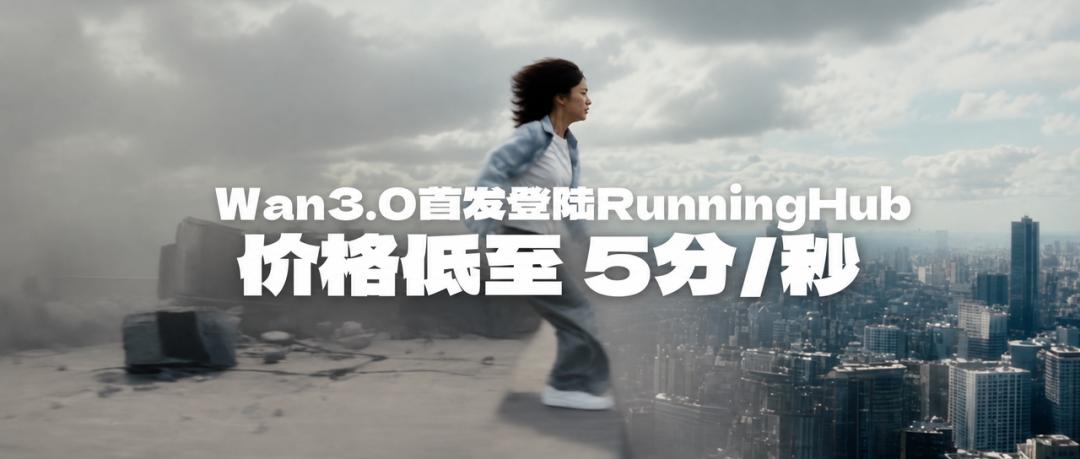
When WAN 3.0 opened for internal beta testing, RunningHub became one of the first launch platforms and obtained internal beta permissions at the magnitude of 100 concurrent sessions. After the model went online, RunningHub further lowered the membership calling price to a minimum of 0.05 yuan/second for 480P and 0.1 yuan/second for 720P. According to the horizontal comparison data provided by RunningHub, this is already in the lowest price range among similar platforms.
After MiniMax H3 was open-sourced, RunningHub also completed the adaptation rapidly. Subsequently, thousands of creators open-sourced nearly 10000 creative generation workflows based on H3, covering multiple fields such as e-commerce, short drama, comic drama, and voice cloning.
For the upcoming Seedance 2.5 1080P, RunningHub will also be one of the first batch of launch platforms, with the minimum membership price of 0.21 yuan/second for 480p.
From WAN 3.0 to MiniMax H3, and then to Seedance 2.5, RunningHub strives for first-release speed and professional creators on one hand, and lowers the usage threshold of models through low prices on the other hand.
Top AI models are collectively competing for the "first launch position". Why is RunningHub able to secure the first launch rights of top SOTA models such as WAN 3.0 and MiniMax H3?
01. Model release is not the end, there are more thresholds afterwards
It is no accident that top models including WAN 3.0 and MiniMax H3 have successively chosen RunningHub as their first launch position.
After all, with the sharp increase in the number of large models and the iteration cycle being compressed infinitely, model release itself is far from the end. A model can achieve excellent results on Benchmark, and gain a lot of attention through media and KOL promotion on the release day, but high attention does not naturally equal high retention and high calling volume.
After the novelty of the launch event fades, model manufacturers have to face a more realistic problem: how to get the model to creators at the fastest speed, integrate it into the real production pipeline, and finally convert it into continuous Token calls and commercial value?
This is also the concern of a large number of creators. There is still a huge gap between a model that can be called and a model that is truly usable, and it is difficult for creators to solve all these problems effectively by their own efforts.
Especially in multimodal creation such as video and image, in the early stage of new model launch, deployment configuration, parameter adjustment, node connection and workflow adaptation all require certain technical capabilities. More importantly, real content production rarely relies on a single model. A short drama, e-commerce advertisement or comic drama may involve text-to-image, image-to-video, digital human, voice cloning and post-processing at the same time. Creators need to select different models and combine them into the same production process. A model with strong enough performance is often just one piece of the puzzle.
APIs make models callable, but that does not mean creators can start working with the model the day they get it. From model launch to actual production, it is still necessary to complete model adaptation, workflow construction and application scenario exploration. This also changes the role of model release platforms: in addition to bringing the first wave of exposure, they also need to find the first batch of professional creators, let them test the model's limits, develop gameplay, build workflows, and then spread the mature methods to more users.
The first launch stage also faces another test. After a new model is released, it often encounters instantaneous concentrated calls. Without stable computing power, concurrent bearing capacity and rapid engineering adaptation, no matter how high the popularity is, it is difficult to convert it into real usage.
Therefore, as basic models become more and more abundant, new value links begin to emerge in the industrial chain, that is, converting model capabilities into productivity.
For model manufacturers, a good first-launch platform should not only handle the concentrated calls after the new model goes online, but also enable the first batch of professional creators to use the model quickly. RunningHub is trying to occupy exactly this position.
This is also why models such as WAN 3.0 and MiniMax H3 have successively chosen RunningHub.
02. Starting from AIGC, the iteration path of RunningHub
Some far-sighted companies have already seen this new trend. Therefore, we can see that there are already many heavyweight players in the market working to narrow the distance between models and creators. For example, one-stop creation products under large manufacturers such as Jimeng AI and Keling AI, AIGC model and creator communities such as Liblib AI, as well as Comfy Cloud officially launched by Comfy UI, all of which are striving to bring models to a wider range of creators.
Surrounded by these giants with huge traffic, capital or ecological background, why is RunningHub able to secure the first launch rights of top SOTA models such as WAN 3.0 and MiniMax H3?
The answer lies in the context of its product evolution: in the past two years of the AIGC wave, RunningHub has keenly and successively seized two key paradigm shifts in the industry.
The first one happened in the early stage of AIGC development.
When Stable Diffusion and Comfy UI just entered the professional creation field, model deployment, node combination, parameter adjustment and workflow construction all had very high technical thresholds. The first group of people to enter this industry were not the ordinary users who use AI image generation and AI video extensively today, but a group of geek-style creators who are closer to developers.
Relying on the underlying computing power and the Comfy UI cloud capability formed earlier, RunningHub reduces the thresholds of local deployment and computing power, while retaining a sufficiently high degree of creation freedom. Creators can freely combine nodes, debug models, and share the workflows they built with others.
When AIGC had not yet become a mass tool, a group of professional users who were willing to study models, debug nodes, and even share workflows "for passion" gathered on RunningHub.
RunningHub just seized this group of top players who know best about AI creation. What they built seems to be an exchange community, but in essence it is an extremely fast productization mechanism: by quickly testing model boundaries, matching commercial scenarios, and assembling multi-model nodes, they naturally precipitate the abstract underlying capabilities into workflows that ordinary people can use directly.

Upload one product image + one model image, and you can easily realize clothing replacement
At present, RunningHub has accumulated more than 13000 workflow nodes, more than 100000 models, more than 80000 workflows and more than 100000 AI applications, and has become one of the largest Comfy UI platforms in China.
But if the story of RunningHub stopped here, it would at most be a sufficiently professional geek community.
What really widens the gap is the subsequent technological evolution: the sharp drop in the threshold of AI application development has allowed this group of advanced players who build workflows to transform into application developers, and the focus of the AIGC industry has shifted to real content production. Compared with generating a few images for model testing, in high-frequency commercial scenarios such as short drama, comic drama, film and television, e-commerce and advertising, the fundamental purpose of creators calling models is to continuously produce dozens of shots, a full episode of comic drama or a large number of e-commerce materials.
Accordingly, the model calls on RunningHub have begun to bear completely different commercial meanings.
To this end, how to help creators schedule multiple models, manage materials and organize different generation links in one environment has become the evolution direction of RunningHub.
RunningHub launched agent-based products such as rhTV infinite canvas and 3D director console in response to the trend, completing the product evolution: Comfy UI solves the problem of "how to call models", workflows solve the problem of "how to organize multimodal capabilities", and agent products directly solve the problem of "how to complete a complete creation task".

The Immortal in the Northeast
Creator "Miemie is a mystery" spent 4 months alone, with the help of the computing power and creation tools of rhTV under RunningHub, to complete a 113-minute AI feature film *The Immortal in the Northeast*. According to public data from Bilibili, the film got 3.55 million views in one week after going online on Bilibili, and was selected into the "Weekly Must-Watch" list.
The improvement of productivity is not only reflected in the fact that creators can produce content of longer duration. The series of short dramas *My Real 2D Paper Man Hero* produced by creator "Orange Peel" combines real 3D scenes with 2D style characters, and has accumulated more than 10 million views on Douyin and Xiaohongshu. For AI creators, this kind of content means that the model can already achieve character consistency, visual style and continuous production between a large number of shots, which was the biggest bottleneck for the large-scale commercialization of AI video in the past.

My Real 2D Paper Man Hero
What can further illustrate the change is that a group of creators have begun to use RunningHub as a daily production tool. "Langge Comic Studio", which focuses on the "Shanghai Animation Film Studio" style, has continuously produced AI animations such as *Fengshen* and *The Record of Nine Nether Judgment*, with the total views of the account exceeding 100 million across all platforms, and uses rhTV for daily content production.

"Shanghai Animation Film Studio" style
At present, multiple AI short drama cases with over 100 million total views across platforms and top-ranked AI film and television short videos on Bilibili have emerged on RunningHub.
These cases are showing that AI creation is moving from occasional demos to more intensive content production. In this process, the value of RunningHub has further extended from making it easier for creators to try models to undertaking real content production.
03. Large-scale production by creators becomes the barrier of the platform
However, gathering a group of people who know best about models can only explain why RunningHub can take the lead in discovering the value of new models, but cannot explain why model manufacturers are willing to give the first launch right to it.
For model companies, community activity ultimately needs to be transformed into more realistic results, such as whether it can be broken down into a large number of reusable workflows, integrated into real content production, and further form continuous and large-scale calls. That is to say, on the basis of having a large number of creators, the platform needs to convert the exploration ability of creators into a set of large-scale production capabilities.
The huge popularity of MiniMax H3 is the most direct example of RunningHub completing this transformation.
As an open-source model with 60B parameters, the weight file of H3 under BF16 precision occupies about 120GB of video memory, which far exceeds the bearing limit of most consumer-grade GPUs. For most creators, the hardware wall of local deployment alone is enough to keep them out.
RunningHub completed in-depth engineering adaptation at the first time when H3 went online, cloudified it, and open-sourced the relevant Comfy UI nodes and complete workflows. Only 10 days after launch, nearly 10000 workflows and AI applications based on H3 emerged on the platform, covering all scenarios such as text-to-video, digital human, automatic short drama generation, and game assets.
A 60B large underlying model with extremely high deployment threshold was quickly deconstructed in this extremely dense geek community into tens of thousands of tools that can immediately improve production efficiency right now.
But this is only half of the story. When content production truly moves towards large scale, the final competition will definitely test the infrastructure.
If a platform only has a small number of players doing experiments every day, no matter how good the community atmosphere is, it is difficult to generate large-scale model consumption. Only when content begins to explode in batches, computing power, concurrency and engineering stability become the key factors that determine the vitality of the model.
This is precisely another irreplicable barrier of RunningHub. Relying on the Haima Cloud GPU computing power platform behind it, RunningHub can not only realize T+0 level rapid adaptation and inference acceleration for cutting-edge open-source models, but also stably access the world's top closed-source models through APIs.
It provides dual values for model manufacturers: high-density professional creators and large-scale engineering bearing capacity — the former is responsible for testing out the gameplay at the first time, and the latter ensures that these gameplays can be seamlessly converted into continuous, high-concurrency real Token consumption.
More importantly, this production capability is accelerating to penetrate from C-end creators to B-end enterprises. Through enterprise-level API capabilities such as hot deployment and elastic high concurrency, RunningHub has served thousands of enterprises, supporting tens of millions of real calls per day on average.
So far, two mutually reinforcing production demands have emerged inside RunningHub: on one side, professional creators constantly test the model boundaries and precipitate workflows; on the other side, enterprises embed mature model capabilities into their businesses through APIs to form large-scale calls.
Why RunningHub? The answer is clear at this moment.
RunningHub enjoyed the talent dividend of the AIGC creator outbreak in the early stage, gathering a group of people who know best about models across the network; but what really turns this advantage into a long-term barrier is that it subsequently seized the productivity dividend of AIGC moving from experiment to industry.
For top manufacturers such as WAN 3.0 and MiniMax H3, RunningHub is by no means a showcase that only displays demo effects. When a new model arrives here, it can quickly undergo limit testing by professional users, be deconstructed into standardized workflows, integrate into real commercial content production, and finally be transformed into huge and stable ecological large-scale calls.
The paths that were completed separately in different links in the past have begun to be compressed into the same platform.