Over 93.5 billion yuan of financing has been secured in half a year, and the robotics industry has ushered in the "8-hour working system"
In 2026, the embodied intelligence industry has quietly crossed its watershed.
At the just-concluded 2026 World Robot Conference (WRC), robots are still carrying boxes, making coffee, folding clothes, and sorting items, seemingly showing little change from the demonstrations at last year's conference, but industry insiders have sensed a completely different "water temperature" in the sector.
"This year, the total shipment of robots of all sizes in the market is expected to reach a scale of around 70,000 units," Liu Dong, founder of Xingyuan Intelligence, told *China Entrepreneur*.
Changes are not limited to volume. The judgment put forward by Yang Haibo, co-founder of Guanglun Intelligence, at the beginning of the year is coming true: "2026 is the first year of large-scale data for embodied intelligence, and also a turning point for the industry to shift from demo performances to industrial implementation."
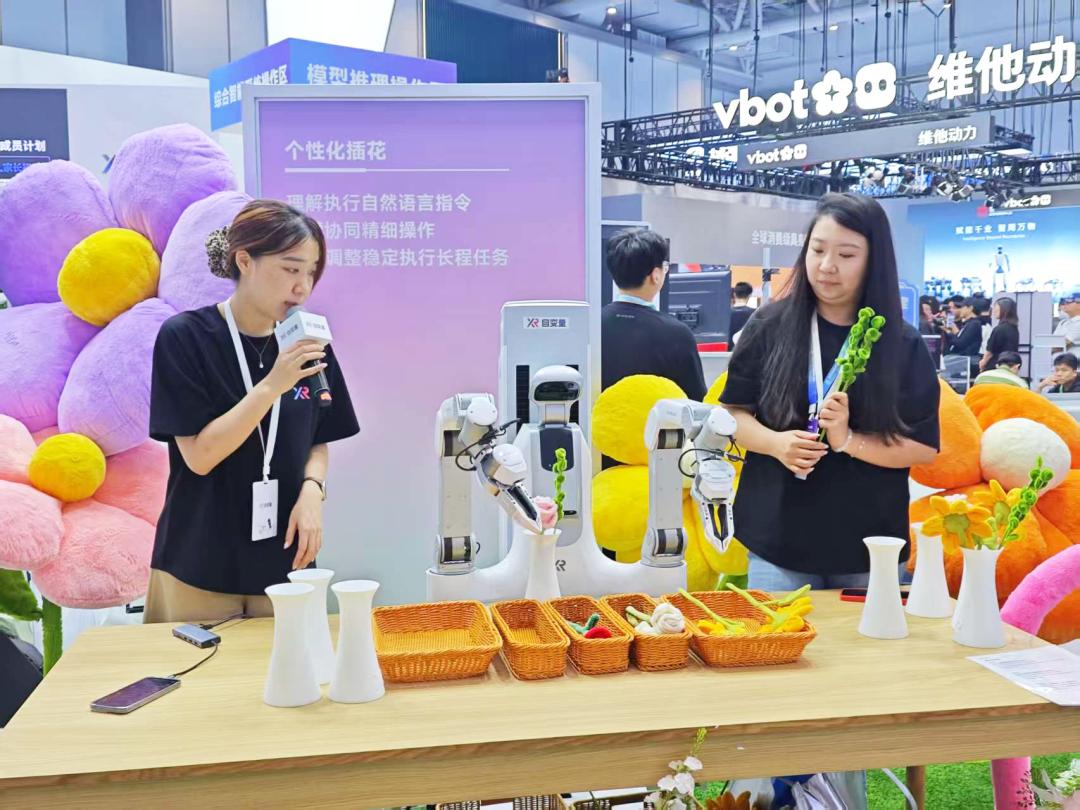
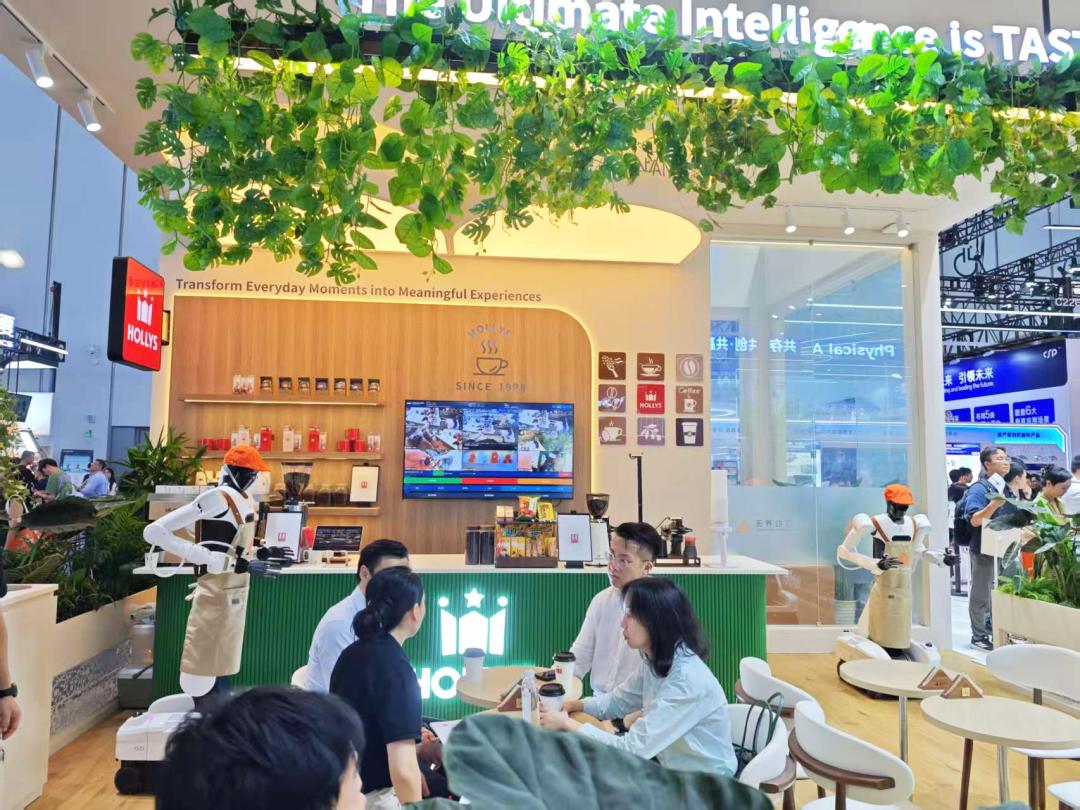
On the exhibition booths of 2026 WRC, what various ontology or model manufacturers display is no longer just demos, but most are achievements of real orders or POC (Proof of Concept): Wujian Power moved its "human-robot symbiosis" space cooperated with South Korean coffee brand HOLLYS to the scene; Xinghaitu made a 1:1 replica of the robot front warehouse cooperated with JD.com; Ziliangji allowed robots to fold clothes, pick up takeaways, water flowers and shovel cat litter on site...
Photography: Kong Yuexin
In addition, logistics sorting, unmanned retail, factory handling and picking are the most crowded scenarios this year. Almost every company involved in robot brain technology will display at least one or two implementable or already implemented cases.
Industry consensus is taking shape. Liu Dong believes that the industry is shifting from the R&D stage to the deployment stage, which means deploying robots in real environments to replace humans in doing real work.
Xi Yue, co-founder of Xingdong Epoch, holds a similar view. In his opinion, the cooperation between robot companies in the current industry and various customers or vertical scenarios is real, and these customers come from automotive, 3C, logistics, retail and other industries. In 2025, when these large industrial manufacturers or traditional enterprises cooperated with robot companies to verify POC and collect data, they almost "did not count the cost". In 2026, customers began to carefully calculate ROI, which is particularly obvious in logistics scenarios. Industrial scenarios also have clear hard requirements for efficiency and stability, which is completely different from the past when only demos were produced.
Although the ultimate goal of all companies is still to enter household scenarios, in the view of most industry insiders, that will not come true until at least 5 years later. What needs to be done at this stage, is to find implementable scenarios, train generalization capabilities in real work, and prepare for the final destination of the industry.
"8-hour Working System"
"2025 is the first year of mass production of humanoid robots, and 2026 is the first year of mass production of operational intelligence," Zhang Yufeng, founder and CEO of Wujian Power, said in an interview.
The intuitive manifestation of this change is that the robots exhibited at WRC can work continuously for a longer time and complete longer process tasks autonomously. Many enterprises said that their robots can currently work stably for 6 to 8 hours with sufficient power. The working duration has extended from "one hour" to "a whole day", behind which is the systematic improvement of model capabilities, data scale and hardware stability.
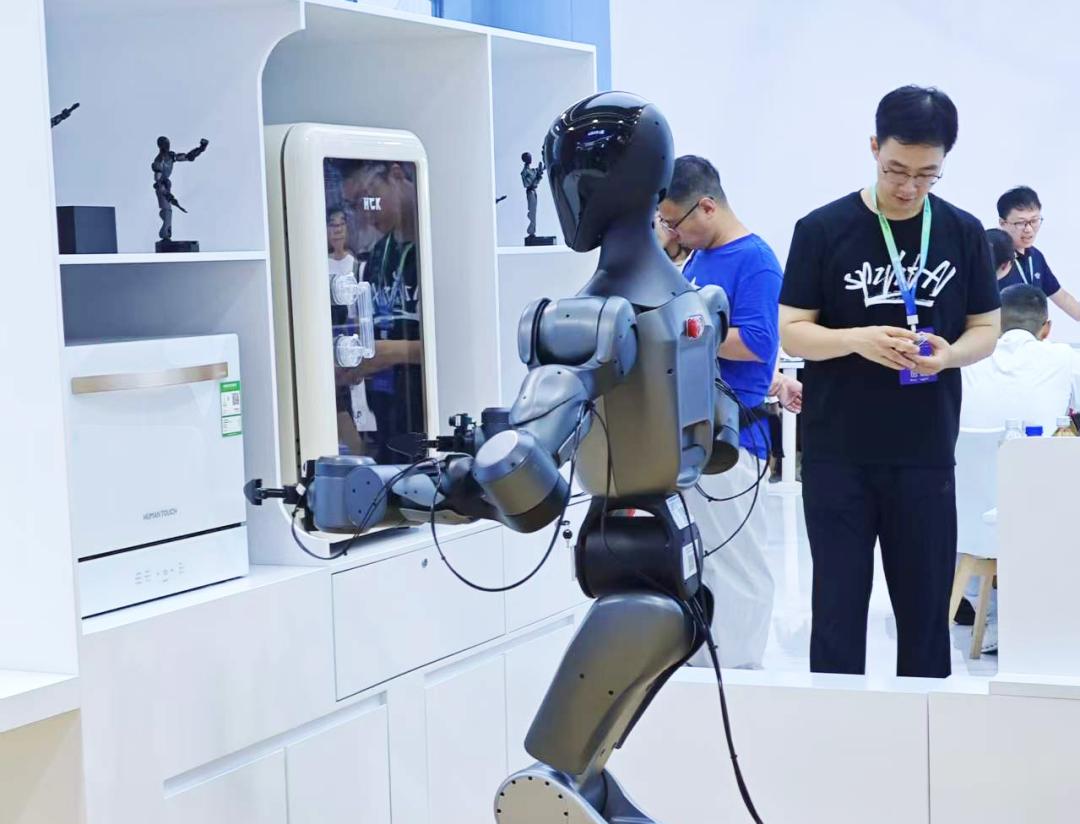
On the booth of Qianxun Intelligence, after receiving the instruction of "tidy up the living room", Moz1 can independently decompose sub-tasks such as "put cola in the refrigerator", "put bowls in the dishwasher" and "throw garbage into the trash can", and plan the execution sequence. During the demonstration, even if the staff temporarily adjusts the position of the items, Moz1 can adjust the route without reissuing instructions. During the half-hour demonstration, Moz1 kept thinking and executing tasks autonomously without interruption.
Photography: Kong Yuexin
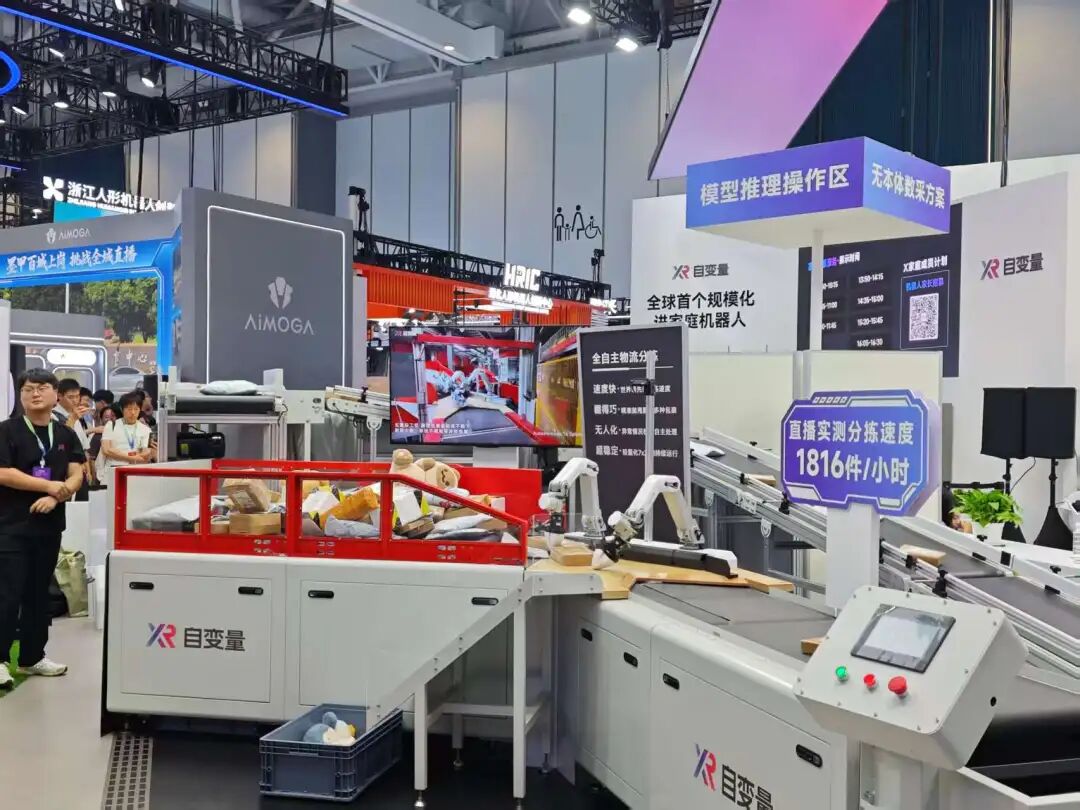
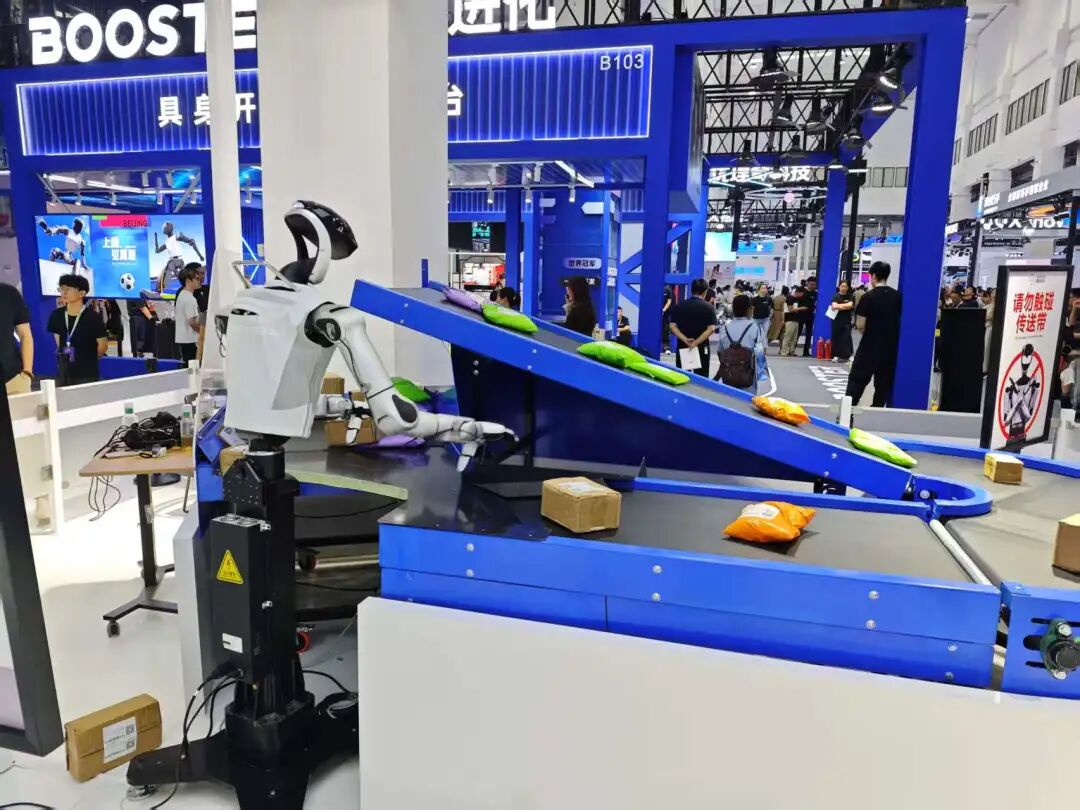
In the logistics sorting exhibition area of Ziliangji Robot, the robot uses two robotic arms equipped with grippers to continuously sort real packages with completely random sizes, shapes and materials. In the live broadcast one week before WRC, Ziliangji Robot achieved a sorting efficiency of 1816 pieces per hour. Its staff said that this speed means the whole process is free of teleoperation, and is completely completed by the robot autonomously.
Photography: Kong Yuexin
Why can the robots at the WRC site achieve a substantial leap in task execution complexity in 2026?
The first is the improvement of model capabilities. The combination of world model and VLA is becoming the industry consensus, which enables the rapid iteration of the generalization ability of embodied models. Liu Dong explained that the VLA strategy widely adopted by the industry in the past required tight coupling between the model and the ontology. Changes in the joint length or motor of each robot would lead to deformation of the output action, the model could not be directly migrated, which also meant that model companies had to train with a fixed ontology.
The Xingyuan Intelligence team found through research that the interactive world model can achieve decoupling between the ontology and the model, that is, pre-training is based on data collected without the ontology, which also makes the model naturally have the cross-ontology generalization ability. "Using a small amount of real machine data for mapping, we can migrate the pre-training capability of the world model to different ontologies. This migration will be very fast, and the cross-ontology capability is brought by the difference in model architecture," Liu Dong said.
Xi Yue also said: "Now the model itself has certain zero-shot capabilities, which can be quickly replicated from one scenario to another, and can be deployed directly to a certain extent. But for further optimization to achieve the efficiency pursued by the site, 1 to 2 days of subsequent training may be required." In the past, it took two months to migrate from one scenario to a new scenario, but now all problems can be solved within a week. The improvement of deployment speed directly promotes the possibility of large-scale replication.
Mo Lei, vice president and head of strategy of Zhi Pingfang, gave the answer from the perspective of "entering the site to work": "The model must be strong, so that after the robot enters the factory, it can not only complete one task, but also complete long-distance multi-tasks." But he also emphasized that hardware stability is equally critical, "Can it work continuously for 8 to 16 hours a day, and not break down for 30 days a month?"
Apart from models, data has also increased by a large margin. In addition to self-collected data from various companies, data collection companies and professional institutions have begun to accumulate data, with more diverse data sources, such as simulation, synthesis, real machine, and real operation data.
Yang Haibo said that the data demand of customers in 2026 is a hundred times or a thousand times that of last year, jumping from hundreds or thousands of hours to hundreds of thousands or even millions of hours. While the volume of data is growing, "everyone's requirements for data quality and diversity are rising, which makes data collection more difficult".
He gave an example that some customers' pursuit of diversity has reached the extreme of "collecting only one piece of data for one person in one scenario". Diversity is not only about people and scenarios, but also about distribution, posture, lighting conditions, etc. "The labeling accuracy is also improving, and the requirements for whether the hand is out of the frame and the accuracy of the labeling format are greatly improved."
"It is the industry consensus that AI is data-centric," Yang Haibo concluded, "The biggest manifestation in the embodied field is supply-driven — the development of data vendors is promoting the evolution of models. The quality, scale and diversity of data are driving the improvement of model capabilities, which is a completely different change from the past."
Securing Orders is the Core Issue
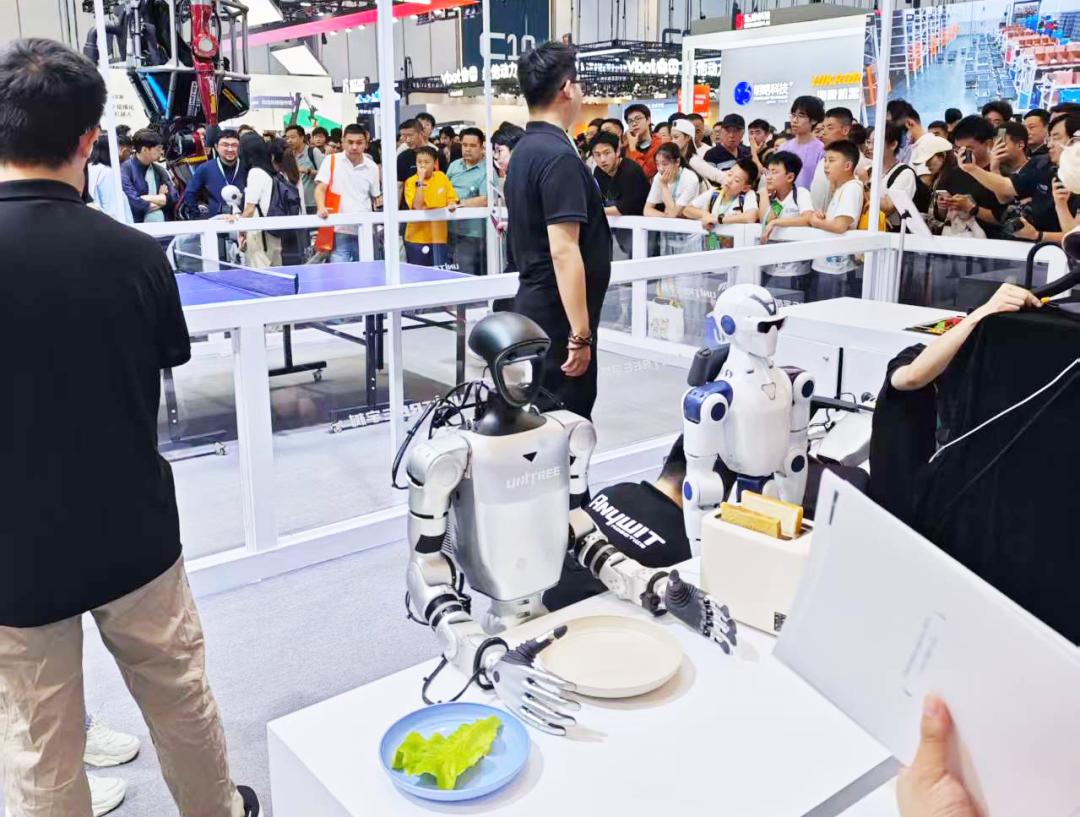
On August 19, Unitree Robotics landed on the Sci-Tech Innovation Board, with an issue price of 150.8 yuan, and the opening price soared to 1100 yuan. Following Unitree, the wave of IPOs in the embodied intelligence industry has arrived. According to incomplete statistics, more than 20 embodied intelligence enterprises have been reported to have IPO plans or capital arrangements in 2026. In addition, according to *China Entrepreneur*'s on-site visits at WRC, many other enterprises have secretly submitted their listing applications.
The primary market is also getting hotter. According to statistics from IT Juzi, in the first half of 2026, the total financing of China's embodied intelligence track reached 935 billion yuan, 5 times higher than the same period in 2025.
Photography: Kong Yuexin
More capital has poured in, but the industry threshold has also been raised. Many enterprises said that primary market investors' assessment of mid-to-late stage projects pays more attention to the company's shipment volume, revenue and large-scale implementation.
On the other hand, embodied intelligence companies themselves also need scenarios. To train the model, it is necessary to work in a real environment to get real data feedback, so as to realize the large-scale deployment of the model.
The core topics of embodied intelligence companies in 2026 are models, scenarios and orders. How to choose scenarios is a question that every ontology and model manufacturer is thinking about.
"We need to find scenarios that are not only difficult and widely distributed, but also replicable," Zhang Yufeng said.
In addition to industrial scenarios such as the automotive industry, Wujian Power focused on displaying the "human-robot cooperative coffee shop" at WRC. Zhang Yufeng revealed that from September to October this year, Wujian Power will carry out large version iteration and batch test verification. The reason for choosing the coffee shop scenario is that "the background is sufficiently generalized and the tasks are sufficiently concrete". Zhang Yufeng believes that chain stores are highly replicable, which is valuable for technology iteration.
Photography: Kong Yuexin
In terms of business strategy, Wujian Power focuses on complete machine sales, and sets its shipment scale at hundreds of units this year. Zhang Yufeng made it clear that the company will focus on industry, commerce and developer ecosystem, "The vertical scenarios we can design are limited, and we need more ecological partners to help us implement scenarios."
In order to "keep the price of a single machine reasonable", Zhang Yufeng said that Wujian Power will choose scenarios with high labor costs, so that the economic account of replacing labor will be cost-effective. Therefore, many large customers of Wujian Power are from overseas. Zhang Yufeng summed up that the core is two accounts: what budget is saved, and what commercial value is brought, that is, customer attraction and cost saving. "If these two accounts are well calculated, everyone will be motivated to place orders."
Therefore, in the coffee shop scenario, Wujian Power is currently negotiating cooperation with some leading chain coffee brands in South Korea. "South Korea has strong consumption power and good industrial foundation, ranging from consumer electronics to automobiles and heavy industry, which is very similar to China. It can become a test field for embodied intelligence, and the labor cost in South Korea is higher than that in China," Zhang Yufeng said. Another practical factor is that the flight time from Beijing to Incheon is even shorter than to Shanghai.
As the first company to realize PMF (Product-Market Fit) verification in the logistics field, Xingdong Epoch chose the logistics scenario for three reasons: First, the working environment is unfriendly to people. Most logistics warehouses operate in the middle of the night, the site has no air conditioning, huge noise, hot in summer and cold in winter, and the original intention is to liberate people from the harsh environment. Second, logistics has clear requirements for rhythm, accuracy and working duration. "If you meet these requirements and the ROI is cost-effective, manufacturers will be willing to pay." Third, the tasks are relatively simple, which is friendly for the embodied intelligence industry to take the lead in realizing industrial deployment. "But the tasks are high-frequency, and it is difficult to get away with just demos. They must be truly tested in the scenario," Xi Yue revealed.
Photography: Kong Yuexin
Since 2024, Zhi Pingfang has been exploring implementation in coffee shops and industrial PCB (Printed Circuit Board) scenarios. Mo Lei also revealed that the production lines deployed with Zhi Pingfang robots have been working in parallel, and "more than one customer is using them, and replication has been realized among similar customers." "How to make robots visible not only in factories that people can't see at all, but also in daily life, is the concept we want to convey."
As for the specific scenario selection, Mo Lei believes that this itself is "non-consensus". Some companies choose to cut in from different scenarios such as household and logistics, but Zhi Pingfang insists on focusing on high-end manufacturing: semiconductors, biotechnology, and automobiles. He believes that there are three criteria for scenario selection: high cleanliness, high flexibility, and high gross margin. "High cleanliness itself is a more friendly environment for robots; high flexibility is the biggest advantage of embodied intelligence over traditional equipment; high gross margin means that the industry has more space to accept new technologies," Mo Lei said.
Liu Dong said that Xingyuan Intelligence has put forward three elements of implementation: effect, efficiency and cost. "For the embodied solution to replace the original solution, we only need to see whether the coefficient of effect multiplied by efficiency divided by cost is greater than 1. If it is greater than 1, it means that it has great advantages over the original solution and can be truly implemented; if it is less than 1, it can only run some demos."
As a company founded in 2025 and focusing on embodied brain technology, Xingyuan Intelligence jointly launched the high-altitude operation robot "Optimus" with Zhongli Group in June this year, equipped with the RoboBrain Pro embodied brain, which can achieve operation at a maximum height of 10 meters.
Liu Dong observed that the industry has been trying to do POC in different scenarios this year. Although the cost is still high or the efficiency is low, it has shown a trend of implementability. Next