The youngest Chinese tenured professor in Japan founded an AI + new materials startup, with more than 200 self-developed physical models that shorten the R&D cycle to only two months | 36Kr Exclusive
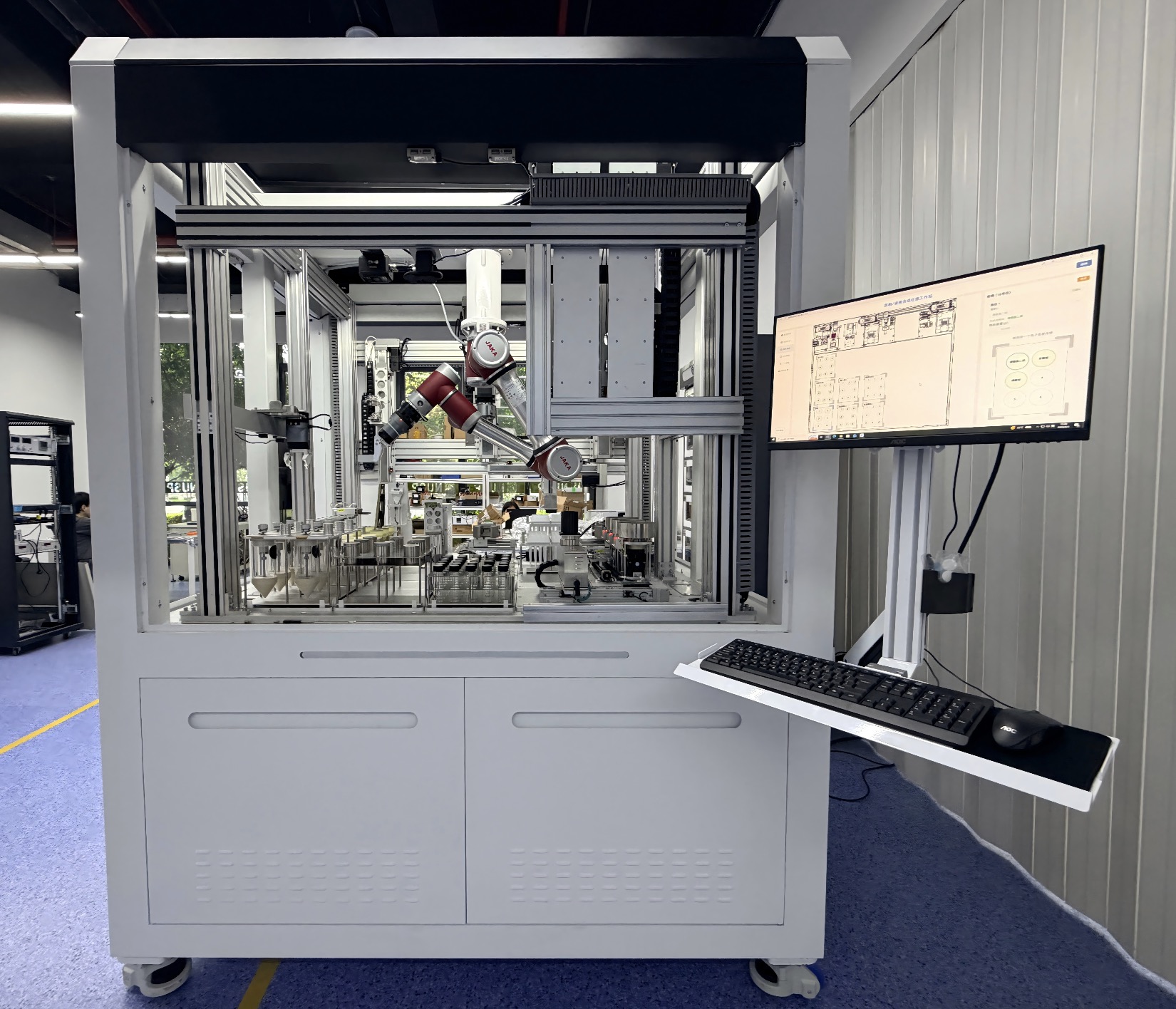
Image Source / Enterprise
This article contains approximately 2800 words, with an estimated reading time of 7 minutes
Author丨Ou Xue
Editor丨Yuan Silai
36Kr has learned that MatSource, an AI + advanced new materials technology enterprise, has announced that it has successively completed two rounds of angel series financing totaling over 100 million yuan in the past three months.
The previous round of financing was co-invested by Su Gao Xin, Silicon Harbor Capital, Hefei Yuanchu No.6, and Shanghai Yuangu, with additional follow-on investment from existing shareholders Yihe and Fresh Capital. The new round of financing is led by Matrix Partners China, with continuous follow-on investment from Suzhou Venture Capital and existing shareholders CAS Star and Silicon Harbor Capital. The raised funds will be mainly used to deepen the full-link R&D closed loop of "data - physical model - AI agent - automated experiment", accelerate the pilot test and industrialization implementation of key materials such as solid electrolytes, and introduce interdisciplinary talents in AI and materials science.
Founded in April 2025, MatSource is a technology company focusing on the "AI for Materials" field. Its founder and chief scientist Li Hao is currently a tenured full professor at Tohoku University in Japan, the only Chinese "Distinguished Professor" in Japan (the highest title in the Japanese academic system), and also one of the youngest tenured full professors in Japanese history (awarded at the age of 32, while the average age of tenured full professors in Japan is 58).
In Li Hao's view, the core bottleneck facing the current new materials industry is not insufficient investment, but the inherent efficiency ceiling of the traditional R&D paradigm itself.
Taking solid electrolytes as an example, human exploration of this type of materials in the past few decades is less than 8%. It is estimated that it will take 60 to 100 years to cover the remaining 92% of the material space with the traditional trial-and-error method. This is the fundamental reason why the mass production of solid-state batteries has been repeatedly delayed: before completing the systematic scan of the material space, any production line construction may face the risk of sunk costs due to the emergence of next-generation materials.
This is exactly the value anchor point of AI for Materials. It is not to replace scientists to conduct experiments, but to enable AI to complete tens of thousands of "pre-experiments" in the virtual world, greatly shortening the exploration cycle of the material space.
The differentiation of MatSource lies in that it is not satisfied with being a "prediction tool", but tries to build a complete closed loop from data to industrial implementation.
The technical architecture of MatSource can be understood as a collaborative system of "brain + limbs": AI agents and physical models form a "smart brain", high-throughput automated experiments form a "strong body", and the database is the "memory" for the continuous evolution of the entire system.
At the data base level, the company has built the world's largest million-level real material database. This database is not generated by automatic AI crawling, but accumulated by the team over seven years with more than 100 domain experts through systematic literature and patent data mining, labeling and cleaning.
"The currently reported accuracy of AI-assisted mining is not high, and the hallucination rate may reach more than 95%, so it still relies on human efforts to sort it out." Li Hao revealed that the company has developed high-precision data mining tools and a systematic review and warehousing process, and plans to expand the database scale to the ten million level within the year.
At the physical model level, MatSource has independently developed more than 200 physical models for material prediction, with the goal of breaking through 250 within the year. The role of physical models is not only prediction, but more importantly to "restrain AI hallucinations". Physical laws such as "F=ma" always hold true in classical scenarios, so AI will not predict material phenomena that violate Newton's second law.
In addition, two-way verification is formed between physical models and AI agents: the results predicted by AI can be filtered by physical models, and physical models can also be embedded into the AI training process.
At the AI agent level, MatSource has developed more than a dozen dedicated AI agents for specific material R&D scenarios, covering directions such as solid electrolytes, hydrogen energy electrocatalysis, ionic liquids, photoresists, thermal catalysis, molecular sieves, organic electrosynthesis and Fischer-Tropsch synthesis. These agents are not general large models, but vertical domain experts trained on real experimental data and physical models. The company recently released the Fischer-Tropsch synthesis AI agent, which enables targeted R&D empowerment for this important industrial catalytic reaction.
At the high-throughput automated experiment level, MatSource has launched the world's first AI Agent-driven high-throughput automated experimental platform for inorganic solid-phase / solid-liquid phase synthesis. The platform has a daily sample processing capacity of 150 units, realizing the full-process closed loop of "planning - design - process - execution - feedback".
The four sections are connected in series to form a self-iterating positive cycle: data → physical model → AI agent → material screening → automated experiment → experimental verification → data feedback → model iteration.
In fact, a common phenomenon exists in the current AI for Materials industry: heavy on prediction, light on verification, and even lighter on industrialization. A large number of papers show that AI has successfully predicted a certain new material, but there are very few cases where the material is actually produced, passed bench-scale and pilot tests, and put into production lines.
MatSource has chosen a more pragmatic path. The company is building a trinity business model of "technical service + material bank + self-developed material production", aiming to open up the full link from AI prediction to material delivery.
Taking the company's service case for a Fortune Global 500 enterprise as an example, the low conversion efficiency of a thermal catalytic reaction catalyst of this enterprise has plagued them for more than 20 years. During this period, they outsourced the problem to multiple universities and leading material R&D companies without success. After MatSource took the order, the contract stipulated that the delivery would be completed in one year, but in fact, a series of catalysts with better performance were found in less than two months. The best one is 30% higher in performance than the original material of the enterprise, which has now passed the bench test and is in the stage of pilot test and mass production.
In terms of self-developed materials, the company focuses on directions such as green organic electrosynthesis and solid electrolytes, and core projects have entered the pilot test stage. In addition, the company recently signed a strategic cooperation agreement with a biomedical material company to expand its AI material R&D capabilities to the field of biomedical materials.
After the completion of this round of financing, MatSource plans to continue to expand the database to the ten million level, break through 250 physical models, improve the AI agent matrix and the construction of high-throughput automated intelligent laboratories, and accelerate the full-chain implementation of key materials from R&D to industrialization.
The following is an edited excerpt of the conversation between 36Kr and Li Hao, founder and chief scientist of MatSource:
36Kr: What is the difference between MatSource's "closed loop" and that of other companies?
Li Hao: A closed loop is not simply stringing things together, nor making breakthroughs on a single point tool. The iteration of R&D paradigms in the past decade has proved that this path does not work. Our closed loop achieves ultimate performance at each link and integrates them organically.
The database is the cornerstone. The million-level real experimental data, not theoretical simulation data, is the largest known in the world. Based on the database, we have derived more than 200 physical models and trained accurate AI agents at the same time. Physical models restrain AI hallucinations and provide interpretability; AI agents are responsible for high-throughput prediction. The prediction results are verified by the automated experimental platform, and the experimental data flows back to the database.
Every section is a moat. The database is the result of seven years of persistent accumulation like the old man who moved mountains, and the physical models are our unique theoretical expertise, which is almost not accumulated by other companies in the industry. AI agents are trained based on high-quality data, and the automated platform involves multi-disciplinary intersection. After stringing these into a closed loop, we have achieved the capability of "precise targeting" in some material directions.
36Kr: What is the bottleneck of solid-state battery industrialization? What can AI do to solve it?
Li Hao: Why have solid-state batteries not been mass-produced on a large scale until now? The bottleneck lies in solid electrolytes. In the past 30 to 40 years, human exploration of solid electrolyte materials is less than 8%, and more than 92% of the rest is unknown. It is estimated that it will take 60 or even 100 years to cover this 92% with the traditional trial-and-error method.
Why does every solid-state battery manufacturer keep pushing back the mass production time? They always say "next year", pushing the timeline from the 2010s to today. Because if you build a production line to produce a certain sulfide electrolyte today, and scientists find a better material with traditional methods next year, your production line will be scrapped.
What AI needs to do is to go through the unknown 92% or at least most of it before building the production line, so that we can know what material is the optimal solution in the current scenario. Without this premise, any large-scale industrialization is like blind men touching an elephant.
36Kr: From AI R&D tools to material industrialization, what is the commercialization path?
Li Hao: What the AI material field lacks most is implementation. Our goal is to become the world's first company to realize large-scale industrial implementation of materials through AI empowerment.
There are three models at present: First, technical services, providing customized R&D for customers. The Fortune Global 500 case mentioned earlier is a typical example, where we solved their 20-year problem in two months. Second, the material bank, which precipitates the new material formulas and processes formed in R&D and realizes monetization through IP licensing. Third, self-developed material production, focusing on directions such as solid electrolytes and green organic electrosynthesis, building our own production lines and completing scale-up.
Only AI is not enough. Without making materials, scaling up, and putting them into production lines, it is impossible to truly empower the industry. We not only need to predict materials, but also produce them, pass pilot tests, and send them to production lines. This is the ultimate value of AI for Materials.