The world's largest all-electric aircraft has completed its maiden flight: the 11-ton "flying laboratory" took to the air, marking that electric aviation has crossed the critical threshold.
$5.
This is the total electricity cost consumed by the entire mission when the Heart Aerospace X1 completed its maiden flight at Plattsburgh International Airport, New York, the United States last week. Converted to RMB, it is just over 30 yuan.
This aircraft has a maximum takeoff weight of more than 11.34 tons, a length of 23.2 meters, a wingspan of 32.3 meters, and a peak power of the electric propulsion system exceeding 1 megawatt. It is the largest battery-powered all-electric aircraft that has completed flight tests in the world so far.
The flight lasted 27 minutes, climbed to a maximum altitude of 335 meters, and fully completed all test flight subjects including ground taxiing, takeoff, aerial maneuvering and smooth landing. The whole process was powered by on-board batteries without using any fuel. This test flight was carried out under the framework of the Federal Aviation Administration (FAA) experimental special airworthiness certificate in the United States.
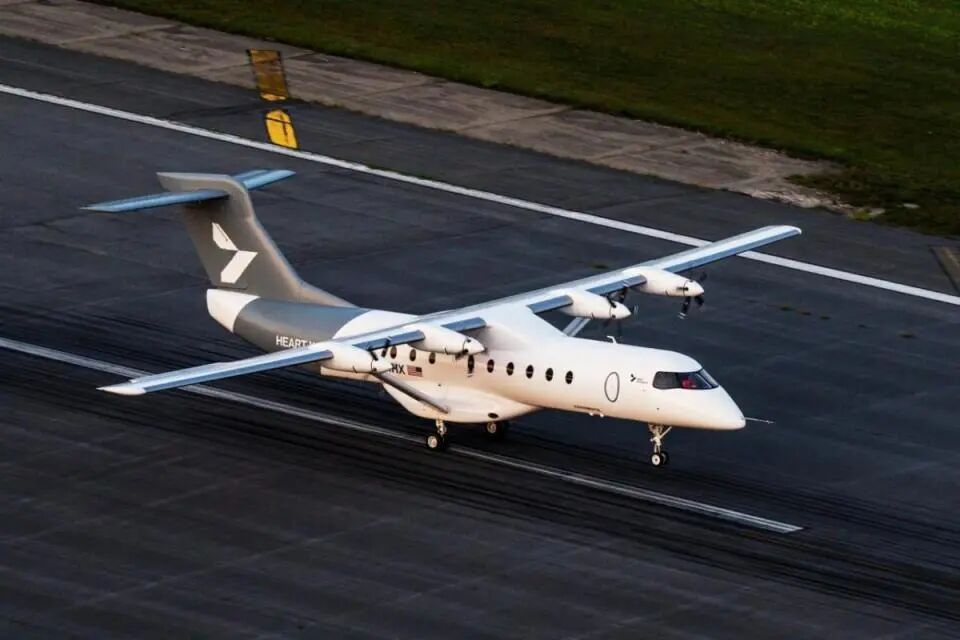
The maiden flight only cost $5 in electricity! The world's largest all-electric aircraft prototype successfully took to the sky for 27 minutes.
The electricity cost of a single test flight is only about 5 US dollars, which shows the potential advantage of electric propulsion in terms of energy cost. Megawatt-level power poses extreme challenges to batteries, motors, thermal management and flight control. The aviation operating conditions feature strong vibration and drastic temperature difference, and the heat generated by high-power discharge directly threatens flight safety. The maiden flight of the X1 has initially verified the operation capability of the megawatt-level electric propulsion system under real flight conditions.
X1 is not a passenger aircraft, but a "preliminary experiment" for the ES-30
The X1 itself will not be put into commercial operation. It is positioned as a full-size technology demonstrator, specially used to test key technologies such as aviation-adapted batteries, high-power electric propulsion, electric flight control, and cooling systems, to accumulate airworthiness data for subsequent mass-produced models.
The real commercial goal of Heart Aerospace is the ES-30, a 30-seat regional hybrid passenger aircraft. The ES-30 is designed to run purely on electricity for short-haul routes and activate the turbogenerator for long-haul routes, focusing on the 200 to 400 km short-haul regional market, covering scenarios including inter-city commuting, tourist routes and remote area connectivity.
The X1 is responsible for getting the technologies fully verified in flight, and the ES-30 is responsible for carrying passengers to generate revenue.
However, the bottlenecks are equally clear. Battery energy density remains the biggest constraint. The X1 has only completed short-duration, low-altitude flight tests this time, and there is a considerable gap from the range and altitude required for commercial regional operations. There are still a large number of problems to be solved in fast charging technology, battery performance in high-altitude low-temperature environments, and thermal management engineering. It will take years of stringent airworthiness certification to go from a demonstrator to a commercial passenger-carrying aircraft. Whether the commercial operation schedule of the ES-30 can be fulfilled depends on the quality of data accumulation in the coming years.
In the same week, China made breakthroughs on the battery side
In the same week as the X1's maiden flight, CATL announced that its aviation power battery system developed for manned eVTOL has passed the non-propagation verification of thermal runaway of adjacent cells, with an energy density of 350Wh/kg. According to CATL, this is the world's first prismatic cell aviation power battery system that has passed this test.
Looking at the two events side by side: Europe and the United States are promoting the verification of the whole aircraft system level, while China is breaking through the boundaries of cell energy density and safety. The paths are different, but both point to the same milestone — as commercial electric aviation moves from technical verification to large-scale implementation, the battery is the last and most critical threshold.
The civil aviation industry is under continuous pressure to achieve carbon neutrality, and electrification is regarded as the third technical route following fuel-saving modification and sustainable aviation fuel. The maiden flight of the X1 marks that this route has officially moved from the laboratory into the airworthiness system.
If the 11-ton X1 verifies the possibility of civil aviation electrification, then CATL's 350Wh/kg aviation battery is also directly related to another closer battlefield — eVTOL. Short range and heavy batteries are the core bottlenecks restricting the current commercialization of manned eVTOL. Every time the energy density is increased by one level, the range and payload of the aircraft can be improved correspondingly. The cell that passed the thermal runaway test this time by CATL is exactly developed for the manned eVTOL scenario.
Civil aviation electrification is still in a long-distance race, while the commercialization window for eVTOL has already opened. The two tracks share the same type of battery. From the 11-ton demonstrator to the two-seat air taxi, the technical logic driving them is the same: to make batteries lighter, safer and more durable. The significance of the X1's successful flight this time is not only for regional aviation, but also for the entire future of electric flight.
This article is from the WeChat official account "Sina Low Altitude", written by Low Altitude Express, and published with authorization from 36Kr.