Last night, the new version of DeepSeek Harness made its debut, with 14 updates and fully maximized multimodal capabilities.
Zhi Dong Xi reported on August 20 that DeepSeek Harness received its first major update after public beta last night. DeepSeek Harness v0.1.0-rc.8 version is now available, and multimodal capabilities are the highlight of this update.
This update brings a total of 14 adjustments, covering multiple directions including multimodal input, sub-agent collaboration, terminal experience, tool invocation and developer support. It not only complements the Agent's ability to handle multimodal tasks such as image processing, but also further optimizes the experience of sub-agent collaboration, terminal interaction and tool invocation.
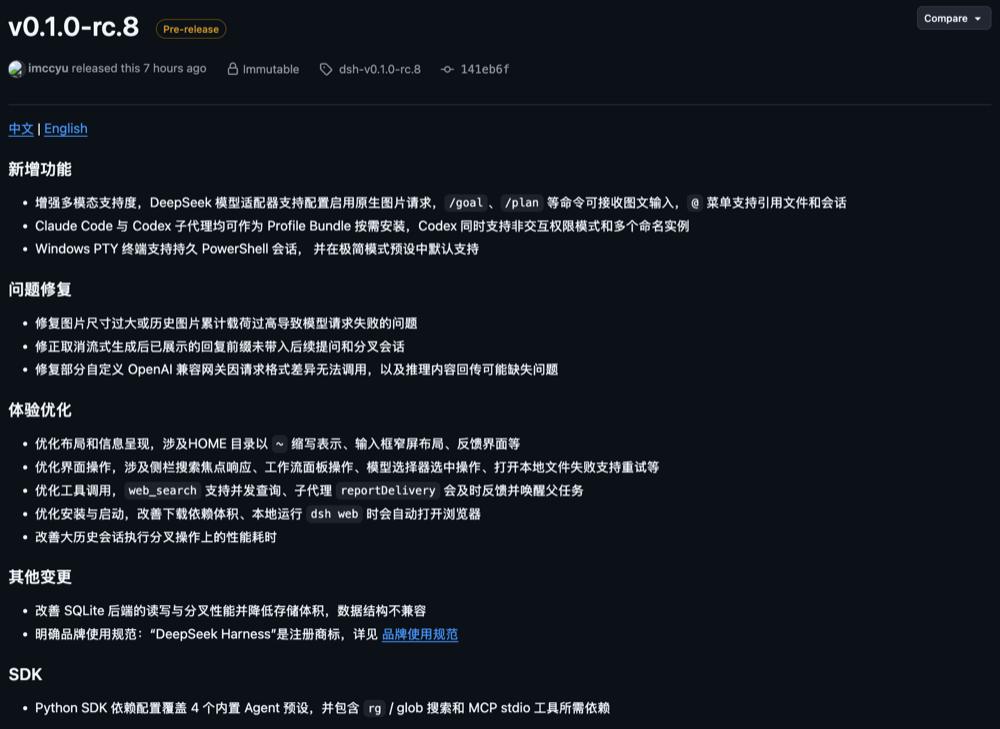
The new version supports native image requests and mixed text-image input, and commands such as /goal and /plan can directly receive images. Meanwhile, Claude Code and Codex are further integrated into its sub-agent system, and a number of issues related to Windows terminal experience, image requests, streaming generation, custom gateways and other aspects have also been fixed.
DeepSeek Harness officially launched the public beta of v0.1 version and open-sourced the code simultaneously on August 13. On the night of the public beta, Zhi Dong Xi immediately pulled the source code for actual testing, and used it to complete tasks such as 88-page paper translation and Snake game development.
Less than a week has passed, this Agent Harness has added multimodal capabilities. This update quickly sparked discussions in the DeepSeek Harness community.
Some domestic developers exclaimed directly after seeing the update: "DSH supports multimodal now, spread the word!"

Overseas developers also focused on these two capabilities. Some netizens commented that DeepSeek Harness is becoming "more and more interesting", and the multimodal support and more complete sub-agent integration are a clear progress.

More interestingly, some developers further dug out how DeepSeek Harness "views images": for models that do not support image input by themselves, it can also call tools such as OCR, color statistics and pixel scanning, split the image into structured information and then send it to the text model for reasoning, which is equivalent to assembling a set of "vision" at the tool layer for pure text models.
GitHub:
https://github.com/deepseek-ai/deepseek-harness/releases/tag/dsh-v0.1.0-rc.8
01. Multimodal Capabilities Officially Added, Directly "View Images"
The most obvious change of rc.8 is that DeepSeek Harness further complements the multimodal input capability.
According to the official update log, the DeepSeek model adapter now enables native image requests through configuration. For models with visual capabilities, Harness can directly send images to the model; instructions such as /goal and /plan also support mixed text-image input now.
Meanwhile, the @ menu in the input box adds new file and session reference functions, allowing users to directly import local files, existing sessions and other content into the current task.
This means that the Agent workflow, which previously mainly focused on text, code and tool invocation, can now further incorporate visual information such as screenshots and pictures into the task context.
The sub-agent system also continues to expand.
The new version supports installing Claude Code and Codex as Profile Bundles on demand. Among them, Codex supports non-interactive permission mode and multiple named instances, making it convenient to configure different Codex sub-agents in the same task.
Windows users are also specially optimized in this update. The PTY terminal of DeepSeek Harness adds persistent PowerShell sessions, which is enabled by default in the minimal mode preset, to reduce the problem of frequently rebuilding the terminal environment during command execution.
In addition to new capabilities, this update also fixes a number of issues exposed after the public beta.
For example, when the size of a single image is too large, or there are too many accumulated images in the historical session, the previous version may cause the model request to fail directly; the new version has handled this problem.
After canceling a streaming generation, the previously displayed reply prefix may not be carried over to the next round of questions or forked sessions, and this problem has now been fixed.
For developers using custom OpenAI-compatible gateways, the new version also fixes the problems that some gateways cannot be invoked due to request format differences, and the inference content return is missing.
02. Pure Text Models Can Also "View Images", OCR and Pixel Analysis Build Tool-layer Vision
In addition to the native image request capability added by DeepSeek Harness, an interesting detail was quickly discovered by developers.
When netizen Yinsen tested DeepSeek Harness to process images, he found that when the called model does not declare the image input capability itself, directly calling read_image will fail at first.
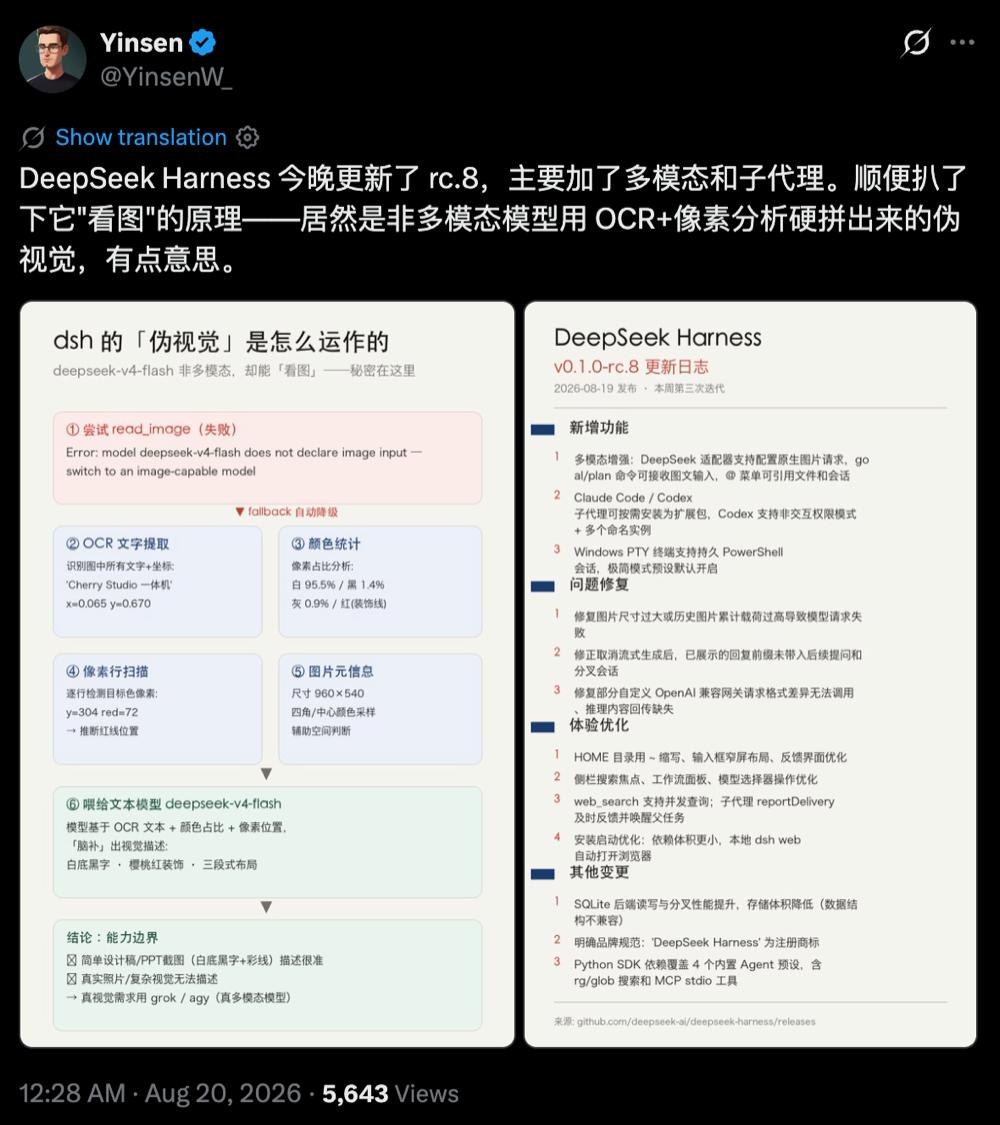
But the task does not stop there. According to the execution trajectory it shows, Harness will then degrade to another set of toolchains: first perform OCR text recognition, then count the color proportion in the image, scan some pixel rows, and read the metadata such as image size and color mode at the same time.
For example, an image containing text and simple graphics can be split into multiple sets of information such as "text content and coordinates", "background color proportion", "pixel changes in specific areas", and "image size".
Finally, these structured results will be sent back to the large text model, allowing the model to "figure out" the general content of the whole image based on evidence such as OCR text, color proportion and pixel position.
Therefore, this capability is still significantly different from the visual large model that directly understands images. For images with relatively clear structures such as PPT screenshots, flowcharts and interface screenshots, it can obtain a lot of effective information with the help of OCR and pixel features; for content such as real photos and complex spatial relationships, the information that this toolchain can restore will be significantly limited.
But from the perspective of Agent Harness, this design is quite interesting: the visual capability is not completely tied to the base model, and tools can also undertake part of the perception work.
In fact, before the official enhanced multimodal support, a number of plugins related to visual capabilities have appeared in the DeepSeek Harness community, including dsh-vision, dsh-vision-toolkit, modlens, dsh-auto-vision, dsh-subagent-vision, and pi-vision bridged through pi2dsh.
Some of these solutions use OCR, pixel analysis, structured evidence or independent visual sub-agents to allow pure text models to process images indirectly; some developers configure input: [text, image] for models that natively support vision through custom routing to receive images directly.
After rc.8 is launched, native multimodal models and this kind of tool-layer vision solution can be further used in coordination.
03. Accelerated Iteration in Less Than a Week After Launch, Focusing on Multimodal and Sub-agents
During the public beta on August 13, the DeepSeek Harness team emphasized that its core design idea is "everything is a plugin": Agent capabilities such as models, tools, skills, sessions, sandboxes, storage, loops, scheduling and UI can be combined and replaced by different plugins. When Agent Harness has more and more abundant tools and sub-agents, some tasks that originally relied on the capability of a single model can also be re-decomposed and implemented through tool orchestration.
This rc.8 continues to strengthen this plug-in idea: visual models can natively receive images, and pure text models can also obtain part of the image information with the help of visual tools; Claude Code and Codex can be installed into the same set of Harness as sub-agents on demand.
In addition to these core changes, rc.8 also adds optimizations such as concurrent web_search queries, timely wake-up of parent tasks by sub-agent reportDelivery, and automatic browser opening when running dsh web locally, and improves the read and write performance of large historical session forking and SQLite backend.
04. Conclusion: Everything is a Plugin, "Disassemble and Reorganize" Model Capabilities
From the public beta opened on August 14 to the current addition of multimodal and more sub-agent capabilities, DeepSeek Harness is still in the stage of rapid iteration.
What is worth looking forward to next is whether this plug-in Harness can continue to integrate more models, tools and Agents into the same system, and run more complex and stable task flows.
This article is from the WeChat official account "Zhi Dong Xi" (ID: zhidxc), Author: Jiang Yu, Editor: Li Shuiqing, Published with authorization from 36Kr.