Unitree cooks breakfast, Keenon does the laundry... At this year's WRC, the trend of "robots entering ordinary households" is gaining strong momentum.
On August 19, the 2026 World Robot Conference (WRC) officially kicked off in Beijing. The reporting team sent by Leikeji (ID: leitech) has arrived at the scene and is delivering first-hand on-site coverage.
At this year's WRC, we can clearly perceive that robots are gradually moving out of demonstration scenarios and into the real world, being deployed in both production and daily life. As ordinary users, we are more concerned about what changes robots can bring to our daily lives.
At this year's AWE, the concepts of "zero housework" and "zero labor" advocated by some home appliance brands left a deep impression on us. At this WRC, Leikeji also pays close attention to what kind of answers the robotics industry will give around the proposition of "robots entering households".
Transforming into Home Assistants, Robots are Accelerating Their "Entry into Homes"
At this year's WRC, there are a large number of participating brands, and the exhibits and scenarios visible on site are quite rich. If we roughly classify these embodied intelligent products, they can be divided into mechanized traditional products and full-form robots. The former can be regarded as the embodied intelligence transformation of traditional devices, expanding new capabilities through physical AI; the latter are mostly humanoid robots that can simulate humans to operate other devices, acting as human helpers in home or industrial scenarios.
Both forms exist for robots entering households, and we have seen a large number of scenario cases at WRC. Limited by space, we select some representative brands and products here to get a glimpse of how far the process of robots entering households has progressed.
1. Unitree: Good at showcasing fun tricks, and even better at doing practical work.
Unitree Robotics was officially listed on August 19, and its soaring stock price has become a hot topic of public discussion. At present, Unitree is one of the most well-known robot brands in China, and many people still have deep impressions of Unitree robots performing at the Spring Festival Gala and boxing in the ring.
As a leader in the industry, Unitree Robotics is not only good at "showing fun tricks", but also more capable of doing practical work. At this WRC, Unitree demonstrated a very rich set of scenarios, including "robot dogs" that can carry goods, and even giant robots that can carry people. In addition, we once again saw Unitree's classic robot, the Unitree G1. This robot has an ultra-large joint motion range, has been continuously updated via OTA, and can learn and imitate to continuously upgrade its capabilities.
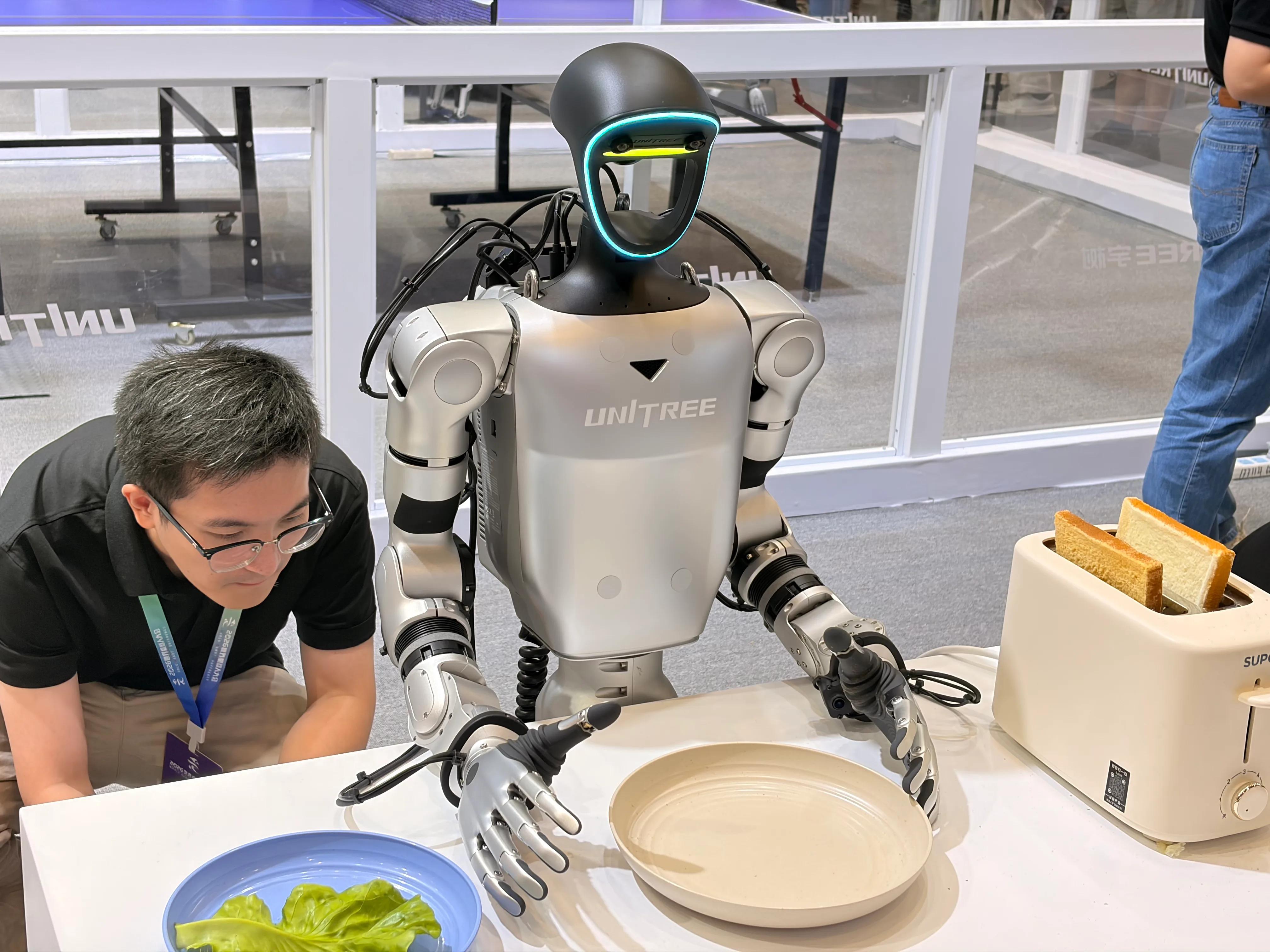
In the WRC exhibition hall, we saw the Unitree G1 again. In the kitchen scenario built on site, it is making breakfast, and can complete operations such as heating toast with a toaster and putting lettuce on a plate.
(Source: Leikeji on-site shooting)
Obviously, the real scenario it simulates is that before office workers go to work, a home assistant like this robot helps make a breakfast, which not only saves the trouble of doing it themselves, but also allows them to seize every minute to sleep a little longer.
2. Robam: Leading the Smart Kitchen into a New Stage
As a leading brand in the field of kitchen home appliances, Robam's smart home appliance products are continuously iterating and upgrading. At this year's WRC, Robam brought its AI solutions for the kitchen space. Among them, the concept of "kitchen space intelligent agent" is the most impressive one for Leikeji.
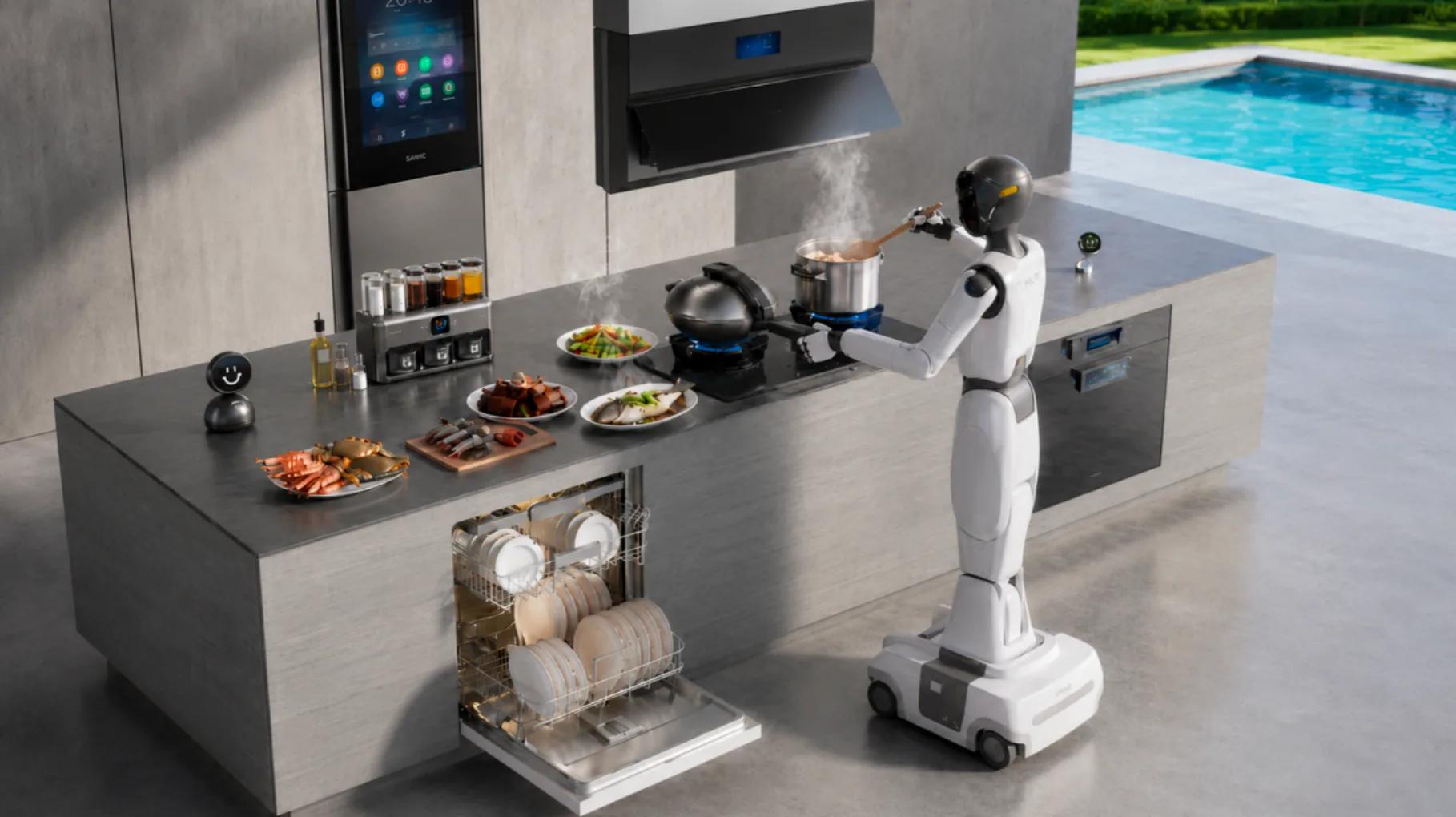
According to Robam's introduction, it will be a kitchen butler that can move and operate autonomously. Specifically, there will be a physical entity in this solution, that is, a humanoid robot. It can move freely in the kitchen and break through space restrictions.
At the same time, this robot is equipped with a flexible robotic arm, which can complete complex operations such as washing vegetables, cutting vegetables, cooking, and plating. The only thing users need to do is issue instructions. That is to say, as long as the user tells what dish they want to eat today and buys the ingredients, the rest can be fully handed over to the kitchen AI Agent system.
(Source: Robam)
Although Robam's solution has not been fully deployed yet, it is gradually approaching the goal. At present, the intelligence level of Robam's smart kitchen products is quite high. Compared with traditional kitchen appliances, both ease of use and automation have been greatly improved, and the interconnection and collaboration of different appliances in kitchen scenarios are also doing well. Letting robots take over the kitchen and completely liberate humans from kitchen labor will not be a distant future.
3. Keenon: Robots can make drinks and even do laundry
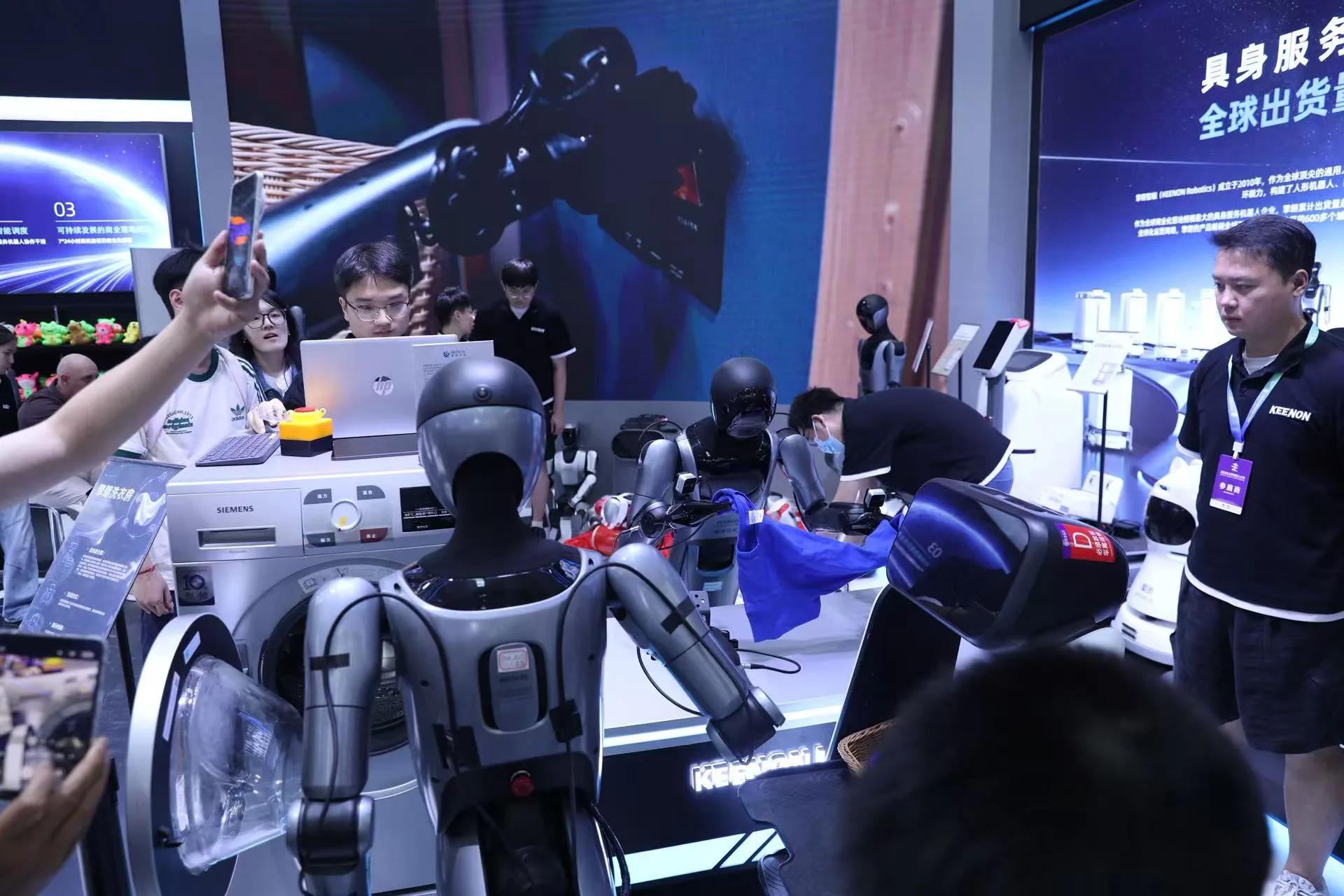
Keenon Intelligence built an "embodied community" covering four scenarios: coffee kiosk, dessert shop, retail store, and laundry room at this exhibition. In the on-site demonstration, we can see the robot equipped with Keenon's large model KOM 3.0 skillfully making coffee and desserts, completing picking up goods and checking out at the retail store, and smoothly completing the whole process of putting clothes into the washing machine and accurately pressing the washing button.
To be honest, the scenarios demonstrated by Keenon are more inclined to B-end commercial use. However, through these scenarios, we can also feel that these robots are equally suitable for deployment in home scenarios. After all, no one will reject a robot assistant that can help you cook, make drinks, and put dirty clothes into the washing machine.
(Source: Keenon)
According to the official introduction, Keenon's large model KOM 3.0 has achieved improved capabilities in multiple aspects. First of all, it deeply integrates the latent space model, which will preview the physical results before executing actions, enabling it to think before acting and reduce the probability of failure and errors.
Secondly, general humanoid robots and dedicated service robots can be uniformly scheduled and coordinated. The former is more like a butler that coordinates the overall situation, responsible for complex operations and interactions, while the latter has its own exclusive specific tasks. In addition, the special feature of KOM 3.0 is that it has a large amount of real data for training, rather than being limited to simple laboratory demonstrations, which further increases the possibility of its deployment in real scenarios.
4. UBTECH: "Pretty Girl" and "Handsome Guy" robots accompany you for the Qixi Festival?
Some time ago, UBTECH's ultra-simulated humanoid robot Utopia U1 caused a heated discussion, which focuses on a realistic shape and emotional companionship scenarios. This time, we finally saw the "real person" version of Utopia U1 on site. To be fair, the facial skin and texture of the female version of Utopia U1 are indeed made very real, and it is easy to mistake it for a real person when viewed from a distance. Similarly, its fingers, palms and other parts have been treated similarly, with vision and touch close to real human beings.
Of course, the selling point of Utopia U1 is not only its appearance. It is built with UBTECH's self-developed Resonance-LM emotional large model, and its face is also equipped with a very fine tendon network and mechanical structure, which can achieve delicate human-like expressions. U1 can not only quickly respond to users' instructions, but also rely on its built-in memory system to actively perceive users' emotions and provide caring services.

(Source: Leikeji on-site shooting)
To be honest, the advantages of this type of robot are not reflected in "doing work", and it is not good at doing housework or handling work tasks. Instead, it focuses on the emotional companionship track. A robot that looks very similar to humans and can provide human-like emotional companionship already has a large number of target groups. In the home space and scenario, we need both practical robots that can do housework and simulated humanoid robots that can provide emotional value.
5. JD: "Go to JD to buy robots".
As a well-known e-commerce platform and technology giant, JD has undertaken the important task of delivering home appliances to homes in the past. Theoretically, robots will become the "ultimate home appliance" in the future, so JD plays a more special role in the robotics field. On the one hand, it has invested a lot of manpower and material resources to launch its own robot products; on the other hand, JD focuses on the entire supply chain and the robotics industry, providing embodied intelligence enterprises with assistance in technology, ecology, sales and other fields to help them realize the commercial deployment of their products.
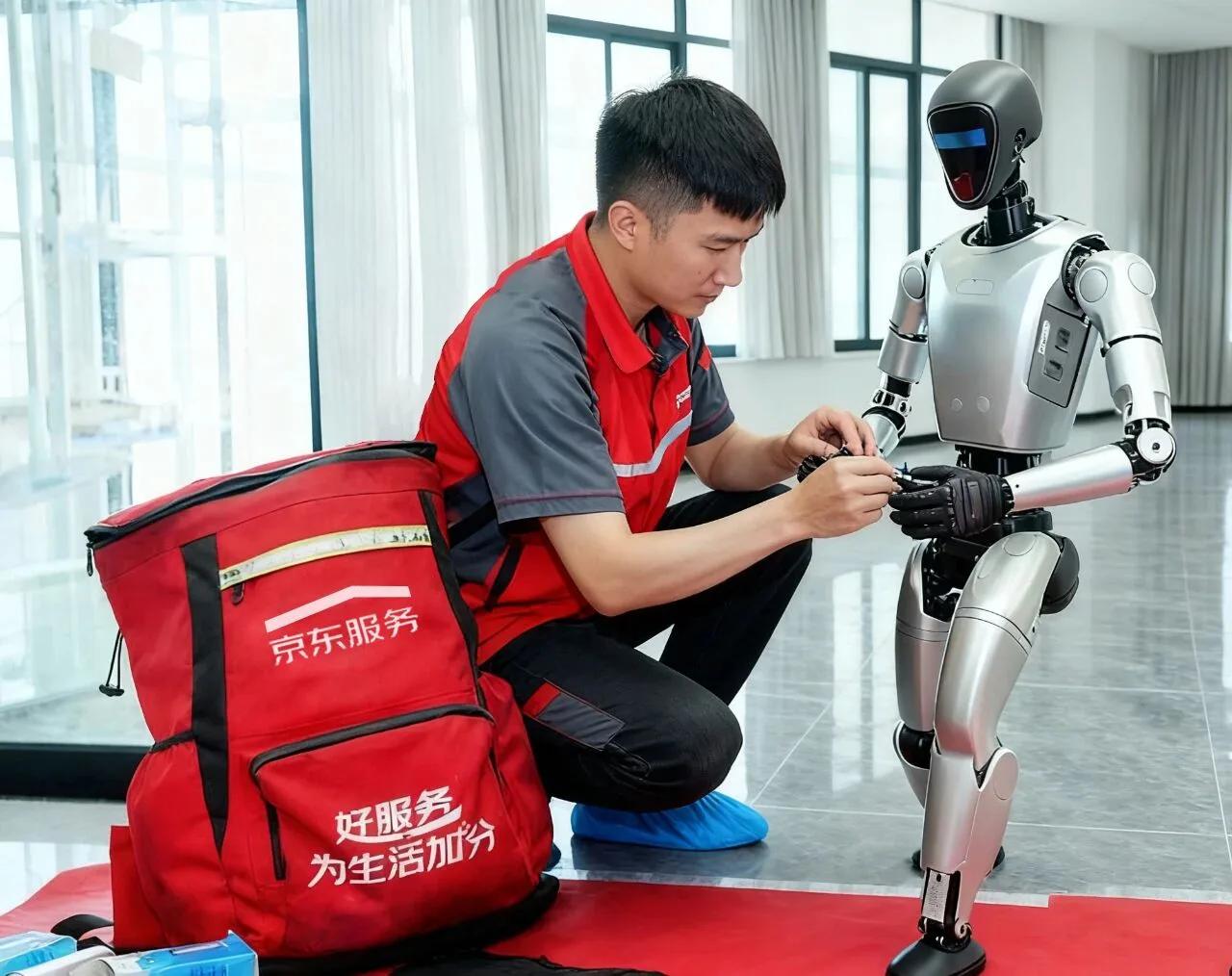
For consumers, the impressive slogan of JD about robots is the line "Go to JD to buy robots". JD's core user group is still C-end consumers. For consumer-grade robots that focus on home scenarios, JD will be a very critical sales platform, which can provide sales and promotion channels for brands and products. At the same time, JD has been using its own advantages to build a complete after-sales system for robots, which is a good thing for both brands and consumers.
(Source: JD)
Overall, at this year's WRC, JD's focus is not on showcasing its own products, but on demonstrating its advantages in the technology base, sales network and after-sales system built based on its own strengths, which will be able to provide full-range supporting services for robots, especially consumer-grade robots.
Robots are Accelerating Their Entry into Homes, and Zero Housework is No Longer a Dream
After visiting the exhibition, robots making breakfast, doing laundry, and making drinks seem to be just one step away from "zero housework". The "zero housework" shouted by home appliance brands at this year's AWE was more of an aspiration, while the scenarios presented by manufacturers at this WRC have begun to give feasible paths. But frankly speaking, to really let robots live in ordinary people's homes and take full charge of all housework, there are still some problems to be solved.
The first is the price. At present, the pricing of humanoid robots generally starts from tens of thousands of yuan or even hundreds of thousands of yuan, which is still difficult for many families to afford. The reason why sweeping robots were popularized first is that their price is at the thousand-yuan level. If robots entering households want to replicate this path, they must first lower their price to a level that ordinary families are willing to pay.
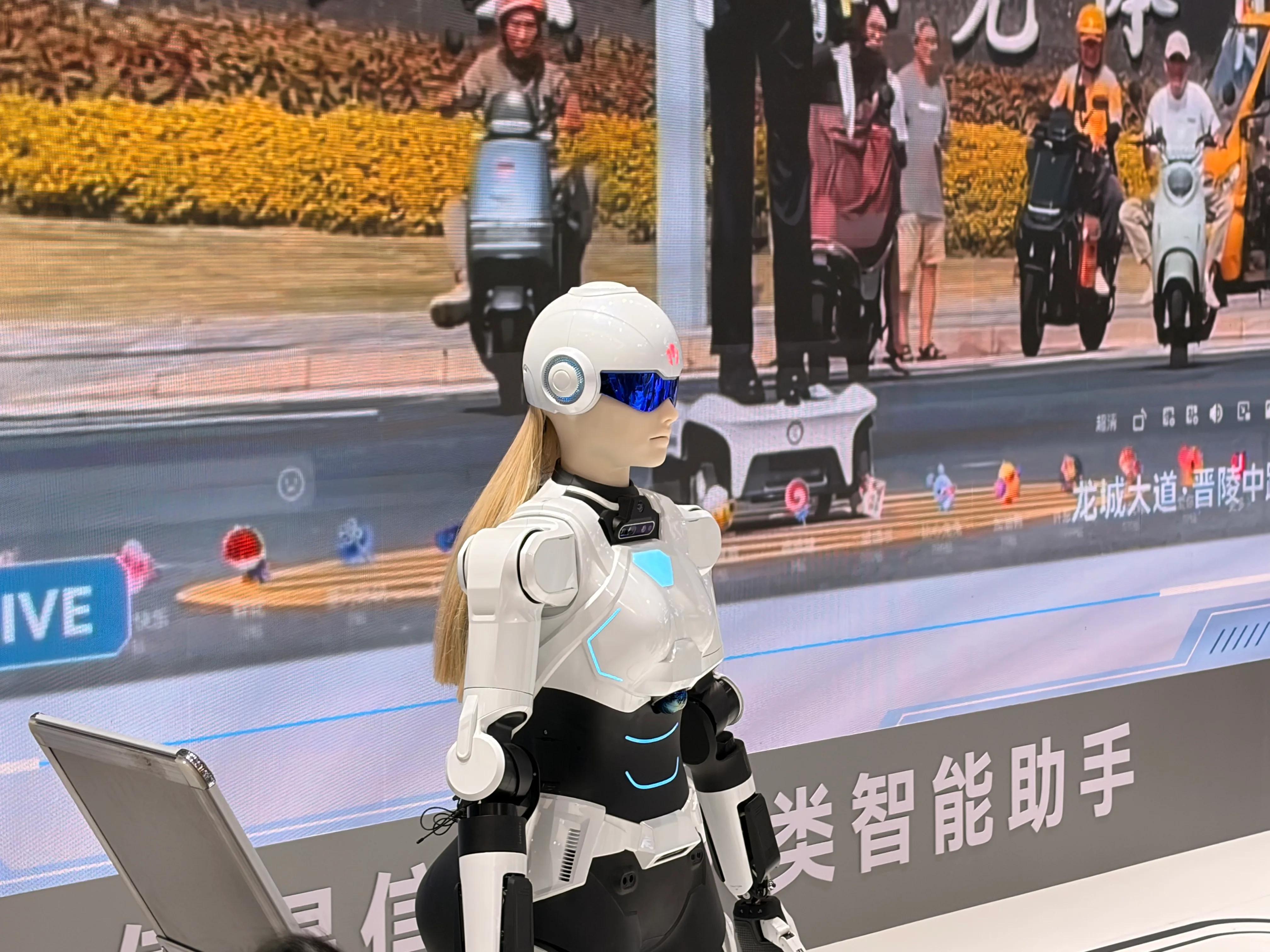
The second is reliability. The scenario demonstrations at the exhibition have tried their best to simulate the real situation in the home, but after all, there are engineers watching the whole process behind the scenes to deal with problems at any time. There are no engineers in the home scenario, and robots need to operate continuously in all kinds of strange home environments without supervision, without making mistakes, damaging objects or hurting people. This requirement is much stricter than any exhibition demonstration.
(Source: Leikeji on-site shooting)
In addition, there are safety and after-sales issues. When robots enter the home, it means they will coexist with people in the same room for a long time. Who is responsible for collisions, who is liable for personal injury caused by misoperation, who to contact for repair if it breaks down, and how much a repair costs. A mature set of industry standards is still needed at present. In contrast, the mature three guarantees policy and on-site after-sales service in the home appliance industry are worthy of reference for the robotics industry.
However, none of the above problems are big problems, and they can be solved gradually with the maturity of technology and richer product experience. In our view, robots entering households will most likely not be achieved in one step, but start by cutting in from a single point. This is also a commendable point of this year's WRC, that all manufacturers have become more pragmatic.
Unitree puts robots in the kitchen to make breakfast, Robam directly presents the complete solution of "kitchen space intelligent agent", Keenon lets general robots and dedicated robots cooperate with division of labor, and UBTECH simply takes the emotional companionship track. The entry points are different, but they all show that the industry has recognized that home scenarios need to be conquered one by one at present, and we cannot expect one robot to handle all tasks for the time being.
As for the process from "single housework tool" to "all-round home butler", it will not be particularly slow. Large models enable robots to have the ability to learn continuously. Many robots at the exhibition can continuously update their skills via OTA, learning one task today and possibly ten tasks tomorrow. When enough single tasks are accumulated, the all-round butler form will naturally emerge.
In addition, the underlying technology of robots is also developing rapidly. The world model is gradually popularized, giving robots stronger capabilities to perceive, learn and understand the real world; dexterous hands are evolving and being deployed rapidly, enabling robots to make more precise movements just like humans.
In addition, at this WRC, we have seen a large number of industrial and commercial scenarios, some of which have been deployed and achieved commercial success. On the surface, there are obvious differences between industrial scenarios and home scenarios, but the capabilities applicable to robots in industrial scenarios can also be migrated to home scenarios.
For example, robots that carry heavy loads in warehouses can also help users move furniture and home appliances at home, and even carry luggage up and down stairs. The robotic arm that can perform fine operations on industrial assembly lines can be connected to home robots to complete housework such as cutting vegetables and doing laundry.
For ordinary consumers, the "zero housework" brought by robots entering households is more like a long-term vision depicted by manufacturers. In the short term, we can already see housework being taken over by robots one by one. From this perspective, behind these demonstrations at WRC, the entire robotics industry is moving step by step towards the zero-housework era, and we only need to give a little more time and patience.