93.5 Billion Yuan of Hot Money and Cold Water: Is Unitree the Last Miracle Stock in the Embodied Intelligence Sector?
Just today, Unitree Robotics officially landed on the STAR Market, becoming the "first humanoid robot stock" on the A-share market. Its opening quotation reached 1,100 yuan per share, skyrocketing by 629.44% compared to the issue price of 150.80 yuan, setting a new record for the opening gain of new stocks on their first trading day this year.
This carnival in the capital market also serves as a striking footnote for the continuously warming embodied intelligence track.
According to the "2026 H1 China Embodied Intelligence Industry Investment and Financing Report" released by IT Juzi, there were 322 financing events in China's domestic embodied intelligence sector in the first half of this year, with the total financing amount reaching 935 billion yuan. Among them, early-stage financings including seed round, angel round, and Pre-A round reached 190 deals, accounting for 58.94% of all financing events, reflecting that capital is still willing to bet on technologies that are not yet fully mature and startup teams. The top 20 enterprises by financing amount (such as Self-Autonomous Robotics, Zhi Square, Qianxun Intelligence, etc.) received a total of 550 billion yuan, accounting for 59% of the total financing of the entire track, indicating that large amounts of capital are rapidly concentrating on a small number of leading projects.
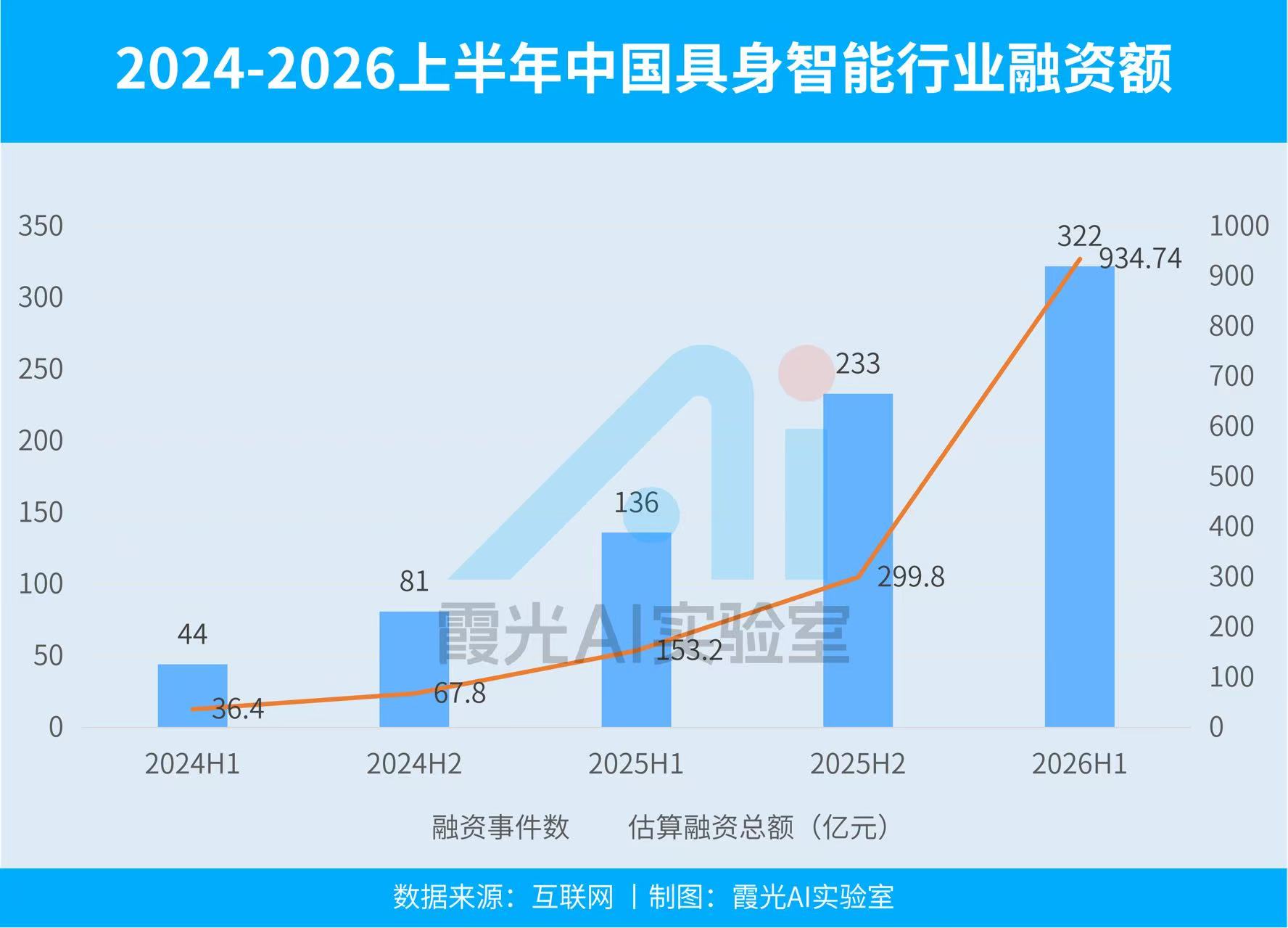
If you only look at these figures, embodied intelligence seems to still be in its most frenzied period.
However, when shifting the focus from financing announcements to the real financing process, a different feeling begins to emerge. The successive news of large-scale financing can easily give entrepreneurs an illusion: the track is so hot, so funding should still be very easy to obtain. But after actually starting the financing process, some startups find that investors are becoming more cautious, and projects need to go through longer communication and evaluation processes. Even enterprises that have successfully completed multiple consecutive rounds of financing can clearly feel that the questions raised by investors are getting more and more specific.
Mini, a dual-currency fund investor who has long focused on the embodied intelligence track, told Xiaguang AI that he has clearly felt that the actual investment "water level" of the industry is falling back recently, and the market is now in a state of "remaining warmth", investors still have money in hand, but investment decisions will become more and more rational.
This perception also appears in the judgments of some industrial capitals. In July this year, Wang Guangxi, Vice President of Lenovo Group and Managing Partner of Lenovo Capital and Incubator Group, mentioned during the Lenovo Capital Week that the current embodied intelligence market is "overheated", and valuations have been driven to a very high level. As leading enterprises go public one after another and more and more robots enter real business scenarios, this round of capital-driven popularity may gradually fade in the second half of this year or next year.
This means that the current boom in embodied intelligence financing may be entering a delicate stage: financing will continue, but the past state of capital pouring in rapidly and making decisive moves as soon as opportunities are spotted is weakening. Some entrepreneurs even begin to wonder whether the dense financing batches we see today are close to the end of this round of concentrated release of "hot money".
Is embodied intelligence financing really going to bid farewell to the era of "spreading money everywhere"?
A single Demo can no longer convince investors
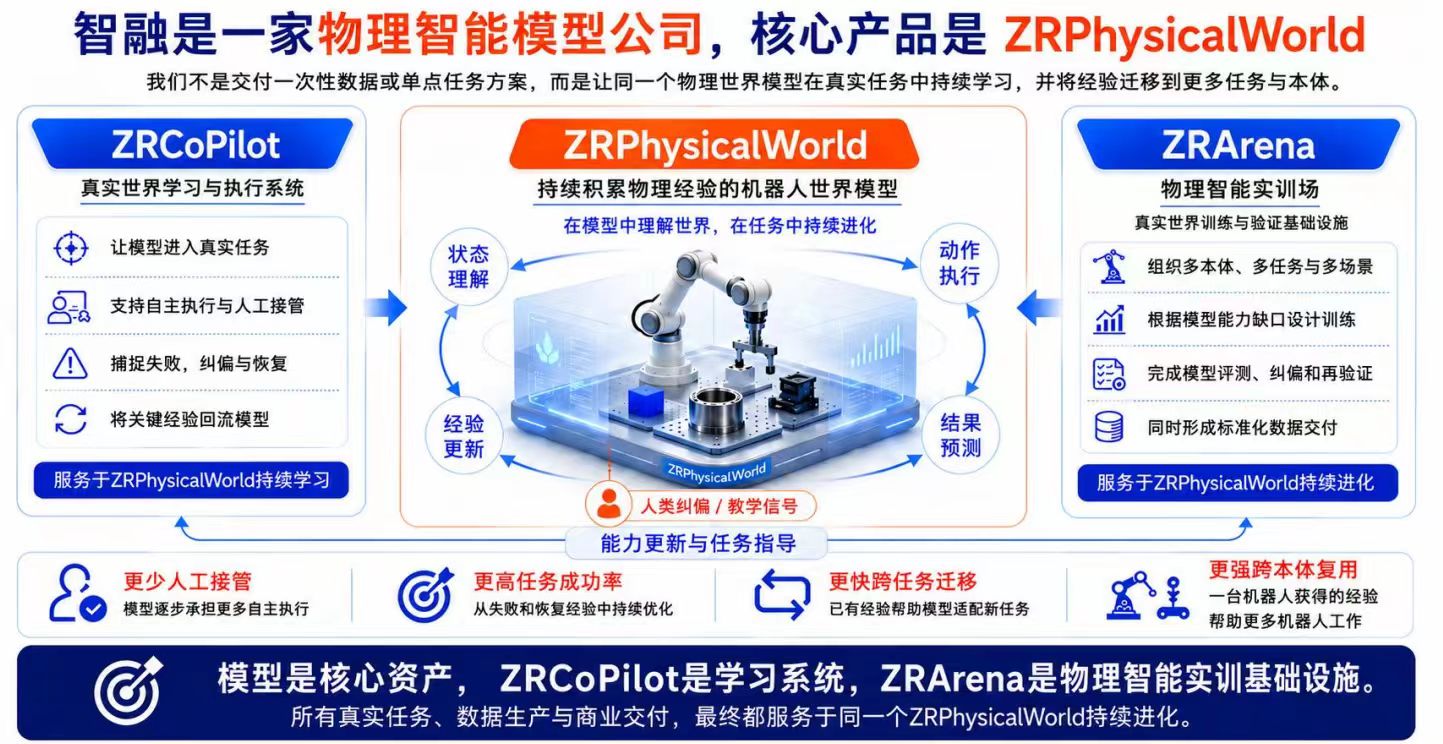
Zhirong is a physical intelligence model company whose core product is ZRPhysicalWorld. Since May this year, Zhang Yunbo, the founder, CEO and CTO of the company, has met with investors intensively, and has met with more than a dozen institutions so far.
During the process, he clearly felt a change: in the past, embodied intelligence entrepreneurs could meet investors with a Demo, and as long as they could prove that "this thing can run", they would get the opportunity for further communication. Now, investors are no longer limited to the technical demonstration itself. They are no longer willing to listen to trivial technical details, but ask directly: "In the simplest one sentence, what exactly can you do?"
This question seems simple, but it forces entrepreneurs to reorganize their way of expression.
Because when an industry is still in its early stage, the team background, technical route, and founder's judgment are part of the story itself. When more and more companies enter the same track, investors need to know what the capabilities and differences of each company are, besides "I am also working on embodied intelligence".
Quan Bo from Lighthouse Capital (FA) divides the financing market in the past few years into three waves.
The first wave was from the end of 2023 to 2024, with Galaxy, Unitree, and Agibot as the typical representatives at this stage. At that time, the market was relatively unfamiliar with embodied intelligence, and investors first focused on the team, technical direction and philosophy. The second wave took place in 2025, when the industry began to accumulate more technical and product performance. In addition to the team, investors also began to pay attention to more specific things such as data capabilities and Demos. In the first half of this year, it entered the third wave, and the focus of the market further shifted to scenarios and implementation.
The evolution of these three stages is not only reflected in the increasing financing amount, but also in the way investors understand the industry.
Initially, the question they needed to answer was: Is this a direction worth betting on? Later it became: Can this team actually make it happen? Now, the question has further evolved into: After the product is developed, what problems can it actually solve?
This is also why when evaluating an embodied intelligence project today, investors begin to habitually ask several more specific questions.
"What is the positioning, what market are you targeting, and how do you plan to roll out." Mini said that he uses these three questions for initial screening when evaluating projects.
As a leading FA in the embodied field, Lighthouse Capital also pays attention to several key points when undertaking projects.
The first is what problem an enterprise has solved for customers or the market. Is it solving the existing stock demand, or creating a new incremental market? Essentially, it is to examine the Value Proposition of a company.
The second is the capability itself. How are the algorithms, models, data, and training methods, and where is the real capability barrier located?
The third is the commercialization and delivery capability that has been raised to a higher position this year: if the product enters the market, can it complete the delivery, and whether the commercialization capability and delivery capability can keep up.
There is a very realistic reason behind this: for companies in the same track today, it is difficult to truly judge who has stronger capabilities only by looking at the external narrative of the company's business plan. All companies working on AI brains can claim that their models are the strongest, and ontology companies also have their own areas of expertise, some show dancing, some show playing football, and some have entered retail scenarios.
However, these Demos are not without value. In Quan Bo's view, dancing and playing football are themselves a kind of capability demonstration. A robot dancing may demonstrate its motion control capability; if this capability can be generalized to other tasks, then it is no longer just a "dancing" Demo. Even the performance of this emotional value itself is meaningful, but moving from emotional value to solving industrial problems, and then to products that end consumers are truly willing to use continuously, needs to be completed step by step.
Therefore, investors do not suddenly stop looking at Demos, but what the Demo represents has changed.
In the past, a Demo could prove that "I can do it". Now, what investors want to know more is: Which of your capabilities does this Demo prove, whether this capability can continue to advance, and where it can finally lead.
Financing is still rising, but capital is shifting gears
When investors' judgments become more cautious and specific, a seemingly contradictory question arises: Why are the news of large-scale financing in embodied intelligence still coming one after another without interruption?
The answer first lies in the inherent logic of "continuous financing".
"The market is still very hot this year, especially for RMB funds. If they do not invest in high-end manufacturing and there are not many AI software tracks to choose from, embodied intelligence is still an important investment landing point." Mini said. However, companies that can get multiple rounds of financing consecutively this year do not necessarily mean that they have suddenly received intensive bets from the capital market this year. Some companies actually entered the financing market last year, and this year is just the time point when it is easier to see phased results.
There is another type of company with a different situation: they have relatively strong technical capabilities, but entered the market late, with a relatively low early valuation, so they can gradually raise their valuation to the generally accepted market level through several consecutive rounds of financing.
Quan Bo used a very vivid term — "show your cards".
In the past, the capital market has actually been in the betting stage. Each company has its own unique team, story and technical route, and it is difficult for investors to know who will stand out in the end, so everyone is willing to bet, and even bet relatively evenly in some stages.
But this year, the first card has begun to be turned over. The model capabilities, data capabilities, and scenario implementation capabilities that were previously written in PPTs have begun to show actual performance. Some enterprises are obviously running faster than their competitors, and capital will naturally further concentrate on these companies; for some other projects, after the first card is turned over, if their performance fails to meet investors' expectations, subsequent financing will become more difficult, and the market will continue to move towards differentiation.
However, turning over the first card only allows the market to see the cards in hand, which does not mean that the outcome has been determined. Companies with high winning rates today may not always maintain their advantages in the next stage; on the contrary, companies that seem to have lower winning rates now may catch up again with technological breakthroughs or scenario progress. When the next round of cards are turned over, the market will make new judgments.
This screening process will continue, and will go deeper along the industrial chain of embodied intelligence. The market first focused on robot ontologies, and many of the enterprises that are close to going public now are ontology companies. Subsequently, capital began to shift its attention to embodied AI brains; later, more refined links such as data collection and tactile sensors also saw companies that can obtain large-scale financing.
"This just shows that the understanding of capital and industry on embodied intelligence is advancing step by step: investors need time to understand what problems exist in this industry, what the most important problems are, and what capabilities are truly worthy of investment." Zhang Yunbo said.
Mini also observed this key change. He believes that as long as the industry β of the embodied intelligence track remains, data can continue to be fed into the model, and the model effect theoretically still has room for improvement. Therefore, it is difficult to simply say that a certain technical route has been falsified in the short term. A key problem that truly restricts the further development of the industry is still data.
But having a large amount of data does not mean the data is effective. Looking back at the first wave of the market, he believes that the industry did a lot of "seemingly busy" work in its early stage, and some data did not really generate value. For example, throwing a large amount of unscreened data directly to the model cannot naturally get good training results. The real problem is that the industry needs to first figure out what kind of data is valuable and how to customize data.
"Domestic model manufacturers were relatively weak in data customization capabilities in the past, and the industry was mostly in a follow-up state for a long time. As everyone truly enters the model training stage, the quality, collection methods and customization capabilities of the data itself have increasingly become the core issues."
Zhirong actually started thinking about this problem very early.
In 2019, when Zhang Yunbo's team started working on Robot Learning, the term "embodied intelligence" was not even as popular as it is today. The problem they wanted to solve at that time was very simple: can robots independently complete some tasks through AI models.
After they actually started training models and developing algorithms, they encountered the most realistic problem — without data, the model cannot run at all.
Therefore, since that time, the team has been constantly exploring data collection methods, and gradually formed the technical route that they still adhere to today: combining data and models together to form a continuous closed-loop cycle between the two.
Its core product system includes AI-assisted data collection, physical intelligence training ground and physical world model, hoping that the data generated by real tasks can be used for model training, and then the model capabilities can in turn assist data collection and task execution, so as to form a faster data flywheel. At present, the model has been implemented in actual scenarios such as VR teleoperation, flexible operation, and tactile perception.
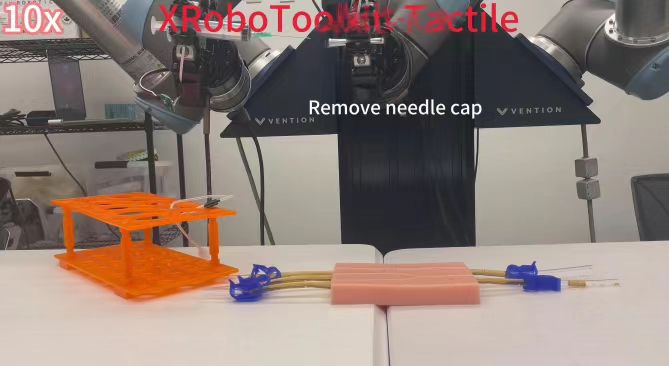
Intelligently assisted contact force enriches flexible physical operations
As for whether to use real data or synthetic data, Zhang Yunbo does not think the two are mutually exclusive.
Synthetic data can help the model complete cold start, but when tasks become more and more complex, real data still has obvious advantages in terms of training effect and success rate. Even some companies that specialize in synthetic data will eventually need to face the problem of real data production. Therefore, the two types of data need to coexist, and different teams just have different priorities.
Behind this actually reflects a larger problem: embodied intelligence is far from having a set of standard answers widely recognized by the industry today. When solving the problem of robot intelligence, different teams have their own judgments on what to solve first, what technology to use, and where to cut in.
In terms of scenarios, some focus on logistics, some on industry, and some on retail; in terms of technology, some choose VLA, while others bet on world models. In Quan Bo's view, these differentiations are real at present, but they have not formed high enough barriers that other companies cannot easily cross. As the industry continues to develop, different routes may eventually converge again, and the market will gradually come up with "best practices".
What kind of companies will be selected in the next round?
When the market is no longer willing to generously pay for concepts, the problem returns to the most essential point: what kind of companies will be selected in the next round?
According to the summary of Lighthouse Capital, there are roughly several types of companies that are more likely to obtain financing in the future:
The first type is companies that already have productization and large-scale delivery capabilities. Such enterprises can prove that they are not only capable of developing a Demo, but also truly capable of delivering products to customers. However, in today's embodied intelligence industry, there are not many such companies, and more mature cases still come from the previous generation of industrial robots.
The second type is companies whose models and data have formed a certain positive cycle. The market can clearly see where its model capabilities are, or at least judge that it has established a continuously iterable technical system.
There is also a type of company that has already achieved commercial validation in specific scenarios. It does not need to solve all problems at the very beginning, but if the team said "we will make it work in half a year" six months ago and actually delivered the product after half a year, this itself is a kind of certainty.
Mini used a term to sum it up: the unity of knowledge and action. In his view, there are more and more startups in the market now, and the stories they tell are getting more and more complete. What really needs to be verified is whether "knowledge" and "action" can match. If a team wants to work on world models, applications, hardware, and multiple industries at the same time, but the team size, technical accumulation and resources are not sufficient to support these goals, it will be difficult for investors to judge how far it can go.
Therefore, Quan Bo believes that the key to this process is to find a "single-point breakthrough". For startup teams with limited resources