36Kr Research | 2026 China Commercial Aerospace Industry Development Research Report
At present, commercial aerospace has become the core track of scientific and technological competition among countries, and it is also one of the most dynamically growing fields in China's strategic emerging industries. After more than ten years of industrial development, China's commercial aerospace is moving from the technology verification period to the large-scale operation period. At the policy level, commercial aerospace has been included in the Government Work Report for many consecutive years. The 2026 Government Work Report further incorporated aerospace into the "emerging pillar industries". At the technical level, on July 10, 2026, the Long March 10B completed the world's first maritime net recovery verification; on August 19, 2026, the Zhuque-3 Y2 of Landspace successfully realized China's first-stage land recovery test for launch vehicles, accelerating the reusable rocket technology to enter the deepening stage of engineering verification. At the same time, flexible satellite production lines have been put into operation one after another, the manufacturing cost and cycle of a single satellite continue to decline, and the industrial basic capacity is steadily consolidated. At the market level, services such as satellite remote sensing and satellite communication have achieved in-depth applications in B/G end scenarios such as refined urban management, emergency services and public services, and are expanding rapidly in consumer fields such as direct satellite connection for mobile phones and direct satellite connection for automobiles. However, the industry still faces many structural challenges: compared with leading international enterprises, there are still gaps in launch capacity and mass production efficiency, the localization rate of core components needs to be improved, and the "first-come, first-served" rule for frequency and orbit resources further amplifies the urgency of industrial development.
Against this background, 36Kr Research Institute releases the "2026 China Commercial Aerospace Industry Development Research Report", which systematically sorts out the industrial development context and ecological pattern, deeply analyzes the development trends of the upstream and downstream of the industrial chain, builds a four-dimensional enterprise evaluation system covering development potential, innovation capability, commercialization capability and capitalization capability, and systematically judges the future development trend of the industry combined with the practice of typical enterprises, aiming to provide relatively objective, systematic and forward-looking research references for industry participants.
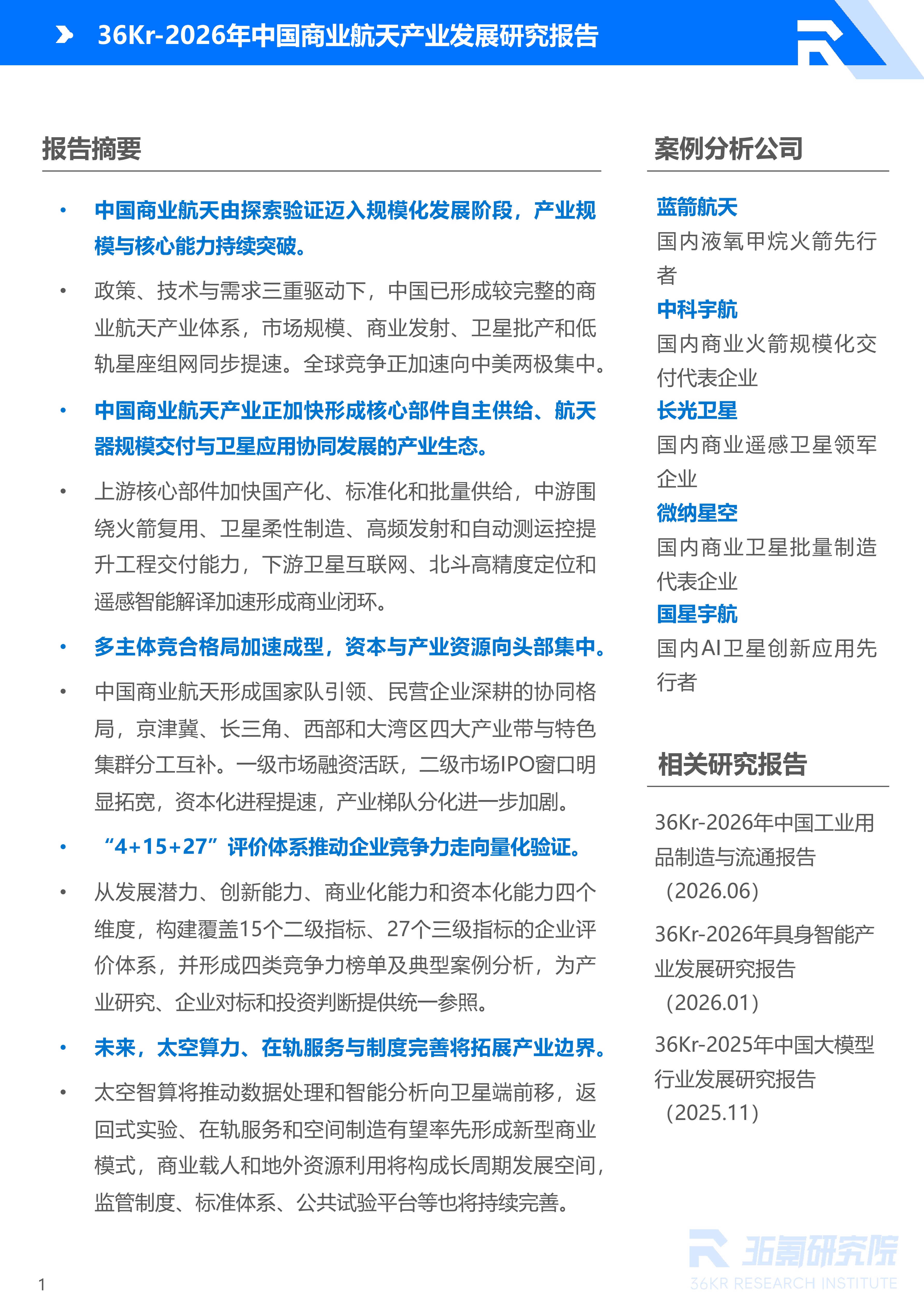
China's commercial aerospace has moved from exploration and verification to the stage of large-scale development, with continuous breakthroughs in industrial scale and core capabilities
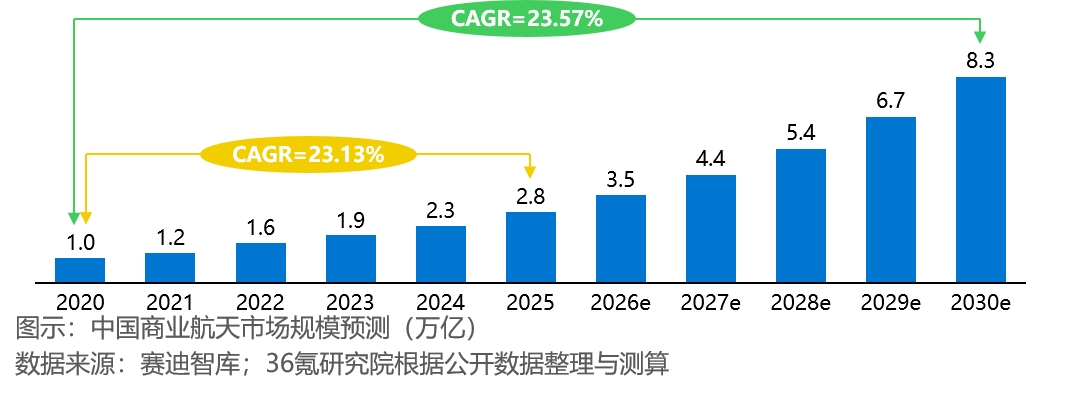
Driven by the three factors of policy, technology and demand, the scale of China's commercial aerospace industry is growing rapidly. According to CCID data, the size of China's commercial aerospace market reached 2.83 trillion yuan in 2025, a year-on-year increase of 21.7%, and it is expected to exceed 3.5 trillion yuan in 2026. Breakthroughs have been made in all links of the industrial chain: rocket launch capacity continues to improve. According to the data from the China National Space Administration, there were 50 commercial launches in 2025, hitting a record high; satellite manufacturing is transforming from "customization" to "industrialization", and the annual production capacity of some leading domestic enterprises has reached the level of hundreds of satellites, with large-scale manufacturing capacity initially formed; the Qianfan Constellation and GW Constellation are accelerating network deployment, and the satellite internet has entered the stage of mass deployment. The global competition pattern presents a bipolar situation with China and the United States as the core. Relying on the parallel exploration of multiple technical routes, China is accelerating to narrow the technical gap with the United States, and with its unique industrial model and institutional advantages, it is accelerating to build an internationally competitive commercial aerospace industrial system.
China's commercial aerospace industry is accelerating to form an industrial ecosystem featuring independent supply of core components, large-scale delivery of spacecraft and coordinated development of satellite applications
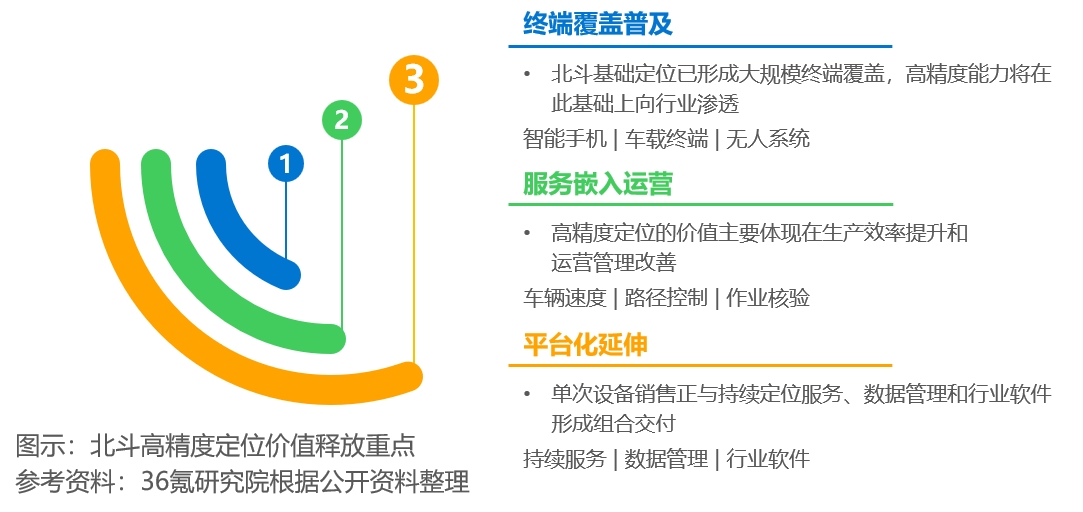
All links of the commercial aerospace industrial chain are advancing in coordination. The upstream core components are moving from single-piece breakthrough to localization, standardization and mass supply: the supply of liquid rocket engines has entered the stage of specialized production line construction, aerospace electronic devices implement a hierarchical substitution strategy, composite materials and additive manufacturing promote the lightweight of spacecraft, and communication payloads and user terminals are developing towards high integration and low power consumption. The midstream links focus on the construction of large-scale delivery capacity: substantial breakthroughs have been made in reusable rocket technology, the Long March 10B has completed the world's first maritime net recovery, the Zhuque-3 Y2 has successfully completed China's first-stage land recovery test for launch vehicles, and the focus of engineering verification is extending from single recovery to reflight of recovered stages and high-frequency operation; satellite manufacturing is accelerating the transformation to standardized, modular and flexible production lines; the Hainan Commercial Spacecraft Launch Site is put into normal operation, and the turnover efficiency of a single station continues to improve, providing infrastructure support for high-frequency launches. At the downstream application end, the LEO satellite internet has entered the continuous networking stage, and large-scale deployment is driving the coordinated expansion of launch vehicles, satellites and launch sites; Beidou high-precision services are extending to terminals, platforms and operation systems, and have achieved large-scale applications in vertical scenarios such as precision agriculture; the supply of remote sensing services continues to expand, AI intelligent interpretation greatly improves the efficiency of data application, and large-scale constellations provide the foundation for cross-industry replication and commercial operation of remote sensing services.
The co-opetition pattern of multiple entities including national teams and private enterprises is taking shape at an accelerated pace, with capital and industrial resources concentrating in leading cities and enterprises
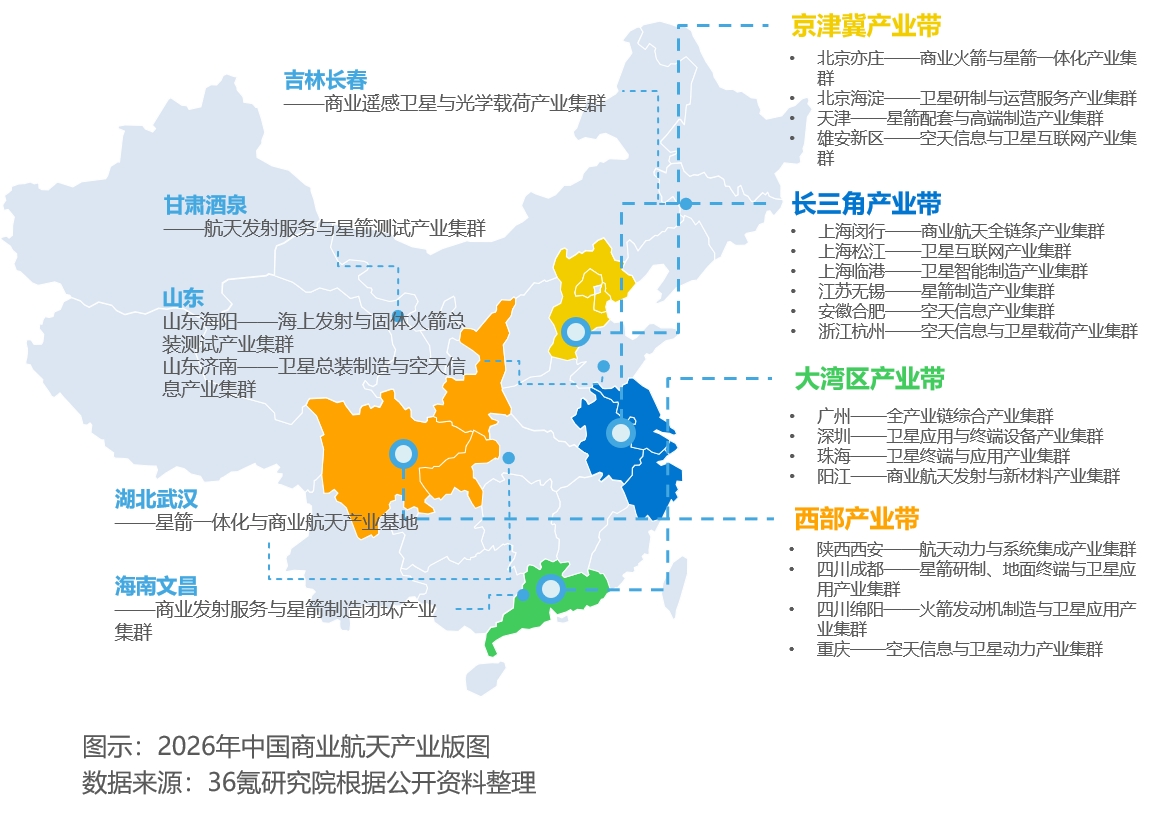
Participants in the commercial aerospace market are pouring in rapidly. National teams and private enterprises carry out collaborative innovation, forming a multi-stakeholder co-opetition and symbiosis pattern of "national teams leading, private enterprises ploughing deep". At the regional level, the four major industrial belts of Beijing-Tianjin-Hebei, Yangtze River Delta, Greater Bay Area and Western China, as well as characteristic industrial clusters, have complementary functions, and have initially formed a spatial framework covering R&D, manufacturing, application and services. In terms of the capital market, financing in the primary market remains active. According to relevant statistics, the total financing in the first half of 2026 exceeds 150 billion yuan, with funds highly concentrated in the rocket launch and satellite manufacturing tracks, and accelerating to gather in leading cities and enterprises. Meanwhile, the participation rate of state-owned capital jumped from 41% to 59.8% in the past year, becoming an important source of funds in the primary market. In the secondary market, as the IPO policy window is significantly widened, the capitalization process of commercial aerospace enterprises speeds up, and the differentiation of industrial echelons is further intensified.
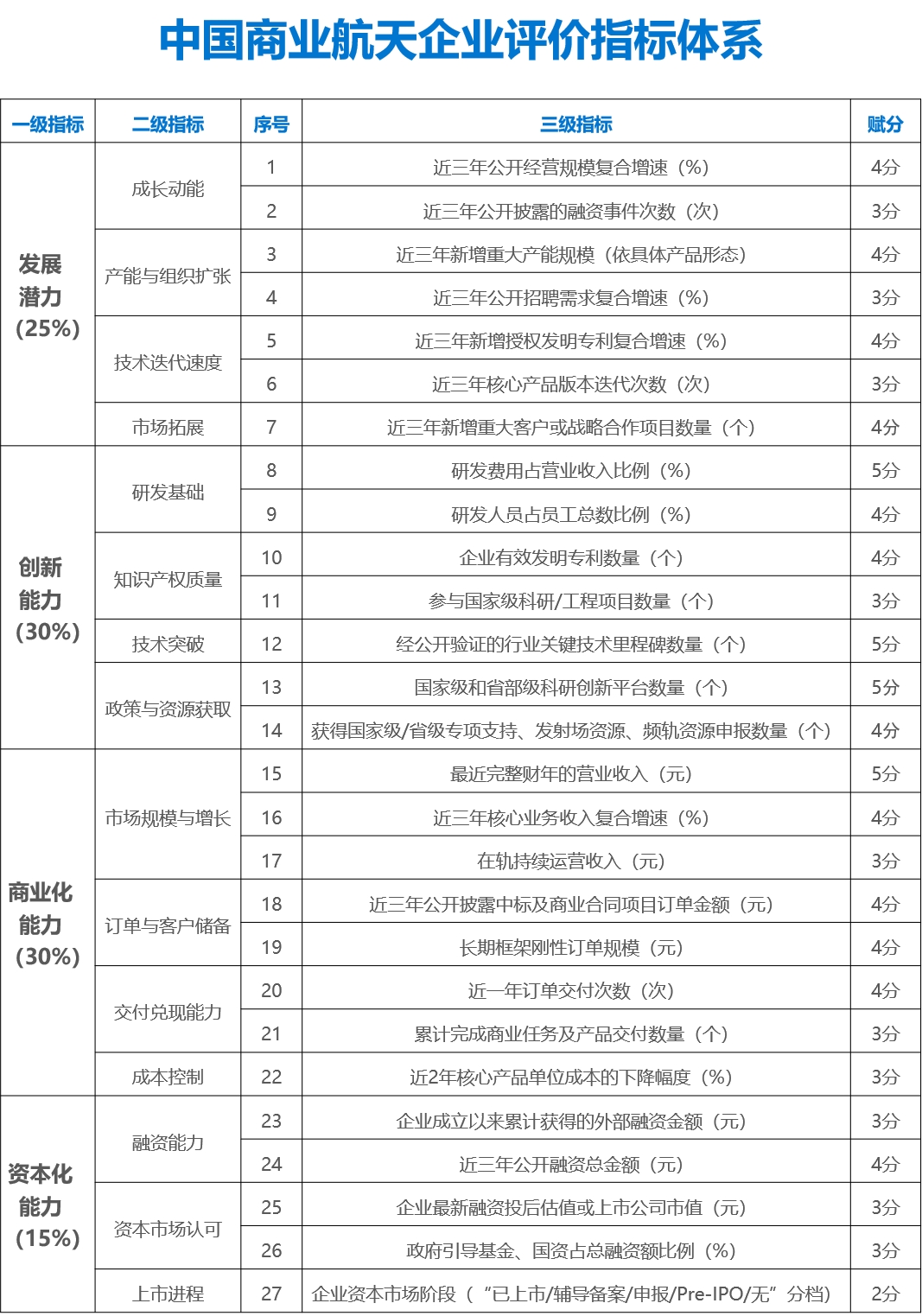
The "4+15+27" evaluation system promotes the quantitative verification of enterprise competitiveness
Targeting the industrial characteristics of commercial aerospace, which features high technical barriers, long-cycle investment and strong capital-driven properties, 36Kr Research Institute has built a "4+15+27" enterprise competitiveness evaluation index system covering four dimensions of development potential, innovation capability, commercialization capability and capitalization capability (namely 4 first-level indicators, 15 second-level indicators, and 27 third-level indicators). The indicator system follows four principles: equal emphasis on comprehensiveness and focus, balance between industry characteristics and comparable classification, balance between standardization and verifiability, and combination of actual performance and forward-looking value. It aims to present the comprehensive competitiveness, capability structure and development stage of enterprises in a quantitative way, and provide a relatively unified analytical framework for industrial research, enterprise benchmarking, investment judgment and policy evaluation.
In the future, space computing power, on-orbit services and system improvement will jointly expand the boundary of the commercial aerospace industry
China's commercial aerospace industry is evolving along three directions: computing power expansion, business format upgrading and industrial maturity. Space intelligent computing will promote some data processing tasks to be moved from the ground to the satellite end. In the future, satellites can complete data screening, target recognition and intelligent reasoning in orbit, effectively shortening the remote sensing monitoring and emergency response links, and improving the utilization efficiency of satellite-ground communication resources. Returnable experimental platforms are expected to take the lead in forming commercial service capabilities in the short term; in the medium term, with the expansion of constellation assets, the demand for professional services such as on-orbit inspection, fuel refueling, component maintenance and debris removal will continue to be released; in the long run, commercial manned activities and extraterrestrial resource utilization will further expand the boundary of the space economy. In the future, commercial aerospace will form a full-life-cycle governance system covering technology R&D, production test, launch operation and data application. Public test and pilot platforms will lower the technical verification threshold for enterprises, and international operation will further expand the capability boundary of commercial aerospace soft infrastructure. China is expected to form a commercial aerospace development path with global influence.

This report conducts research on the following key issues:
- What kind of development path has China's commercial aerospace industry experienced? What stage of development is it currently in?
- What are the core driving forces promoting the development of China's commercial aerospace industry?
- What is the trend of the global commercial aerospace competition pattern? In which dimensions are the technical gaps and differentiated development paths between China and the United States reflected?
- What structural characteristics and new development trends are presented in the upstream, midstream and downstream links of the commercial aerospace industrial chain respectively?
- What breakthroughs have been made in key fields such as localization of core components, rocket recovery and reuse, and satellite mass manufacturing? What bottlenecks are faced?
- What are the characteristics of China's commercial aerospace market pattern? What is the spatial pattern of the industrial regional distribution?
- What changes have taken place in the financing structure and capital flow of the commercial aerospace primary market?
- What are the driving factors for IPO of commercial aerospace enterprises? What are the characteristics of the current capitalization process?
- How does the "4+15+27" evaluation system depict the comprehensive competitiveness of commercial aerospace enterprises? What are the typical representative enterprises?
- Facing the future, along which directions will China's commercial aerospace industry evolve? How to expand the boundary of the commercial aerospace industry?
For more exciting content, please refer to the "2026 China Commercial Aerospace Industry Development Research Report", click Download Link, Extraction code: gjxw