Baidu earned 12.5 billion yuan in the second quarter driven by AI.
GPU cloud revenue surged 283% and AI applications revenue rose 3%, Baidu's AI revenue accounts for more than half of its core business.
August 18 report from Zhidx, Baidu has just released its financial results for the second quarter of 2026. Its total revenue in the second quarter reached 31.325 billion yuan, a year-on-year decrease of 4.2%; its net profit was 2.319 billion yuan, a year-on-year decrease of 68.33%, and the non-GAAP net profit was 2.6 billion yuan; its R&D investment reached 4.6 billion yuan, a year-on-year decrease of 10%.
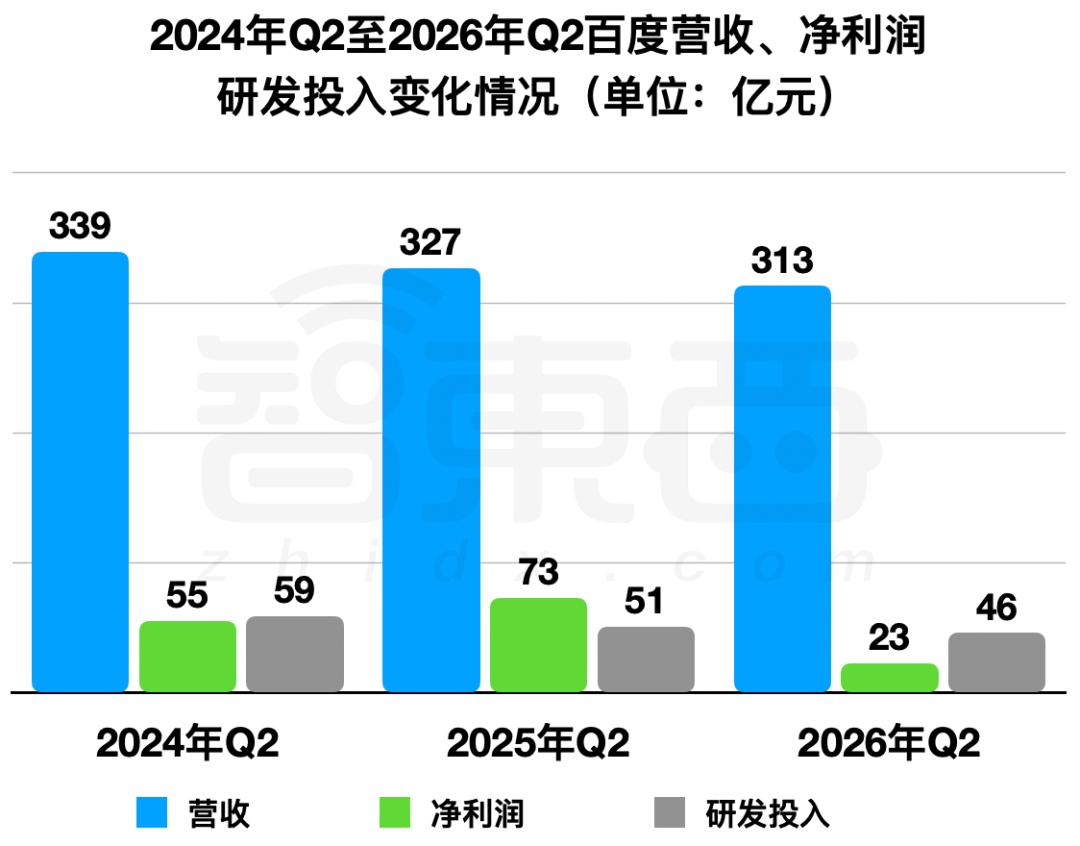
Changes in Baidu's revenue, net profit and R&D investment from Q2 2024 to Q2 2026 (Unit: 100 million yuan)
Overall, the decline in Baidu's core advertising business offset the growth of AI-related cloud services, leading to a drop in total revenue and net profit. There are several key figures in Baidu's AI-related business: the revenue of Baidu's core AI-driven business reached 12.5 billion yuan, and the proportion of AI business revenue in Baidu's general business revenue has reached or even exceeded 50% for two consecutive quarters; within Baidu Intelligent Cloud sector, its GPU cloud business revenue skyrocketed 283% year-on-year, though the specific amount was not disclosed.
Baidu's executives revealed during the earnings call that its GPU cloud business has achieved triple-digit growth for four consecutive quarters.
Regarding the listing of Kunlunxin, Shen Dou, Executive Vice President of Baidu Group and President of Baidu Intelligent Cloud Business Group, revealed during the conference call that the listing process of Kunlunxin is still in progress, and the team is fully confident in its long-term growth potential and business prospects.
In addition, Baidu is pushing forward the conversion to dual primary listing in Hong Kong, which is expected to be completed and take effect within this year. Yang Yuanqing, an independent director, will be newly appointed as a member of the Audit Committee, and Liu Xiadan, another independent director, will be newly appointed as a member of the Corporate Governance and Nomination Committee.
Baidu's revenue performance fell short of Wall Street analysts' expectations, as analysts previously predicted an average revenue of 31.96 billion yuan. After the release of the financial report, Baidu's stock price fell by 9% in pre-market trading.
01. GPU cloud business skyrocketed 283%, AI application revenue rose 3% year-on-year
Baidu's total revenue in the second quarter reached 31.3 billion yuan, consisting of 25.2 billion yuan from general business revenue and 6.4 billion yuan from iQiyi.
In the general business, the revenue of core AI technology-driven business reached 12.5 billion yuan, the revenue of traditional legacy business reached 10.4 billion yuan, and the revenue of other businesses was 2.2 billion yuan.
Among them, the proportion of AI business revenue in Baidu's general business revenue has reached or exceeded 50% for two consecutive quarters, hitting 50% in the second quarter of this year, 52% in the first quarter of this year, and 38% in the second quarter of last year.
Specifically, Baidu's AI business revenue consists of three parts: AI cloud infrastructure revenue, AI application revenue, and AI-native marketing service revenue.
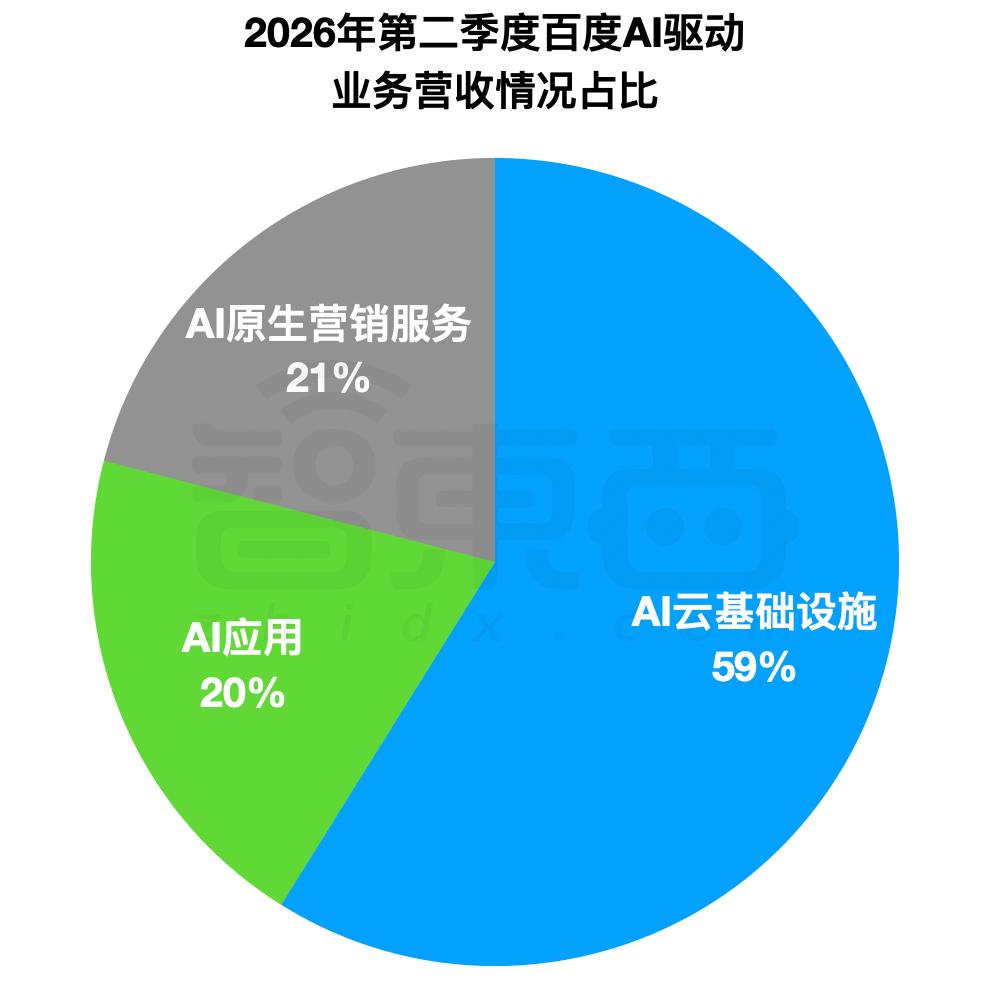
Revenue proportion of Baidu's core AI-driven business
First, let's look at the AI cloud infrastructure segment.
Benefiting from the surge in computing power demand brought by AI implementation, in the second quarter of 2026, Baidu Intelligent Cloud's infrastructure revenue reached 7.3 billion yuan, a year-on-year increase of 50%. Within Baidu Intelligent Cloud sector, its GPU cloud business revenue skyrocketed 283% year-on-year, and the growth rate was 184% in the first quarter of this year.
Baidu's financial report mentions that the GPU cloud revenue was previously called AI accelerated infrastructure subscription revenue, and the growth of GPU cloud business revenue reflects the continuously rising market demand for public cloud AI computing power. He Haijian, Baidu's CFO, stated that Baidu's GPU cloud business usually has a higher profit margin, and its proportion in total revenue will gradually increase.
Li Yanhong revealed during the earnings call that the token usage revenue from external customers of Baidu's Qianfan large model service and Agent platform increased by more than 9 times year-on-year.
The second part is the AI application segment. Baidu's AI application segment revenue reached 2.5 billion yuan in the second quarter, a 3% year-on-year increase. As of June 2026, the daily active user penetration rate of AI functions across all products of Baidu Wenku and Baidu Netdisk increased by 27.4% year-on-year.
Baidu also disclosed the latest product data of its AI application matrix.
According to the AI office agent ranking, Baidu's general agent Baidu Dazi achieved a month-on-month MAU (Monthly Active Users) growth rate of 1063.79% in July, ranking first in the growth list; the general agent Kuku AI for office scenarios has an MAU of over 25 million, ranking first in the AI office track across the industry.
The "China AI-native No-Code Application Generation Platform Market Research Report (H1 2026)" released by Sullivan shows that Baidu's no-code application generation platform Miaoda occupies 33.4% of the domestic market share, ranking first in the industry; the self-evolving agent Baidu Famou has received trial applications from 3000 enterprises since its release.
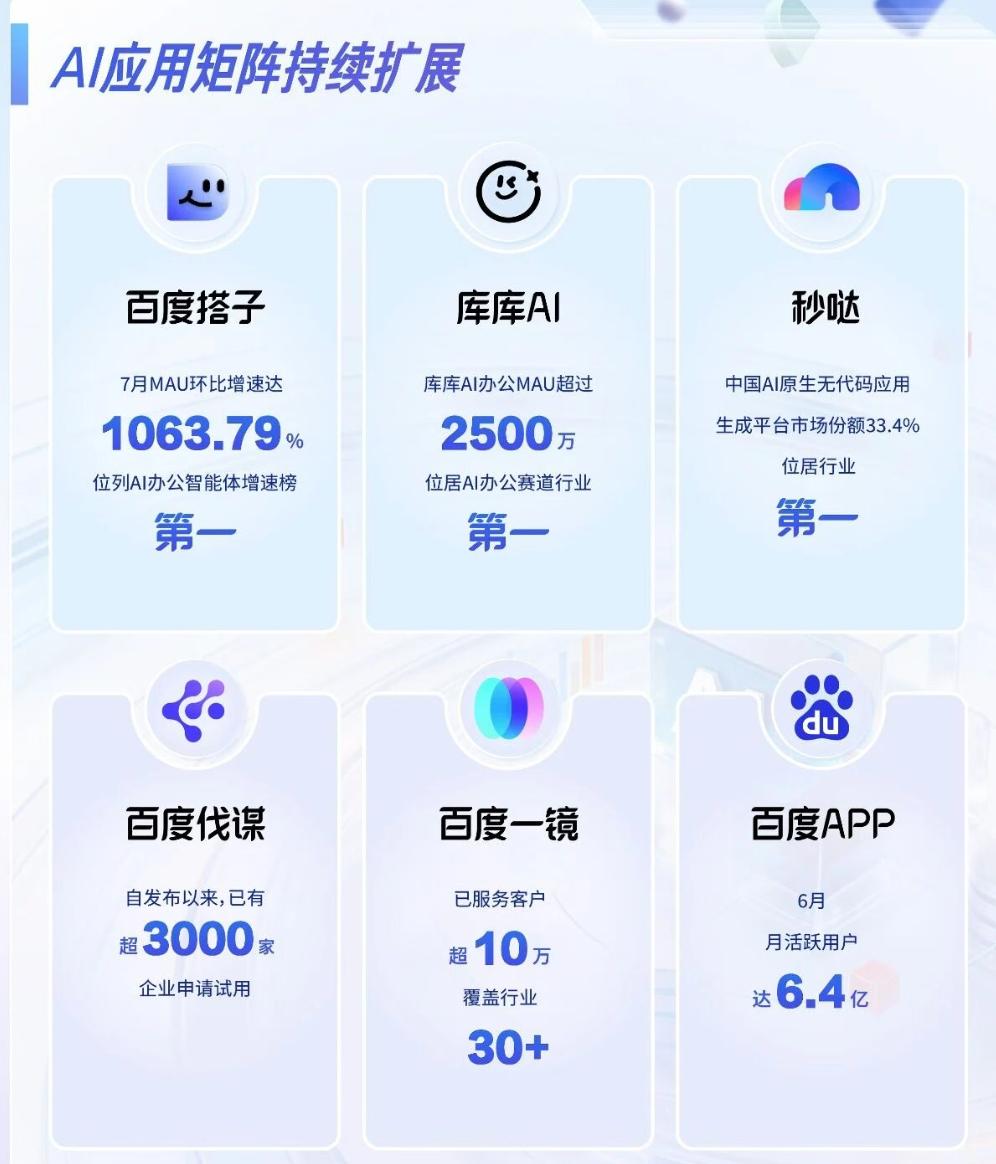
User data of Baidu's disclosed AI products (Source: Baidu)
The last part is AI-native marketing services. In the second quarter of 2026, the revenue of Baidu's AI-native marketing services reached 2.6 billion yuan, which was basically flat year-on-year. As of June 2026, the monthly active users of Baidu App reached 644 million.
For the AI marketing service sector, data disclosed by Baidu shows that Baidu's full-scenario digital human platform Baidu Yijing has served more than 100,000 customers, covering over 30 industries.
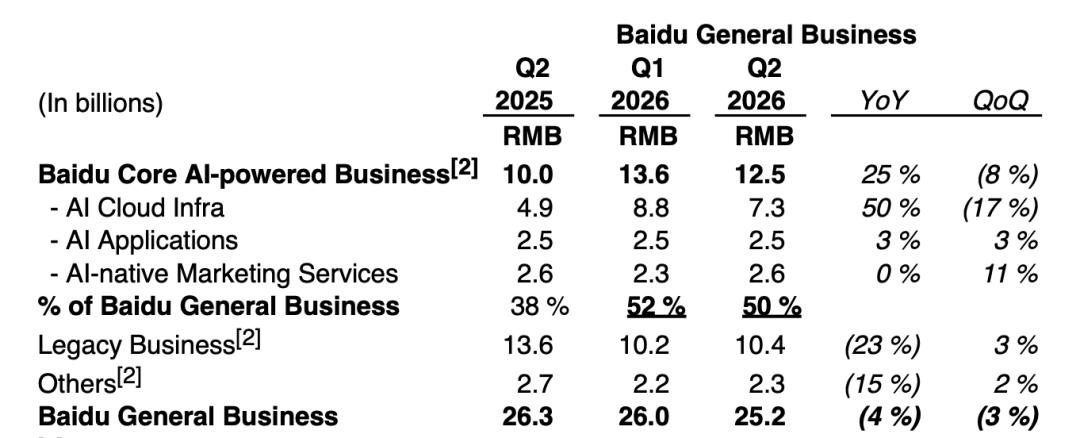
Financial performance of Baidu's core AI-driven business
Nikkei Asia cited analysts' views that Baidu continues to increase investment in AI infrastructure construction and talent recruitment. Even if AI-related revenue maintains growth, this high transformation investment may continue to put pressure on Baidu's profit margin in the short term.
02. Advertising base business declined by 19% year-on-year, AI growth was partially offset by the decline of traditional business
Overall, the advertising revenue in Baidu's general business revenue has dropped significantly.
Baidu's advertising business revenue in the second quarter of 2026 was 13.1 billion yuan, a year-on-year decrease of 19% and a month-on-month increase of 4%, accounting for 52% of the total main business revenue.
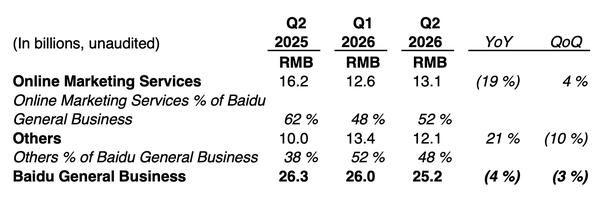
Financial performance of Baidu's online marketing business
Baidu's financial report mentions that its cost of revenue was 19.1 billion yuan, a year-on-year increase of 4%, which was mainly driven by the rise in costs related to Baidu Intelligent Cloud business.
In the second quarter, Baidu's operating profit was 3 billion yuan, with an operating profit margin of 10%; its non-GAAP operating profit was 3.8 billion yuan, with an operating profit margin of 12%.
The net profit attributable to Baidu was 2.3 billion yuan, with a net profit margin of 7%, and the diluted earnings per ADS was 5.74 yuan. Under non-GAAP, the net profit attributable to Baidu was 2.6 billion yuan, with a net profit margin of 8%, and the diluted earnings per ADS was 7.22 yuan. Baidu's adjusted EBITDA reached 6.2 billion yuan, with a profit margin of 20%.
As of June 30, 2026, Baidu's total cash and investments reached 283.1 billion yuan, and the cash flow from operating activities was 3.4 billion yuan.
In terms of R&D investment, Baidu's R&D expenses in the second quarter reached 4.6 billion yuan, a year-on-year decrease of 10%. The financial report shows that this fluctuation is mainly caused by changes in personnel compensation-related expenditures.
Since the beginning of the first quarter of 2026, Baidu has returned 259 million US dollars (about 1.746 billion yuan) to shareholders through the current stock repurchase program.
As of June 30, 2026, Baidu's general business has approximately 27,000 employees. Baidu's financial report for the fourth quarter of 2025 shows that its general business had 29,000 employees at that time.
03. Dual primary listing to be completed within the year, members of special committees under the board of directors adjusted
In July this year, Baidu announced that it plans to voluntarily convert its listing status on the Main Board of the Hong Kong Stock Exchange from secondary listing to primary listing. After the conversion, Baidu will achieve dual primary listing on both the Main Board of the Hong Kong Stock Exchange and the NASDAQ Global Market.
The financial report mentions that this primary listing conversion is expected to take effect within 2026, subject to the approval of the general meeting of shareholders and the authorization of the Hong Kong Stock Exchange.
Along with this primary listing conversion, Baidu's board of directors has approved the adjustment of members of the special committees under the board of directors. The new rules will take effect on the date when the dual primary listing conversion takes effect:
Independent director Yang Yuanqing will be newly appointed as a member of the Audit Committee. After the adjustment, the members of the Audit Committee include Liu Xiadan, Fu Jixun and Yang Yuanqing, with Liu Xiadan serving as the chairperson.
Independent director Liu Xiadan will be newly appointed as a member of the Corporate Governance and Nomination Committee. After the adjustment, the members of the Corporate Governance and Nomination Committee include Fu Jixun, Yang Yuanqing and Liu Xiadan, with Fu Jixun serving as the chairperson.
Baidu's executives mentioned during the earnings call that the main purpose of Baidu's realization of dual primary listing is to expand the investor base, improve the liquidity of the company's stock, and gain greater flexibility in financing channels.
04. Conclusion: Baidu's revenue focus is shifting, computing power has become the key revenue source of AI business
Judging from Baidu's revenue performance in the second quarter of this year, the significant year-on-year decline in online marketing services has become the main factor dragging down the overall revenue. Nowadays, content platforms such as Douyin, Xiaohongshu, WeChat ecosystem, and AI-native search tools are continuously seizing users' general search demands, which puts pressure on Baidu's search advertising business.
In the AI field, the sale of computing power infrastructure is the main source of revenue, and the commercialization capability of AI-native applications is relatively weak. But overall, Baidu has achieved the milestone that AI revenue accounts for more than half of the general revenue. In the future, whether Baidu can gradually narrow the gap between the increment of traditional business and new AI business is the key for it to start a new round of AI-driven growth cycle.
This article is from the WeChat official account "Zhidx" (ID: zhidxcpm), written by Cheng Qian, edited by Li Shuiqing, and published with authorization from 36Kr.