After strict vetting by Elon Musk, Doubao makes up for Tesla's only remaining shortcoming.
On July 31, Tesla China started rolling out the 2026.14.13 version of infotainment software update in batches, covering Model 3, Model Y, Model S and Model X vehicles. After this software update, the Doubao large model is officially connected to Tesla's infotainment system.
The Doubao large model is currently integrated into the infotainment system in the form of an independent APP, providing in-vehicle voice interaction functions with 4 timbres, delivering services including casual chatting, real-time online Q&A, debate, storytelling, singing and song guessing, and oral practice for users. This is obviously just the beginning. Once the large model enters the vehicle, it will inevitably take over the entire vehicle interaction.
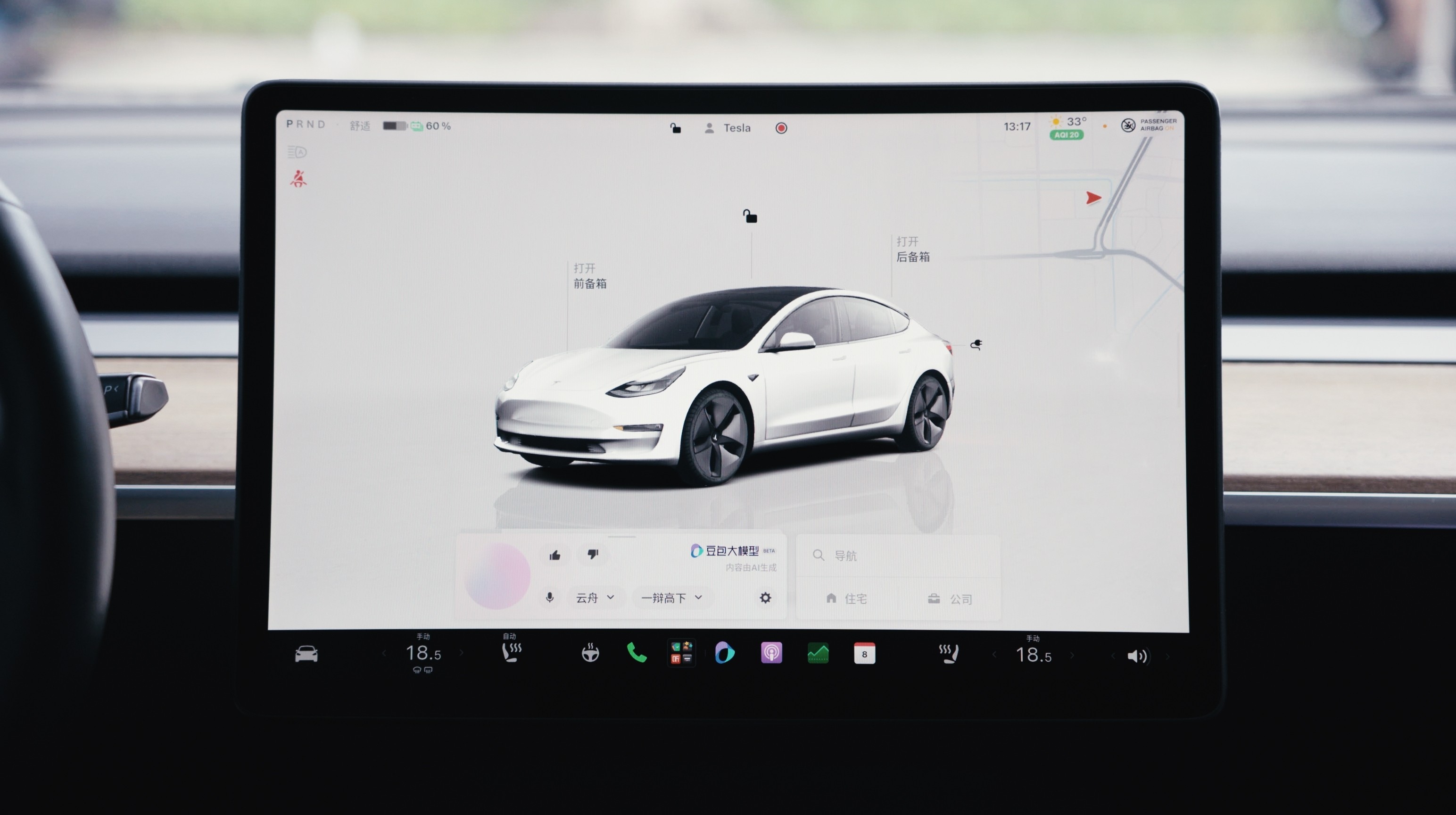
This is the first time that Tesla has accessed a third-party large model in its infotainment system in more than a decade since entering China, and it is also a milestone strategic choice made by the company that regards self-developed AI as its belief in its globally critical single market.
Almost every technical move of Tesla has become a weathervane for the industry. Since its release, FSD has always been the pursuit target in the global intelligent driving field; after the company's Grok was launched in vehicles last year, the in-cabin interaction that had been silent for many years was re-ignited. The industry generally realized that the transformation of large models to the cabin is not an extra embellishment, but an intergenerational replacement of the interaction paradigm. With the dual AI capabilities of "Grok + FSD", Tesla has once again established its position as the global benchmark for smart vehicles.
However, due to some compliance procedures, Tesla's FSD, which has been rumored for nearly two years, has not yet been delivered in batches to Chinese car owners. The killer technology of the smart car pioneer has always remained in the stage of building momentum and has not been transformed into actual market competitiveness. From this perspective, it is obviously a more pragmatic choice for Tesla to cooperate with leading local Chinese technology players in the in-cabin field.
During this period, the market once spread the rumor of "Doubao + DeepSeek dual models launched in vehicles", but according to the rollout results, the Doubao large model is the only large model deployed in vehicles; while another widely speculated candidate, Tongyi Qianwen, has no official public information at present.
Now that the Doubao large model has been officially launched on Tesla's infotainment system, its strategic significance is self-evident: in the Chinese market, Tesla cooperates with Volcano Engine, and the Doubao large model may undertake the mission of North American Grok. If FSD can also be implemented in the Chinese market, the two may replicate the AI experience that Tesla has verified in North America. This move is a watershed event for Tesla, Volcano Engine, and even the entire Chinese automotive industry.
Doubao Large Model Launched in Vehicles: Tesla Makes Up for Its Biggest Short Board
To understand the value of Doubao being deployed in vehicles, we must first return to a long-standing pain point of Tesla in the Chinese market: the relative backwardness of in-cabin intelligence.
For more than ten years since entering China, Tesla's voice assistant and in-cabin interaction capabilities have long been left behind by domestic new energy vehicle brands. When NIO's NOMI can already perform anthropomorphic emotional interaction, and Li Auto's "Li Auto Classmate" can carry out multiple rounds of continuous conversations and schedule all vehicle functions, Tesla's voice system is still at the primary stage of "command recognition" — it can open the sunroof and adjust the air conditioner, but that's all. There is a visible generation gap between Tesla and leading domestic brands in dimensions such as the depth of Chinese context understanding, multi-round dialogue, and scenario linkage.
This may not have been a problem in the past. Tesla relied on its three-electric technology, supercharging network, brand prestige and FSD expectations to support its outstanding product strength and brand appeal, leading the global new energy market in sales all year round, and the shortcomings of the cabin were covered by its strong strengths. Consumers can tolerate a Tesla that "can't chat" because it has no rivals in more core dimensions.
But the competition logic of China's auto market has completely changed. With domestic new energy car brands rapidly catching up with Tesla in the three-electric technology, chassis and energy replenishment system, and even surpassing it in some parts, Tesla's strengths no longer have overwhelming advantages. Especially after the AI paradigm entered the automotive field, the disruptive change it brought is that domestic automotive brands can also quickly catch up with Tesla in intelligent experience. The one-stage end-to-end intelligent driving solution has been widely deployed and applied in vehicles priced as low as 100,000 RMB.
Large models are also rapidly penetrating into vehicles. Xiaomi has carried out a company-level AI transformation before, with the goal of integrating its own Mimo large model more thoroughly into Xiaomi cars. Automakers including Geely, Great Wall Motor, Chang'an Automobile, Seres and Li Auto are all introducing large model capabilities into their vehicles. The intelligent aura that Tesla used to be proud of, which is also the core appeal of its brand, is being rapidly diluted.
This is unacceptable in today's fiercely competitive auto market where every move is a direct contest.
The iron law of competition in the industry has evolved from "one trick that makes you stand out" to "having strong enough strengths and no obvious shortcomings" — any obvious short board will be magnified infinitely in the white-hot comparative consumption decision-making. In-cabin intelligence is precisely the dimension that Chinese consumers perceive more directly and experience more frequently, and Tesla must quickly make up for this short board.
The access of the Doubao large model is exactly the answer for Tesla to catch up. The extremely intuitive change is reflected in the experience level: before and after the upgrade, Tesla's in-cabin interaction directly jumps from "understanding commands" to "being able to chat, having emotions, and taking the initiative to find topics".
In particular, the Doubao large model supports ultra-low-latency real-time calls, can perform tone recognition and emotional understanding according to the user's voice input, and give quite appropriate high EQ responses, as well as support active response, topic promotion and interruption at any time. On this basis, it can also expand roles such as tour guide, music partner, English practice partner and storyteller.
This is a direct generation upgrade of the interaction paradigm — what users face is no longer a voice remote control, but an intelligent agent with semantic understanding, emotional expression and initiative. For a brand that has been lagging behind in the in-cabin field for many years, this kind of leapfrogging progress with external help is a particularly efficient catch-up path.
Of course, the more critical point is the systematic significance. We might as well predict that if FSD is implemented in the Chinese market, Tesla will replicate the North American "Grok + FSD" intelligent architecture in China, forming the dual-core capability of "Doubao + FSD": FSD is responsible for driving intelligence, and the Doubao large model is responsible for interaction intelligence. The two together form a complete AI capability closed loop of a smart car.
Such a capability combination is not only sufficient to cope with the intelligent competition in China's auto market, but even with the globally leading model capability of FSD, superimposed on the Chinese context ecology and technical accumulation of the Doubao large model, it is expected to redefine the benchmark level of smart cars in China in turn.
In other words, for Tesla, the deployment of Doubao in vehicles is "completing a function" in the short term, and in the long run, it also completes the puzzle of its localized AI strategy.
"Musk's Strict Selection": Why Is the Doubao Large Model Chosen?
Tesla is a company that regards AI strategy as the lifeline of the enterprise. From Grok to FSD to the supercomputing center, Musk has always adhered to the obsession of full-stack self-developed AI — this is not only a technical belief, but also a commercial moat. Therefore, Tesla's access to a third-party large model in China is in itself a rare exception.
Under the compliance process, the implementation of Tesla's FSD in China alone has gone through a long cycle, and it is still waiting for the final landing. If Grok goes through the same process again, Tesla may not be able to afford the time cost.
From the product perspective, the intelligent assisted driving technology such as FSD is essentially data engineering. Tesla has solved the local data infrastructure and compliance process in China, and then reuses its own mature model capabilities, which is completely feasible in technical logic.
However, the in-vehicle intelligent interaction agent is not only a data problem. Behind it, there are not only the technical capabilities of the large model, but also the understanding of semantics, culture and scenarios deeply integrated with localization, and even trivial engineering problems of high-efficiency collaboration with automotive execution components. If Tesla follows the strategy of reusing the headquarters' FSD and moves Grok to the Chinese market, it will not only be too late in time, but also technically unworkable.
Therefore, if Tesla wants to deliver its AI strategy in the Chinese market, the better choice is naturally to select a strong local partner.
Since it is part of the company's core AI strategy, the selection criteria are naturally very strict. It is understood that Tesla uses a set of strict standards to screen large model partners in the Chinese market, and even Musk himself has personally participated in the review.
From the strategic cooperation reached between the two sides in August 2025 to the official OTA rollout in July 2026, the nearly one-year filing and verification cycle itself illustrates the prudence of this selection and engineering implementation.
During this period, the market once spread the rumors of "Doubao + DeepSeek dual models deployed in vehicles" and "Qianwen is also under test", but according to the rollout results, Doubao is the only large model launched in vehicles. The clarification of the rumors further highlights the gold content of this cooperation.
What does the Doubao large model rely on to pass "Musk's strict selection"? The answer is not complicated. The Doubao large model has been fully prepared from technology to experience, and even to engineering accumulation.
First of all, the end-to-end voice capability. The main battlefield of in-vehicle interaction is voice, while the traditional cascaded architecture of "speech recognition — text understanding — speech synthesis" has natural bottlenecks in core experiences such as latency, emotional expression and continuous dialogue.
Doubao's end-to-end speech large model directly realizes the understanding and generation of "speech to speech", which can almost reproduce the natural language dialogue of Grok in North America. This technical base of "chatable and emotional" experience is also the premise for Tesla's in-cabin experience to achieve intergenerational leap.
Secondly, the latency performance. The tolerance for response speed in in-vehicle scenarios is much lower than that of mobile phones — in the driving state, any unexpected waiting will be perceived as "stuck" or even a safety hazard. The low-latency delivery of large models on the vehicle end tests not only the model itself, but also the full-link engineering capabilities of inference optimization and cloud-end collaboration. Backed by ByteDance's rich resources and technical system, the Doubao large model naturally passed this indicator smoothly.
Third, a point that is easily overlooked: automotive delivery engineering capabilities. Deploying a large model in vehicles is not a simple API call, but needs to go through many levels of vehicle-level verification, functional safety, data compliance, OTA deployment and other checkpoints. Volcano Engine, behind Doubao, has completed mass production delivery with dozens of automakers, accumulating more than 7 million delivery experiences, which together constitute a complete in-vehicle engineering system. For a company like Tesla that is almost harsh on delivery quality, "proven mass production capability" is more convincing.
Of course, finally, according to public statistics from third parties, the monthly active users of the Doubao APP have exceeded 382 million in June, which is already the activity level of a mainstream social application. Tesla installs the same model of such a product in the vehicle as the entry of in-cabin interaction, which almost obtains the "national-level" user appeal in one step.
To sum up, leading technology and industry accumulation are the real reasons why the Doubao large model wins in the fierce competition. What Musk chose is essentially not a model, but a set of large-scale verified intelligent in-cabin interaction capability system.
"Doubao + FSD": Smart Cars May Welcome the Standard Answer
What is the ultimate form of smart cars? This question has been debated in the industry for ten years, and there has never been a clear outline. Some people bet on the entertainment of the cabin, some believe in the single-point breakthrough of autonomous driving, until the large model paradigm of "Grok + FSD" is deployed in vehicles, the outline of the answer gradually becomes clear: smart car = thinking driving system + human-centered interaction hub, both of which are driven by the large model in a unified way and deeply connected.
The overseas "Grok + FSD" has verified the feasibility of this path: fuzzy navigation — users only need to say "take me to a quiet cafe", the system can independently understand, make decisions and plan routes; multi-task travel planning has been put into use; Grok's permissions have also been connected to vehicle control functions such as air conditioners and glove boxes, and the large model is evolving from a "chat tool" to the scheduling hub of the entire vehicle.
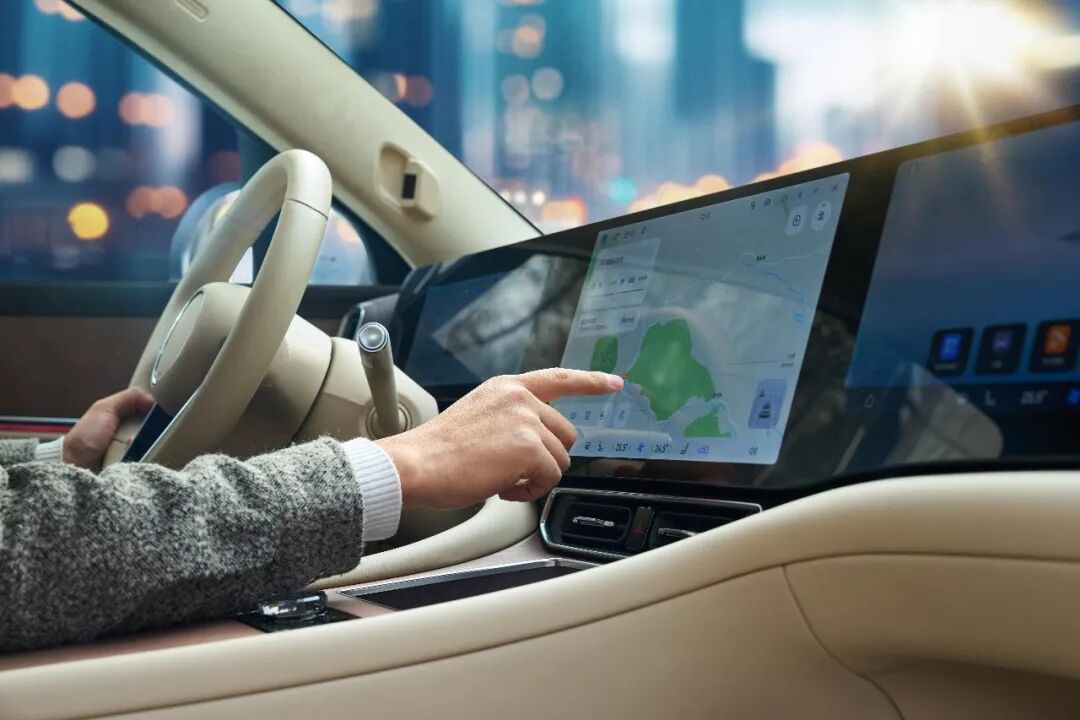
It is not difficult to deduce that the Chinese version of this combination is likely to be the "Doubao + FSD" double-team combination. And the iteration path is also predictable: the permission of the Doubao large model will gradually penetrate from the current relatively independent application form to navigation and vehicle control, and finally connect with FSD to form a complete closed loop of perception — decision-making — execution — interaction.
This path is not a fantasy. AIVA, the cooperation product between Volcano Engine and Seres, and the "Automotive Brain" jointly built with SAIC Roewe, have provided a comparable cooperation paradigm — the large model is no longer a function in the cabin, but an operating system-level existence of the entire vehicle intelligence. At the same time, the underlying technology of the Doubao large model itself is also being upgraded to the Agentic AI architecture.
According to 36Kr, the Doubao large model will run 3 to 4 core Agents (cloud engine / intelligent agent) in cloud collaboration, to jointly handle complex tasks such as cabin-driving collaboration, driving and riding experience, comfort control and emotional interaction.
This means that Tesla's next step of in-cabin experience can further use the Doubao large model to realize the evolution from "passively responding to commands" to the intelligent agent form of "actively understanding intentions and completing tasks independently", reaching the ceiling-level in-cabin intelligent interaction experience. And this set of capabilities superimposed on Tesla's FSD technology is exactly the standard answer for a smart car experience, isn't it?
Looking at the industry position of the Doubao large model, the weight of this cooperation will be clearer. Up to now, the delivery volume of the Doubao large model in vehicles has reached 7 million, achieving 100% coverage of mainstream automakers: the cooperation camp ranges from luxury brands such as Mercedes-Benz, BMW and Audi, to leading Chinese local automakers, then to joint-venture brands and new energy vehicle startups, almost completing the penetration of the entire camp.
Tesla's participation fills in the last and most critical piece of the territory — top-tier foreign automakers. Moreover, this is not an ordinary expansion of the customer list: as a pioneer of smart cars and a global AI leader, Tesla's strict technical requirements and delivery standards are in itself a strong endorsement of the capabilities of the Doubao large model.
The far-reaching significance is that when a large model serves both the globally aggressive smart car company and China's extremely complete automaker camp, it is no longer just an in-cabin intelligent interaction technology supplier, but evolving towards the role of the smart car interaction hub, and even the physical world AI brain — the car is likely to be the first super scenario for Doubao to cut into physical AI.
A brief review of the development history of smart cars shows that every technical choice of Tesla will set off a wave of transformation in China's auto market and even the whole world: its localized production in Shanghai has become a catfish for China's smart electric vehicle industry, promoting the expansion of the smart electric vehicle supply chain, and the continuous evolution of FSD has also provided an evolution route for China's intelligent assisted driving.
This time, the large-scale deployment of the Doubao large model in the Chinese market will most likely replicate the same script — when the industry leader declares with action that "large model in the cabin is a must-answer question", all Chinese automakers will be forced to accelerate.
A smart competition storm centered on "AI