Revenue has exceeded 1 million US dollars in the past two weeks, surging by more than 30 times within 4 months. Can this hit "Like" product still be upgraded?
In the global casual game market, truly innovative gameplay mechanics are becoming increasingly scarce.
However, this does not mean that established gameplay formulas have lost their growth potential. On the contrary, recombining mechanisms that have already been proven by the market, and reaching global users through lower understanding thresholds and more efficient user acquisition methods, is becoming a key competitive advantage in the hyper-casual game track.
Recently, a game titled Bus Traffic Fever! has been posting a remarkably impressive growth curve in overseas markets.
Launched in March, the game has maintained relatively stable overall download volumes while doubling its revenue every month, As of August 14, its cumulative revenue has exceeded 2.16 million US dollars, and revenue in the first ten days of August alone has surpassed 1 million US dollars.
Behind this game is GOODROID, a Japanese developer that has been laying out in the global hyper-casual game sector for many years. So how did Bus Traffic Fever! revamp the overfamiliar "car-moving" gameplay? And how did GOODROID carve out new growth space in the hyper-casual game track again?

Early Market Performance of Bus Traffic Fever!
(1) Revenue Performance
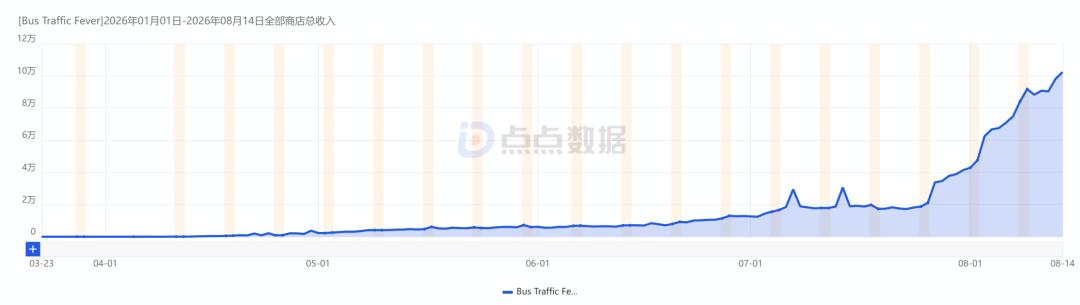
According to Diandian Data, Bus Traffic Fever! started generating revenue data from the end of March 2026, with total revenue of 21,000 US dollars in April, climbing to 150,000 US dollars in May, reaching 240,000 US dollars in June, recording 670,000 US dollars in July, and revenue in the first ten days of August has exceeded 1 million US dollars, forming a very impressive revenue growth curve.
As of August 14, the cumulative revenue of the game has exceeded 2.16 million US dollars. In August, the game's single-day revenue exceeded the 100,000 US dollar mark for the first time and is still on the rise. Among all platforms, the App Store contributes 61.9% of the total revenue.
In terms of market distribution, the United States is the main source of revenue at present, accounting for 65.18% of the total revenue, contributing about 1.4 million US dollars; the United Kingdom ranks second with a 5.66% revenue share, followed by markets including Canada, Australia, and Japan.
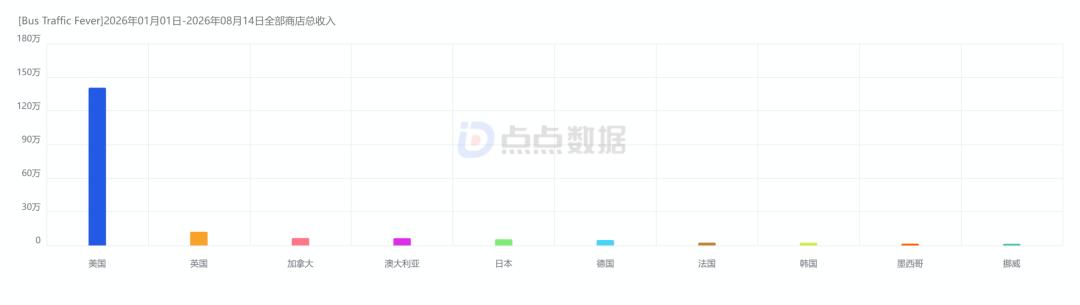
Overall, the revenue source of Bus Traffic Fever! is highly concentrated in the mature US market, its revenue scale has achieved a qualitative leap in August and continues to break new daily revenue records, and its growth potential is far from being fully tapped.
(2) Download Performance
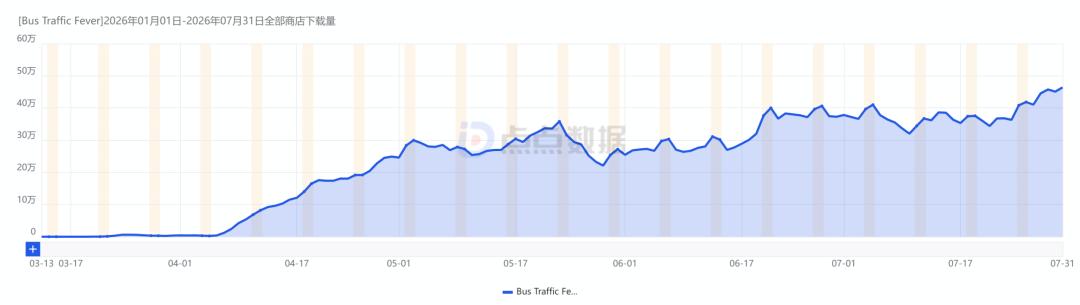
According to Diandian Data, as of August 14, the cumulative download volume of the game Bus Traffic Fever! has approached 40 million times. In contrast to its revenue growth curve, the download volume of the game has not fluctuated drastically in recent months, which indirectly proves that the per-user value of the game is extremely high.
In terms of download markets, the United States is still the largest single market, accounting for 13.34% with about 5.32 million cumulative downloads. However, compared with the revenue distribution, the download side shows a more scattered feature, and markets such as Mexico, Indonesia, India, and Turkey all contribute a considerable number of downloads.
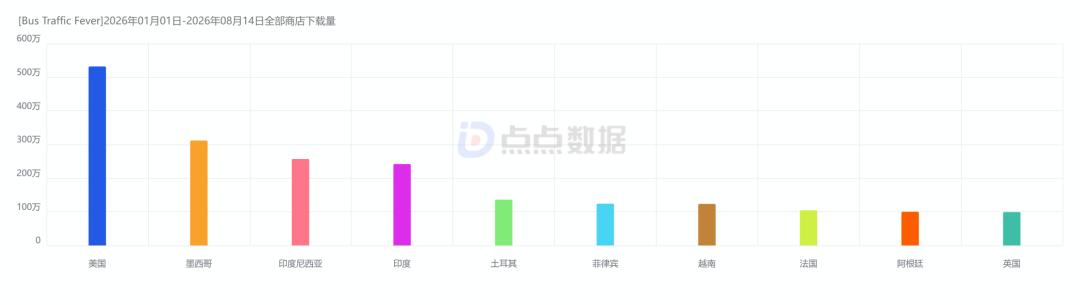
This structure of "wider download markets and more concentrated revenue markets" appears in many global hyper-casual mobile games. On the one hand, products obtain user feedback from different groups through tests in a wider range of regions; on the other hand, mature markets such as Europe and the United States undertake the main commercial verification task. Judging from the case of Bus Traffic Fever!, its performance in a single market can be described as extremely excellent.
What Exactly Did Bus Traffic Fever! Modify?
On the surface, Bus Traffic Fever! does not seem to have created a brand new casual game category.
The "car-moving" gameplay has already been proven by the market, color matching has long been a mature mechanism in casual games, and conveyor belts are also not appearing in mobile games for the first time.
But what is really noteworthy about Bus Traffic Fever! is not what it invented, but that it recombines several proven casual gameplay mechanics and further strengthens the "timing judgment" element in the game.
The basic logic of the game is not complicated: There are buses of different colors in the parking area, and players need to drive the buses out according to the direction of the arrows and let passengers of the corresponding color get on the bus.

The problem is that passengers are not statically arranged in a simple queue, but keep moving around the conveyor belt. This means players need to consider three issues at the same time:
First, whether the current bus can drive out smoothly;
Second, whether the passengers on the conveyor belt can meet the capacity of the current bus;
Third, if you choose this bus now, whether it will affect the matching between passengers and buses in the next round.
The original single spatial judgment of "driving the car out" is thus added with a layer of time sequence. Players no longer only think about "which car to go first", but also need to judge "when is the most appropriate time to go". This is also the obvious difference between Bus Traffic Fever! and traditional car-moving gameplay.
It does not redefine the car-moving game, but turns the original two-dimensional spatial puzzle into a puzzle where space, color and timing work together.
It Is Not the First Time for Japanese Developers to Make Global Hyper-Casual Games
If we shift our focus from Bus Traffic Fever! to its developer GOODROID, we will find that this company has actually been laying out in the global hyper-casual game track for many years.
Founded in 2014, GOODROID is a subsidiary of CyberAgent. Unlike better-known Japanese game developers such as Cygames, GOODROID has long focused on lighter casual entertainment products.
More importantly, it did not start targeting the global market only recently.
According to official disclosure of GOODROID, the company entered the field of hyper-casual game development in 2020, and successively established professional studios including 2PEACE and HASIGO. In 2024, GOODROID's hyper-casual team launched 19 products in one year; as of February 2026, the cumulative download volume of its games has exceeded 600 million times, and overseas revenue accounts for more than 90% of the total.

The R&D entity behind Bus Traffic Fever! further reflects GOODROID's systematic investment in the hyper-casual business.
CyberAgent disclosed in its 2026 investor materials that GOODROID established a new hyper-casual game studio Pawars in September 2025, and launched Bus Traffic Fever! in March 2026.
Therefore, it is more accurate to say that Japanese developers are building the global hyper-casual game sector into a mature product industry, rather than "Japanese developers are starting to learn to make hyper-casual games". Bus Traffic Fever! is a concentrated embodiment of this system in 2026.
User Acquisition Material Placement of Bus Traffic Fever!
Data from the overseas version of DataEye-ADX shows that Bus Traffic Fever! started placing advertising creative materials in late March.
In terms of placement rhythm, the game maintained stable placement from mid-April, the number of daily materials is basically maintained between 50 and 100 groups, with peak values appearing in late May and mid-August respectively. Combined with the material exposure of the game, the placement strategy of Bus Traffic Fever! is not simply to pursue large volume, but to increase the exposure of native real-machine gameplay materials.
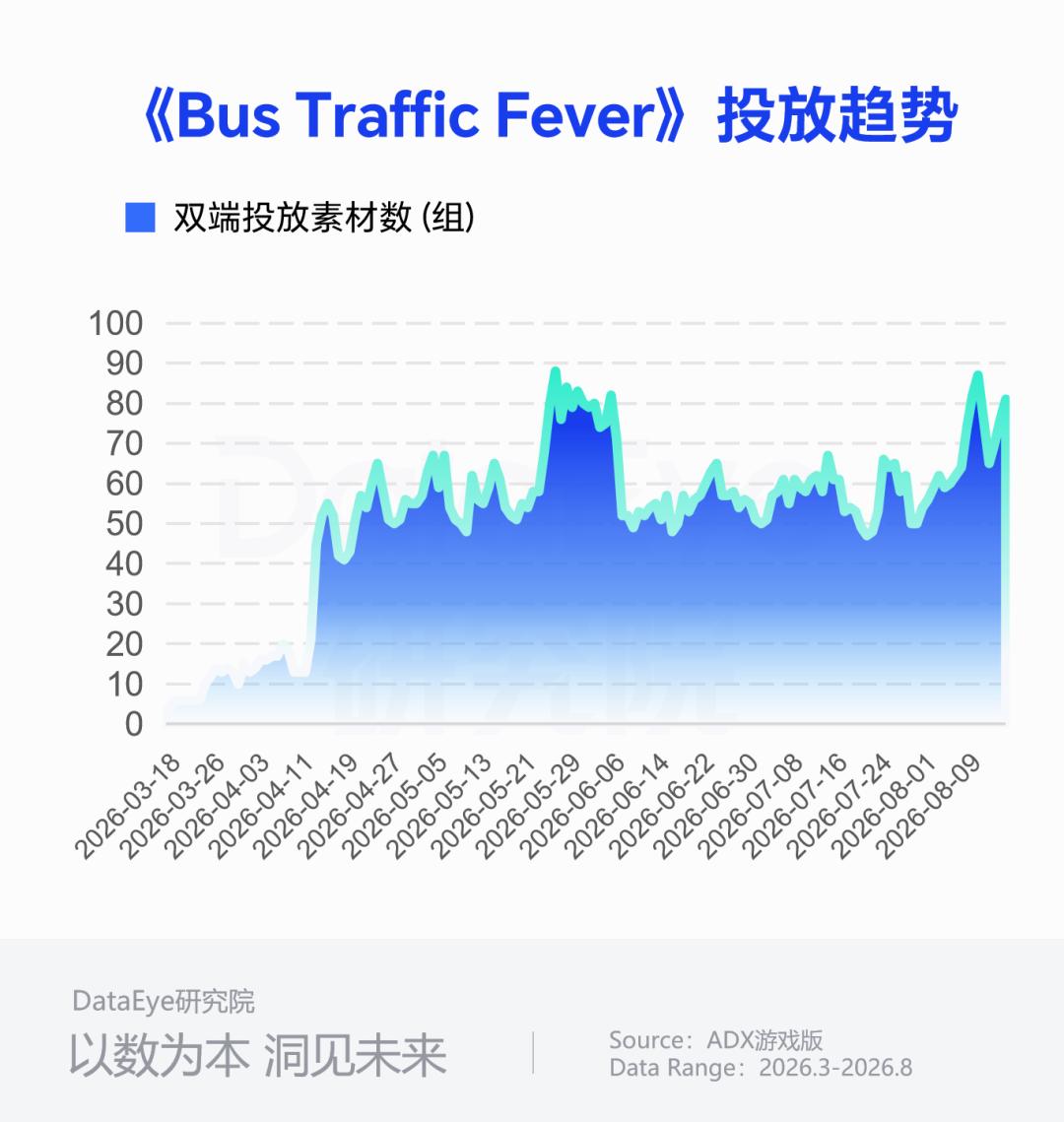
Consistent with the download and revenue performance of the game, the US market accounts for the highest proportion of placed materials, followed by various Southeast Asian markets.
Most of the most frequently placed creative materials for Bus Traffic Fever! focus on demonstrating its native gameplay, with minor adjustments to maps and shapes in different materials. Such materials obviously reduce players' resistance to "advertisements", and the creativity close to real gameplay also greatly reduces conversion friction.

Material display from the overseas version of ADX
Another type of material placed by the game adds an AI cat introduction, leading to the display of game gameplay through simple voiceover promotion. In general, Bus Traffic Fever! chooses quite "simple" creative materials, but its communication efficiency for target users is very high.

Material display from the overseas version of ADX
Conclusion
The success of Bus Traffic Fever! proves another thing: in today's casual game market, mature gameplay still has huge growth space.
The premise is that the product can find a sufficiently lightweight innovation point.
The innovation chosen by Bus Traffic Fever! is the conveyor belt. This seemingly simple mechanism adds timing judgment to the traditional car-moving game; color matching further strengthens players' calculation of capacity and sequence. In the end, the game does not change users' basic perception of "car-moving games", but endows the previously market-proven gameplay with a brand new playing rhythm.
Since 2020, GOODROID has continuously verified global hyper-casual products through multiple studios, and has accumulated a download scale of hundreds of millions, even up to 600 million levels.
This means that the success of Bus Traffic Fever! is more another result after long-term product experiments, rather than a lucky hit on a random gameplay. In the global casual game track that relies more on efficiency, iteration and commercialization, Japanese developers are also forming their own unique competitiveness.
This article is from the WeChat Official Account "DataEye" (ID: DataEye), authored by DataEye Research Institute, and published by 36Kr with authorization.