Cell therapy is reshaping the landscape of the orthopedics field, as industry giants are rushing to place bets, with numerous Phase II/III pipelines clustered in this track.
Cartilage regeneration was once a forbidden zone in orthopedics, a boundary that is now being broken by cell therapy.
VCBeat has noticed that a number of cell therapy pipelines for orthopedic diseases have seen intensive progress recently, with multiple pipelines entering Phase II and Phase III clinical stages. Publicly listed orthopedic enterprises have also laid out in this track, with Kailitai and Sanyou Medical simultaneously holding shares in a cell therapy enterprise focusing on lumbar disc degenerative diseases.
Positive results have been observed in multiple orthopedic cell therapy pipelines that have entered the clinical trial stage. Taking the NCR100 from ZhongSheng Origin as an example, NCR100 Injection, the first domestically approved iPSC-derived MSC cell product for clinical trials, has completed the enrollment of all subjects in its Phase II clinical trial for the treatment of knee osteoarthritis. Preliminary data show that NCR100 Injection exhibits good safety and tolerance, and shows positive efficacy signals, most importantly, cartilage growth has been observed.
An investor said: Cell therapy has a patient group of tens of millions in orthopedics, and we are very confident in this direction.
These signals indicate that cell therapy is moving from marginal exploration to the core track of orthopedics. In the past, orthopedic treatment has long remained at the physical level — replacement, fixation, and decompression, and there has always been a lack of effective products for the regeneration and repair of bone and soft tissues. Can cell therapy fill this gap? How will it rewrite the current landscape of orthopedic treatment?
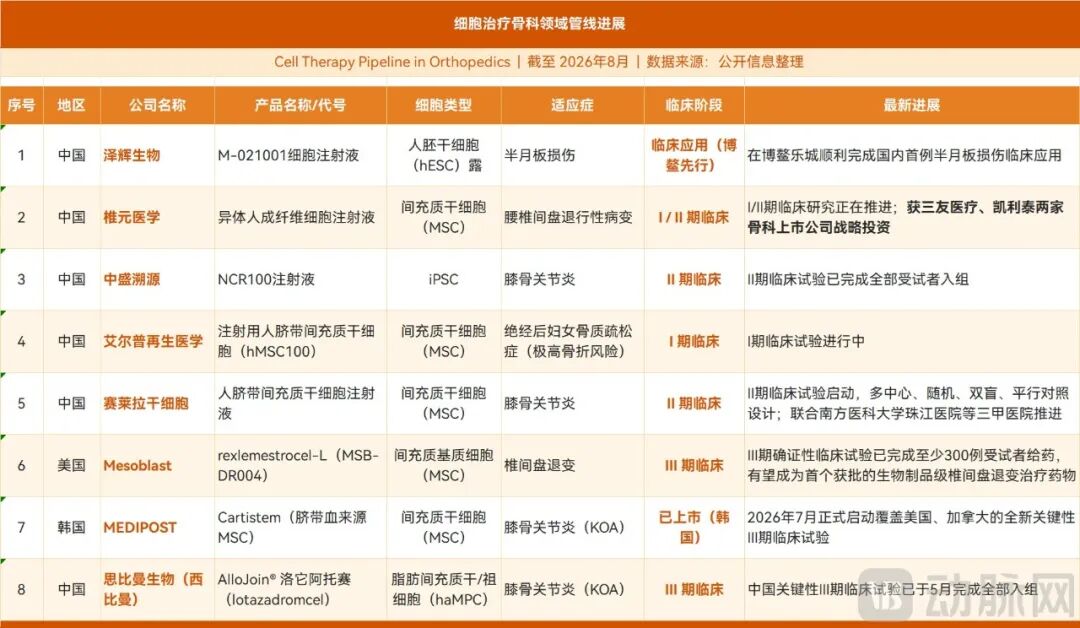
01 Mechanism of Action of Cell Therapy in the Orthopedic Field
The difficulty of cartilage regeneration is a widely recognized problem in the medical community.
Why has orthopedic treatment long stayed at the physical repair level? Can cell therapy bring a real breakthrough in regeneration?
The difficulty of cartilage regeneration is a widely recognized problem in the medical community, and its root cause lies in the special tissue structure and physiological characteristics of cartilage. It can be summarized in one sentence: it is a "four-no" island tissue that "has no blood vessels, no nerves, no lymph, and few cells".
The repair of most human tissues relies on stem cells, growth factors and nutrients brought by blood. However, there are no blood vessels inside healthy cartilage, and the only nutrient source for chondrocytes is the penetration of synovial fluid.
Cell therapy is expected to provide a fundamental solution to this dilemma. Mesenchymal stem cells (MSCs) are a type of adult stem cells with self-renewal and multi-directional differentiation capabilities, with low immunogenicity. Through paracrine and immunomodulatory mechanisms, they can play roles in tissue injury repair, hematopoietic support, nutritional supply, activation of endogenous stem/progenitor cells, immunoregulation, promotion of angiogenesis, and anti-fibrosis.
At present, stem cell drugs in the clinical R&D stage are mainly divided into two camps: adult stem cells and pluripotent stem cells. The former is represented by MSCs derived from umbilical cord, umbilical cord blood, adipose tissue, bone marrow, etc.; the latter mainly includes functional cell drugs derived from human embryonic stem cells (hESCs) and induced pluripotent stem cells (iPSCs).
However, different technical paths face completely different bottlenecks. Adult MSCs are directly isolated from tissues with a wide range of sources, but there are huge differences between different donors, poor batch consistency, high standardization difficulty, and it is difficult to achieve large-scale stable supply. Although hESCs have strong differentiation potential, they face ethical controversies because the acquisition process requires the destruction of human embryos.
In contrast, iPSC-derived MSCs (iMSCs) show unique comprehensive advantages. iPSCs can be obtained by reprogramming easily accessible somatic cells such as peripheral blood and skin cells, with the characteristics of unlimited expansion and easy genetic engineering modification. The iMSCs prepared from iPSCs are all derived from the same seed cells, which can realize large-scale production with more stable and uniform cell quality; at the same time, genetic modification can be carried out at the iPSC stage to obtain iMSCs with specific functions. More importantly, the iMSCs obtained by induced differentiation of iPSCs are more similar to fetal MSCs, which are the youngest MSCs with the strongest proliferative function and full differentiation potential. Therefore, it can be said that iPSC technology is an important innovation direction for the development of "off-the-shelf" MSC therapies, but it also has very high technical difficulty.
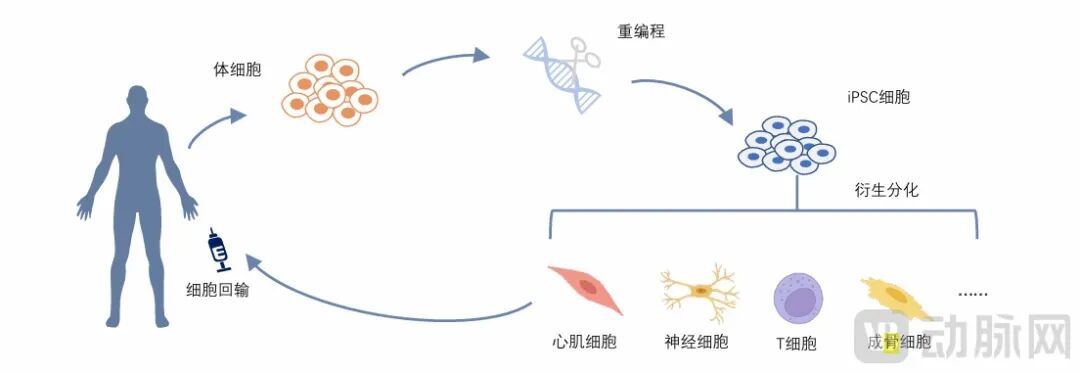
Schematic diagram of iPSC therapy Source: Sullivan
From the perspective of the domestic industrial landscape, existing clinical pipelines are mainly concentrated in adult MSCs, which benefits from their technical maturity and early clinical exploration. As a rising star, the iPSC technology platform has initially observed tissue repair effects in clinical trials.
02 Can Cell Therapy Replace Surgical Treatment?
If cell therapy can promote tissue regeneration, will cell therapy replace surgery? The answer is no. Even if cell therapy is approved for marketing in the future and can achieve structural repair and functional reconstruction, it does not mean that surgery will withdraw from the historical stage.
The greater value of cell therapy in orthopedics lies in the forward shift of the treatment window — it opens a new door for patients who have symptoms but have not yet met the surgical indications; for patients who have already developed severe structural lesions, although cell therapy shows certain clinical benefits, surgery is still the main end-stage treatment option at this stage.
Many domestic pipelines target the huge population suffering from chronic pain, for example, mesenchymal stem cells alleviate lumbar disc degenerative diseases. Many long-time office "workers" are plagued by chronic low back pain, with severely reduced quality of life, but they are far from meeting the surgical criteria. Mesenchymal stem cells are expected to quickly relieve pain and restore motor function within 1-2 weeks after administration, and in the long term, improve the biomechanical tolerance of intervertebral discs by secreting collagen, so as to delay or even reverse the degeneration process at the structural level.
The choice of indications directly determines success or failure, and orthopedic cell therapy has also paid a painful price for this.
In 2006, Enrico Bastianelli, a senior industry expert, founded Bone Therapeutics together with a top scientist team. Its core pipeline ALLOB was cultured from bone marrow mesenchymal stem cells from healthy donors. In preclinical studies, ALLOB halved the healing time in the delayed union fracture model, and two Phase IIa trials also showed good tolerance and efficacy signals. Based on these impressive data, the company launched a pivotal Phase IIb multicenter clinical trial for acute tibial fractures in 2020, which was once highly expected by the industry.
However, in 2023, ALLOB suffered a fatal blow: the Phase IIb trial failed to meet the primary efficacy endpoint, there was no statistical difference between the ALLOB group and the placebo group in promoting early fracture healing, and the core pipeline was forced to be suspended indefinitely. The confidence of the capital market collapsed, and Bone Therapeutics, with its capital chain broken, eventually went to restructuring, merged with Medipost and renamed itself BioSenic, and its orthopedic stem cell myth came to an end.
Reviewing the reasons for the failure, the team underestimated the local microenvironment in the initial stage of acute trauma — early fracture is accompanied by a severe inflammatory storm. In this high-inflammation environment, exogenous osteoblasts are extremely vulnerable to being attacked by inflammatory factors and die in large numbers, so they cannot successfully home and play an osteogenic role at all.
However, the fall of Bone Therapeutics did not stagnate the industry, but left extremely precious road signs for latecomers: cell therapy is not suitable as an emergency medicine for acute trauma, but should be positioned as a repairer for chronic degenerative diseases. This lesson directly inspired enterprises such as Mesoblast in Australia and Medipost in South Korea — they chose to avoid acute bone fractures, and instead focused on chronic degenerative osteoarthritis (OA) and intervertebral disc lesions with relatively stable articular cavity microenvironment, using the paracrine anti-inflammatory effect of mesenchymal stem cells to promote tissue self-healing.
The same is true for domestic enterprises. Most domestic enterprises' orthopedic indications for cell therapy focus on degenerative osteoarthritis (OA) and chronic intervertebral disc lesions.
03 What Thresholds Still Need to Be Crossed to Enter Clinical Application?
The industrialization process of cell therapy in the orthopedic field is accelerating, but there are still several key thresholds to be crossed before it can be truly applied on a large scale in clinical practice.
At present, domestic cell therapy for orthopedic diseases is still in the verification period of safety and efficacy.
ZhongSheng Origin said that its iMSC therapy NCR100 for knee osteoarthritis still needs to cross two major thresholds from clinical use to real widespread availability: "The first is the confirmation of safety and efficacy. The next core step for NCR100 is to complete the confirmatory clinical trials, and verify the safety and clinical efficacy of the product with more sufficient evidence-based medical evidence. The second is the challenge of payment and accessibility. The upfront R&D investment of innovative cell drugs is relatively large. While realizing cost optimization through large-scale production, it is also necessary to explore diversified payment paths such as medical insurance and commercial insurance to effectively improve patient accessibility, which is a practical problem that must be overcome for the product to achieve real popularization."
In addition to self-verification and payment challenges, cell therapy also needs to prove its differentiated value in the competition with existing regenerative therapies.
In the landscape of regenerative therapies in orthopedics and sports medicine, platelet-rich plasma (PRP) injection is already the most widely used mature technology. Its principle is not complicated: extract the patient's autologous blood, centrifuge to concentrate the plasma rich in platelets and growth factors, inject it back into the injured site precisely, and release a variety of growth factors through the activated platelets to start the tissue regeneration cascade reaction, promote cell proliferation, angiogenesis and matrix synthesis, so as to accelerate the repair of tendons, ligaments, cartilage and bone tissue. PRP can effectively relieve pain in the short term, especially suitable for acute injury and tendon repair, but the inconsistency of preparation methods limits its long-term efficacy stability in chronic diseases.
Then, what exactly are the advantages of cell therapy compared with PRP?
A meta-regression analysis published in *J Clin Med* in 2025 gave a clear answer: MSC therapy is the most effective intervention to relieve pain (β = 8.45, p < 0.05), while PRP and peptide therapies only show moderate improvement effects. In terms of cartilage regeneration and early osteoarthritis improvement, MSC therapy shows better structural repair potential. iMSCs further break through the source bottleneck of traditional MSCs, can realize large-scale production, and ensure stable and uniform quality of cell products.
Overall, cell therapy has shown encouraging clinical potential in chronic degenerative orthopedic diseases, but to truly win clinical trust, it still needs to cross three thresholds: confirmatory data, payment system, and standardized production. Only by accumulating hard evidence through larger-scale and longer-cycle clinical research can this cutting-edge technology move from proof of concept to standard treatment, responding to the expectations and doubts of the market.
This article is from the WeChat official account "VCBeat" (ID: vcbeat), Author: Yang Xue, published with authorization from 36Kr.