Is using AI at work actually faster? 1,237 people have conducted real tests on this.
"I can get this done quickly with AI", you must have said that. Using AI does make tasks easier, so we tend to assume it also saves far more time. But a study involving 1237 participants found that ease of operation does not always go hand in hand with time savings. More interestingly, people tend to make biased judgments on the time cost of AI-assisted tasks, while they do not make such misjudgments for tasks completed with colleagues. Where does this illusion come from?
Have you ever actually recorded the time you spent on tasks?
Think of one task you recently finished with the help of AI. It can be writing a weekly report, organizing materials, or revising a version of a project plan.
Before you started the task, how long did you estimate it would take? After you finished it, how many minutes did you actually spend?
You may still remember the first number, but you may not remember the second one. After finishing a task, people are more likely to remember whether the process went smoothly and whether they felt tired, but they may not necessarily remember exactly how long they spent. Normally this does not cause any trouble, because ease and speed usually appear at the same time.
But after using AI, will the two still appear together? The following study is exactly exploring this question.
Tasks feel easier, but not faster
In 2026, a group of researchers in cognitive science and computational linguistics recruited 1237 participants to complete a batch of simple cognitive tasks. The research protocol had been registered in advance.
After each task was completed, the researchers recorded three sets of data.
The actual time spent on the task
The pre-estimated time required to complete the task
The self-reported effort level after finishing the task
The tasks are divided into two types: one is completed by the participant alone, the other can be completed with the help of AI.
The third number is not a random score. They used a scale called NASA-TLX, which measures several dimensions including mental demand, time pressure, effort level, and frustration.
This scale was originally developed by NASA to evaluate the workload of pilots. More than 40 years later, it is used to measure how tired a person sitting in front of a computer is when revising a weekly report.
The results show that there is no difference in the actual completion time between the two conditions.
There is no difference on the whole, but it is indeed faster in a few types of tasks: finding synonyms, summarizing long articles, and editing long texts. These types of work all have relatively clear answers, and doing them manually is mainly repetitive labor.
But when it comes to estimating the time in advance, everyone thinks that using AI will be much faster. They are quite accurate in estimating how long it will take to do it manually; once they can use AI, the estimated time will be much shorter.
Researchers call this the speedup illusion.
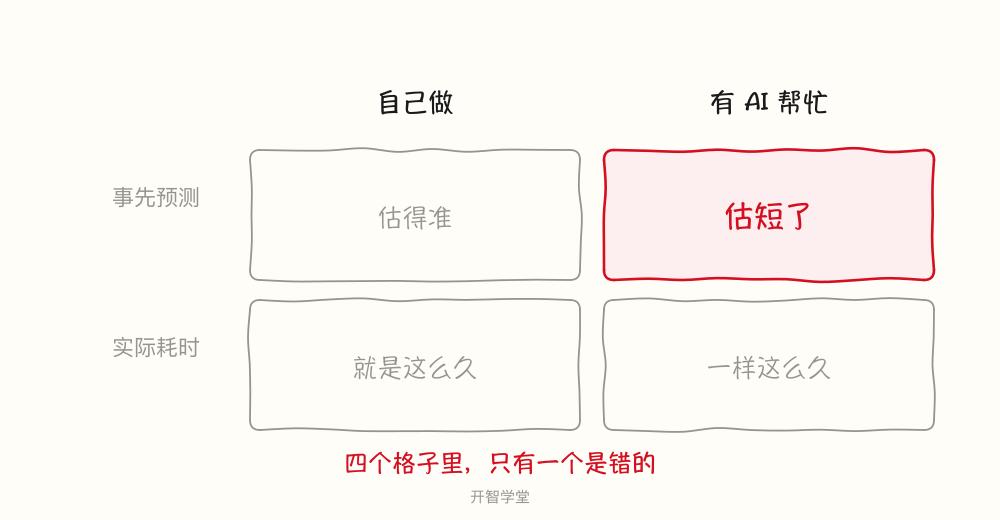
Seeing this, it is easy to assume that as long as someone helps, people will underestimate the time required.
But the researchers also tested another scenario: if another person helps you, how long do you estimate it will take?
This time, the bias did not appear. The same group of participants made quite accurate estimates when the helper was a colleague; when the helper was AI, they underestimated the time.
Having someone to help does not necessarily make people overly optimistic. This only happens when the helper is AI.

The reason why the paper specifically measures the scenario of colleague assistance is related to the long-term research direction of the authors. Robert Hawkins from Stanford University has long been exploring how two people can communicate smoothly and build tacit understanding. His original research focus is on how people collaborate with each other, so he specially set up the colleague assistance group in this paper. Another author is Dan Jurafsky, a professor of linguistics at Stanford University. The textbook he wrote is read by almost all people engaged in natural language processing.
Long before the emergence of AI, people have been outsourcing mental work to external tools
The name "speedup illusion" is new, but the problem behind it is not new: people have been outsourcing mental work to external objects, and they have never been fully aware of how much work they have outsourced.
In 1994, some researchers put forward the concept of epistemic action: you tilt your head to look at an inverted picture instead of rotating it in your mind. You use a physical action to replace a mental operation. Two years later, another group of researchers studied computational offloading: for the same problem, the effort required to calculate it on paper is different from that required to calculate it in your mind.
By 2016, two researchers collected these scattered studies into a review paper, and named this phenomenon cognitive offloading. Its definition is not obscure: using physical actions to change the information processing requirements of a task, so as to reduce the mental burden. Setting an alarm clock to remind yourself is a typical example of cognitive offloading. This review paper is now a standard reference in this field.
The review also raised a question: when will people outsource their mental work to external objects? The answer does not only depend on how difficult the task is. The review lists three points:
The tendency of offloading depends on how much internal cognitive cost you need to pay if you do not offload the task;
It also depends on your evaluation of your own mental ability;
And this evaluation may be wrong. If you make a wrong estimate, the decision to outsource the task will not be cost-effective.
The third point is most relevant to this AI study. People may even misjudge how well they can cope with the task by themselves.
People who do not have confidence in their own memory will over-rely on external records. People who overestimate their own ability will not memorize the things that should be remembered. Researchers have long pointed out that once people's evaluation of their own ability is biased, the decision to outsource tasks will also be biased accordingly.
Putting the speedup illusion into this framework, it is no longer an isolated new discovery. Previous studies have found that people will misjudge their own memory. In the context of AI, what people misestimate becomes how much time AI can actually save for them.
The author himself put forward a warning in the paper: inaccurate calibration will lead people to over-offload their cognitive tasks, especially for those mentally demanding tasks that they already hate. The more mentally exhausting and annoying a task is, the more likely people are to hand it over to AI. But once this becomes a habit, people will rarely go back to check how much time they have actually saved.
But when it comes to underestimating time, we will encounter an old question: don't people often underestimate the completion time of tasks anyway?
In 1994, Canadian psychologist Roger Buehler and his colleagues asked a group of students who were about to submit their graduation theses: When do you think you can finish and submit it? The average answer was 33.9 days.
The actual time spent was 55.5 days. About 70% of the participants exceeded their own prediction.
This kind of underestimation was later called the planning fallacy, which has been studied in behavioral science for many years.
Since people always underestimate the time of their own tasks, why are the estimates quite accurate when they complete the tasks by themselves in the above study?
Because the tasks are different. Subsequent studies have found that underestimation only occurs when the task is long enough; when the task is very short, people tend to overestimate the time instead. The two studies are not really contradictory. The graduation thesis takes months to complete, while the tasks in the experiment are finished in a few minutes.
In actual work, these are two different types of underestimation, which should not be confused. The planning fallacy focuses on how you view your own progress; this new study focuses on how you view the time that AI can save for you. The former has been studied for 30 years, while the latter has just started.
Time is not saved, but effort is reduced
No extra time is saved, but the task feels less tiring. The participants spent almost the same amount of time, but reported much lower effort levels.
Ease and time saving are usually bound together. So when we feel that a task is easy, we often assume that it does not take much time, and this judgment is usually not too wrong.
AI separates these two things.
Why does this deviation only occur when using AI? One possible reason is that we are not yet clear about to what extent this kind of tool can help us complete tasks.
The uses of calculators and search engines are relatively fixed. After using them a few times, people know what tasks to assign to them and where they need to check the results by themselves.
Large language models are different. The reliability of the same model can vary greatly when applied to different tasks, but it is difficult for users to judge in advance whether the result of this task is reliable. What's more, there may be no difference in tone between its correct answer and wrong answer.
In the past, we would judge whether a helper is reliable by observing how fast they answer, how smoothly they speak, and whether they hesitate. When facing large language models, these clues fail. Even if it gives a wrong answer, it often outputs the result quickly and confidently.
If you can't accurately grasp the actual capability of this tool, you will probably not be able to estimate the required time accurately.
When the helper is a colleague, this deviation disappears. Is it because we know the actual capability of our colleagues very well? This study did not carry out further exploration on this point.
What are the limits of these evidences respectively
First, let's talk about a study that is often mentioned together with this 1237-participant study. In 2025, some researchers conducted a study using electroencephalogram (EEG), but its evidence is very limited.
EEG records the electrical signals generated by brain activity by attaching electrodes to the scalp. It cannot read what you are thinking, but it can show whether the activities of different brain regions are synchronized. Researchers call this connectivity, and the tighter the synchronization, the more cognitive resources are usually invested.
In that study, participants were divided into three groups to write articles: using AI, using search engines, and using no external tools. The connectivity patterns of the three groups were indeed different: the more external support the participants got, the weaker the brain connectivity was.
This study is very widely spread on the Internet, but it cannot support those exaggerated conclusions.
It is still a preprint and has not gone through peer review — this process requires anonymous researchers in the same field to point out errors, require supplementary experiments or revisions, which often modifies or even negates the original conclusions
It only has 54 participants in total, and only 18 participants are left in the final round of experiment
Formal comment papers have already questioned its sample size, EEG methodology, and the reproducibility of its results
The authors themselves stated that they only tested one AI product, and the conclusion cannot be generalized
It only measures the differences during the writing process, not the long-term changes, and does not prove that "using AI will make your brain dull"
The two specific numbers that are widely spread on the Internet are not verified in the original paper, so they are not cited here.
The only point that is consistent with the main study is that when using external tools, the mental effort people spend at the moment may be less. As for what consequences this reduction will bring, it cannot give an answer.
The EEG study cannot be extended too far, and the 1237-participant study also has its own limitations.
It only measures simple cognitive tasks, not the complex project plan you are working on. This is the most important point among all limitations. Once the task is long and complex, the situation may be completely different, or even reversed. AI may indeed be faster in long tasks, but people still cannot estimate the time accurately. The study did not test this scenario, so we cannot make arbitrary inferences for it.
The experiment only recorded the predicted time and actual time spent. It did not track whether people will take on more tasks and arrange their schedules more densely after they underestimate the time required.
The degree of human participation varies greatly when using AI to generate first drafts, find errors, or debate the scheme with AI; this study did not make separate comparisons for these different scenarios.
This paper was published recently, and no one has independently replicated the experiment yet. Before that, we cannot draw overly absolute conclusions. The only conclusion that is currently valid is that in these simple tasks, effort saving does not equal time saving.
There is another kind of questioning that does not target the data, but the research perspective. François Chollet, the author of the deep learning framework Keras, once said: Framing AI as an efficiency tool for old workflows is inherently wrong; just like every previous wave of computing technology, AI is a tool that allows people to do new things in new ways.
From this point of view, the question "how much faster can you get by using AI" is inherently too narrow.
The question raised by Chollet and the question raised by this study are better viewed separately, and they do not conflict with each other. AI may change what tasks you choose to do, but at the same time it can still make you misjudge how long the current task will take.
Do not equate ease with time saving
The benefit of feeling easier after using AI is undeniable. The participants in the experiment did feel less effort.
But you can no longer directly estimate the time required according to how easy the task feels. In the scenario with AI, the logic of "this task felt very easy to complete" can no longer deduce the conclusion of "so it did not take much time".
If you want to know whether you have underestimated the time, just record five consecutive tasks:
Before you start the task, write down the estimated minutes; after you finish it, write down the actual minutes spent.
Do not rush to analyze, and do not rush to summarize. After you have recorded five tasks, check which tasks have the largest deviation between estimated time and actual time.
Recording these five tasks does not expect you to immediately make accurate time estimates. After you record them, you can see two things at the same time: how easy you felt the task was at that time, and how much time it actually took.
The ease of task is real. Whether it is faster or not can only be confirmed by checking the clock.
References
Buehler, R., Griffin, D., & Peetz, J. (2010). The planning fallacy: Cognitive, motivational, and social origins. Advances in Experimental Social Psychology, 43, 1–62. https://doi.org/10.1016/S0065-2601(10)43001-4
Buehler, R., Griffin, D., & Ross, M. (1994). Exploring the "planning fallacy": Why people underestimate their task completion times. Journal of Personality and Social Psychology, 67(3), 366–381. https://doi.org/10.1037/0022-3514.67.3.366