A Collective AGI company seeks to add an "organization" layer to artificial intelligence.
In the past few years, the clearest development path in the AI industry has been to continuously strengthen the performance of individual models.
With larger parameters, more data and stronger reasoning capabilities, a single model can handle increasingly complex tasks. However, as AI starts to expand from chat interfaces to robots, drones, industrial and urban systems, the problems to be solved have also changed accordingly.
Real-world systems rarely operate relying on only one single model.
In a robot fleet, each machine is equipped with different sensors, computing power and assigned tasks; a low-altitude security system may integrate cameras, radars, drones, edge devices and different algorithms at the same time. No matter how intelligent a single model is, it cannot natively know how these devices should divide work, when to collaborate, and who should take over the work once a failure occurs.
When there are more and more intelligent elements, how to organize them properly? — This is exactly the question that Dunxu Technology is committed to answering.
In April this year, Dunxu Technology was officially established. Derived from the State Key Laboratory of Complex System Cognition and Decision-Making under the Institute of Automation, Chinese Academy of Sciences, this company has a somewhat unexpected goal.
As an artificial intelligence enterprise, Dunxu Technology does not focus on large models and related tracks. Instead, it tries to add a new capability layer — the Organization Layer — between existing intelligent units such as large models and end applications.
This is no small undertaking. In the computer era, the emergence of the new Operating System Layer gave birth to Microsoft and Apple. In the AI era, the emergence of the new Intelligence Layer spawned OpenAI and Anthropic. It can even be said that every leap of the information revolution originates from the emergence of a new tier in the computing architecture.
In the technical logic of Dunxu Technology, models are responsible for generating individual intelligence, while organization is responsible for generating collective intelligence: connecting agents with different capabilities, costs and forms, enabling them to collaborate, give feedback and adjust, so that the entire system can finally obtain capabilities that a single individual does not originally have.
Simply put, large models solve the problem of whether an agent is "intelligent enough". What Dunxu Technology wants to solve is: When more and more individuals with basic intelligence appear, how to organize them — and even make them generate higher-level intelligence through emergence.
The company calls this goal Collective AGI, Collective Artificial General Intelligence. This is also the problem that Pu Zhiqiang, founder and chairman of Dunxu Technology, has studied for more than ten years. The 38-year-old man is the deputy director of the State Key Laboratory of Complex System Cognition and Decision-Making, a researcher at the Institute of Automation of Chinese Academy of Sciences, and a recipient of the National Science Fund for Excellent Young Scholars.
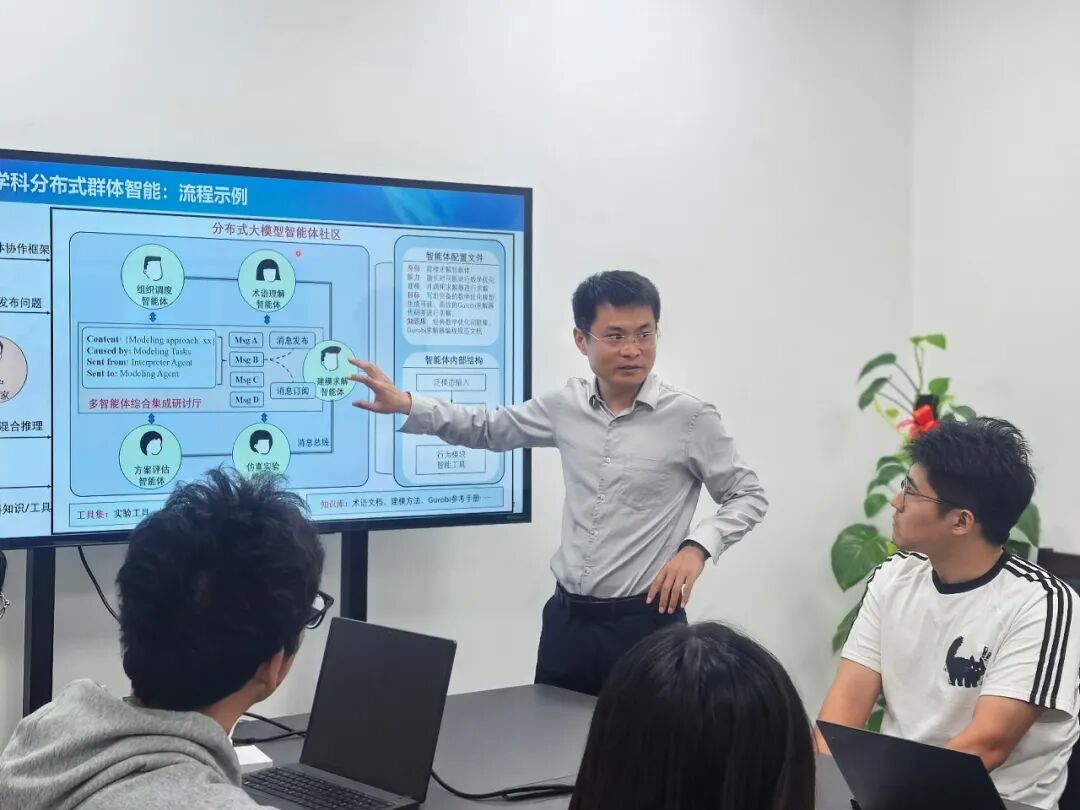
In 2024, Pu Zhiqiang discussed distributed collective intelligence with his team
More than ten years ago, it did not have such a cutting-edge name as Collective AGI. At that time, what attracted the 20-something Pu Zhiqiang was an ant.
01
Another Source of Intelligence
A single ant can do very few things. But a group of ants, without a central "commander" issuing orders, can complete complex behaviors such as foraging and nesting that far exceed the capabilities of a single individual — and guiding this process only requires one or two simple rules.

Relying on collective intelligence, ants that do not know how to build bridges can still put up a bridge (AI-generated image)
The summary of complex science for this phenomenon is very simple: the essence of collective intelligence is to generate advanced intelligence by properly organizing simple rules. "That is to say, it is not 1+1=2, but 1+1>2." What really interests Pu Zhiqiang is exactly that "extra" part. In the research of complex science, this phenomenon is often called "emergence".
Although this research field won the Nobel Prize in Physics in 2021, it was a very unpopular direction more than a decade ago. Pu Zhiqiang later recalled that if a direction was already very hot and the path was very clear, he might not be willing to enter it.
"There is nothing to hesitate about." He thinks collective intelligence is cutting-edge enough, but it is not cutting-edge for the sake of being cutting-edge. In today's artificial intelligence era, it touches a more essential problem: does intelligence necessarily come from increasingly powerful individuals? Or can intelligence be generated through the organizational relationship between individuals themselves?
He has been working on this problem for more than ten years. Pu Zhiqiang has always emphasized that research should solve "real problems", which made his research move from algorithms and simulations to the real world very early.
Around 2020, he began to apply collective intelligence to the research of real football matches. Football is actually a very intuitive collective intelligence system. No player in a team has all the information. Everyone can only see part of the scene, but the team must constantly make overall decisions: who to pass the ball to next, who should run for position, and how to adjust after the opponent changes the playing style.
What Pu Zhiqiang wants to solve is not just to do data statistics after the game, but the problems "during the game" and "before the game": when the game reaches this point, how to play next? What will happen if another player is replaced? Is it possible to deduce in advance when facing opponents of different styles?
The team even conducted counterfactual deduction and tried to turn this system into a kind of "virtual coach". In 2025, in a specific complex decision-making experiment, the team tried to make two self-built models with 100-million-level parameters work collaboratively. Under the same conditions, compared with the general large model of 100-billion-level parameters at that time, the experimental results of this task were significantly better.
For Pu Zhiqiang, this is not just a story of "small models defeating large models", but a more plain evidence: Individuals do not need to be omnipotent. By properly organizing rules, they can also generate more advanced capabilities.
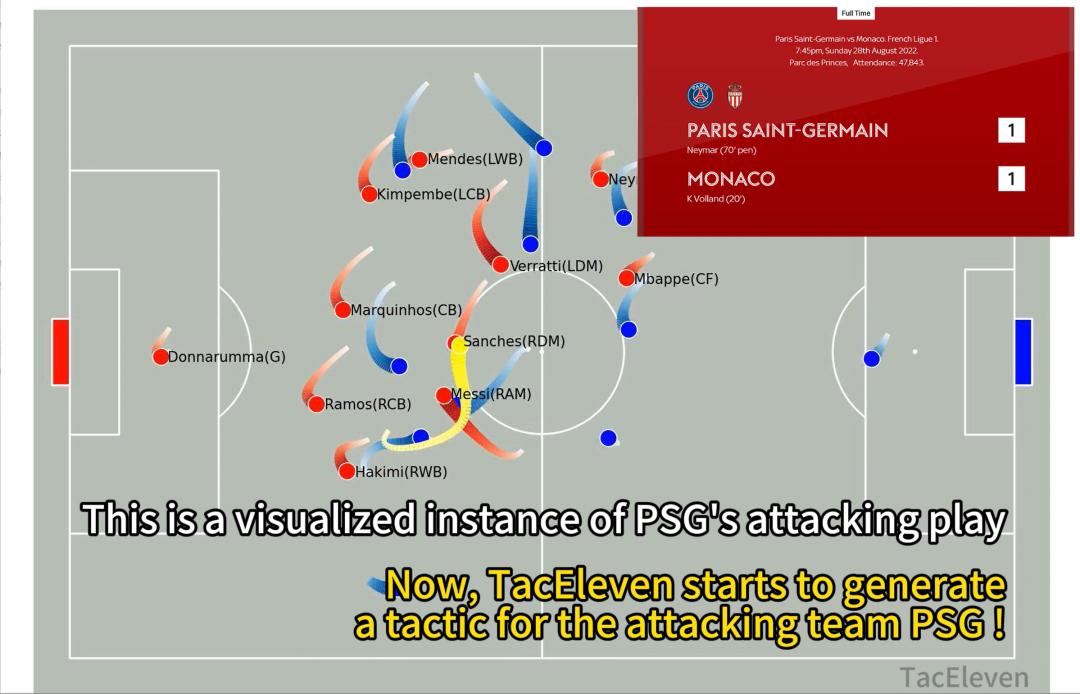
Using real UEFA Champions League match data and collective intelligence, the 100-million-parameter model "defeats" the 100-billion-parameter model
However, the players on the football field have gradually become drones, cameras, radars and different algorithms, and then robot dogs and robots. The problem has not actually changed. Each individual has limited information and different capabilities. The real difficulty is to make them complete division of labor, collaboration and adjustment in a constantly changing real environment.
When these laboratory researches enter the real world, they also start to leave another thing for this research: data and engineering experience.
In the first real-world application scenario of low-altitude security, Pu Zhiqiang's team has accumulated about 50TB of multi-modal drone detection data, covering different modalities such as visible light, near-infrared, thermal infrared and radar; at the same time, there are 15 million frames of effectively annotated target samples and more than 2000 related experiments.
The significance of these numbers is not only "large". The fact that an algorithm works in simulation does not mean it still works after changing the weather, background or camera; the fact that drones can collaborate in an ideal environment does not mean they can still operate normally when encountering communication delay, equipment error and node failure.
Real scenarios test technology on the one hand, and generate data required for the next round of technology on the other hand.
From early cluster management and multi-agent game to UAV swarm and heterogeneous management of low-altitude security, the same problem has been repeatedly verified in different systems. Algorithms, data, dedicated models and software and hardware collaboration experience are also retained in this process.
This constitutes the difference between Dunxu Technology and many early AI startups: The company is new, but the capabilities it needs to productize are not new. Theoretical construction, data accumulation and engineering foundation have already been completed before the company was founded.
02
Turning "Relationship" into Products
Having accumulated enough technology does not mean that a company must be established. In fact, in the path Pu Zhiqiang designed for this matter, the company is placed at the very end.
Around 2023, he began to consider the industrialization of collective intelligence more seriously. The team formed an internal sequence: Real application — Real system — Product — Company. First enter the real environment to confirm that the technology can really work; then move from a single algorithm to a complete system; after the system runs, judge how many capabilities can be precipitated into products. Only at the last step is a company needed.
When Pu Zhiqiang judges "whether the time has come", he does not look at whether there is a beautiful Demo, but at another more practical indicator — reusability.
At the beginning, the team was still doing specific projects one by one. When a customer came with a demand, they solved the corresponding problem. Unconsciously, the team completed projects with a total value of over 100 million yuan in a few years. But after doing so many projects, Pu Zhiqiang gradually found a change: Some capabilities that originally needed to be redeveloped can now be reused between different projects.
"It's only the last kilometer left." He described that stage like this. The last kilometer is no longer suitable to be completed in the research institute.
The market then accelerated this process. An appearance at an industry exhibition attracted more than 30 institutions to express their willingness to cooperate, and the market demand of tens of millions of yuan suddenly appeared in front of him, which made Pu Zhiqiang realize: "it's time".
Pu Zhiqiang later called it "order-driven entrepreneurship": It is not to first establish a company with the mission of Collective AGI, and then find a scenario that can verify the business logic; but that the technology is already in demand, and the company has conversely become a necessary part to be completed.
In April this year, Dunxu Technology was established. The May and June after the establishment of the company were called "Market Months" internally. Several co-founders in charge of different fields had to meet customers, sort out demands and seek cooperation.
Two months later, no one in the team worried about the market anymore, "The demands are all piling up!"
At this time, he began to worry about products.
Because there are enough demands, sometimes it will drag a technology company back to the most familiar and dangerous path: this customer needs a set of solutions, and the next customer needs a customized set. There are more and more projects, and the revenue may also grow, but the underlying capabilities can never be precipitated.
Pu Zhiqiang chose to exercise restraint. He did not accept every demand immediately, but judged first: after completing this project, what on earth can be retained?
This is also the meaning of "reusability" after it really enters the business world. For Dunxu Technology, what needs to be reused is not just a certain model, but whether the "cooperation mode" between different models and devices can be reused.
Low-altitude security has become the earliest test field. In a real low-altitude system, there may already be cameras, radars, drones, edge devices and disposal terminals from different manufacturers. Each of them can complete part of the tasks, but in the past, people still needed to connect these links in most cases.
Dunxu Technology adds a "Collective Intelligence Brain" in the middle. The front end is connected to perception devices, the middle end carries out information fusion, judgment and scheduling, and the back end is connected to execution devices; different modules can also be deployed separately according to the existing systems of customers.
From this perspective, what Dunxu Technology really wants to productize is not a radar or a drone, but the organizational relationship of collective intelligence between them.
There is a somewhat technical term inside Dunxu Technology called "organizational distillation". Simply understood, whether an effective collaboration can be turned into an empirical rule that can be used again next time, and even eventually become a set of formulas.
If several devices have gone through many rounds of operation and formed an effective division of labor and collaboration mode, the system hopes to precipitate it. Next time when replacing devices or changing tasks, there is no need to start from scratch; the new operation results will continue to feed back, so that this organizational mode can be adjusted continuously.
Therefore, what a project leaves behind is not only data and models, but also "how to organize these intelligences". This is also the most critical step from artificial intelligence to Collective AGI — Collective Artificial General Intelligence.
The realization of this matter will have great industrial significance. It may directly change the cost structure and market rules of the AI industry: it is not only the strongest model that can create powerful AI.
03
Why Dunxu Technology?
What Dunxu Technology faces is not an uncharted territory. On the contrary, "how to organize more and more agents" is becoming a problem of common concern in the AI industry.
In the software world, large model manufacturers are making multi-agent collaboration and workflow orchestration basic capabilities; in the physical world, autonomous system companies such as Shield AI and Anduril are also enabling different platforms, sensors and unmanned systems to work collaboratively.
Even in 2026, the boundary of similar products is still expanding. Applied Intuition launched the Agentic Platform for Physical AI, hoping to connect AI, data, development tools and real physical systems.
These adjacent players in the market start from two directions: one starts from large models and Agents to solve workflow orchestration in the software world; the other starts from physical systems such as drones, robots and autonomous driving, and continuously abstracts autonomous decision-making software to a higher level. Dunxu Technology starts from a completely different paradigm — collective intelligence.
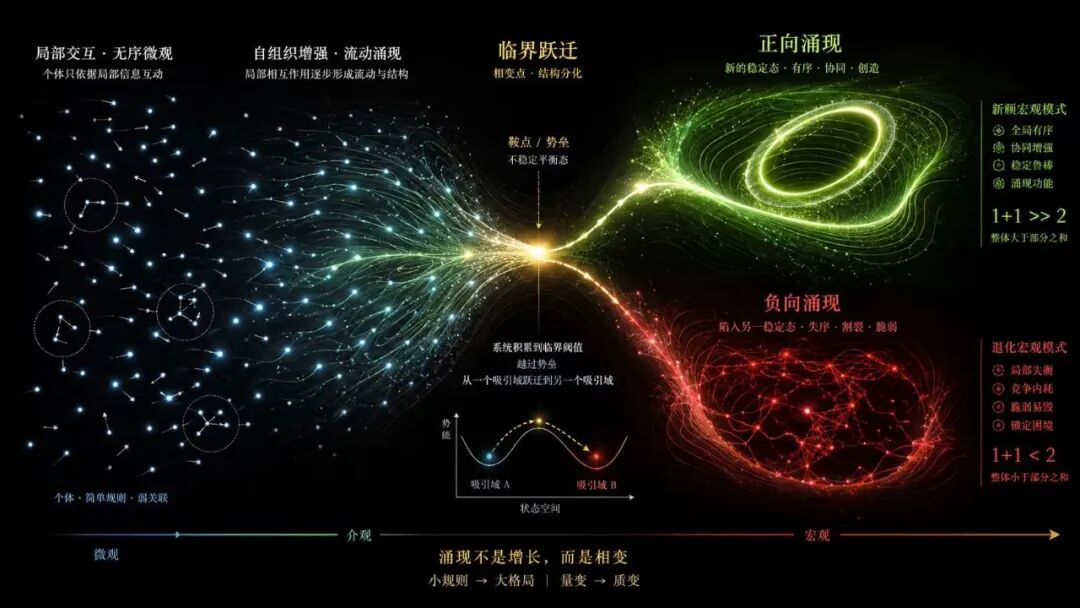
Collective intelligence is a completely different intelligence paradigm
This also determines that its relationship with large model companies is not simple competition — the Organization Layer needs models. In Dunxu Technology's system, more powerful general models are responsible for complex reasoning, professional models are responsible for vertical tasks, and small models and end-side devices handle low-cost and low-latency demands; the Organization Layer is responsible for organizing these different capabilities according to tasks.
This is a path that can cooperate with basic model manufacturers, rather than rebuilding a set of AI outside large models. The continuous enhancement of model capabilities is not necessarily bad news for Dunxu Technology — the stronger and more diverse the nodes that can be organized, the more important the organizational problem will be.
However, only seeing this demand is not enough to explain why it is Dunxu Technology. What it really has unique identification at present is that it superimposes several capabilities at the same time.
First, more than ten years of collective intelligence research. Dunxu Technology did not start studying how multiple agents collaborate after the Agent concept became popular. From cluster management, multi-agent game to heterogeneous collaboration and real unmanned systems, this research line is far earlier than the establishment of the company, and the team has a deep understanding of the underlying interdisciplinary mechanism of collective intelligence.
Second, data and engineering experience accumulated through long-term practice in real physical systems. Dozens of TB of data is only the easiest part to quantify. What is more difficult to